ERP audit logs—found in tables like SAP's CDHDR/CDPOS, Oracle's AUD$, or NetSuite's System Notes—are rich but underutilized. AI integration connects at three key points: 1) Real-time Event Ingestion, via CDC streams, database triggers, or API listeners, to process logs as they are written. 2) Contextual Enrichment, where the AI cross-references log entries (e.g., USER_X modified PO_123) with master data (user role, vendor risk, PO value) and external signals (geo-location, time of day). 3) Proactive Workflow Triggers, where the AI system creates alerts in ServiceNow, tasks in Microsoft Teams, or directly annotates records in the ERP for follow-up.

Integration
Audit Trail Automation with AI for ERP
A technical blueprint for embedding AI to monitor, analyze, and query ERP audit logs. Automate detection of suspicious access, sequence-of-error analysis, and provide conversational interfaces for auditors in SAP, Oracle, NetSuite, and Infor.
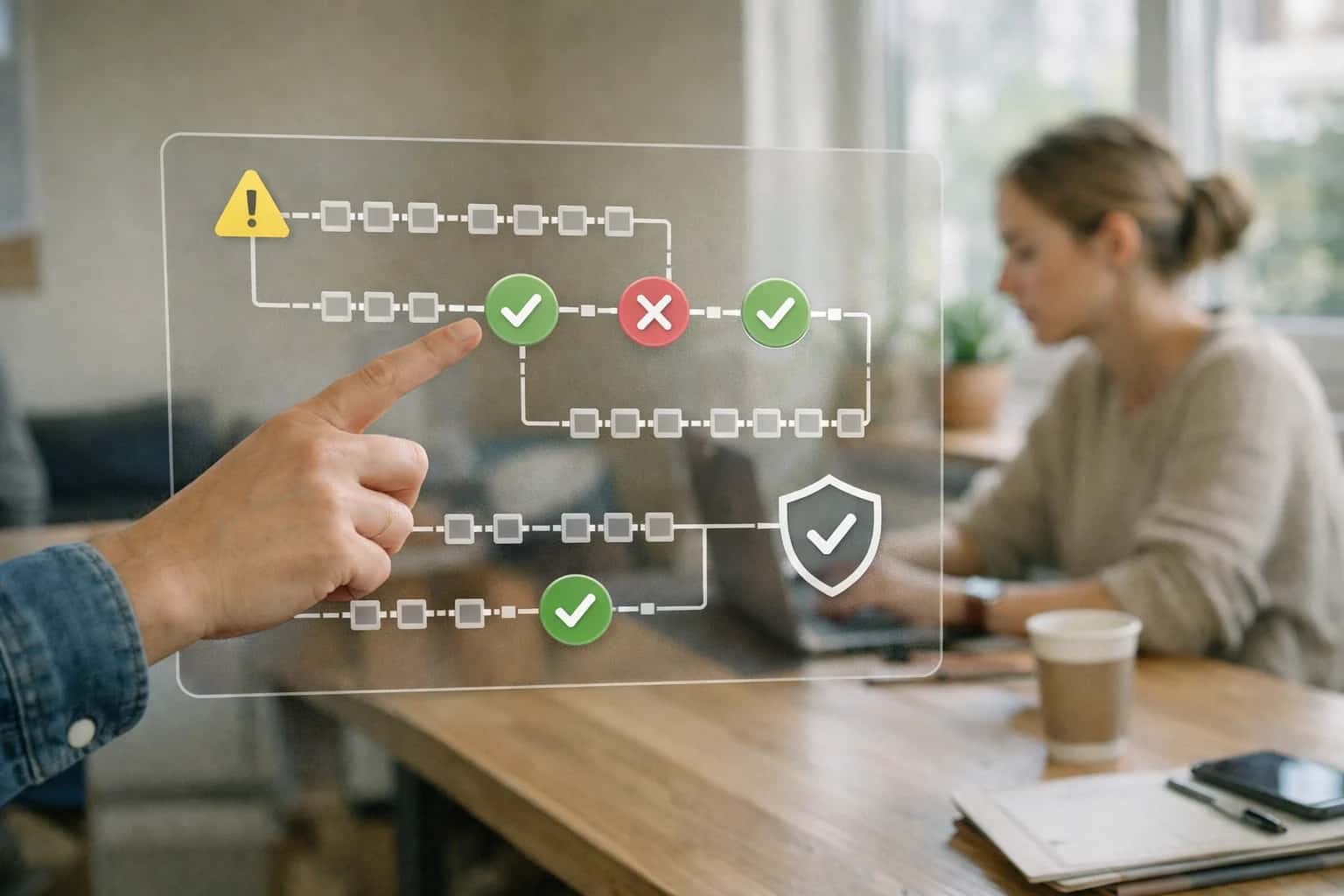
FROM REACTIVE LOGS TO PROACTIVE INTELLIGENCE
Where AI Fits into ERP Audit Trail Management
Integrating AI directly into your ERP's audit trail transforms a compliance archive into an active risk and operational intelligence system.
High-value use cases emerge from this architecture:
- Suspicious Access Detection: Identify sequences like
user logs in from unusual IP → queries sensitive customer list → exports datathat deviate from normal patterns. - Error Chain Analysis: After a financial posting error, the AI can trace back through the audit trail to pinpoint the originating transaction and user, summarizing the "path to failure" for the controller.
- Natural Language Auditing: Auditors can ask, "Show me all adjustments to account 5100 in Q4 made after hours," and receive a narrative summary with linked evidence, replacing manual log queries.
- Segregation of Duties (SoD) Monitoring: Continuously check configured SoD rules against actual user activity in the logs, flagging potential violations with the transaction context needed for review.
Rollout requires a phased, risk-based approach. Start with a read-only integration in a non-production environment to baseline normal activity. Initial models should focus on high-risk areas like journal entry approvals, vendor master changes, and user privilege modifications. Governance is critical: all AI-generated alerts must be tied to a human review workflow within your existing GRC or ticketing system. The final architecture should treat the AI not as a replacement for your audit team, but as a force multiplier that prioritizes their attention on the 2% of log entries that signal real risk or operational insight.
ARCHITECTURE FOR INTELLIGENT MONITORING
ERP Platform Audit Log Touchpoints
Monitoring Authentication and Authorization Events
User access logs are the primary source for detecting suspicious activity. AI models can analyze patterns in login attempts, session durations, and role-based transactions to identify potential credential compromise or privilege misuse. Key ERP surfaces include:
- Authentication Services: Logs from SAP NetWeaver AS, Oracle Identity Cloud Service, or NetSuite's login history.
- Role Changes: Audit trails for user role assignments (e.g., SAP SU01 changes, Oracle User Management).
- Sensitive Transaction Codes: Access to critical T-codes (SAP) or functions like
GL Journal Post,Vendor Master Change, orCost Center Release.
An AI agent can correlate failed logins with subsequent successful access from unusual IPs, flagging potential breaches for immediate review by security teams. This layer is foundational for Segregation of Duties (SoD) compliance and internal audit readiness.
ERP AUDIT TRAIL AUTOMATION
High-Value Use Cases for AI-Powered Audit
AI transforms ERP audit logs from static records into dynamic intelligence. By analyzing sequences of events, access patterns, and transactional data, AI can automate detection, accelerate investigations, and provide natural language access for auditors and compliance teams.
01
Segregation of Duties (SoD) Violation Detection
Continuously monitors user access logs and transaction trails (e.g., PO_CREATE, JOURNAL_POST) to detect risky combinations of activities by a single user that violate configured SoD policies. AI correlates events across modules (FI, MM, SD) to identify real-time violations, not just static role conflicts.
Batch -> Real-time
Detection mode
02
Anomalous Journal Entry & Financial Sequence Analysis
Analyzes the sequence and context of general ledger postings to flag unusual patterns—such as a journal posted after hours, immediately followed by a user access change, or a series of adjusting entries before period close. AI learns typical 'clean' sequences to surface high-risk outliers for review.
Hours -> Minutes
Review time
03
Natural Language Query for Audit Trails
Enables internal and external auditors to ask plain-language questions against months of audit log data. Example: "Show all user JSMITH's vendor master data changes in Q3" or "List transactions where the same user created a purchase order and approved the invoice." Connects to SAP AUDIT_LOG, Oracle FND_LOG, or NetSuite audit trail APIs.
04
Privileged Access & 'Super User' Monitoring
Focuses on high-risk user groups (e.g., SAP_ALL, Oracle SUPER_USER). AI establishes behavioral baselines for normal administrative activity and alerts on deviations—such as mass data exports, unscheduled batch job execution, or access to unusual transaction codes—providing a focused audit trail for sensitive roles.
05
Automated Audit Evidence Package Assembly
For common audit requests (e.g., revenue recognition testing, fixed asset additions), AI automatically queries relevant ERP tables, extracts supporting documents (invoices, contracts), and compiles a structured, time-stamped evidence package with a summary narrative. Reduces manual gathering from FI_DOCUMENT, RA_CUSTOMER_TRX, or custom record tables.
1 sprint
Typical timeline saved
06
Root-Cause Analysis for Error & Correction Chains
When a critical error is found (e.g., misposted intercompany journal), AI reconstructs the full event chain from the audit log: who made the original entry, what subsequent corrections were attempted, which master data was changed, and when approvals occurred. Provides auditors with a complete, causal narrative instead of isolated log entries.
ERP AUDIT TRAIL AUTOMATION
Example AI Audit Workflows
These workflows illustrate how AI can be integrated into ERP audit log monitoring to automate detection, investigation, and reporting, reducing manual review time from weeks to hours.
Trigger: A new audit log entry is written to the ERP's security log table (e.g., SAP AUDITLOG, NetSuite Audit Trail, Oracle FND_AUDIT_SCHEMAS).
Context/Data Pulled: The AI agent queries the last 90 days of logs for the same user, role, and transaction code. It enriches this with the user's department (from HCM master data) and typical access hours.
Model/Agent Action: A lightweight classification model evaluates the log entry against learned baselines for:
- Geographic Impossibility: Login from two distant locations within an implausible time frame.
- After-Hours Access: Significant activity outside the user's normal working hours for sensitive transactions (e.g.,
FB50posting, vendor master change). - Role Explosion: A user accessing a high volume of previously unused transaction codes in a short period.
System Update/Next Step: If a high-confidence anomaly is detected, the agent:
- Creates a high-priority incident ticket in the connected ITSM platform (e.g., ServiceNow).
- Posts a summarized alert with key context (user, transaction, risk score) to a dedicated Slack/Teams channel for the security team.
- Optionally, triggers a temporary, system-enforced step-up authentication requirement for the user's next login.
Human Review Point: All generated alerts are logged in a review queue within the AI governance dashboard. Security analysts can confirm, dismiss, or adjust the model's risk thresholds based on feedback.
A PRODUCTION-READY BLUEPRINT
Implementation Architecture: Data Flow & Guardrails
A secure, governed architecture for AI-powered audit trail analysis in SAP, Oracle, NetSuite, and Infor.
A production implementation connects to your ERP's audit log tables or APIs (e.g., SAP CDHDR/CDPOS, Oracle Audit Vault, NetSuite Audit Trail, Infor ION Event Monitor) via a secure, read-only service account. The core flow is event-driven: a change data capture (CDC) stream or scheduled batch job extracts new audit entries, anonymizes sensitive user or data fields based on policy, and pushes them to a processing queue. An AI agent, governed by a central prompt management system, retrieves these entries, enriches them with contextual master data (e.g., User→Role, Material→Cost Center), and executes analysis tasks like sequence reconstruction or anomaly scoring.
Critical guardrails are implemented at each layer:
- Data Layer: Strict RBAC and field-level masking ensure the AI only sees compliant data; PII is never in the prompt.
- Orchestration Layer: All AI interactions are logged with a
session_idlinked to the source audit event, creating an immutable meta-audit trail. - Output Layer: Findings (e.g., 'Suspicious pattern: User X modified 50 PO lines after hours') are not direct actions but annotated alerts routed to a human review queue in your SOAR, SIEM, or GRC platform. Approvals or dismissals in that system feed back to close the loop.
- Model Safety: Queries use a retrieval-augmented generation (RAG) pattern against your ERP's data dictionary and compliance policies, grounding responses and preventing hallucination of procedures.
Rollout follows a phased, risk-based approach. Phase 1 targets read-only, non-financial data (e.g., user access logs, configuration changes) to validate detection accuracy and user comfort. Phase 2 expands to transactional areas (journal entries, payment terms) with dual-control review, where AI suggestions require a senior auditor's sign-off before being accepted. The final architecture operates as a continuous control monitoring layer, sitting outside the core ERP but integrated via its APIs and event bus, providing auditors with a natural-language interface (/integrations/enterprise-resource-planning-platforms/ai-powered-analytics-for-erp) to investigate without writing complex SELECT statements against cryptic log tables.
AUDIT TRAIL AUTOMATION
Code & Payload Examples
Ingesting ERP Audit Logs
ERP systems like SAP, Oracle, and NetSuite generate detailed audit logs for transactions, user access, and data changes. The first integration step is to stream these logs to a secure processing layer.
A common pattern is to use the ERP's native eventing framework (e.g., SAP Change Pointers, Oracle Business Events, NetSuite SuiteScript) to publish log events to a message queue like Apache Kafka or AWS EventBridge. This decouples the AI processing from the core ERP, ensuring no performance impact.
Example Payload (SAP S/4HANA OData API Call):
httpGET /sap/opu/odata/sap/AUDIT_LOG_SRV/AuditLogEntries? $filter=CreationDate ge datetime'2024-01-01T00:00:00' and UserName eq 'JSMITH'&$format=json
The AI service subscribes to this stream, enriches each log entry with contextual metadata (e.g., user role from HR system, transaction value from related GL entry), and prepares it for analysis.
AUDIT TRAIL AUTOMATION
Realistic Time Savings & Operational Impact
This table illustrates the operational impact of integrating AI to monitor and analyze ERP audit logs, moving from manual, reactive reviews to proactive, intelligent oversight.
| Process | Before AI | After AI | Key Notes |
|---|---|---|---|
Suspicious Access Pattern Detection | Manual review of logs post-incident | Real-time alerts for anomalous sequences | Reduces detection time from days to minutes |
Audit Trail Query for Investigations | Manual SQL queries by IT/audit teams | Natural language questions (e.g., 'Show all GL changes by user X') | Enables self-service for auditors and compliance officers |
Sequence Analysis for Error Root Cause | Hours reconstructing event chains from log files | Automated timeline generation linking user actions to errors | Accelerates problem resolution and blame assignment |
Segregation of Duties (SoD) Compliance Check | Periodic manual sampling or rule-based scripts | Continuous transaction monitoring against dynamic policy sets | Shifts from quarterly audits to ongoing enforcement |
Audit Evidence Compilation for External Auditors | Manual gathering and formatting of log excerpts | Automated report generation with relevant context and narratives | Cuts preparation time for audit cycles by 60-80% |
Privileged User Activity Review | Sampled manual oversight of high-risk accounts | Behavioral baselining with anomaly scoring and alerting | Provides scalable oversight without proportional headcount increase |
Audit Log Retention and Archiving Compliance | Manual processes to verify retention policies are met | Automated policy checks, lifecycle management, and integrity validation | Reduces risk of non-compliance and manual oversight errors |
AUDITABLE AI FOR REGULATED ENVIRONMENTS
Governance, Security & Phased Rollout
Implementing AI for audit trail analysis requires a controlled, phased approach that prioritizes data security, model explainability, and a clear human-in-the-loop governance model.
In an ERP context, the AI system must operate as a privileged, audited user within the platform's native security model. This means:
- Service Account Integration: The AI agent authenticates via a dedicated service account with RBAC permissions scoped strictly to read-only access on audit log tables (e.g., SAP
CDHDR/CDPOS, OracleAUD$, NetSuiteSystem Notes). - Query Logging: Every natural language query (e.g., "Show all user changes to vendor payment terms in Q3") is logged with the requesting user's ID, timestamp, and the generated SQL or OData query executed against the ERP.
- Data Lineage: Results are tagged with the source transaction IDs and timestamps, allowing auditors to trace any AI-provided insight back to the original system-of-record entry.
A production rollout typically follows three phases:
- Phase 1: Read-Only Assistant (Weeks 1-4)
- Deploy a chat interface for internal audit teams to query audit logs in natural language.
- AI provides summaries of access patterns, sequences of events for a given transaction, and anomaly detection (e.g., after-hours access spikes).
- All outputs are clearly marked as "AI-Generated Analysis" and require manual verification against source logs.
- Phase 2: Supervised Automation (Months 2-3)
- Implement scheduled AI scans for high-risk patterns (SoD violations, mass data exports).
- AI generates draft audit workpapers and exception reports, but a senior auditor must review and approve each finding before it's added to the official audit file.
- Integration with GRC platforms like SAP GRC or RSA Archer to create preliminary risk tickets.
- Phase 3: Continuous Control Monitoring (Months 4+)
- AI agents run continuous, real-time monitoring of defined control objectives.
- Automated alerts are routed to compliance officers via ERP workflow or Microsoft Teams/Slack.
- A quarterly model review ensures the AI's detection logic aligns with evolving internal policies and external regulations (SOX, GDPR).
Critical Governance Controls:
- Prompt Management: All analytical prompts (e.g., "Detect potential fraud indicators") are version-controlled in a repository like LangChain or Weights & Biases, with change approval required from the head of internal audit.
- Output Grounding: Every AI response must cite the specific ERP transaction IDs, user IDs, and timestamps it used, preventing hallucination. This is enforced via a RAG layer on the vectorized audit log.
- Human Review Thresholds: Any AI finding with a confidence score below a configured threshold (e.g., 85%) is automatically routed for human review before alerting.
- Performance Auditing: The AI's own performance—query accuracy, false positive rates, user feedback—is tracked in a separate audit log, creating a meta-audit trail for the AI system itself.
This structured approach ensures the AI augments the audit function without compromising the integrity, security, and defensibility of the audit process itself.
Enabling Efficiency, Speed & Accuracy
Intelligent Analysis, Decision & Execution
We build AI systems for teams that need search across company data, workflow automation across tools, or AI features inside products and internal software.
Talk to Us
Search across company data
Give teams answers from docs, tickets, runbooks, and product data with sources and permissions.
Useful when people spend too long searching or get different answers from different systems.
Enterprise searchRAGPermissions
Read more
Automate internal workflows
Use AI to route work, draft outputs, trigger actions, and keep approvals and logs in place.
Useful when repetitive work moves across multiple tools and teams.
AI agentsWorkflow automationGovernance
Read more
Add AI to products and internal tools
Build assistants, guided actions, or decision support into the software your team or customers already use.
Useful when AI needs to be part of the product, not a separate tool.
AI integrationDecision supportModel routing
Read moreAUDIT TRAIL AUTOMATION
Frequently Asked Questions
Practical questions for technical leaders planning AI-driven audit trail monitoring and analysis within SAP, Oracle, NetSuite, or Infor.
AI integration typically connects via the ERP's native logging APIs or by consuming change data capture (CDC) streams. The required data includes:
- User and Session Data: User ID, IP address, session timestamp, client application.
- Transaction Context: Transaction code (e.g., SAP T-Code), program ID, changed table names (e.g.,
BKPFfor SAP Financial Documents). - Object-Level Details: Record key (e.g., document number, vendor ID), field names changed, old values, new values, change timestamp.
Implementation Pattern:
- Ingest: Use ERP-specific APIs (SAP Audit Log via SOAP, Oracle Fine-Grained Auditing, NetSuite SuiteAnalytics Connect) or database-level CDC tools to stream log events to a secure data lake.
- Enrich: Correlate log events with master data (user roles from HR module, vendor names) for context.
- Process: AI models analyze the enriched stream for patterns. A typical payload sent for analysis looks like:
json{ "event_id": "AUDIT_20241105_001", "user": "JSMITH", "role": "FI_ACCOUNTANT", "transaction": "FB01", "table": "BSEG", "document": "4900012345", "field_changes": [ { "field": "WRBTR", "old_value": "1000.00", "new_value": "15000.00" } ], "timestamp": "2024-11-05T22:15:30Z", "client_ip": "10.10.1.50" }
- Store: Processed logs and AI-generated insights are written back to a dedicated audit analytics database, separate from the production ERP, for querying and reporting.

About the author
Prasad Kumkar
CEO & MD, Inference Systems
Prasad Kumkar is the CEO & MD of Inference Systems and writes about AI systems architecture, LLM infrastructure, model serving, evaluation, and production deployment. Over 5+ years, he has worked across computer vision models, L5 autonomous vehicle systems, and LLM research, with a focus on taking complex AI ideas into real-world engineering systems.
His work and writing cover AI systems, large language models, AI agents, multimodal systems, autonomous systems, inference optimization, RAG, evaluation, and production AI engineering.
LinkedIn
Limited slotsGet a Free AI Consultation
Partnered with leading AI, data, and software stack.





How We Work
Custom AI workflows for your Business
One-fit-all AI don't work for modern businesses. At Inferensys, we aim to understand your business & custom requirements; which we use to define most efficient agentic workflows, the data, and the tools for your business.
01
Review the use case
We understand the task, the users, and where AI can actually help.
Read more02
Pick the right approach
We define what needs search, automation, or product integration.
Read more03
Build the first useful version
We implement the part that proves the value first.
Read more04
Improve from there
We add the checks and visibility needed to keep it useful.
Read moreThe first call is a practical review of your use case and the right next step.
Talk to Us