AI integration for revenue recognition targets specific surfaces within your ERP's revenue management module. The primary touchpoints are the Contract/Order object, Performance Obligation (POB) table, Revenue Schedule, and the General Ledger interface. AI agents act on this data via the ERP's native APIs—such as NetSuite's SuiteTalk, SAP's OData services for S/4HANA Revenue Accounting, or Oracle's REST APIs for Revenue Management—to interpret contract language, allocate transaction prices, and propose journal entries. The integration is event-driven, triggered by a contract's creation or modification, a billing event, or a manual review request from a revenue accountant.

Integration
AI Integration for ERP Revenue Recognition
A technical blueprint for embedding AI into ERP revenue management modules to automate complex ASC 606/IFRS 15 workflows, from contract interpretation to performance obligation allocation and journal entry posting.
ARCHITECTURE & ROLLOUT
Where AI Fits into ERP Revenue Recognition
A practical blueprint for integrating AI into complex revenue recognition workflows governed by ASC 606 and IFRS 15.
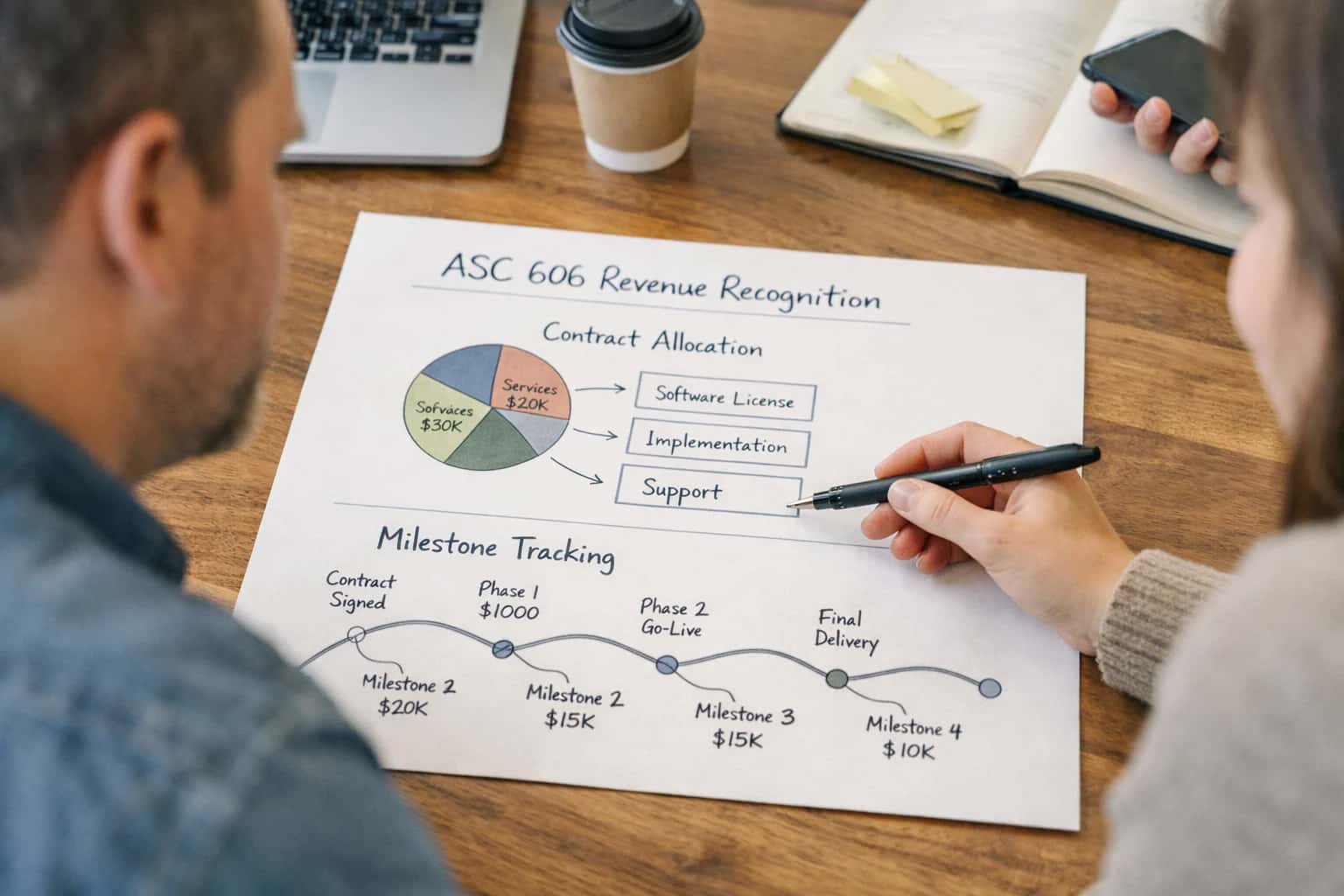
The core workflow begins with AI analyzing the unstructured text of customer contracts and amendments. Using a RAG (Retrieval-Augmented Generation) system grounded in your company's accounting policies and historical contract data, the agent identifies distinct performance obligations, determines if they are satisfied over time or at a point in time, and suggests an allocation of the total transaction price. This proposed allocation and schedule are written back to the ERP as draft records in the POB and revenue schedule tables, flagged for accountant review. For recognized revenue, the system can automatically generate the corresponding debit to deferred revenue and credit to revenue, posting the draft journal entry to the GL module with a clear audit trail linking back to the source contract and AI reasoning.
Rollout should be phased, starting with a single, high-volume contract type (e.g., SaaS subscriptions) before expanding to more complex arrangements. Governance is critical: all AI-proposed allocations and entries must route through a mandatory human-in-the-loop approval workflow within the ERP. The system should maintain a complete audit log, capturing the source document, the AI's interpretation, the reviewer's action, and the final posted entry. This controlled approach reduces manual data entry and review time from hours to minutes for standard contracts, while ensuring strict compliance and providing a defensible audit trail for external auditors.
AI INTEGRATION FOR ERP REVENUE RECOGNITION
ERP Module Touchpoints for AI Integration
Core Data Sources for Revenue Allocation
AI integration begins with the modules that hold the commercial agreement. In platforms like SAP SD (Sales and Distribution), Oracle Order Management, or NetSuite Sales Orders, AI agents can be triggered via API to analyze new or amended contracts.
The workflow involves extracting performance obligations, distinct goods/services, and transaction price details from unstructured contract documents attached to the order. Using a retrieval-augmented generation (RAG) pattern, the AI cross-references the contract text against the ERP's item master and pricing rules to propose an allocation schedule. This output populates custom objects or staging tables that feed the revenue recognition engine, ensuring the initial data setup for ASC 606/IFRS 15 compliance is accurate and auditable.
ERP REVENUE RECOGNITION
High-Value AI Use Cases for Revenue Teams
For revenue managers and controllers, AI integration with ERP revenue modules automates the complex, manual tasks of ASC 606/IFRS 15 compliance. These use cases connect to contract documents, transaction data, and the general ledger to allocate revenue, generate entries, and maintain audit-ready documentation.
01
Automated Contract Obligation Mapping
AI reads sales contracts and amendments to identify distinct performance obligations (POBs), determine transaction price, and allocate it according to standalone selling prices. This automates the initial setup for complex, multi-element arrangements in the ERP's revenue management module.
Days -> Hours
Setup time for new arrangements
02
Intelligent Journal Entry Generation
For each billing or fulfillment event, AI automatically proposes the correct deferred revenue, unbilled receivable, and revenue recognition journal entries. It references the obligation schedule, ensuring entries align with the recognized pattern of satisfaction (over time or at a point in time).
Batch -> Event-driven
Posting trigger
03
Real-Time Revenue Schedule Updates
When contract modifications occur (change orders, terminations), AI re-calculates the remaining transaction price and updates the revenue recognition schedule in the ERP. It flags material changes for controller review and maintains a full audit trail of adjustments.
Same day
Schedule revision
04
Automated Disclosure Support
AI aggregates data from recognized revenue, contract balances (deferred revenue, unbilled AR), and remaining performance obligations to auto-populate disclosure workpapers and footnote templates required for quarterly and annual SEC or IFRS filings.
1 sprint
Close acceleration
05
Anomaly & Policy Deviation Detection
Continuously monitors revenue postings against contract terms and company policy. Flags unusual recognition patterns, premature revenue booking, or entries that deviate from standard POB mappings for immediate internal audit review.
Proactive alerts
Compliance monitoring
06
Contract Data Lake for Retrospective Analysis
Builds a searchable repository of all contract terms, obligations, and recognition history. Enables natural language queries (e.g., 'Show all contracts with material rights') and supports retrospective impact analysis for new accounting standards or business model changes. Connects to tools like /integrations/enterprise-resource-planning-platforms/ai-integration-for-erp-document-management.
IMPLEMENTATION PATTERNS
Example AI-Augmented Revenue Recognition Workflows
These workflows illustrate how AI agents can interpret complex contracts and automate revenue recognition tasks within ERP modules like SAP Revenue Accounting, NetSuite Revenue Recognition, or Oracle Revenue Management, ensuring compliance with ASC 606/IFRS 15.
Trigger: A new sales contract or amendment is uploaded to the ERP's document management system or attached to a sales order.
AI Agent Action:
- The agent extracts the full contract text and any referenced exhibits.
- Using a specialized LLM prompt, it identifies distinct performance obligations (POs), material rights, and transaction price.
- It classifies each PO (e.g., software license, implementation services, post-contract support) and flags any ambiguous clauses for human review.
System Update: The agent creates or updates a structured data record in a custom ERP object or staging table, mapping:
- Performance Obligation ID
- Description
- Standalone Selling Price (SSP) allocation (if determinable)
- Expected fulfillment pattern (point-in-time vs. over-time)
- Link to the source contract document
Human Review Point: The system flags contracts with non-standard terms, multiple material rights, or where SSP cannot be clearly inferred, routing them to a revenue accountant in a queue within the ERP or a connected workflow tool like /integrations/enterprise-resource-planning-platforms/ai-integration-for-erp-contract-management.
BUILDING A CONTROLLED, AUDITABLE PIPELINE
Implementation Architecture: Data Flow & System Boundaries
A production-ready AI integration for revenue recognition requires a clear separation of concerns between the ERP's transactional system and the AI's analytical layer.
The core architecture establishes the ERP (e.g., NetSuite Revenue Management, SAP Revenue Accounting and Reporting, Oracle Revenue Management Cloud) as the system of record. AI agents interact via secure, versioned APIs—like NetSuite's SuiteTalk REST or SAP's OData services—to fetch contract documents, sales orders, and existing performance obligation schedules. A dedicated integration middleware layer (often an event-driven service bus) orchestrates the flow: it subscribes to ERP events (e.g., Contract Approved, Order Booked), retrieves the relevant unstructured contract text and structured line items, and dispatches them to the AI service for analysis. This layer also enforces idempotency, manages retries, and logs all data exchanges for a complete audit trail.
Within the AI service, a multi-step reasoning pipeline processes each contract. First, a document intelligence model extracts key terms, clauses, and monetary values. This output is then passed to a configured LLM agent, grounded in ASC 606/IFRS 15 guidelines, which performs the core logic: identifying distinct performance obligations, determining the transaction price, and allocating that price to each obligation based on standalone selling prices. The agent's reasoning chain and proposed allocation schedule are captured as a structured JSON payload. This payload is returned to the middleware, which formats it into the ERP's native object schema (e.g., a Revenue Contract record in NetSuite, an RAARR item in SAP) and posts it back as a draft journal entry or revenue schedule—never an auto-post—into a dedicated holding queue or a custom object for financial reviewer approval.
Governance is designed into the data flow. All AI-generated outputs are tagged with a confidence score and source citations (highlighting the contract clauses used). The middleware routes low-confidence allocations for mandatory human review within the ERP's existing approval framework. The final, approved revenue schedules and journal entries are posted by a service account with appropriate ERP role permissions (e.g., Revenue Accountant), maintaining a clear segregation of duties. Rollout typically follows a phased approach: starting with a single, high-volume contract type (e.g., software subscriptions) in a sandbox environment, validating the AI's allocations against a manual control group, and then gradually expanding to more complex scenarios like bundled goods and services or variable consideration.
AI FOR REVENUE RECOGNITION
Code & Payload Examples for Key Integration Points
Extracting Performance Obligations from Contract Text
AI integration begins by parsing unstructured contract documents (PDFs, Word files) linked to sales orders or projects in the ERP. The goal is to identify distinct performance obligations (POBs) and transaction price allocation as per ASC 606/IFRS 15.
A typical workflow:
- Document Retrieval: Fetch contract attachments from the ERP's document management system or custom object records via REST API.
- AI Processing: Send text to a language model (e.g., GPT-4, Claude) with a structured prompt to extract obligations, pricing, and terms.
- Data Structuring: Return parsed data as JSON for validation and loading into a staging table or custom object within the ERP.
Example Payload to AI Service:
json{ "erp_context": { "contract_id": "CT-2024-001", "customer_name": "Global Manufacturing Inc.", "total_transaction_price": 250000 }, "contract_text": "...Agreement to provide software license, implementation services, and 3 years of premium support...", "instruction": "Identify distinct performance obligations. For each, describe the good/service, determine if it is distinct, and suggest an allocation of the transaction price based on standalone selling prices if available." }
The AI response populates a staging table that feeds the ERP's revenue management module for schedule creation.
AI-ENHANCED REVENUE RECOGNITION
Realistic Time Savings & Operational Impact
This table illustrates the operational impact of integrating AI into ERP revenue recognition workflows, focusing on ASC 606/IFRS 15 compliance. Metrics are based on typical implementations for complex, multi-element arrangements.
| Process Step | Manual / Legacy Process | AI-Assisted Process | Impact & Notes |
|---|---|---|---|
Contract Review & Obligation Identification | 2-4 hours per complex contract | 20-40 minutes with AI draft review | AI extracts performance obligations and terms; legal/finance provides final validation. |
Transaction Price Allocation | Manual spreadsheet modeling, 3-6 hours | Automated allocation proposals in <1 hour | AI applies allocation rules consistently; finance adjusts for significant financing or variable consideration. |
Journal Entry Drafting & Posting | Manual JE creation from allocation schedules, 1-2 hours | Automated JE generation for review, 15 minutes | AI drafts complete JEs with proper accounts and descriptions; requires controller approval before ERP posting. |
Monthly Revenue Schedule Updates | Manual reconciliation and roll-forward, 1-2 days | Automated schedule generation, 2-4 hours | AI processes new orders/modifications to update deferred revenue and recognized revenue schedules. |
Disclosure & Audit Support | Manual gathering of contracts and support for samples, 1-2 weeks | Centralized AI audit trail and natural language Q&A, days to hours | AI provides queryable repository of recognition logic and supports PBC (Prepared By Client) requests. |
Policy Exception & Judgment Documentation | Ad-hoc email/note documentation | Structured rationale capture within workflow | AI prompts for and records key judgments (e.g., standalone selling price estimates) for compliance. |
Period-End Close Cycle Time | Revenue recognition as a critical path item, adding 3-5 days | Parallel processing and early exception flagging, reduces to 1-2 days | AI shifts effort from manual compilation to exception management and review. |
IMPLEMENTING AI FOR ASC 606/IFRS 15
Governance, Audit, and Phased Rollout Strategy
A controlled approach to deploying AI for revenue recognition that prioritizes accuracy, auditability, and user adoption.
Integrating AI into ERP revenue recognition modules (like SAP Revenue Accounting, NetSuite Revenue Management, or Oracle Revenue Management Cloud) requires a governance-first architecture. This typically involves a middleware layer that sits between the AI service and the ERP, handling all prompts, context retrieval from contracts and performance obligations, and proposed journal entries. Every AI-generated output—such as a transaction price allocation or a suggested revenue schedule—must be written to a dedicated audit log table alongside the source data IDs, model version, and confidence scores before any posting is proposed to the ERP's journal entry interface.
A phased rollout is critical for managing risk and building trust. Phase 1 often starts in a parallel "shadow mode," where the AI processes historical or current-quarter contracts but only outputs its recommendations to a comparison dashboard for the revenue accounting team to review against manual calculations. Phase 2 introduces a human-in-the-loop approval workflow within the ERP, where AI-drafted revenue schedules and journal entries are created as draft records in a staging table, requiring a controller's review and explicit approval before posting to the general ledger. Phase 3, enabled after consistent accuracy is proven, allows for automated posting of low-risk, high-confidence entries (e.g., standard SaaS subscriptions) while flagging complex, multi-element arrangements for continued manual review.
Governance extends to the AI model itself. Implement version control for prompts and grounding rules tied to specific accounting standards (ASC 606 vs. IFRS 15). Establish a regular review cadence with technical accounting to validate the AI's logic for new contract types or evolving interpretations. Furthermore, integrate the AI's activity into the existing ERP audit trail; any AI-assisted entry should clearly indicate its origin and approval path to satisfy internal and external audit requirements for revenue, one of the most scrutinized areas in financial reporting.
Enabling Efficiency, Speed & Accuracy
Intelligent Analysis, Decision & Execution
We build AI systems for teams that need search across company data, workflow automation across tools, or AI features inside products and internal software.
Talk to Us
Search across company data
Give teams answers from docs, tickets, runbooks, and product data with sources and permissions.
Useful when people spend too long searching or get different answers from different systems.
Enterprise searchRAGPermissions
Read more
Automate internal workflows
Use AI to route work, draft outputs, trigger actions, and keep approvals and logs in place.
Useful when repetitive work moves across multiple tools and teams.
AI agentsWorkflow automationGovernance
Read more
Add AI to products and internal tools
Build assistants, guided actions, or decision support into the software your team or customers already use.
Useful when AI needs to be part of the product, not a separate tool.
AI integrationDecision supportModel routing
Read moreAI INTEGRATION FOR ERP REVENUE RECOGNITION
Frequently Asked Questions for Technical Buyers
Technical questions for architects and finance leaders planning AI integration into ERP revenue management modules for ASC 606/IFRS 15 compliance.
Integration typically occurs at two primary layers:
-
Data Extraction & Event Ingestion:
- APIs: Use the ERP's native REST or SOAP APIs (e.g., NetSuite SuiteTalk, SAP OData for S/4HANA Revenue Recognition) to pull contract headers, line items, performance obligations, and transaction prices.
- Database Connectors: For legacy or high-volume batch analysis, secure JDBC/ODBC connections to the underlying revenue schema may be used to extract data for AI processing.
- Webhooks/Events: Listen for events like
Contract.Signed,Amendment.Created, orInvoice.Postedto trigger real-time AI analysis.
-
Write-Back & Orchestration:
- The AI system processes the data and generates outputs (e.g., allocated revenue schedules, journal entry proposals). These are posted back via:
- API Calls: Creating new revenue arrangement records, revenue schedules, or journal entry drafts.
- Staging Tables: Writing results to custom objects or staging tables (e.g., a
CSTM_AI_Revenue_Scheduleobject) for review before final ERP posting. - Process Automation Tools: Leveraging the ERP's native workflow engine (e.g., Oracle Process Cloud, SAP Cloud Platform Workflow) to route AI-generated proposals for approval.

About the author
Prasad Kumkar
CEO & MD, Inference Systems
Prasad Kumkar is the CEO & MD of Inference Systems and writes about AI systems architecture, LLM infrastructure, model serving, evaluation, and production deployment. Over 5+ years, he has worked across computer vision models, L5 autonomous vehicle systems, and LLM research, with a focus on taking complex AI ideas into real-world engineering systems.
His work and writing cover AI systems, large language models, AI agents, multimodal systems, autonomous systems, inference optimization, RAG, evaluation, and production AI engineering.
LinkedIn
Limited slotsGet a Free AI Consultation
Partnered with leading AI, data, and software stack.





How We Work
Custom AI workflows for your Business
One-fit-all AI don't work for modern businesses. At Inferensys, we aim to understand your business & custom requirements; which we use to define most efficient agentic workflows, the data, and the tools for your business.
01
Review the use case
We understand the task, the users, and where AI can actually help.
Read more02
Pick the right approach
We define what needs search, automation, or product integration.
Read more03
Build the first useful version
We implement the part that proves the value first.
Read more04
Improve from there
We add the checks and visibility needed to keep it useful.
Read moreThe first call is a practical review of your use case and the right next step.
Talk to Us