
Inferensys

Integration

AI Integration for ERP Order Management

A technical guide to embedding AI into ERP order-to-cash workflows, automating manual entry, enhancing promise dates with reasoning, and handling exceptions within SAP S/4HANA, Oracle Cloud ERP, NetSuite, and Infor.
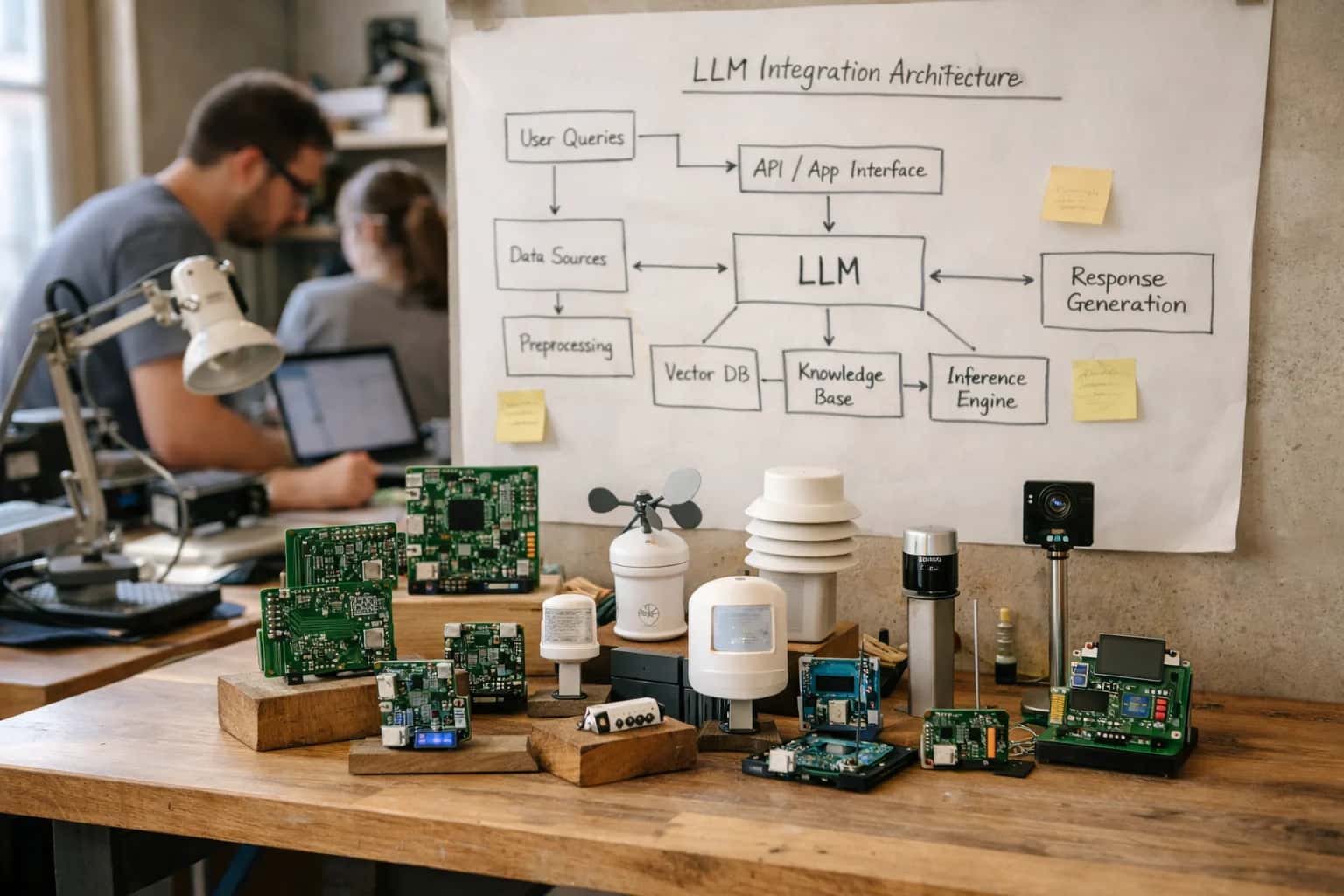
Hardware engineer integrating LLM with IoT sensors, circuit boards on desk, soldering iron nearby, maker lab aesthetic.
ARCHITECTURE BLUEPRINT

Where AI Fits into ERP Order Management

A practical guide to embedding AI agents and workflows into the order-to-cash lifecycle within SAP, Oracle, NetSuite, and Infor.

AI integration for ERP order management targets specific functional surfaces and data objects to automate manual steps and enhance decision-making. Key integration points include:

  • Order Capture: Ingesting and structuring orders from email, PDF, EDI, or web forms into SalesOrder, SalesOrderLine, and Customer records via REST APIs (e.g., NetSuite SuiteTalk, SAP OData).
  • Available-to-Promise (ATP): Querying real-time inventory (OnHand, Committed) and production schedules, then using an LLM to generate customer-friendly promise dates with reasoning for delays.
  • Credit Management: Triggering automated credit checks by analyzing the Customer credit limit, aging ARBalance, and recent payment history before order approval.
  • Fulfillment Exception Handling: Monitoring Shipment and WorkOrder statuses for delays, using AI to diagnose root cause (e.g., part shortage, carrier issue) and propose next steps.


Implementation typically involves a middleware agent layer that sits between front-end channels and the ERP's core transaction engine. This layer:

  1. Listens for order creation or update events via webhook or message queue.
  2. Enriches the order context by calling internal APIs (for ATP, credit) and external services (for shipping rates, product recommendations).
  3. Uses a configured LLM with retrieval-augmented generation (RAG) from ERP data and policy documents to make decisions or draft communications.
  4. Posts updates back to the ERP via API or triggers approval workflows in tools like SAP Workflow or NetSuite SuiteFlow. The goal is to reduce order processing time from hours to minutes and cut manual exception handling by 40-60% for operations teams.

Rollout requires a phased, workflow-specific approach. Start with a single high-volume, rule-based process like email order intake or ATP promise generation to prove value and establish governance. Key considerations include:

ORDER MANAGEMENT

AI Integration Points by ERP Platform

Automating Order Intake from Unstructured Sources

AI integration transforms manual order entry by processing inbound emails, PDFs, and web forms. Key integration surfaces include:

  • ERP Email Inboxes: Connect AI to monitor dedicated inboxes (e.g., [email protected]) via IMAP or Microsoft Graph API. Ingest attachments and body text for processing.
  • Document Management Systems: Link to repositories like SAP DMS or Oracle Content to extract data from uploaded purchase orders and contracts.
  • Webhook Endpoints: Build a secure endpoint to receive structured order data from eCommerce platforms (Shopify, WooCommerce) or partner portals, triggering validation workflows.

Example Workflow: An AI agent extracts line items, quantities, and pricing from an email attachment, validates against the ERP's item master and customer credit limit via API, and creates a sales order draft in NetSuite or SAP. Exception items are flagged for human review within the same UI.

Impact: Reduces order entry from hours to minutes, minimizes manual data entry errors, and accelerates quote-to-cash cycles.

INTEGRATION BLUEPRINT

High-Value AI Use Cases for ERP Order Management

Practical AI applications that connect directly to your ERP's order management APIs and workflows to accelerate processing, improve accuracy, and enhance customer experience.

01

Intelligent Order Capture from Email & PDF

Automate the ingestion of customer orders from unstructured sources. AI agents parse incoming emails and PDF attachments, extract line items, quantities, and pricing using OCR and NLP, and create draft Sales Orders in the ERP via its REST API (e.g., NetSuite SuiteTalk, SAP OData). This eliminates manual data entry and reduces intake time from hours to minutes.

Hours -> Minutes
Intake time
02

AI-Powered Available-to-Promise (ATP) with Reasoning

Enhance standard ERP ATP checks with an AI layer that considers real-time inventory, in-transit shipments, and production schedules. The agent provides a promised delivery date with a natural language explanation (e.g., 'Delayed 2 days due to component shortage at supplier'). This logic can be exposed as a microservice called from the order entry UI or workflow script.

Batch -> Real-time
Promise accuracy
03

Contextual Upsell & Cross-Sell During Order Entry

Integrate an AI recommendation engine with the ERP's order entry module. Using the customer's history and current cart, the system suggests relevant add-ons or substitutes (e.g., 'Customers who bought X also purchased Y'). Recommendations are served via API to a custom field or sidebar in the Sales Order UI, helping reps increase average order value.

Same day
Implementation start
04

Automated Credit Check & Risk Scoring

Move beyond static credit limits. An AI agent analyzes the new order value against the customer's payment history (from ERP AR data), external credit scores, and current economic signals. It provides a risk score and recommendation (Approve, Hold, Require Deposit) to the order workflow, automating a manual review step for credit managers.

1 sprint
Typical pilot
05

Fulfillment Exception Triage & Routing

When a pick, pack, or ship exception occurs (e.g., item damaged, address correction), an AI agent classifies the issue, retrieves relevant order details from the ERP and WMS, and routes it to the correct team with suggested actions. This is built by listening to ERP/WMS webhooks and posting updates back to the Order Status field, reducing resolution time.

Hours -> Minutes
Triage time
06

Proactive Order Status Communication

Automate customer communications by integrating AI with the ERP's order transaction lifecycle. The agent monitors status changes (e.g., 'Shipped', 'Backordered'), drafts personalized update emails or SMS, and can answer follow-up questions via a chatbot linked to the Order API. This improves CX and reduces inbound support tickets to the service team.

Batch -> Real-time
Customer updates
ERP ORDER MANAGEMENT

Example AI-Enhanced Order Workflows

These concrete workflows illustrate how AI agents integrate directly with your ERP's order management APIs and data model to automate high-effort tasks, reduce cycle times, and improve customer experience. Each flow is designed to be triggered by existing system events and to update records within the native ERP environment.

Trigger: A new email arrives in a dedicated inbox (e.g., [email protected]) monitored via IMAP or Microsoft Graph API.

Context/Data Pulled:

  1. The AI agent ingests the email body and attachments (PDFs, Word docs, spreadsheets).
  2. It extracts key entities using a pre-trained model: Customer Name, PO Number, Line Items (SKU, Quantity), Shipping Address, Requested Delivery Date.
  3. The agent queries the ERP via REST API (e.g., NetSuite SuiteTalk, SAP OData) to:
    • Validate the customer record and default terms.
    • Check inventory availability for extracted SKUs.

Model/Agent Action:

  • The LLM classifies the email intent as a New Order.
  • It constructs a draft Sales Order JSON payload conforming to the ERP's API schema.
  • For ambiguous line items (e.g., "the usual widget"), it queries the customer's order history to suggest the most recent SKU.

System Update/Next Step:

  • The draft order is created in the ERP in a Pending Review status.
  • A link to the order and a summary of extracted data is posted to a Slack/Teams channel for the sales ops team.
  • The agent sends an automated acknowledgment email to the customer with the pending order number.

Human Review Point: A sales coordinator reviews the Pending Review order in the ERP UI, makes any necessary adjustments, and approves it for fulfillment.

AI-ENHANCED ORDER-TO-CASH

Typical Implementation Architecture

A production-ready architecture for embedding AI agents into ERP order management workflows, connecting data, decisions, and actions.

The integration is built on a loosely-coupled event-driven layer that sits adjacent to the ERP. Core ERP objects—Sales Orders, Items, Customers, Inventory—are mirrored or accessed in near real-time via the platform's native APIs (SuiteTalk REST for NetSuite, OData for SAP S/4HANA, REST APIs for Oracle Cloud ERP). An event router (e.g., Apache Kafka, AWS EventBridge) listens for key order lifecycle events like ORDER_CREATED, CREDIT_HOLD, or SHIPMENT_EXCEPTION. This triggers specific AI agents that perform discrete tasks: an Order Capture Agent processes incoming PDF/email attachments, a Promise Agent queries ATP and provides reasoning, and a Fulfillment Exception Agent analyzes shipping carrier updates.

Each agent is a containerized service with access to a shared context layer. This includes a vector store (e.g., Pinecone, Weaviate) for semantic search over product catalogs and historical exceptions, and a cache of recent customer interactions. Agents call the appropriate LLM (e.g., GPT-4, Claude 3) with carefully engineered prompts and tool-calling capabilities to execute actions back in the ERP, such as updating an order line's promise date via API or creating a service ticket for a fulfillment delay. All agent decisions and proposed system changes are logged to an audit database and, for high-risk actions like credit limit overrides, routed through a human-in-the-loop approval step configured in the ERP's native workflow engine.

Rollout follows a phased, workflow-specific approach. Phase 1 typically automates order capture from unstructured sources, deploying a single agent with a tightly scoped API integration. Governance is enforced via a centralized prompt registry and usage monitoring to track cost, latency, and decision accuracy. The system is designed for zero-downtime updates; agents can be versioned and A/B tested against business rules. This architecture ensures the core ERP's stability while enabling rapid iteration on AI-driven order intelligence, directly impacting metrics like order-to-cash cycle time and manual exception handling volume.

ERP ORDER MANAGEMENT INTEGRATION PATTERNS

Code & Payload Examples

Ingest & Parse Unstructured Orders

AI agents can monitor dedicated inboxes or parse attachments from ERP-connected email services. The goal is to extract structured line items, customer details, and special instructions from PDFs or email bodies for automatic sales order creation.

Typical Workflow:

  1. Webhook triggers on new email in a service like Microsoft Graph or Google Workspace.
  2. Agent uses vision/OCR models to process attachments and NLP to understand the request.
  3. Extracted data is validated against ERP master data (customer, item).
  4. A draft sales order payload is assembled for API submission.
python
# Example: Process email and prepare NetSuite sales order
import base64
from openai import OpenAI

# Assume `email_content` and `pdf_bytes` are retrieved via webhook
client = OpenAI()

response = client.chat.completions.create(
    model="gpt-4o",
    messages=[
        {"role": "system", "content": "Extract customer PO, line items (item, qty), ship-to address from email and attached PDF. Return JSON."},
        {"role": "user", "content": f"Email: {email_content}"},
        {"role": "user", "content": f"PDF (base64): {base64.b64encode(pdf_bytes).decode()}"}
    ],
    response_format={ "type": "json_object" }
)

extracted_order = json.loads(response.choices[0].message.content)
# Map to NetSuite fields
order_payload = {
    "entity": {"id": customer_id},
    "tranDate": "2024-05-15",
    "item": {
        "items": [
            {"item": {"id": item_id}, "quantity": line["qty"]}
            for line in extracted_order["lineItems"]
        ]
    }
}
# Post to NetSuite SuiteTalk REST API
AI-ENHANCED ORDER MANAGEMENT

Realistic Time Savings & Operational Impact

This table illustrates the tangible operational improvements when AI is integrated into core ERP order management workflows. Metrics are based on typical implementations for mid-to-large enterprises.

Workflow / TaskBefore AI IntegrationAfter AI IntegrationImplementation Notes

Order Capture from Email/PDF

Manual data entry (15-30 mins/order)

Automated extraction & draft creation (2-5 mins/order)

Human review for complex or non-standard formats remains critical

Available-to-Promise (ATP) Inquiry

Manual check across systems, follow-up calls (Hours)

Real-time check with reasoning & alternative suggestions (Minutes)

Integrates ERP inventory, WMS, and production schedule APIs

Credit Check & Approval Routing

Manual review of AR aging, credit score lookup (Next business day)

Automated scoring & dynamic routing for approval (Same day)

AI flags exceptions; final decision stays with credit manager

Upsell/Cross-sell Suggestion

Rep-dependent knowledge or static rules

Context-aware suggestions during order entry

Leverages customer purchase history and product catalog data

Fulfillment Exception Handling

Manual monitoring, email/phone triage (Delays of 1-2 days)

Automated detection, root-cause analysis, and alerting (Same-day resolution)

Triggers workflows in ERP or connected WMS/TMS systems

Order Status Customer Inquiry

Agent looks up in ERP, composes email (5-10 mins/inquiry)

Self-service chatbot with real-time ERP API access (Instant)

Reduces call center volume; escalates complex cases to agents

End-of-Day Order Batch Processing

Manual validation and error reconciliation (1-2 hours)

Automated validation, error summarization, and prioritization (20-30 mins)

Provides operations lead with a concise exception report to act on

ARCHITECTING FOR PRODUCTION

Governance, Security, and Phased Rollout

A practical framework for deploying AI in ERP order management with control, security, and measurable impact.

A production-grade integration treats AI as a new, governed system within your ERP landscape. For order management, this means defining clear boundaries: AI agents should have read-only access to core transaction tables (like SalesOrder, InventoryItem, Customer) via dedicated service accounts and should write back only through established APIs such as NetSuite's SuiteTalk REST or SAP's OData services. All AI-generated actions—a suggested upsell, a credit hold recommendation, an ATP promise—must be logged in a dedicated audit table with the source prompt, model reasoning, and user approval. Implement role-based access controls (RBAC) to ensure only authorized roles (e.g., Order Manager, Credit Analyst) can approve AI-proposed changes before they post.

Roll out in phases, starting with a single, high-volume, low-risk workflow. A typical Phase 1 is automated order capture from email/PDF, where the AI extracts line items and customer data but requires a human to review and click 'Create Order' in the ERP UI. Phase 2 introduces AI-assisted Available-to-Promise (ATP) with reasoning, where the agent suggests a ship date based on inventory levels, open production orders, and inbound shipments, but the planner makes the final commit. Phase 3 expands to automated exception handling for common fulfillment blocks, like suggesting an alternate warehouse or initiating a backorder, with rules limiting the AI's autonomy to pre-defined scenarios. Each phase includes a parallel run to compare AI-assisted outcomes against the manual baseline, measuring cycle time reduction and error rates.

Security is paramount. Ensure all calls to foundational models (like OpenAI, Anthropic) or internal vector stores are encrypted in transit, and that no personally identifiable information (PII) or sensitive financial data is sent externally without tokenization or prior redaction. For on-premise ERPs like SAP S/4HANA, deploy the AI inference layer within your data center or VPC. Use the ERP's native approval workflows (e.g., Oracle Cloud ERP Approval Management) as the final gate for any AI-initiated transaction change, creating a clear, reversible audit trail. This controlled approach minimizes risk while delivering incremental value, turning order management from a cost center into a strategic, intelligent operation. For related architectural patterns, see our guide on AI Integration for ERP Business Process Automation.

ERP ORDER MANAGEMENT

Frequently Asked Questions

Practical questions about integrating AI agents and workflows into your ERP's order-to-cash cycle.

This workflow connects your ERP's order entry APIs to an AI agent that processes incoming documents.

  1. Trigger: An email with a purchase order attachment arrives in a dedicated inbox, or a PDF is uploaded to a shared drive.
  2. Context/Data Pulled: The AI agent uses a document understanding model to extract key fields: Customer Name/ID, PO Number, Line Items (SKU, Quantity, Price), Ship-To Address, and Terms.
  3. Agent Action: The agent validates the extracted data against your ERP in real-time:
    • Matches the customer to the ERP vendor/customer master.
    • Validates SKUs and pricing against the item master and customer-specific agreements.
    • Flags any discrepancies (e.g., invalid SKU, price mismatch) for review.
  4. System Update: If validation passes, the agent calls the ERP's Order API (e.g., NetSuite SuiteTalk, SAP Sales Order BAPI) to create a sales order draft. If discrepancies exist, it routes the document and its analysis to a human queue in your workflow tool.
  5. Human Review Point: All orders over a certain value, from new customers, or with flagged discrepancies are held for human approval before final submission to the ERP.
Prasad Kumkar

About the author

Prasad Kumkar

CEO & MD, Inference Systems

Prasad Kumkar is the CEO & MD of Inference Systems and writes about AI systems architecture, LLM infrastructure, model serving, evaluation, and production deployment. Over 5+ years, he has worked across computer vision models, L5 autonomous vehicle systems, and LLM research, with a focus on taking complex AI ideas into real-world engineering systems.

His work and writing cover AI systems, large language models, AI agents, multimodal systems, autonomous systems, inference optimization, RAG, evaluation, and production AI engineering.


