
Inferensys

Integration

AI Integration for ERP Contract Management

A technical guide for embedding AI into ERP contract workflows to automate obligation extraction, renewal alerts, compliance checks, and spend commitment tracking for procurement and legal teams.
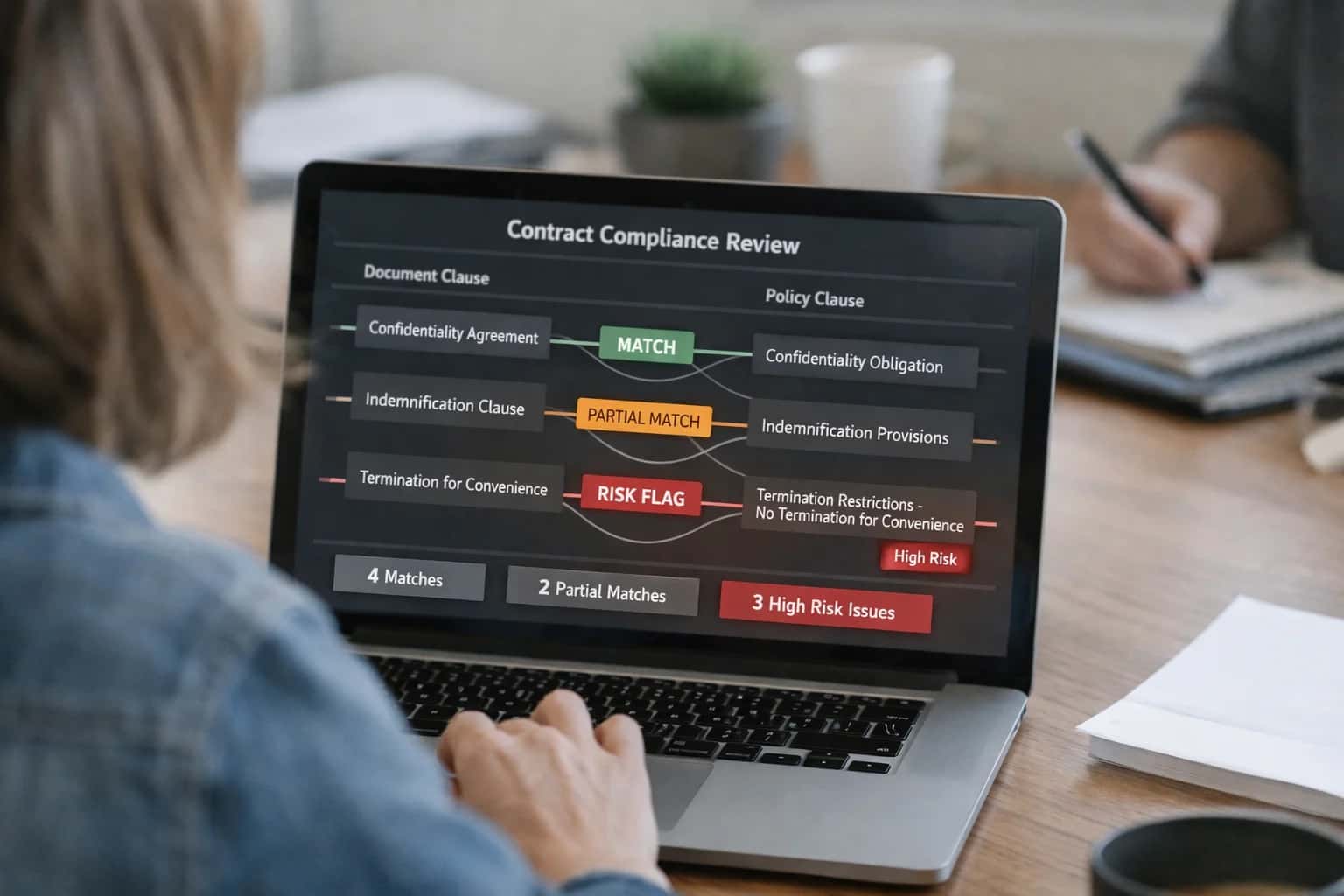
Legal team reviewing AI contract compliance agent on laptop, contract documents visible, modern WeWork meeting room.
ARCHITECTURE & IMPLEMENTATION

Where AI Fits into ERP Contract Management

A practical blueprint for embedding AI into ERP contract workflows to automate obligation tracking, compliance, and renewals.

AI integration for ERP contract management focuses on the contract documents attached to vendor, customer, or project records and the transactional data they govern. The primary surfaces are:

  • Vendor/Customer Master Records: Where contracts are linked for procurement or sales.
  • Procurement (P2P) & Order Management (O2C) Modules: Where contract terms dictate pricing, payment terms, and delivery schedules.
  • Project Accounting Modules: Where SOWs and milestone-based contracts drive billing and cost recognition.
  • Fixed Assets & Leasing Modules: For managing lease agreements and related obligations.
  • ERP-Attached Document Repositories (e.g., SAP DMS, Oracle Content Management): The central store for contract PDFs, amendments, and supporting documents.

The integration connects AI to these surfaces via the ERP's REST or SOAP APIs (like SAP's OData, NetSuite's SuiteTalk, Oracle's REST APIs for Financials) to read linked documents, extract data, and write back extracted obligations, dates, and compliance flags to custom objects or dedicated contract management extensions.


Implementation typically follows a three-tier pattern:

  1. Ingestion & Extraction: A background service monitors the ERP document repository or specific modules for new contract uploads. Using a document AI pipeline, it extracts key entities: parties, effective/expiration dates, payment terms, service level agreements (SLAs), auto-renewal clauses, termination notices, and liability caps.
  2. Orchestration & Enrichment: The extracted data is validated against the ERP's master data (vendor/customer IDs, item numbers). AI can then:
    • Create or update custom contract summary records within the ERP, linking them to the relevant vendor, customer, or project.
    • Generate milestone tasks in the project module or renewal alerts in the procurement calendar.
    • Perform spend commitment analysis by comparing contracted rates and volumes against actual PO and invoice data in the ERP.
  3. Workflow & Action: AI triggers native ERP workflows or builds intelligent agents:
    • 90-day renewal alerts are sent to the responsible buyer via the ERP's notification system or integrated comms platform.
    • Compliance checking agents run periodically, comparing invoice payments against contracted payment terms and flagging early payment discounts missed or late payment penalties incurred.
    • For complex contracts, an AI-assisted review workflow can highlight non-standard clauses during the sourcing or sales process before finalization.

Rollout should be phased, starting with a single contract type (e.g., NDAs or Master Service Agreements) and a pilot user group like procurement or legal ops. Governance is critical: establish a human-in-the-loop review step for AI-extracted data before it posts to master records, and maintain a clear audit trail linking the source document, the AI extraction output, and any resulting ERP transaction. This approach turns static contract repositories into active systems of obligation, reducing manual tracking and mitigating financial and compliance risk. For a deeper dive into related document intelligence workflows, see our guide on AI Integration for ERP Document Management.

CONTRACT MANAGEMENT

ERP Modules and Surfaces for AI Integration

Core Data Layer for AI

The foundation for AI-driven contract management is the ERP's document storage system. This is typically a dedicated module (e.g., SAP Document Management System, Oracle Content Management) or a custom object/attachment structure in platforms like NetSuite.

AI integration surfaces here include:

  • Document Ingestion APIs: Programmatically feed contracts (PDFs, Word files, scanned images) into the system for processing.
  • Metadata & Full-Text Search: AI agents use search APIs to retrieve contracts based on semantic queries, not just keywords.
  • Version Control Hooks: Trigger AI review workflows when new contract versions are uploaded.

Integrating at this layer allows AI to perform bulk analysis of the entire contract portfolio, extract standardized metadata (parties, dates, value), and build a searchable knowledge base. This turns a static file store into an intelligent asset.

INTEGRATION OPPORTUNITIES

High-Value AI Use Cases for ERP Contract Management

Integrating AI into ERP contract management automates the extraction, tracking, and analysis of obligations buried in legal documents. This connects procurement, legal, and finance by surfacing actionable data directly within the ERP workflows they already use.

01

Automated Contract Obligation Extraction

AI agents ingest contracts linked to vendor or customer masters in the ERP (e.g., via SAP DMS, Oracle Content, or NetSuite File Cabinet) to extract key terms: payment terms, renewal dates, SLAs, pricing tiers, and termination clauses. Extracted data populates custom objects for tracking, triggering renewal alerts and compliance workflows.

Batch -> Real-time
Data availability
02

Spend Commitment & Budget Guardrails

AI correlates extracted contract pricing and volume commitments with actual PO and invoice data in the ERP. It flags overspend risks, underutilized commitments, and auto-renews to procurement and budget owners. This prevents maverick spend and ensures negotiated rates are captured in the procure-to-pay cycle.

Same day
Risk visibility
03

Dynamic Compliance Monitoring

Continuously monitors ERP transactions (goods receipts, invoices) against contract SLAs and regulatory clauses. AI identifies non-compliant shipments, late payments triggering penalties, or missing certifications, generating alerts and corrective action tickets in connected systems like Coupa or ServiceNow.

Proactive vs. Reactive
Compliance mode
04

Intelligent Renewal & Negotiation Support

AI analyzes contract performance history from the ERP (spend, delivery metrics, dispute logs) and external market data to provide renewal recommendations, red-line risk scoring for new terms, and draft negotiation briefs. This equips sourcing managers with data-driven insights before vendor discussions.

1 sprint
Prep time reduction
05

Unified Contract Search & Clause Retrieval

Deploys a RAG-powered semantic search layer over the ERP's document repository. Legal and procurement teams can ask natural language questions like "Show all contracts with indemnification clauses for cybersecurity" or "Find MSA templates for EU suppliers" without manual folder digging.

Hours -> Minutes
Search time
06

Automated Obligation Tracking & Reporting

AI creates and maintains a live obligation register by linking extracted terms to ERP master data (vendors, materials, projects). It auto-generates periodic reports for stakeholders on upcoming renewals, expiring certificates, or milestone deliverables, pushing summaries via ERP workflows or email.

Batch -> Real-time
Reporting cadence
ERP INTEGRATION PATTERNS

Example AI-Enhanced Contract Workflows

These workflows illustrate how AI agents can be embedded into your ERP's contract lifecycle, connecting to modules like Procurement, Project Accounting, and Fixed Assets to automate obligations, monitor compliance, and trigger financial actions.

Trigger: A new contract document (PDF, DOCX) is uploaded to the ERP's document management system (e.g., SAP DMS, Oracle Content) or attached to a Vendor or Project record.

AI Agent Action:

  1. The document is routed to an AI extraction pipeline.
  2. A multi-modal LLM identifies and extracts key obligations: renewal dates, payment milestones, reporting deadlines, service level agreements (SLAs), and termination clauses.
  3. The agent validates extracted dates and amounts against any structured data already in the ERP (e.g., PO value).

System Update:

  • Creates or updates a dedicated "Contract Obligations" custom object/table in the ERP, linking it to the vendor, project, and GL account.
  • Generates calendar entries in the integrated enterprise calendar with pre-configured alert rules (e.g., "90-day renewal notice").
  • Optional Human Review Point: Flags low-confidence extractions or clauses that deviate from standard templates for legal/procurement review.

Payload Example (to ERP API):

json
{
  "erp_record_id": "VENDOR-78910",
  "contract_id": "CT-2024-045",
  "obligations": [
    {
      "type": "payment_milestone",
      "description": "Phase 1 Delivery Acceptance",
      "due_date": "2024-11-15",
      "amount": 50000.00,
      "currency": "USD",
      "linked_gl_account": "5500-Professional Fees"
    },
    {
      "type": "reporting",
      "description": "Quarterly SLA Performance Report",
      "due_date": "2024-10-05",
      "recurring": true
    }
  ]
}
CONTRACT INTELLIGENCE PIPELINE

Implementation Architecture: Data Flow and APIs

A practical blueprint for connecting AI to your ERP's contract data to automate obligation tracking, renewal management, and compliance monitoring.

The integration connects to your ERP's contract repository—whether native modules like SAP Contract Accounts Receivable and Payable (FI-CA), Oracle Procurement Contracts, or custom object stores in NetSuite and Infor—via RESTful APIs (e.g., OData, SuiteTalk, ION) or by monitoring designated document management folders. A primary agent ingests contract documents (PDFs, Word files) and their linked metadata (vendor, effective date, value) to execute a multi-step pipeline: 1) Document Extraction using vision models to handle scanned PDFs and complex layouts, 2) Entity Recognition to identify parties, dates, monetary values, and termination clauses, and 3) Obligation Mapping to tag recurring deliverables, reporting requirements, and auto-renewal triggers.

Extracted structured data is written back to the ERP as custom objects or enriched attributes on existing vendor, purchase order, or project records. For example, a Contract_Obligation record in NetSuite would link to the vendor and include fields for Next_Milestone_Date, Responsible_Party, and Obligation_Type. Critical dates and thresholds trigger workflows: an AI agent can analyze spend against contract commitments and post a journal entry accrual in the General Ledger, or automatically generate a Purchase Requisition ahead of a renewal. For compliance, the system cross-references extracted terms against a policy library to flag non-standard clauses, routing exceptions to legal via the ERP's native approval framework.

Governance is built into the flow. All extractions and generated actions are logged in an immutable audit trail linked to the source contract ID. A human-in-the-loop review step is configured for high-value or low-confidence clauses before any system updates are committed. The architecture is deployed as a containerized service adjacent to the ERP, ensuring it does not impact core transaction processing. Rollout typically begins with a pilot on a single contract type (e.g., NDAs or software licenses) to tune extraction models before scaling to master service agreements and complex amendments, delivering incremental value from automated alerting while building towards full spend commitment tracking.

AI Integration for ERP Contract Management

Code and Payload Examples

Ingesting and Extracting Contract Data

AI integration begins by connecting to the ERP's document repository or external storage (e.g., SharePoint, Box) linked to vendor or customer records. The goal is to extract structured obligations, dates, and parties from unstructured PDFs or scanned contracts.

A common pattern is to use an event-driven architecture: when a new contract is attached to a Vendor or Project record in the ERP, a webhook triggers an AI extraction pipeline. The extracted data is then written back to custom objects or fields within the ERP for downstream workflows like renewal tracking or compliance checks.

Example Payload for Extraction Trigger:

json
{
  "event": "contract.uploaded",
  "erp_record_id": "VEND-2024-789",
  "erp_record_type": "vendor",
  "document_url": "https://storage.example.com/contracts/msa_2024.pdf",
  "metadata": {
    "uploaded_by": "jsmith",
    "erp_module": "Procurement"
  }
}

This payload is sent from the ERP (via SuiteScript, BAdI, or a REST endpoint) to a processing queue, initiating the AI extraction job.

AI-ENHANCED CONTRACT MANAGEMENT

Realistic Time Savings and Operational Impact

This table illustrates the typical operational impact of integrating AI into an ERP's contract management lifecycle, focusing on measurable efficiency gains and risk reduction for procurement and legal teams.

ProcessBefore AIAfter AIKey Impact & Notes

Contract Obligation Extraction

Manual review by legal/ops (30-60 min/doc)

Automated extraction & summarization (2-5 min/doc)

Enables tracking of 10x more contracts; human review for validation.

Renewal & Milestone Alerting

Calendar reminders; manual tracking in spreadsheets

Automated alerts 90/60/30 days prior with obligation summary

Reduces missed renewals; provides context for negotiation prep.

Spend Commitment Tracking

Manual cross-reference of contracts to POs/invoices

AI links contract terms to ERP procurement & AP data

Real-time visibility into committed vs. actual spend; flags overages.

Compliance & Clause Review

Sample-based audits; reliance on institutional knowledge

Continuous scanning for non-standard terms & regulatory keywords

Proactive risk identification; standardizes clause library usage.

Vendor Risk Assessment Integration

Annual manual refresh of supplier risk scores

AI correlates contract terms with live external risk data feeds

Dynamic risk scoring; alerts on high-risk vendors pre-renewal.

Response to Contract Inquiries

Legal/Procurement team researches and drafts replies (hours)

AI retrieves relevant clauses & obligations; drafts initial response

Frees specialist time for complex negotiations; same-day response possible.

Contract Data Migration/Upload

Manual data entry or costly consulting services

AI parses legacy PDFs/Word docs and populates ERP contract objects

Accelerates ERP implementations; improves historical data quality.

ARCHITECTING FOR CONTROL AND CONFIDENCE

Governance, Security, and Phased Rollout

A production-ready AI integration for ERP contract management requires a deliberate approach to data security, change management, and operational governance.

Implementation begins by defining a secure data perimeter. AI agents should interact with contract documents and related ERP objects—such as Vendor, Purchase Order, Project, and GL Account records—via dedicated service accounts with role-based access control (RBAC). All data flows through a secure middleware layer that logs prompts, context, and generated outputs for auditability. For platforms like SAP S/4HANA or Oracle Cloud ERP, this often means leveraging OData or REST APIs from a trusted network zone, ensuring sensitive terms and financial obligations are never exposed to unauthorized models or users.

A phased rollout is critical for user adoption and risk mitigation. Start with a pilot focused on read-only intelligence, such as using AI to extract key dates and obligations from a controlled set of procurement contracts stored in the ERP's document management system (e.g., SAP DMS, Oracle Content). This provides immediate value through automated renewal alerts without altering core processes. The next phase introduces assistive workflows, like AI-powered compliance checks that flag non-standard clauses against a playbook and suggest edits, requiring human review before updates are committed back to the ERP's contract repository or linked purchase agreements.

Governance is maintained through a combination of technical and human oversight. All AI-generated outputs should be tagged with confidence scores and source references. High-stakes actions, such as proposing a new spend commitment in the ERP's financial planning module, should route through an approval step. Establish a regular review cycle to evaluate the AI's performance on key metrics—extraction accuracy, false positive rates in compliance checks—and retrain or adjust prompts as needed. This controlled, iterative approach ensures the integration scales from a tactical tool to a trusted component of the legal and procurement operations landscape, directly within the system of record.

ERP CONTRACT MANAGEMENT

Frequently Asked Questions

Common questions about integrating AI into ERP-based contract management workflows for procurement, legal, and finance teams.

AI integrates via the ERP's APIs and document management layer. A typical architecture involves:

  1. Trigger & Ingestion: A new contract document is uploaded to a designated ERP module (e.g., SAP Document Management, NetSuite File Cabinet, Oracle Content). A webhook or scheduled job triggers the AI pipeline.
  2. Data Extraction: The AI service uses OCR and NLP to extract key terms: parties, dates, payment terms, SLAs, termination clauses, auto-renewal flags, and monetary obligations.
  3. ERP Record Creation/Enrichment: Extracted data is mapped to ERP objects:
    • Creates/updates a Vendor/Customer Contract master record.
    • Links obligations to Purchase Agreements or Sales Orders.
    • Sets up Asset Leases or Project Milestones.
    • Creates calendar events for key dates in the ERP's workflow engine.
  4. Human-in-the-Loop Review: The system flags low-confidence extractions or high-value clauses for legal/procurement review within a connected interface before final ERP posting.
Prasad Kumkar

About the author

Prasad Kumkar

CEO & MD, Inference Systems

Prasad Kumkar is the CEO & MD of Inference Systems and writes about AI systems architecture, LLM infrastructure, model serving, evaluation, and production deployment. Over 5+ years, he has worked across computer vision models, L5 autonomous vehicle systems, and LLM research, with a focus on taking complex AI ideas into real-world engineering systems.

His work and writing cover AI systems, large language models, AI agents, multimodal systems, autonomous systems, inference optimization, RAG, evaluation, and production AI engineering.


