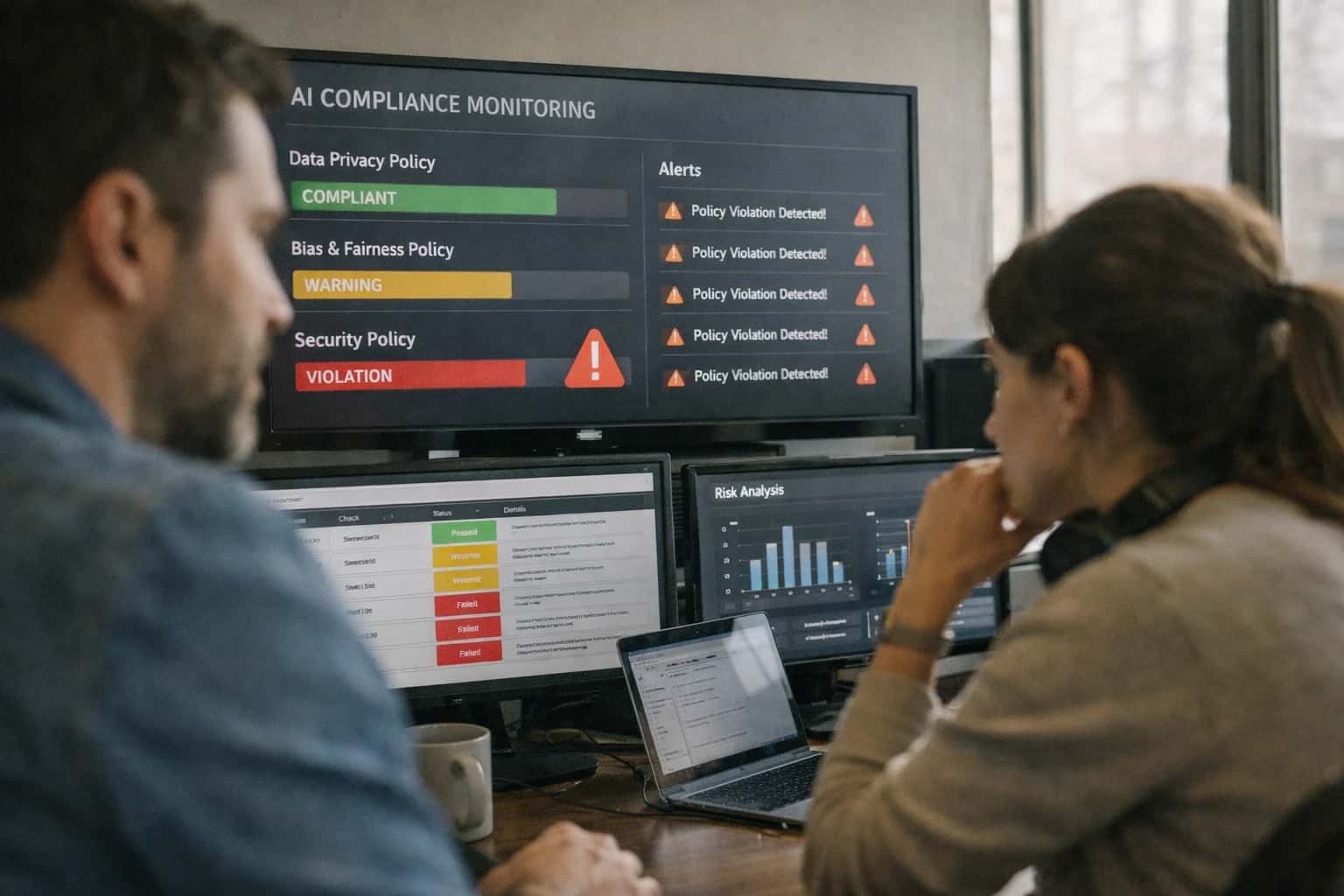
AI integration for ERP compliance monitoring focuses on three key surfaces: transactional data streams (journal entries, purchase orders, payments), master data changes (vendor, customer, user role updates), and the audit log itself. The goal is to move from scheduled, sample-based audits to continuous, intelligent surveillance. For platforms like SAP S/4HANA, this means subscribing to OData feeds for JournalEntry and PurchaseOrder headers; in NetSuite, it involves SuiteScript listeners on Transaction and Employee records; and for Oracle Cloud ERP, it's about leveraging REST APIs for Financials and HCM modules to stream data into a dedicated monitoring layer.

Integration
AI Integration for ERP Compliance Monitoring
A technical guide to embedding AI agents for continuous, automated monitoring of ERP transactions and master data to detect segregation of duties violations, unusual journal entries, and policy deviations, generating prioritized alerts for audit teams.
ARCHITECTURE AND ROLLOUT
Where AI Fits in ERP Compliance Monitoring
A practical blueprint for embedding AI into ERP compliance workflows to automate detection, prioritize alerts, and support audit teams.
The core implementation pattern involves an AI agent layer that sits adjacent to the ERP, consuming these data streams. This layer applies three types of logic: 1) Rule-based checks for known Segregation of Duties (SoD) conflicts (e.g., a user who can both create a vendor and approve a payment), 2) Anomaly detection models trained on historical patterns to flag unusual journal entry amounts, off-cycle postings, or atypical vendor payment behaviors, and 3) Natural language processing to scan attached document text in Invoice or Contract records for non-compliant clauses or missing terms. High-confidence violations are routed via the ERP's native workflow engine (e.g., SAP Workflow, Oracle BPM) to create ComplianceCase records for internal audit teams, while low-confidence alerts are queued for human review.
Rollout should be phased, starting with a single, high-risk process like intercompany reconciliations or procurement approvals. Governance is critical: all AI-generated alerts must be stored with a complete provenance trail—the source transaction ID, the AI model/rule version, the confidence score, and the human disposition. This creates a defensible audit trail. A key success factor is integrating the AI findings back into the ERP's GRC (Governance, Risk, and Compliance) module or a custom ComplianceFinding object, ensuring a single system of record. This approach transforms compliance from a periodic cost center into a continuous, AI-augmented control layer that reduces manual review effort by 60-80% for routine checks, allowing audit teams to focus on complex investigations.
ARCHITECTURAL BLUEPRINT
ERP Modules and Data Surfaces for AI Monitoring
Core Financial Transaction Surfaces
AI compliance monitoring integrates most directly with the General Ledger (GL), Accounts Payable (AP), and Accounts Receivable (AR) modules. The key data objects are journal entry headers and lines, vendor invoices, customer payments, and the underlying master data for accounts, vendors, and customers.
Primary Monitoring Points:
- Journal Entries: Analyze postings for unusual amounts, frequencies, round-number entries, or postings to unusual account combinations that may indicate manual override or error. AI can flag entries that deviate from historical patterns by user, cost center, or time of day.
- Vendor & Customer Masters: Monitor changes to bank details, tax IDs, or payment terms that could indicate fraudulent setup or takeover.
- Segregation of Duties (SoD): Cross-reference transaction creators and approvers against role-based access control (RBAC) matrices defined in the ERP's security module to detect potential SoD violations in real-time, rather than during periodic audits.
ERP INTEGRATION PATTERNS
High-Value AI Compliance Monitoring Use Cases
Deploy AI agents to continuously monitor ERP transactions and master data for segregation of duties (SoD) violations, unusual journal entries, and policy deviations, generating actionable alerts for internal audit and compliance teams.
01
Continuous Segregation of Duties (SoD) Monitoring
AI agents analyze user-role assignments and transaction logs in real-time against a configured SoD matrix (e.g., CREATE_PO + APPROVE_PO). Instead of quarterly access reviews, violations are flagged within minutes of a role change or risky transaction, triggering automated workflows in the ERP's security module or ticketing system for immediate remediation.
Quarterly -> Real-time
Violation detection
02
Anomalous Journal Entry Detection
Monitor the GL posting interface (e.g., FB50 in SAP, Journal Entry in NetSuite) for entries that deviate from historical patterns—unusual amounts, atypical accounts, off-cycle postings, or entries from non-standard users. AI provides a reasoning summary (e.g., 'First time user X posted to account Y') and routes high-risk entries to a designated reviewer queue before posting or for post-posting audit.
Batch -> Real-time
Review workflow
03
Policy Deviation in Procurement Workflows
Integrate with ERP procurement modules (e.g., SAP MM, Oracle iProcurement) to monitor POs and contracts against policy rules: maverick spending, supplier tier violations, or missing approvals. AI checks requisitions against contract terms, spend thresholds, and approval hierarchies, blocking or escalating non-compliant transactions and logging deviations for audit trails.
Pre-emptive blocks
Policy enforcement
04
Master Data Governance & Change Monitoring
Monitor changes to critical master data—vendor bank details, material prices, customer credit limits—for unauthorized or high-risk modifications. AI correlates changes with supporting documentation (e.g., change tickets, approved forms) and user roles. Unsupported changes trigger automated rollback scripts or immediate alerts to data stewards, maintaining data integrity for financial reporting and operations.
Same-day alerts
Unauthorized change detection
05
Automated Audit Evidence Collection
For internal and external audits, AI agents execute natural language queries (e.g., 'Show all intercompany transactions above $100k in Q3') against the ERP, retrieving relevant transactions, supporting documents, and user logs. The system generates a structured, auditor-ready packet with a narrative summary, reducing manual evidence gathering from weeks to hours and ensuring consistent audit trails. Learn more about our approach to ERP audit trail automation.
Weeks -> Hours
Evidence assembly
06
Risk-Based Transaction Sampling for Internal Audit
Move from periodic, random sampling to continuous, risk-based sampling. AI scores all transactions (e.g., payments, journal entries) based on risk factors: amount, user, supplier risk score, and historical error rates. It prioritizes a high-risk sample for audit teams daily, focusing manual review where it matters most and increasing coverage of the transaction population. This integrates with broader ERP risk management strategies.
50%+ efficiency gain
Audit focus
ERP COMPLIANCE MONITORING
Example AI Monitoring Workflows and Agent Orchestration
These workflows illustrate how AI agents can be orchestrated to continuously monitor ERP transactions and master data for compliance risks, moving from detection to actionable review.
Trigger: A user with a Purchasing Agent role creates a new vendor master record and immediately creates a purchase order for that vendor.
Context/Data Pulled:
- The agent queries the ERP's user-role assignment tables and recent audit logs via REST API (e.g., SAP GRC API, NetSuite SuiteTalk).
- It retrieves the user's current role assignments and the last 24 hours of transaction history.
- It fetches the organization's SoD rule matrix from a connected policy repository.
Model/Agent Action:
- An LLM-based classifier evaluates the sequence of actions (
CREATE_VENDOR,CREATE_PO) against the SoD rule matrix. - The agent determines if this combination of actions by a single user violates defined control policies (e.g., vendor creation + procurement authority).
System Update/Next Step:
- A high-priority alert is created in the connected compliance case management system (e.g., ServiceNow, Jira), tagged with the risk level, user ID, and transaction IDs.
- The alert payload is also sent to a designated Slack/Teams channel for the internal audit team.
Human Review Point: The internal audit team reviews the alert in their case queue. The AI provides a summary of the violation, the user's role history, and a link to the exact transactions in the ERP for investigation.
A PRODUCTION BLUEPRINT
Implementation Architecture: Data Flow, APIs, and Guardrails
A secure, governed architecture for continuous AI-driven compliance monitoring within SAP, Oracle, NetSuite, or Infor.
The core integration connects to your ERP's transactional APIs and master data tables. For segregation of duties (SoD) monitoring, the system ingests user-role assignments (e.g., from SAP AGR_USERS, Oracle FND_USER_RESP_GROUPS) and transaction logs. For anomalous journal entry detection, it pulls GL line items (e.g., NetSuite JournalEntry records, SAP BKPF/BSEG tables) via native REST/SOAP APIs or change data capture (CDC) streams. This raw data is normalized, hashed for privacy, and sent to a secure processing queue.
Our AI agents analyze this stream against your compliance ruleset and learned behavioral baselines. For SoD, a rules engine checks for policy violations (e.g., a user creating a vendor and approving an invoice), while an ML model identifies risky role combinations. For journal entries, anomaly detection models flag unusual amounts, postings to rarely used accounts, or off-cycle timing. Each flagged event generates an actionable alert—a structured JSON payload containing the transaction ID, user, rule violated, risk score, and suggested next step—which is posted back to a dedicated Compliance Case object in your ERP or to a connected GRC platform like SAP GRC or Oracle Risk Management.
Governance is built-in. All AI inferences are logged with the source data hash, model version, and confidence score for audit. A human-in-the-loop step is configured where high-risk or high-value alerts are routed via the ERP's workflow engine (e.g., SAP Workflow, Oracle BPM) to an internal audit lead for review before any system action. The system's access to the ERP is scoped to a dedicated service account with read-only permissions on transactional data and write access only to the designated alert staging table or API endpoint, enforcing the principle of least privilege.
Rollout is phased, starting with a single high-risk process like intercompany journal approvals or vendor master maintenance. We configure the system in monitoring-only mode for 4-6 weeks to tune detection thresholds and reduce false positives, ensuring the compliance team trusts the alerts before enabling automated case creation and workflow integration.
ERP COMPLIANCE MONITORING
Code and Payload Examples for Key Platform Integrations
Real-Time SoD Violation Detection
Continuously monitor user-role assignments and transaction postings against a defined SoD matrix. The integration listens for changes in user master data (USER_ADDR, AGR_USERS in SAP) and analyzes posted journal entries (BKPF, BSEG), purchase orders (EKKO, EKPO), and payment runs (REGUP).
When a high-risk transaction is posted by a user with conflicting permissions, the system generates an alert payload with the violation context, user, transaction, and a risk score. This payload is sent to a compliance case management system or a dedicated audit queue.
Example Alert Payload:
json{ "violation_id": "SOD-2024-001", "timestamp": "2024-05-15T14:30:00Z", "erp_system": "SAP S/4HANA", "user_id": "JSMITH", "conflicting_roles": ["FI_POSTER", "FI_PAYMENT_EXECUTOR"], "transaction_type": "Payment Run (F110)", "transaction_id": "5000000123", "document_amount": 125000.00, "vendor": "VEND-4567", "risk_score": 0.92, "recommended_action": "Immediate review by Internal Audit. Suspend payment until cleared." }
This enables audit teams to move from periodic, sample-based reviews to continuous, transaction-level monitoring.
ERP COMPLIANCE MONITORING
Realistic Time Savings and Operational Impact
This table illustrates the typical operational impact of integrating AI for continuous compliance monitoring within SAP, Oracle, NetSuite, or Infor. It focuses on measurable improvements in speed, coverage, and team efficiency for internal audit and compliance functions.
| Compliance Activity | Before AI | After AI | Key Notes |
|---|---|---|---|
Segregation of Duties (SoD) Violation Detection | Monthly batch review | Continuous real-time monitoring | Shifts from periodic audit to proactive prevention |
Journal Entry Anomaly Review | Manual sampling of 5-10% | Automated analysis of 100% | Dramatically increases coverage and risk surface visibility |
Policy Deviation Alert Generation | Days to weeks after event | Same-day or real-time alerts | Enables faster corrective action and reduces exposure |
Audit Evidence Compilation | Manual data pulls and formatting | Automated report generation | Frees up 40-60% of audit prep time for analysis |
Master Data Change Review | Ad-hoc, triggered by support tickets | Systematic monitoring of all critical fields | Prevents unauthorized or erroneous changes to vendor/customer data |
Compliance Dashboard Updates | Static, manually refreshed reports | Dynamic, auto-updated dashboards | Provides leadership with real-time compliance posture |
Remediation Workflow Initiation | Email-based manual assignment | Automated ticket creation and routing | Ensures consistent tracking and closure of identified issues |
CONTROLLED DEPLOYMENT FOR REGULATED ENVIRONMENTS
Governance, Security, and Phased Rollout
A practical guide to implementing AI-powered compliance monitoring in ERP systems with appropriate controls, security, and a risk-managed rollout.
A production AI integration for ERP compliance monitoring must be architected with zero-trust principles. This means the AI agent operates with strictly scoped, read-only API access to sensitive modules like the General Ledger (FI-GL), Accounts Payable (FI-AP), User Master (SU01), and Segregation of Duties (SoD) rule sets. All queries and inferences are logged to a dedicated audit trail, linking each alert back to the source transaction IDs, user sessions, and the specific policy rule or ML model version that triggered it. Access to the AI's findings should be gated by existing ERP role-based access control (RBAC), ensuring only authorized internal audit or compliance team members can view and act on generated alerts.
A phased rollout is critical for user adoption and risk management. Start with a detection-only pilot in a single, non-production environment or a controlled business unit. Focus the AI on monitoring a high-volume, rule-based area like journal entry posting for unusual amounts, round-number transactions, or postings outside normal business hours. In this phase, alerts are generated but do not trigger automated workflows; they are reviewed by the audit team to calibrate the AI's precision and recall. The next phase introduces human-in-the-loop workflows, where prioritized alerts are routed via the ERP's native workflow engine (e.g., SAP Business Workflow, Oracle Approval Management) to designated reviewers for investigation and closure, creating a feedback loop to improve the AI.
Governance is established through a cross-functional AI Compliance Steering Committee with members from Internal Audit, IT Security, Finance, and Legal. This committee approves the use cases, defines the acceptable false-positive rate, and mandates regular model drift and bias assessments for any machine learning components analyzing transaction patterns. All AI-generated content—such as alert summaries or variance explanations—must be clearly watermarked as AI-assisted within the ERP interface. Finally, the integration should be designed for graceful degradation; if the AI service is unavailable, the core ERP compliance workflows (like manual SoD reports) continue to operate uninterrupted, ensuring business continuity.
Enabling Efficiency, Speed & Accuracy
Intelligent Analysis, Decision & Execution
We build AI systems for teams that need search across company data, workflow automation across tools, or AI features inside products and internal software.
Talk to Us
Search across company data
Give teams answers from docs, tickets, runbooks, and product data with sources and permissions.
Useful when people spend too long searching or get different answers from different systems.
Enterprise searchRAGPermissions
Read more
Automate internal workflows
Use AI to route work, draft outputs, trigger actions, and keep approvals and logs in place.
Useful when repetitive work moves across multiple tools and teams.
AI agentsWorkflow automationGovernance
Read more
Add AI to products and internal tools
Build assistants, guided actions, or decision support into the software your team or customers already use.
Useful when AI needs to be part of the product, not a separate tool.
AI integrationDecision supportModel routing
Read moreERP COMPLIANCE MONITORING
FAQ: Technical and Commercial Questions
Practical answers for teams evaluating AI to automate compliance monitoring within SAP, Oracle, NetSuite, or Infor.
AI integrates directly with your ERP's APIs and database to monitor transactions in near real-time. The typical architecture involves:
- Data Ingestion: Using ERP-specific connectors (e.g., SAP OData, NetSuite SuiteTalk, Oracle REST APIs) to pull journal entries, purchase orders, user access logs, and master data changes. CDC (Change Data Capture) streams or scheduled batch extracts are common.
- Analysis Engine: A dedicated service applies pre-configured and learnable rules to the data. This includes:
- Segregation of Duties (SoD) Checks: Cross-referencing user roles and transaction types against a violation matrix.
- Anomaly Detection: Using statistical models to flag unusual journal amounts, off-cycle postings, or vendor payment patterns.
- Policy Deviation: Checking transactions against configurable business rules (e.g., PO approval thresholds).
- Alerting & Orchestration: Violations are scored, contextualized with related data, and routed as alerts to systems like ServiceNow, Microsoft Teams, or back into the ERP as a workflow task for the internal audit team.
This creates a continuous monitoring layer atop your existing ERP, without disrupting core financial posting workflows.

About the author
Prasad Kumkar
CEO & MD, Inference Systems
Prasad Kumkar is the CEO & MD of Inference Systems and writes about AI systems architecture, LLM infrastructure, model serving, evaluation, and production deployment. Over 5+ years, he has worked across computer vision models, L5 autonomous vehicle systems, and LLM research, with a focus on taking complex AI ideas into real-world engineering systems.
His work and writing cover AI systems, large language models, AI agents, multimodal systems, autonomous systems, inference optimization, RAG, evaluation, and production AI engineering.
LinkedIn
Limited slotsGet a Free AI Consultation
Partnered with leading AI, data, and software stack.





How We Work
Custom AI workflows for your Business
One-fit-all AI don't work for modern businesses. At Inferensys, we aim to understand your business & custom requirements; which we use to define most efficient agentic workflows, the data, and the tools for your business.
01
Review the use case
We understand the task, the users, and where AI can actually help.
Read more02
Pick the right approach
We define what needs search, automation, or product integration.
Read more03
Build the first useful version
We implement the part that proves the value first.
Read more04
Improve from there
We add the checks and visibility needed to keep it useful.
Read moreThe first call is a practical review of your use case and the right next step.
Talk to Us