AI integration connects directly to the core AR data objects in your ERP—be it SAP's FBL5N/Customer Line Items, Oracle's AR_TRANSACTIONS, NetSuite's Transaction records, or Infor's ARTRN tables. The primary surfaces for automation are the collections workbench, dunning engine, cash application routines, and customer communication logs. AI agents can be triggered by scheduled jobs, payment application exceptions, or newly posted invoices to perform tasks like analyzing payment patterns, generating personalized collection emails, and proposing cash application matches for unresolved receipts.

Integration
AI Integration for ERP Accounts Receivable
A technical blueprint for embedding AI into the Accounts Receivable modules of SAP S/4HANA, Oracle Cloud ERP, NetSuite, and Infor to automate dunning, prioritize collections, generate personalized communication, and predict cash application challenges.
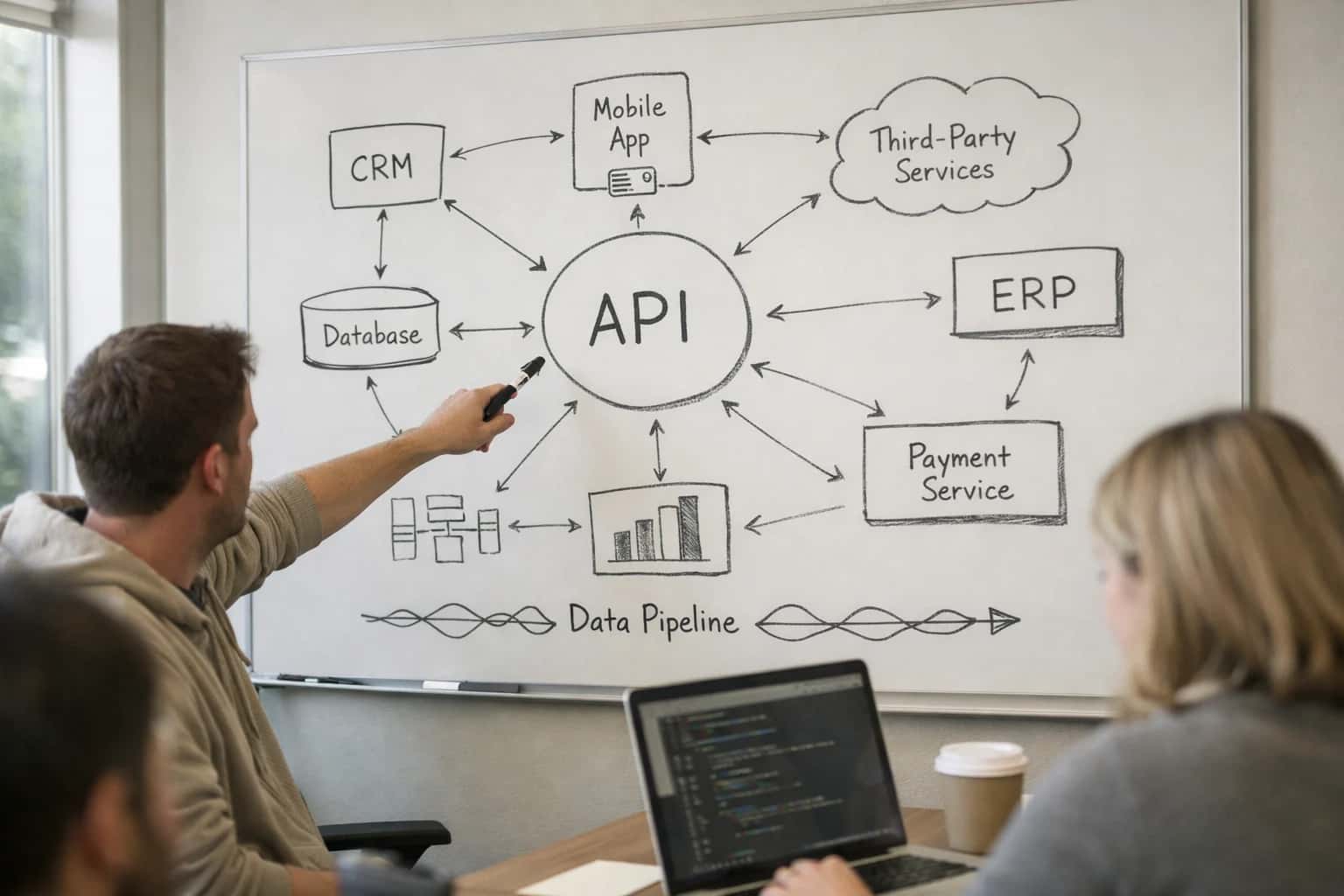
AUTOMATE DUNNING, PRIORITIZE COLLECTIONS, AND PREDICT CASH FLOW
Where AI Fits in ERP Accounts Receivable
Integrating AI into ERP Accounts Receivable modules transforms a reactive, manual process into a proactive, intelligent cash application and collections engine.
High-impact workflows begin with prioritized collections. An AI model scores each open invoice based on payment history, customer credit risk, invoice age, and even external signals like news sentiment, then surfaces a dynamic, ranked worklist for collectors. For automated dunning, the system can generate and send personalized communication—escalating from gentle reminders to structured payment plans—via email or customer portal, logging all interactions back to the customer record. In cash application, AI tackles the hardest exceptions by analyzing remittance details, historical application patterns, and invoice line items to propose matches, reducing manual research from hours to minutes.
A production rollout typically involves a phased approach: starting with AI-assisted prioritization and communication drafting (with human review), then moving to fully automated dunning for low-risk segments, and finally implementing intelligent cash application for exception handling. Governance is critical; all AI-generated actions should be logged in the ERP audit trail, with configurable approval steps for communication above certain thresholds or for key customers. The result isn't just efficiency—it's improved Days Sales Outstanding (DSO) through earlier collections and more accurate cash flow forecasting as payment patterns become predictable.
WHERE AI CONNECTS TO THE DATA AND WORKFLOWS
AR Integration Surfaces by ERP Platform
Core AR Objects and APIs
AI integrations for SAP Accounts Receivable primarily connect to the Financial Accounting (FI) module, specifically the Accounts Receivable (FI-AR) sub-ledger. The key integration surfaces are:
- Customer Master Data (KNA1, KNB1): Enrich and validate customer records for credit scoring.
- Open Item Management (BSID/BSAD tables): Access unpaid invoices and customer balances for dunning prioritization and cash application prediction via OData APIs or direct RFC/BAPI calls.
- Dunning (F150): Automate the generation and personalization of dunning notices by analyzing payment history and customer communication preferences.
- Payment Medium Workbench (F110): Optimize payment proposal runs and predict which incoming payments will be difficult to apply automatically.
A typical AI agent workflow listens for Business Application Logs (BAL) or SAP Event Mesh triggers on new invoice postings or payment failures, then calls an external AI service to generate a personalized collection email or update a risk score in a custom Z-table.
For a deeper technical blueprint, see our guide on AI Integration for SAP S/4HANA.
ERP ACCOUNTS RECEIVABLE
High-Value AI Use Cases for AR
Integrating AI into your ERP's Accounts Receivable module automates high-volume, manual tasks, prioritizes collector effort, and improves cash flow visibility. These use cases target the core workflows in SAP, Oracle, NetSuite, and Infor.
01
Intelligent Dunning & Collections Prioritization
AI analyzes payment history, invoice age, customer risk scores, and communication patterns to dynamically prioritize the collections queue. It recommends which accounts to contact first and suggests the most effective channel (email, SMS, call).
Same day
Priority identification
02
Personalized Customer Communication Automation
Generates and sends context-aware, personalized payment reminders and statements by pulling invoice details, customer name, and past interactions from the ERP. Integrates with email or customer portals to maintain a consistent, professional tone while scaling outreach.
Batch -> Real-time
Communication workflow
03
Cash Application Prediction & Dispute Triage
Predicts which incoming payments will be difficult to apply by matching payment patterns to open invoices and flagging potential short-pays or disputes before they hit the lockbox. Routes exceptions to the appropriate AR specialist with suggested root causes.
Hours -> Minutes
Exception review
04
Credit Limit & Risk Analysis Automation
Continuously monitors customer financial data, payment behavior, and external risk signals to recommend credit limit adjustments. Automates the generation of risk review packets for credit analysts, pulling data directly from the ERP's AR and customer master modules.
1 sprint
Review cycle reduction
05
Deduction & Short-Pay Reason Coding
Uses NLP to read customer notes and deduction documentation from remittance advices or portals, then automatically suggests the correct reason code (e.g., pricing discrepancy, damaged goods). This standardizes data for faster resolution and recovery workflows.
80%+ Auto-coded
Typical volume
06
AR Health Dashboard & Predictive Cash Flow
Builds an AI-powered dashboard that goes beyond aging reports. It predicts cash collection dates, forecasts DSO based on current pipeline and economic factors, and highlights customers showing early signs of payment stress for proactive management.
Real-time
Risk visibility
PRACTICAL AUTOMATION PATTERNS
Example AI-Driven AR Workflows
These workflows illustrate how AI agents integrate directly with ERP Accounts Receivable modules to automate high-volume tasks, prioritize effort, and improve cash flow visibility. Each pattern connects to specific APIs, data objects, and user roles within SAP, Oracle, NetSuite, or Infor.
Trigger: A scheduled job runs nightly against the ERP's open receivables ledger.
Context Pulled: The agent queries the Customer, Invoice, and Payment History tables for all overdue invoices. It enriches this with external data via API calls to credit bureaus or business risk databases.
AI Agent Action: A model scores each overdue account on:
- Payment probability (based on history, external risk).
- Strategic value of the customer.
- Size and age of the overdue amount. It then clusters invoices into action tiers (e.g., "Auto-email reminder," "Call required," "Escalate to credit hold").
System Update: For the "Auto-email" tier, the agent generates a personalized collection message, merges invoice details, and uses the ERP's communication API (e.g., NetSuite's email.send) to dispatch it, logging the activity to the customer record. For higher tiers, it creates a task in the ERP's workflow or CRM module for a collector, pre-populated with the risk score and recommended action.
Human Review Point: The "Escalate to credit hold" recommendation is routed via an approval workflow to the Credit Manager before any system action is taken.
PRODUCTION-READY INTEGRATION PATTERNS
Implementation Architecture: Data Flow & Guardrails
A secure, governed data flow connecting AI agents to your ERP's AR module, designed for auditability and incremental rollout.
The integration architecture connects your ERP's AR data layer—specifically customer master data, open invoices, payment history, and dunning records—to a dedicated AI orchestration service. For SAP S/4HANA, this typically uses OData APIs for the A_Customer and A_AccountsReceivable business objects. For NetSuite, it leverages SuiteTalk REST APIs for Customer, Invoice, and Payment records. This service acts as a middleware layer, performing real-time data retrieval, constructing prompts with relevant transaction context, and calling the configured LLM (e.g., OpenAI GPT-4, Anthropic Claude). The AI's outputs—such as a prioritized collections list, a draft dunning email, or a cash application prediction—are returned as structured JSON payloads to the ERP for review or automated action via its native workflow engine.
Critical guardrails are implemented at multiple levels. A policy layer enforces rules before any AI call: it checks invoice age, customer credit limits, and pre-defined "do not contact" flags. All prompts are dynamically constructed with system-provided context only, preventing prompt injection and ensuring responses are grounded in the actual AR data. The AI service logs every interaction—input context, full prompt, raw LLM response, and final structured output—to a secure audit trail linked to the original ERP transaction ID. For high-stakes actions like sending communications, a human-in-the-loop approval step is enforced within the ERP's standard workflow, where a collections agent can review, edit, and approve the AI-generated message before it's dispatched from the system.
Rollout follows a phased, risk-managed approach. Phase 1 is read-only analysis, where the AI generates daily collection priority reports for team review, building trust in its logic. Phase 2 introduces draft generation, automating the creation of personalized dunning emails that agents approve and send. Phase 3, after validation, enables limited autonomous actions, such as automatically updating a customer's dunning status or proposing cash application matches for difficult-to-apply payments. Each phase includes monitoring for model drift (e.g., changes in payment prediction accuracy) and feedback loops where agent overrides are used to retrain and improve the system. This architecture ensures the AI augments—rather than replaces—existing controls, keeping your financial operations compliant and accountable. For related architectural patterns, see our guides on AI Integration for ERP Reconciliation and AI Governance and LLMOps Platforms.
AI-ENHANCED AR WORKFLOWS
Code & Payload Examples
Automating Dunning Workflows
Integrate AI to prioritize collections and generate personalized outreach by analyzing open AR aging data, payment history, and customer risk scores.
Typical Integration Points:
- ERP Objects:
Customer,Invoice,Payment,Collection Log. - Trigger: Scheduled job on aged invoices (e.g., NetSuite Scheduled Script, SAP Background Job).
- AI Action: Calls an LLM with customer context to draft a personalized collection email, suggests next action (e.g., call, offer payment plan), and updates the customer record with a risk score.
Example Payload to AI Service:
json{ "workflow": "collections_prioritization", "customer_id": "CUST-10023", "total_overdue": 12500.50, "aging_bucket": "61-90 days", "payment_history": { "avg_days_to_pay": 45, "on_time_percentage": 78 }, "previous_contact_notes": "Customer replied on 10/15, promised payment by EOM." }
The AI service returns a prioritized list, a recommended communication template, and a suggested follow-up date for the collections agent.
AI-ENHANCED ACCOUNTS RECEIVABLE
Realistic Time Savings & Operational Impact
This table illustrates the tangible workflow improvements and time savings achievable by integrating AI into ERP Accounts Receivable modules, focusing on high-volume, manual tasks within SAP, Oracle, NetSuite, and Infor.
| AR Workflow | Before AI | After AI | Key Impact & Notes |
|---|---|---|---|
Dunning/Collection Prioritization | Manual aging report review, static lists | AI-scored customer risk & payment likelihood | Collections focus shifts to highest-risk accounts first; reduces days sales outstanding (DSO) by prioritizing effort. |
Customer Payment Inquiry Response | Manual lookup across systems, email drafting | Automated response with account snapshot & next steps | Turns 15-30 minute tasks into <2 minute reviews; improves customer satisfaction with faster, accurate replies. |
Cash Application Exception Handling | Manual review of unmatched payments, calls to sales | AI proposes matches based on history & fuzzy logic | Reduces exception backlog from days to hours; frees up cash app specialists for complex cases only. |
Personalized Collection Communication | Generic payment reminder templates | AI-drafted, context-aware emails & SMS | Increases payment response rates; maintains customer relationships with tailored, professional tone. |
Payment Pattern Analysis & Alerting | Periodic manual analysis for trends | Continuous monitoring, alerts on deviation (e.g., slowing pay) | Proactive identification of at-risk customers before they become severely delinquent. |
Dispute Intake & Triage | Manual form entry, email routing to correct team | AI extracts details from email/PDF, categorizes, routes | Cuts dispute registration time by 75%; ensures faster assignment to resolution teams. |
Credit Review for Order Release | Manual check of credit limits & aging | AI-assisted recommendation with risk reasoning | Accelerates order release decisions from hours to minutes while providing audit-ready rationale. |
Month-End AR Reserve Calculation | Spreadsheet-based historical analysis | AI-generated aging analysis & bad debt probability | Provides data-driven, explainable reserve figures; reduces close cycle time for the AR ledger. |
ARCHITECTING FOR CONTROL AND CONFIDENCE
Governance, Security & Phased Rollout
A practical framework for deploying AI in Accounts Receivable with enterprise-grade controls.
Integrating AI into your ERP's AR module requires a security-first architecture that respects existing financial controls. The core integration pattern involves deploying a secure middleware layer that acts as a policy-aware orchestrator. This layer connects to your ERP (e.g., SAP S/4HANA's FI-AR, Oracle Cloud ERP's Receivables, NetSuite's Customer Payments) via its native REST or SOAP APIs, and to AI services via a dedicated, auditable gateway. All AI-generated actions—like a proposed dunning letter, a collections priority score, or a cash application suggestion—are treated as recommendations that must be logged, often require human approval, and are posted back to the ERP as a system user with a clear audit trail in the Journal Entry or Customer Ledger.
A phased rollout is critical for managing risk and proving value. Start with a read-only pilot focused on analysis and insight generation. For example, connect AI to 90 days of Open Items and Payment History data to produce a prioritized collections list with reasoning, which AR specialists review in a separate dashboard. Phase two introduces assisted workflows, such as AI drafting personalized collection emails based on customer payment patterns and past communication sentiment, which are sent for agent review and dispatch via the ERP's communication framework. The final phase enables closed-loop automation for low-risk, high-volume tasks, like auto-applying cash for exact-match payments with a reconciliation report for exceptions, governed by pre-defined rules and thresholds.
Governance is enforced through role-based access control (RBAC) tied to your ERP's security model, ensuring only authorized AR managers or collectors can approve AI-initiated actions. Every AI interaction is logged with the source data, the prompt, the model used, the output, and the final human decision, creating a complete lineage for compliance (SOX, GDPR) and model performance monitoring. This controlled, incremental approach de-risks the integration, builds organizational trust, and allows you to scale AI from a single process—like dunning—to the entire Order-to-Cash cycle.
Enabling Efficiency, Speed & Accuracy
Intelligent Analysis, Decision & Execution
We build AI systems for teams that need search across company data, workflow automation across tools, or AI features inside products and internal software.
Talk to Us
Search across company data
Give teams answers from docs, tickets, runbooks, and product data with sources and permissions.
Useful when people spend too long searching or get different answers from different systems.
Enterprise searchRAGPermissions
Read more
Automate internal workflows
Use AI to route work, draft outputs, trigger actions, and keep approvals and logs in place.
Useful when repetitive work moves across multiple tools and teams.
AI agentsWorkflow automationGovernance
Read more
Add AI to products and internal tools
Build assistants, guided actions, or decision support into the software your team or customers already use.
Useful when AI needs to be part of the product, not a separate tool.
AI integrationDecision supportModel routing
Read moreIMPLEMENTATION AND WORKFLOW
Frequently Asked Questions
Practical questions for technical leaders planning AI integration into ERP Accounts Receivable modules.
The workflow is typically event-driven, using a combination of scheduled batch jobs and real-time triggers from the ERP.
- Trigger: A nightly batch job queries the AR aging report (e.g., SAP
FBL5N, NetSuiteAged Receivablessaved search) for invoices past a defined threshold (e.g., > 30 days). Alternatively, a real-time trigger can fire when a payment promise is missed or a customer's credit score changes. - Context Pulled: The agent retrieves the customer's full context:
- Payment history and average days to pay
- Open sales orders and recent activity
- Contract terms and any existing disputes
- External data (via API call): recent news, financial health signals from providers like Dun & Bradstreet
- Agent Action: A scoring model (LLM-based or traditional ML) analyzes the aggregated context to assign a collection priority score (e.g., High, Medium, Low) and a recommended action (e.g., "Send gentle reminder email," "Schedule call," "Escalate to credit hold").
- System Update: The priority score and recommendation are written back to a custom field on the Customer or Invoice record in the ERP. A high-priority task is automatically created in the collections queue for the assigned agent.
- Human Review: The collections agent reviews the AI-generated recommendation and context in their ERP or collections dashboard before executing the outreach.

About the author
Prasad Kumkar
CEO & MD, Inference Systems
Prasad Kumkar is the CEO & MD of Inference Systems and writes about AI systems architecture, LLM infrastructure, model serving, evaluation, and production deployment. Over 5+ years, he has worked across computer vision models, L5 autonomous vehicle systems, and LLM research, with a focus on taking complex AI ideas into real-world engineering systems.
His work and writing cover AI systems, large language models, AI agents, multimodal systems, autonomous systems, inference optimization, RAG, evaluation, and production AI engineering.
LinkedIn
Limited slotsGet a Free AI Consultation
Partnered with leading AI, data, and software stack.





How We Work
Custom AI workflows for your Business
One-fit-all AI don't work for modern businesses. At Inferensys, we aim to understand your business & custom requirements; which we use to define most efficient agentic workflows, the data, and the tools for your business.
01
Review the use case
We understand the task, the users, and where AI can actually help.
Read more02
Pick the right approach
We define what needs search, automation, or product integration.
Read more03
Build the first useful version
We implement the part that proves the value first.
Read more04
Improve from there
We add the checks and visibility needed to keep it useful.
Read moreThe first call is a practical review of your use case and the right next step.
Talk to Us