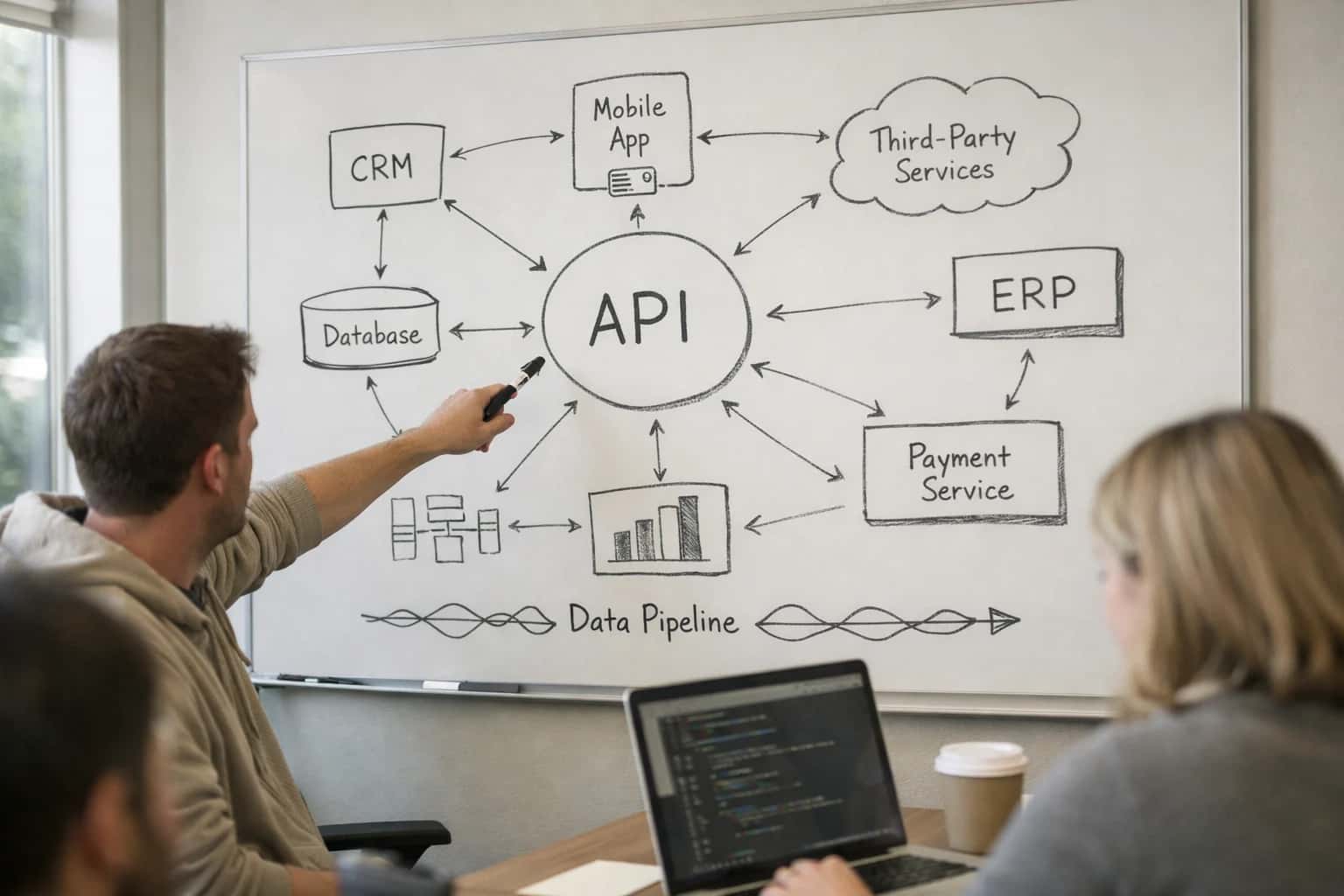
AI integration for ERP Accounts Payable targets three primary functional surfaces: the invoice processing hub, the matching and exception engine, and the payment proposal and vendor communications layer. In platforms like SAP S/4HANA (Fiori Apps for Invoice Management), Oracle Cloud ERP (Payables Invoices work area), NetSuite (Vendor Bills), and Infor (Accounts Payable), this means connecting AI to the APIs and queues that handle document ingestion (/API/invoice), the business rules for 2/3-way matching, and the tables storing vendor master data and open payables. The goal is not to replace the ERP but to augment its native workflows with intelligent decision-making at key bottlenecks.

Integration
AI Integration for ERP Accounts Payable
A technical guide for embedding AI into the Accounts Payable modules of SAP S/4HANA, Oracle Cloud ERP, NetSuite, and Infor to automate invoice processing, handle matching exceptions, respond to vendor inquiries, and optimize payment runs.
A PRACTICAL BLUEPRINT FOR AP AUTOMATION
Where AI Fits in the ERP Accounts Payable Workflow
A technical guide to embedding AI agents into the core AP modules of SAP, Oracle, NetSuite, and Infor to automate invoice-to-pay cycles.
A production implementation typically wires an AI agent between the document capture service and the ERP's invoice creation API. For example, a PDF invoice lands in a secure blob store, triggers an event, and is processed by a vision/LLM agent that extracts line items, taxes, and PO numbers. This structured payload is validated against the ERP's Purchase Order and Goods Receipt tables via OData or REST calls. Discrepancies (price variances, quantity mismatches) are analyzed by the agent, which can either auto-resolve within tolerance, flag for a specific AP clerk's review, or route to the buyer for clarification—all while logging the decision rationale in an audit trail linked to the ERP's Document Number.
Rollout and governance are critical. Start with a pilot vendor or invoice type, using the ERP's standard approval workflows (WF_APPROVAL) as a safety net. Implement human-in-the-loop design for exceptions over a certain dollar threshold or for new vendors. AI governance focuses on monitoring the agent's match rate, false positive/negative rates on fraud detection (e.g., duplicate invoice checking), and drift in extraction accuracy. This integration directly impacts operational metrics: reducing manual data entry from hours to minutes per batch, cutting exception handling time by prioritizing the most complex mismatches, and enabling same-day payment runs to capture early payment discounts.
For teams evaluating this integration, the high-value use cases are clear: automated invoice capture and coding, intelligent exception handling with root-cause analysis, and self-service vendor inquiry resolution via a chatbot that queries the Vendor Portal and Payment Status APIs. The architecture extends the ERP's capabilities without risky customization, using its public APIs for all writes and maintaining a single source of truth. Explore our related guide for AI Integration for ERP Invoice Processing or the broader framework for AI-Powered Analytics for ERP.
WHERE AI CONNECTS TO THE PAYABLES WORKFLOW
AP Module Touchpoints for AI Integration by Platform
Core Data Ingestion Points
AI integration begins at the point of invoice receipt, connecting to the ERP's document management or inbound processing layer. Key surfaces include:
- Vendor Portal Submissions: Intercept files uploaded to portals like SAP Ariba or Oracle iSupplier for pre-validation.
- Email Inboxes & OCR Services: Process attachments from AP-dedicated email accounts or integrated OCR services (e.g., NetSuite's SuiteScript for file parsing).
- Document Management Systems (DMS): Read from repositories like SAP DMS or Oracle Content where scanned invoices are stored.
AI agents extract line-item details, validate against purchase orders and receipts, and prepare a cleansed data payload for the AP module's invoice creation API. This automates the most manual step, reducing entry time from hours to minutes per invoice.
AUTOMATION FOR AP MANAGERS & CONTROLLERS
High-Value AI Use Cases for ERP Accounts Payable
Integrating AI directly into your ERP's AP module automates high-volume, manual tasks, reduces errors, and frees your team for strategic vendor management and cash flow optimization. These are practical, production-ready patterns for SAP, Oracle, NetSuite, and Infor.
01
Intelligent Invoice Capture & 2/3-Way Matching
AI agents ingest invoices via email, portal, or scan, extract line-item data, and validate them against ERP purchase orders and goods receipts. The system auto-flags mismatches (quantity, price) with reasoning, routes exceptions, and posts clean invoices—turning a multi-day manual review into a same-day automated workflow.
Days -> Hours
Processing time
02
Exception Handling & Dispute Resolution
For invoices that fail matching, AI analyzes the discrepancy, checks historical patterns with the vendor, reviews contract terms, and suggests a resolution (accept with note, short pay, request credit memo). It can auto-draft vendor communication for reviewer approval, slashing back-and-forth email cycles.
1 sprint
Typical implementation
03
Automated Vendor Inquiry Response
A chatbot integrated with the ERP's vendor portal and AP tables answers common vendor questions in real-time—payment status, invoice receipt confirmation, remittance details—by querying live transaction data. This deflects 40-60% of routine AP support tickets without human intervention.
04
Payment Proposal Optimization & Fraud Screening
AI analyzes payment terms, cash position, and early payment discounts to recommend an optimal payment run. It simultaneously screens vendor bank details against internal master data and external watchlists for anomalies, flagging high-risk payments for additional approval before execution.
Batch -> Optimized
Payment strategy
05
Vendor Master Data Cleansing & Enrichment
An automated workflow periodically reviews the ERP vendor master. AI identifies duplicates, fills in missing tax IDs or DUNS numbers by querying external sources, and flags inactive vendors for review. This maintains data hygiene for accurate 1099 reporting and spend analysis.
06
Accrual & Month-End Close Support
At period close, AI scans the AP subledger for received goods/services without an invoice (3-way match receipt). It uses PO and receipt data to auto-generate proposed accrual journal entries with supporting documentation, ensuring completeness and accelerating the financial close.
Hours -> Minutes
Accrual identification
PRACTICAL AUTOMATION PATTERNS
Example AI-Augmented AP Workflows
These workflows illustrate how AI agents connect to ERP Accounts Payable modules via APIs and event hooks to automate high-volume, manual tasks. Each pattern is designed to be implemented with human oversight points and a clear audit trail.
Trigger: A new invoice file (PDF, email attachment, scanned image) is received in a designated AP inbox or document management system.
Workflow:
- An AI document processing agent extracts line-item details (vendor, invoice number, date, amounts, PO number, descriptions) using a vision/LLM model.
- The agent calls the ERP's Vendor and Purchase Order APIs to validate the vendor and retrieve the corresponding PO and its line items.
- The system performs a 2-way match between the invoice line items and the PO. AI handles fuzzy matching for quantity/price variances (e.g., "10 units" vs. "10.0") and identifies discrepancies.
- Human Review Point: Invoices with matches within a pre-defined tolerance (e.g., < 2% price variance) are auto-posted to the ERP as a voucher. Invoices with significant discrepancies or missing POs are routed to an AP clerk's exception queue with a clear explanation from the AI (e.g., "Unit price on invoice is 15% above PO price. PO: $10.00, Invoice: $11.50").
- The clerk reviews and approves the exception, triggering the system to post the voucher or create a debit memo.
Impact: Reduces manual data entry by 70-90% and cuts invoice processing time from days to hours.
A PRODUCTION BLUEPRINT FOR SAP, ORACLE, NETSUITE, AND INFOR
Implementation Architecture: Data Flow, APIs, and Guardrails
A practical guide to the data flows, integration points, and control layers for deploying AI in ERP Accounts Payable.
A production AI integration for AP sits between your document ingestion channels and the ERP's payable ledger. The core data flow begins when invoices arrive via email, EDI, or portal and are routed to an AI processing queue. Using native ERP APIs—like SAP's OData services for FB60, Oracle's REST APIs for Payables Invoices, NetSuite's SuiteTalk for Vendor Bill records, or Infor's ION APIs—the system extracts line-item details, matches them to POs and receipts (2/3-way matching), and enriches data with vendor master details. Unmatched or exceptional invoices are flagged with a reasoning code (e.g., PRICE_VARIANCE, RECEIPT_MISSING) and routed to a human-in-the-loop review queue within the ERP's standard exception workflow, ensuring the AP clerk's native interface remains the system of record.
Guardrails are implemented at three layers: data validation, policy enforcement, and audit integrity. Before any posting, AI-suggested coding (GL account, cost center, tax) is validated against configured rules and historical patterns. Approval workflows are dynamically informed by AI analysis of invoice risk, amount, and approver availability, but final authority remains with the ERP's native approval hierarchy. Every AI action—extraction, matching suggestion, exception flag—is logged with a full audit trail linked to the source document and ERP transaction ID, creating a transparent record for internal audit and compliance reviews.
Rollout follows a phased, risk-managed approach. Start with a pilot for low-value, high-volume non-PO invoices to validate matching logic and user trust. Then expand to PO-backed invoices and, finally, complex utility and services invoices. Governance involves weekly reviews of AI confidence scores versus human overrides to continuously refine models. The architecture is designed to fail gracefully; if the AI service is unavailable, invoices simply queue for manual processing, ensuring AP operations never halt.
AI-ENHANCED AP AUTOMATION
Code and Payload Examples for Common AP Tasks
Extracting and Validating Invoice Data
AI agents can process incoming invoices (PDF, email, scanned image) by extracting key fields and validating them against ERP master data before creating a draft invoice record. This involves calling a document intelligence service, then using the ERP's API to fetch vendor and PO details for validation.
Example Python payload for a vendor validation check before creating an invoice record in NetSuite:
pythonimport requests # Payload from document AI service extracted_invoice_data = { "vendor_id": "VENDOR456", "invoice_number": "INV-2024-789", "invoice_date": "2024-05-15", "total_amount": 12500.75, "line_items": [ {"item_code": "SRV-IT", "quantity": 10, "unit_price": 1250.075} ] } # Validate vendor exists and is active in NetSuite validation_response = requests.post( 'https://<your-netsuite-account>.suitetalk.api.netsuite.com/services/rest/record/v1/vendor', headers={ 'Authorization': 'Bearer <token>', 'Content-Type': 'application/json' }, json={ "q": f"companyName CONTAINS '{extracted_invoice_data['vendor_id']}' AND isInactive IS false" } ) if validation_response.json()['count'] == 0: # Trigger exception workflow: vendor not found or inactive raise Exception("Vendor validation failed. Route for manual review.") else: # Proceed to create invoice transaction print("Vendor validated. Proceeding to create invoice.")
This validation step prevents creating invoices for invalid vendors, reducing downstream matching exceptions.
AI-ENHANCED ACCOUNTS PAYABLE
Realistic Time Savings and Operational Impact
This table illustrates the practical impact of integrating AI into the Accounts Payable workflow of major ERP platforms like SAP, Oracle, NetSuite, and Infor. Metrics focus on process acceleration, exception reduction, and team capacity shifts.
| Process / Metric | Before AI | After AI | Notes |
|---|---|---|---|
Invoice Data Entry | Manual keying (5-15 min/invoice) | Automated extraction & validation (<1 min) | AI reads PDF/email, populates ERP fields; human reviews exceptions |
2/3-Way Matching | Manual line-by-line review | Automated matching with exception flagging | AI validates PO, receipt, invoice; flags price/quantity variances for review |
Exception Resolution | AP analyst investigates each variance | AI suggests root cause & resolution | Analyzes history to propose corrections (e.g., wrong PO, unit of measure) |
Vendor Inquiry Response | Manual lookup & email drafting | AI drafts response with transaction context | Agent pulls payment status, invoice details; AP approves before sending |
Payment Proposal Generation | Manual review for discounts & holds | AI-optimized proposal with reasoning | Prioritizes early-pay discounts, avoids blocked vendors, suggests payment run |
Month-End AP Accrual | Manual estimation & spreadsheet work | AI predicts liabilities from unprocessed docs | Scans email queues & intake systems; provides accrual estimate with backup |
Audit Support (Sample Selection) | Manual, random sample selection | Risk-weighted sample based on AI analysis | Flags high-risk transactions (new vendors, large amounts, rounding) for audit testing |
PRODUCTION ARCHITECTURE FOR AP AUTOMATION
Governance, Security, and Phased Rollout
A practical guide to deploying AI for ERP Accounts Payable with controlled risk and measurable ROI.
A production AI integration for ERP AP modules must be architected as a secure, governed extension of your core financial system. This typically involves a middleware layer that orchestrates between your ERP (e.g., SAP, Oracle, NetSuite) and AI services. Key architectural components include:
- Secure API Gateways: Manage authentication and rate-limiting for calls from the ERP's native APIs (like SAP OData, NetSuite SuiteTalk) to AI models.
- Immutable Audit Logs: Every AI action—from invoice extraction to variance explanation—is logged with a transaction ID, user context, and model reasoning for full traceability.
- Human-in-the-Loop (HITL) Queues: Exceptions flagged by the AI (e.g., a potential duplicate invoice, a match variance exceeding threshold) are routed to a dedicated AP analyst queue within the ERP or a companion dashboard for review and override.
Rollout should follow a phased, risk-based approach, starting with the highest-volume, lowest-risk processes. A common sequence is:
- Phase 1: Invoice Data Capture & Validation. Deploy AI for extracting line-item data from PDF/email invoices and validating against the ERP's vendor master and PO data. This phase delivers immediate labor savings with minimal financial risk, as no postings are automated.
- Phase 2: 2/3-Way Matching Exception Handling. Introduce AI to analyze and explain matching discrepancies (e.g., quantity, price tolerances). The AI suggests resolution actions (request credit memo, adjust PO) but requires AP analyst approval before any ERP transaction is modified.
- Phase 3: Automated Payment Proposal & Inquiry Response. Once confidence is high, enable AI to propose weekly payment runs optimized for early-pay discounts and to auto-draft responses to common vendor payment inquiries via integrated communication channels.
Governance is non-negotiable. Establish a cross-functional AI Steering Committee with members from Finance, IT, Internal Audit, and Procurement. This group should:
- Define and monitor key control metrics, such as AI-assisted match rate, false-positive rate for exceptions, and reduction in invoice cycle time.
- Approve prompt templates and logic for critical workflows (e.g., variance explanation logic) and manage their versioning.
- Mandate regular model validation against a hold-out dataset to detect performance drift in extraction or classification accuracy.
- Enforce role-based access controls (RBAC) within the integration layer to ensure only authorized users can override AI decisions or modify posting rules.
Enabling Efficiency, Speed & Accuracy
Intelligent Analysis, Decision & Execution
We build AI systems for teams that need search across company data, workflow automation across tools, or AI features inside products and internal software.
Talk to Us
Search across company data
Give teams answers from docs, tickets, runbooks, and product data with sources and permissions.
Useful when people spend too long searching or get different answers from different systems.
Enterprise searchRAGPermissions
Read more
Automate internal workflows
Use AI to route work, draft outputs, trigger actions, and keep approvals and logs in place.
Useful when repetitive work moves across multiple tools and teams.
AI agentsWorkflow automationGovernance
Read more
Add AI to products and internal tools
Build assistants, guided actions, or decision support into the software your team or customers already use.
Useful when AI needs to be part of the product, not a separate tool.
AI integrationDecision supportModel routing
Read moreIMPLEMENTATION & WORKFLOW DETAILS
Frequently Asked Questions (FAQ)
Common technical and operational questions about integrating AI agents into ERP Accounts Payable modules for invoice processing, matching, and vendor communications.
When a standard match fails (e.g., PO quantity vs. invoice quantity mismatch), the AI agent follows a defined workflow:
- Trigger: ERP matching engine flags an invoice for exception.
- Context Pull: The agent retrieves the PO, invoice line items, goods receipt notes, and any prior correspondence from the vendor master record.
- Agent Action: Using the document context, the LLM analyzes the discrepancy. It can:
- Classify the Exception: Determine if it's a pricing error, quantity variance, tax miscalculation, or missing receipt.
- Generate a Resolution: Draft a communication to the vendor requesting a corrected invoice, or propose a partial payment amount within tolerance limits.
- Route for Review: For complex exceptions or those exceeding configurable thresholds, the agent creates a task in the AP clerk's queue with its analysis and recommendation attached.
- System Update: Upon human approval or based on automated rules, the agent can update the invoice status, post a holding journal, or trigger a workflow to request a credit memo.
This moves resolution from hours of manual investigation to minutes of assisted review.

About the author
Prasad Kumkar
CEO & MD, Inference Systems
Prasad Kumkar is the CEO & MD of Inference Systems and writes about AI systems architecture, LLM infrastructure, model serving, evaluation, and production deployment. Over 5+ years, he has worked across computer vision models, L5 autonomous vehicle systems, and LLM research, with a focus on taking complex AI ideas into real-world engineering systems.
His work and writing cover AI systems, large language models, AI agents, multimodal systems, autonomous systems, inference optimization, RAG, evaluation, and production AI engineering.
LinkedIn
Limited slotsGet a Free AI Consultation
Partnered with leading AI, data, and software stack.





How We Work
Custom AI workflows for your Business
One-fit-all AI don't work for modern businesses. At Inferensys, we aim to understand your business & custom requirements; which we use to define most efficient agentic workflows, the data, and the tools for your business.
01
Review the use case
We understand the task, the users, and where AI can actually help.
Read more02
Pick the right approach
We define what needs search, automation, or product integration.
Read more03
Build the first useful version
We implement the part that proves the value first.
Read more04
Improve from there
We add the checks and visibility needed to keep it useful.
Read moreThe first call is a practical review of your use case and the right next step.
Talk to Us