In platforms like OpenText, Hyland OnBase, Laserfiche, and SharePoint, workflow routing is typically triggered by basic metadata (document type, source, date). AI integration injects intelligence at the point of ingestion or review, analyzing the full text and context of documents—such as invoices, contracts, service requests, or claims forms—to make routing decisions. This moves beyond simple folder-based rules to evaluate intent, urgency, required expertise, and compliance risk embedded within the document content itself. For example, an inbound vendor invoice can be routed to AP Specialist A for high-value items requiring manager approval, while a standard utility bill is sent directly to AP Specialist B for straight-through processing.

Integration
AI Integration for Automated Workflow Routing Based on Document Content
Use AI to read documents and automatically assign them to the correct workflow, queue, or individual based on intent, urgency, and required expertise in enterprise content management platforms.
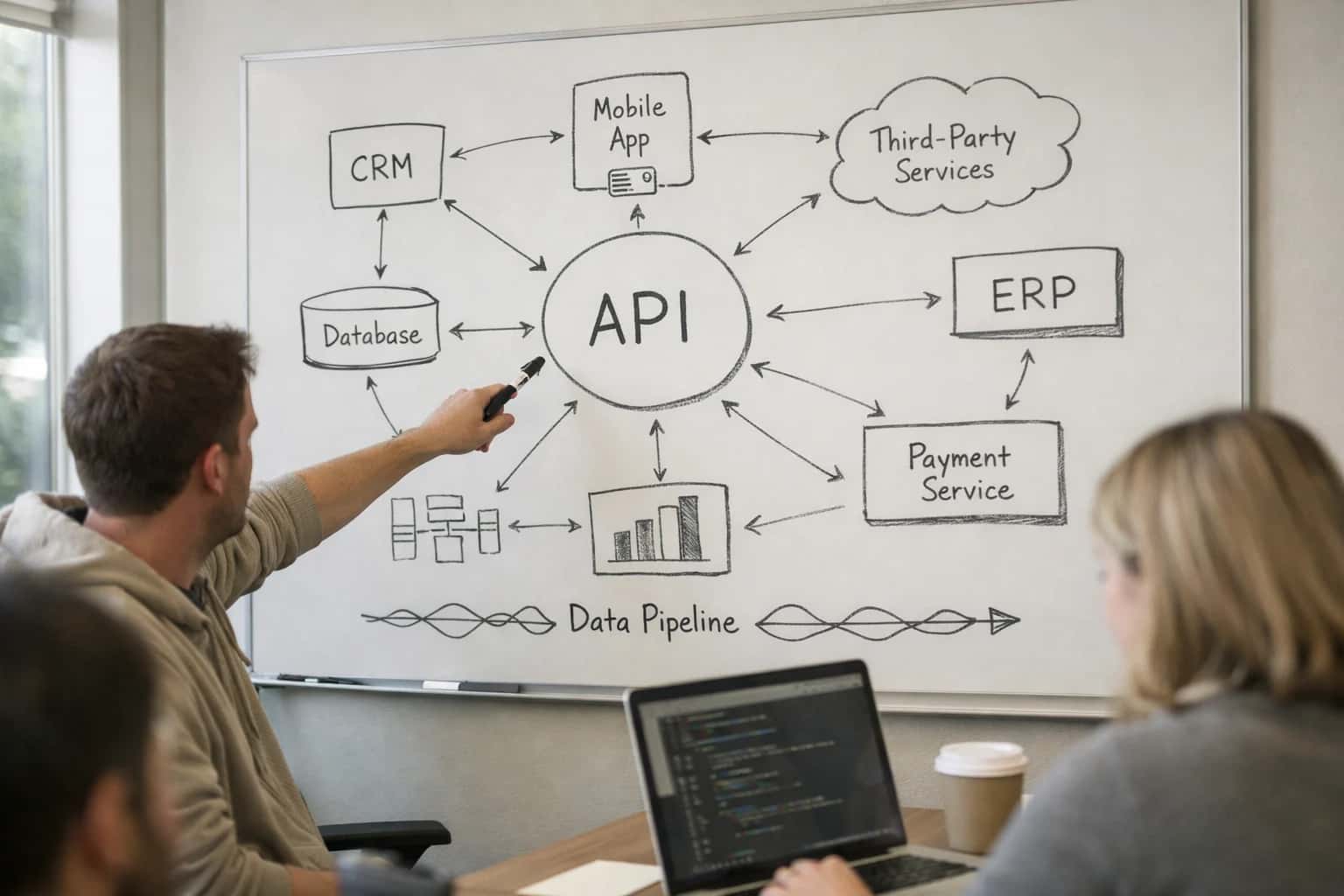
ARCHITECTURE FOR INTELLIGENT PROCESS AUTOMATION
Where AI Fits in Document-Driven Workflow Routing
AI integration transforms static, rules-based routing into dynamic, content-aware workflows that assign documents to the correct queue, team, or individual in seconds.
Implementation connects via the platform's REST API or event system (e.g., OnBase Unity API, Laserfiche Workflow Event, SharePoint webhook). A typical pattern: 1) A document is uploaded or scanned, 2) an event triggers an AI service call, 3) the AI model (LLM or classifier) analyzes the document text, extracting key entities and classifying it against a routing matrix, 4) the result is returned as structured JSON, and 5) the workflow engine uses that payload to set variables, assign tasks, or move the document to the correct queue. This can reduce manual triage from hours to minutes and cut misrouting errors that cause SLA breaches and rework.
Rollout requires mapping high-volume, high-variability document streams to specific queues and defining a routing logic matrix (e.g., IF document contains 'urgent' AND value > $10k THEN route to 'Senior Approvers' queue). Governance is critical: implement a human-in-the-loop review for low-confidence classifications and maintain an audit log of all AI-driven routing decisions for compliance. Start with a pilot on a single document type, measure routing accuracy and time-to-assign, then expand. Inference Systems architects these integrations with security and scale in mind, ensuring the AI layer operates within the platform's existing RBAC and data residency boundaries.
AI-Powered Workflow Routing
Integration Points Across Major ECM Platforms
Ingest and Classify at the Point of Entry
AI integration begins at the capture layer, where documents are ingested via scanning, email, or upload. For platforms like OpenText Document Intelligence, Hyland Brainware, or Laserfiche Quick Fields, you can inject an AI service call to classify the document type (e.g., invoice, contract, application form) and extract initial metadata before the document is even committed to the repository.
This initial classification is the primary trigger for routing. The AI model analyzes the document's content, structure, and context to assign a document type and critical attributes like department, priority, or required action. This metadata is then written back to the ECM's index, where the native workflow engine (e.g., Laserfiche Workflow, OnBase Workflow, SharePoint Power Automate) uses it to start the correct process.
Key Integration Pattern: Event-driven architecture. Use platform webhooks (e.g., Box webhooks, SharePoint event receivers) or capture-stage scripting to call an AI classification API synchronously, then pass the results into the ECM's workflow variables.
ENTERPRISE CONTENT MANAGEMENT PLATFORMS
High-Value Use Cases for AI-Powered Document Routing
AI-driven document routing analyzes content, intent, and context to automatically assign documents to the correct workflow, queue, or individual. This eliminates manual triage, reduces cycle times, and ensures expertise-based handling across platforms like OpenText, Hyland, Laserfiche, SharePoint, and Box.
01
Invoice & AP Document Routing
AI reads incoming invoices, delivery notes, and purchase orders to extract vendor, PO number, and amount, then routes them to the correct AP clerk's queue in your ECM. High-value invoices are flagged for manager approval, while routine items are sent directly for GL coding and posting to the ERP.
Batch → Real-time
Processing speed
02
Customer Intake & Case Triage
Incoming emails, scanned forms, and support tickets attached to a case in Hyland OnBase or Laserfiche are analyzed for urgency and subject. AI classifies them (e.g., 'Billing Inquiry', 'Technical Support', 'Complaint') and routes to the appropriate service queue or specialist, auto-populating case fields with extracted data.
Hours → Minutes
Initial assignment
03
Contract & Legal Document Review Routing
Upon upload to a SharePoint library or OpenText Documentum, AI scans contracts to identify type (NDA, MSA, SOW), extract key parties and dates, and assess clause risk. Documents are then routed to the correct legal reviewer based on expertise, jurisdiction, or workload, with a summary of key points pre-attached.
1 sprint
Review cycle reduction
04
Compliance & Records Declaration
AI continuously monitors document repositories in Box or OpenText Content Suite to identify records based on content and metadata. It automatically applies the correct retention schedule, declares records, and routes items nearing disposal for legal or compliance review, ensuring policy adherence.
Same day
Policy application
05
HR Onboarding & Employee File Workflow
New hire documents (I-9, W-4, certifications) uploaded to a Laserfiche or SharePoint HR folder are classified and validated for completeness. Incomplete packets are routed back to HR coordinators, while complete sets are automatically filed in the employee's digital record and routed to payroll and IT for provisioning.
Hours → Minutes
Packet processing
06
Exception Handling & Escalation Routing
Within automated OpenText VIM or Hyland Brainware capture workflows, AI identifies documents that fail validation (mismatched PO, unusual amount). Instead of dropping to an exception queue, it analyzes the discrepancy, suggests a resolution, and routes it to a specific AP analyst or the requesting manager for expedited review.
Batch → Real-time
Exception resolution
IMPLEMENTATION PATTERNS
Example AI Routing Workflows
These concrete workflows illustrate how AI can be integrated into enterprise content management (ECM) platforms to read, classify, and route documents automatically. Each pattern connects to specific APIs, data models, and automation surfaces within platforms like OpenText, Hyland OnBase, Laserfiche, SharePoint, and Box.
Trigger: A new PDF or scanned image is uploaded to a monitored \Inbound\Vendor Invoices folder in the ECM system.
Context Pulled: The system retrieves the file binary and any available metadata (source email, uploader).
AI Agent Action: A pre-configured AI model performs the following sequence:
- Classification: Confirms the document is an invoice (vs. a statement or quote).
- Extraction: Uses an LLM with a structured output schema to extract key fields:
Vendor Name,Invoice Number,Invoice Date,Total Amount,PO Number. - Validation & Enrichment: Cross-references the
Vendor NameandPO Numberagainst the ERP system's vendor and purchase order tables via a pre-built connector (e.g., for SAP or NetSuite). - Routing Logic: The agent evaluates the extracted and enriched data to determine the next step:
- Rule: If
PO Numberis valid andTotal Amountis within a 10% variance of the PO, route to the\AP\For Paymentqueue. - Rule: If
PO Numberis missing or invalid, route to the\AP\Exception - PO Researchqueue assigned to the procurement team. - Rule: If
Total Amountvariance exceeds 10%, route to the\AP\Exception - Price Discrepancyqueue assigned to the requesting manager.
- Rule: If
System Update: The ECM system is updated via its API:
- Applies metadata tags (
DocType: Invoice,Status: In Review,AssignedQueue: AP_For_Payment). - Moves the file to the determined workflow folder.
- Creates a task in the linked workflow engine (e.g., Laserfiche Workflow, OnBase Workflow) with the extracted data pre-populated.
Human Review Point: All documents routed to Exception queues require manual review. The AI's extracted data and reasoning (e.g., "PO not found in SAP") are displayed to the reviewer to accelerate resolution.
FROM INGESTION TO ACTION
Implementation Architecture: Data Flow and System Design
A practical blueprint for connecting AI to your ECM platform to automate document routing decisions.
The integration architecture is event-driven, connecting at the ingestion layer of your ECM platform (e.g., OpenText Content Server, Hyland OnBase, Laserfiche). When a new document is uploaded, scanned, or emailed into the repository, a webhook or API event triggers the AI service. The system streams the document's raw text and any existing metadata (like source or uploader) to a secure inference endpoint. An LLM, configured with a routing policy, analyzes the content for intent, urgency, required expertise, and relevant business entities. It returns a structured payload containing the recommended destination: a specific workflow queue, user group, or individual, along with confidence scores and extracted key data points for pre-filling case fields.
This payload is sent back to the ECM platform's workflow engine (e.g., Laserfiche Workflow, OnBase Workflow, SharePoint Power Automate) via its REST API. The workflow engine uses the AI's output to automatically assign the document, set its status, apply relevant metadata tags, and trigger the next step—whether that's a review task, an approval process, or a data entry automation. For governance, every decision is logged with the source document ID, the AI's reasoning (a natural language justification), and the confidence score, creating a full audit trail. The system is designed for human-in-the-loop fallback; low-confidence predictions or exceptions are routed to a manual review queue instead of blocking the process.
Rollout follows a phased approach: start with a pilot document type and workflow (e.g., inbound customer service emails to triage between 'Billing', 'Technical Support', and 'Sales'), using historical data to fine-tune the LLM's classification prompts. Implement rate limiting and circuit breakers on the AI calls to manage cost and latency. The final architecture is a resilient, observable service that sits between your ECM's capture and workflow modules, turning unstructured content into structured, routable work items without manual intervention.
IMPLEMENTATION PATTERNS
Code and Payload Examples
Webhook Handler for Ingested Documents
When a document is uploaded to your ECM platform, trigger an AI classification service via webhook. This pattern is ideal for real-time routing as documents enter the system.
python# Example: Flask endpoint receiving a Box webhook def handle_document_upload(request): # Payload from ECM webhook payload = request.json file_id = payload['source']['id'] file_name = payload['source']['name'] # 1. Download file content (using ECM SDK) file_content = box_client.download_file(file_id).text # 2. Call AI service for classification classification_result = ai_client.classify_document( text=file_content, metadata={'filename': file_name} ) # 3. Extract routing decision workflow_type = classification_result.get('primary_workflow') priority = classification_result.get('priority_score') suggested_queue = classification_result.get('assigned_queue') # 4. Update ECM metadata and trigger workflow box_client.update_file_metadata( file_id, { 'workflow_type': workflow_type, 'routing_priority': priority, 'target_queue': suggested_queue } ) # 5. Initiate workflow via ECM API workflow_client.start_process( document_id=file_id, process_name=workflow_type ) return {'status': 'routed', 'workflow': workflow_type}
This handler classifies the document, enriches its metadata, and automatically launches the appropriate workflow—all within seconds of upload.
AI-Powered Document Routing
Realistic Time Savings and Operational Impact
This table illustrates the operational impact of integrating AI for automated document routing within Enterprise Content Management platforms like OpenText, Hyland, and Laserfiche. Metrics show realistic improvements in processing time, accuracy, and team efficiency.
| Workflow Stage | Before AI | After AI | Implementation Notes |
|---|---|---|---|
Initial Document Classification | Manual review and folder assignment (2-5 min/doc) | AI auto-classifies and suggests routing (10-15 sec/doc) | Human review for low-confidence classifications; taxonomy alignment required |
Exception Handling & Rerouting | Manual investigation and reassignment (15-30 min/exception) | AI suggests correct queue based on content analysis (2-5 min/exception) | Reduces misrouted documents; analyst makes final decision |
Priority & SLA Triage | Manual flagging based on keywords or sender (3-5 min/doc) | AI scores urgency and intent for automatic SLA tagging (30 sec/doc) | Ensures critical documents (e.g., legal notices, complaints) are expedited |
Workload Balancing | Supervisor manually redistributes based on volume | AI predicts queue load and suggests distribution | Pilot: 2-4 weeks to train on historical patterns |
Metadata Tagging for Search | Manual entry of 5-10 key fields (3-8 min/doc) | AI extracts and proposes metadata (1-2 min/doc) | Dramatically improves future search and retrieval accuracy |
Compliance Check & Hold | Periodic manual audits for sensitive content | AI pre-scans for PII/PHI, flags for review | Proactive risk reduction; integrates with records management |
New Document Type Onboarding | IT creates new routing rules and templates (1-2 weeks) | AI learns from sample documents, suggests routing logic (2-3 days) | Requires initial human-in-the-loop validation for new forms |
ARCHITECTING FOR CONTROL AND SCALE
Governance, Security, and Phased Rollout
A production-ready AI routing system requires careful planning around data security, human oversight, and incremental deployment to manage risk and prove value.
The core architectural pattern connects your ECM platform's event system (e.g., SharePoint webhooks, Laserfiche Entry Events, OnBase workflow triggers) to a secure, containerized AI service. Documents are streamed for analysis via a dedicated API gateway, where content is processed in-memory or within a transient, encrypted workspace. No raw document data is persisted in the AI layer unless explicitly configured for audit purposes. The AI service returns a structured routing payload—containing predicted workflow, priority, required expertise, and confidence score—back to the ECM platform, which then executes the assignment via its native workflow engine or API. This keeps the system of record and enforcement within the trusted ECM environment.
Governance is implemented through a human-in-the-loop review queue for low-confidence predictions or high-risk document types. For example, contracts above a certain value or documents containing specific keywords can be flagged for manual review before routing. All AI decisions, input metadata, and final routing actions are logged to the ECM platform's audit trail or a separate SIEM, creating a transparent chain of custody. Access to configure or modify the AI routing logic should be controlled via the ECM platform's existing RBAC (Role-Based Access Control), ensuring only authorized administrators can adjust models or prompts.
A phased rollout is critical for adoption and risk management. Start with a low-risk, high-volume document stream, such as internal HR forms or standard invoices, where misrouting has minimal consequence. Run the AI in shadow mode for 2-4 weeks, comparing its routing suggestions to historical human decisions to calibrate confidence thresholds and refine prompts. For the first live phase, implement a co-pilot model where the AI suggests a route to a human operator for a single-click approval. Finally, progress to full automation for document classes where the AI consistently exceeds a 95% accuracy benchmark against a held-out validation set. This measured approach builds trust, surfaces edge cases, and delivers tangible ROI at each step, from reduced manual triage time to faster process cycle times.
Enabling Efficiency, Speed & Accuracy
Intelligent Analysis, Decision & Execution
We build AI systems for teams that need search across company data, workflow automation across tools, or AI features inside products and internal software.
Talk to Us
Search across company data
Give teams answers from docs, tickets, runbooks, and product data with sources and permissions.
Useful when people spend too long searching or get different answers from different systems.
Enterprise searchRAGPermissions
Read more
Automate internal workflows
Use AI to route work, draft outputs, trigger actions, and keep approvals and logs in place.
Useful when repetitive work moves across multiple tools and teams.
AI agentsWorkflow automationGovernance
Read more
Add AI to products and internal tools
Build assistants, guided actions, or decision support into the software your team or customers already use.
Useful when AI needs to be part of the product, not a separate tool.
AI integrationDecision supportModel routing
Read moreIMPLEMENTATION AND WORKFLOW
Frequently Asked Questions
Practical questions for architects and operations leaders planning AI-driven document routing within ECM platforms like OpenText, Hyland, Laserfiche, SharePoint, and Box.
The workflow is typically triggered by a document upload or ingestion event within your ECM platform.
Common Triggers:
- A file is added to a monitored folder or library (e.g., a SharePoint document library, a Box folder, an OpenText Content Server volume).
- A document is captured via a scanning station or email ingestion into a system like Hyland OnBase or Laserfiche.
- A webhook or event from the ECM platform calls your AI service endpoint.
Architecture: The AI processing usually runs in a separate, secure middleware layer or cloud function (e.g., Azure Functions, AWS Lambda). This service:
- Receives the document ID and metadata via the trigger.
- Uses the ECM's API (like the Box API, SharePoint Graph API, or OpenText REST API) to fetch the document content.
- Processes the content with an LLM (like GPT-4) or a custom model.
- Returns a routing decision (e.g.,
workflow: "High-Priority Legal Review",queue: "AP-Invoices",assignee: "[email protected]"). - The middleware then uses the ECM's workflow API (e.g., Laserfiche Workflow API, ServiceNow IntegrationHub) to update the document's metadata and move it to the next step.

About the author
Prasad Kumkar
CEO & MD, Inference Systems
Prasad Kumkar is the CEO & MD of Inference Systems and writes about AI systems architecture, LLM infrastructure, model serving, evaluation, and production deployment. Over 5+ years, he has worked across computer vision models, L5 autonomous vehicle systems, and LLM research, with a focus on taking complex AI ideas into real-world engineering systems.
His work and writing cover AI systems, large language models, AI agents, multimodal systems, autonomous systems, inference optimization, RAG, evaluation, and production AI engineering.
LinkedIn
Limited slotsGet a Free AI Consultation
Partnered with leading AI, data, and software stack.





How We Work
Custom AI workflows for your Business
One-fit-all AI don't work for modern businesses. At Inferensys, we aim to understand your business & custom requirements; which we use to define most efficient agentic workflows, the data, and the tools for your business.
01
Review the use case
We understand the task, the users, and where AI can actually help.
Read more02
Pick the right approach
We define what needs search, automation, or product integration.
Read more03
Build the first useful version
We implement the part that proves the value first.
Read more04
Improve from there
We add the checks and visibility needed to keep it useful.
Read moreThe first call is a practical review of your use case and the right next step.
Talk to Us