The integration point is the event ingestion pipeline. AI models consume streaming telemetry from platforms like PTC ThingWorx or Siemens MindSphere—vibration, temperature, pressure, runtime—and translate raw signals into structured maintenance events. These events must map to your EAM's data model: creating a Notification in SAP PM, a Work Order in IBM Maximo, or an Inspection Request in Infor EAM. The critical design decision is whether to push AI-generated alerts directly into the EAM's native API or use an intermediate queue (e.g., Kafka, AWS SQS) for governance, deduplication, and human-in-the-loop review before system-of-record updates.

Integration
AI for Industrial IoT Platforms with EAM
A technical guide to designing the integration layer between industrial IoT platforms and EAM systems, turning sensor data into automated, actionable maintenance workflows.
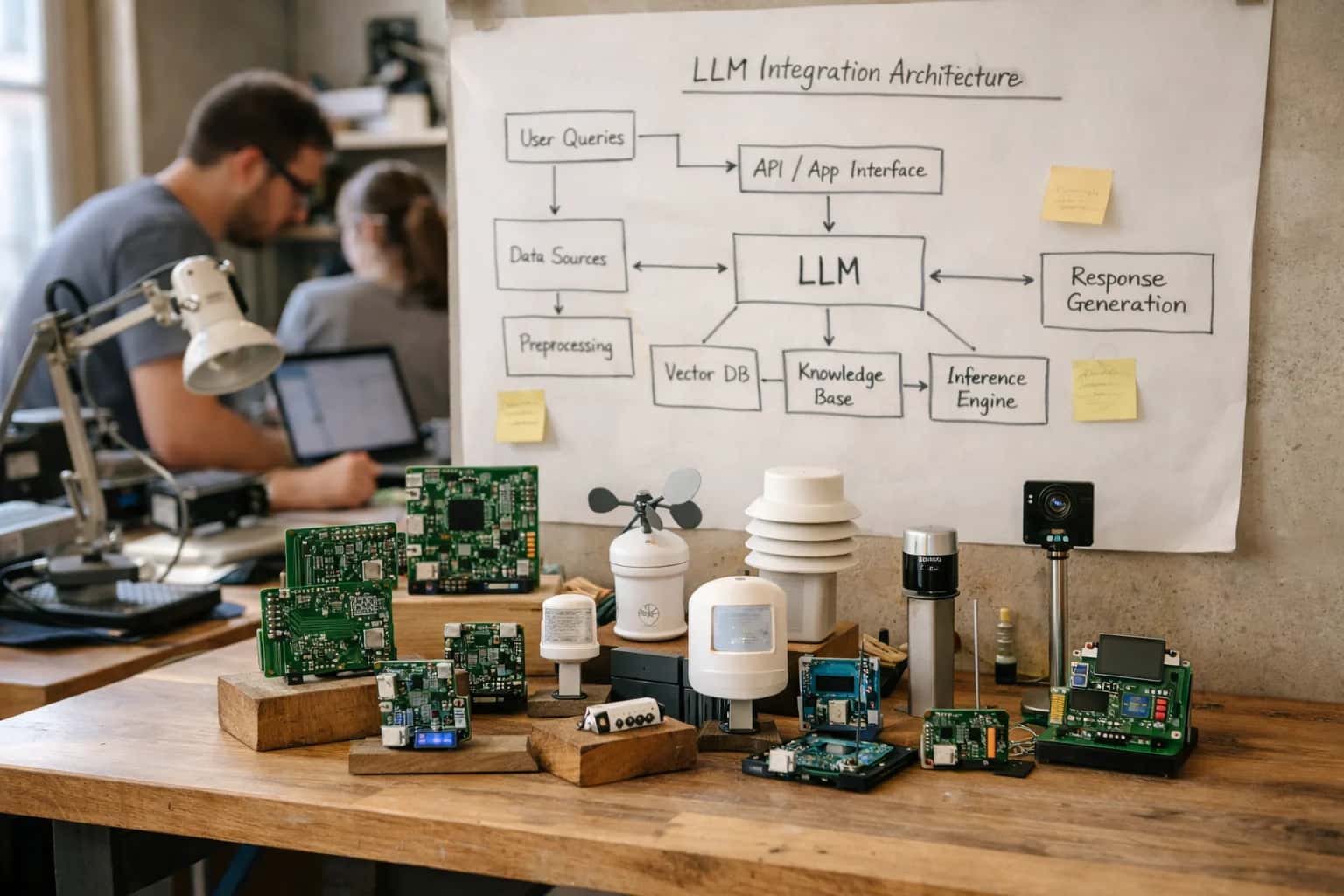
ARCHITECTURE BLUEPRINT
Where AI Connects IoT Data to EAM Workflows
A practical guide to designing the integration layer that turns industrial IoT data into actionable maintenance tasks within your EAM system.
Implementation focuses on context enrichment. A raw IoT alert of 'bearing temperature high' is not a work order. The AI agent must retrieve the asset's maintenance history, BOM for spare parts, warranty status, and technician certifications from the EAM to build a prescriptive action: 'Create a Priority 2 Work Order for Pump P-101A, assign to certified mechanic, and reserve bearing part #BX-203 from the Houston warehouse.' This requires bi-directional APIs: the AI queries the EAM for context, then writes back the enriched, actionable record. The workflow often integrates with a vector database for retrieving similar historical failures and resolution procedures from past work orders.
Rollout and governance require a phased approach. Start with a single asset class (e.g., centrifugal pumps) and a single failure mode (bearing wear). Instrument the pipeline with full audit trails: log the source IoT data, the AI model's confidence score, the context retrieved, and the final EAM record created. Implement a human approval step for low-confidence predictions or high-criticality assets, which can be automated away over time. The goal is to move from scheduled preventive maintenance in the EAM to condition-based alerts, reducing unplanned downtime by addressing failures before they cause production loss, while keeping all planning and execution within the trusted EAM workflow.
ARCHITECTURAL SURFACES
Key Integration Touchpoints: IoT Platform to EAM
Ingesting and Structuring Streaming Telemetry
The first critical touchpoint is the pipeline for consuming raw IoT data. Industrial platforms like PTC ThingWorx or Siemens MindSphere stream telemetry from sensors, PLCs, and edge devices in varied formats (OPC UA, MQTT, REST). An AI integration must normalize this data into a structured, time-series format for model consumption.
Key architectural decisions involve:
- Event Brokers: Using Kafka or cloud-native queues (AWS Kinesis, Azure Event Hubs) to handle high-volume, low-latency ingestion.
- Schema Mapping: Applying AI to map disparate tag names and units to a canonical asset model aligned with the EAM's hierarchy.
- Context Enrichment: Merging telemetry with static asset metadata (make, model, location) from the EAM to provide full context for AI models.
This layer outputs clean, contextualized asset health signals ready for condition monitoring and predictive analytics.
OPERATIONALIZING SENSOR DATA
High-Value AI Use Cases for IoT-EAM Integration
Industrial IoT platforms generate vast telemetry streams. The real challenge is turning that data into automated, actionable maintenance workflows within your EAM system. These are the proven patterns for connecting AI insights from PTC ThingWorx, Siemens MindSphere, or similar platforms to IBM Maximo, SAP EAM, and Infor EAM.
01
Condition-Based Maintenance Triggers
Replace fixed-interval PMs with dynamic work orders. AI models analyze real-time IoT sensor data (vibration, temperature, pressure) to detect anomalies. When a threshold is breached, the integration layer automatically creates a priority work order in the EAM with the suspected fault code and linked sensor history for the technician.
Batch -> Real-time
Alerting mode
02
Automated Failure Prediction & Mitigation
Predict asset failures 7-30 days out by feeding historical IoT trends and work order data into ML models. High-probability predictions generate preventive work orders in the EAM, automatically reserving parts from inventory and scheduling crews. This moves teams from reactive repair to planned intervention.
1 sprint
Lead time gained
03
Mobile Technician Copilot
Enrich the field technician's workflow. When a work order is dispatched from the EAM to a mobile device, the integration pulls relevant, real-time IoT data for that asset (live readings, last 24-hour trend) and AI-generated diagnostic suggestions. This provides context-aware guidance at the point of repair.
Hours -> Minutes
Diagnosis time
04
Asset Health Scoring & Prioritization
Continuously calculate a unified health score for each monitored asset by aggregating IoT data, maintenance history, and OEM recommendations. Expose these scores via a custom dashboard or EAM interface, enabling reliability engineers to prioritize the backlog and capital planning based on data-driven criticality.
05
Intelligent Spare Parts Replenishment
Connect IoT-driven failure predictions to the EAM's inventory module. When a high-probability failure is predicted for an asset, the AI agent checks parts availability and lead times, then automatically generates a reservation or purchase requisition to ensure the right part is available before the work order starts.
Same day
Procurement trigger
06
Regulatory Compliance & Audit Trail
Automate proof of performance for regulated assets (e.g., safety valves, emissions equipment). The integration uses AI to monitor if IoT data streams demonstrate compliance with operating envelopes. It then logs verified compliance events directly into the EAM's record for that asset, creating an automated audit trail.
ARCHITECTING THE INTEGRATION LAYER
Example AI-Driven Workflows: From Sensor to Work Order
These workflows illustrate how to design the integration layer between industrial IoT platforms (like PTC ThingWorx or Siemens MindSphere) and your EAM system (like IBM Maximo or SAP EAM). Each example follows a concrete automation path, detailing the trigger, data flow, AI action, and resulting system update.
Trigger: A vibration sensor on a critical pump (tag P-101) in ThingWorx exceeds a dynamic AI-calculated threshold, not a static limit.
Context/Data Pulled:
- The IoT platform streams 5-second vibration spectrum data (FFT) to a pre-processing service.
- The integration layer fetches the pump's asset record from Maximo (including model, last overhaul date, failure history).
- Historical vibration baselines for this specific asset and its siblings are retrieved from a time-series database.
Model/Agent Action:
- A pre-trained model (e.g., for imbalance, misalignment, bearing fault) analyzes the real-time spectrum against the baseline and historical failure patterns.
- An agent interprets the model output:
{"confidence": 0.92, "likely_fault": "bearing_outer_race_defect", "severity": "high", "estimated_RUL_weeks": 2}. - The agent queries the EAM for: open work orders on P-101, spare part (bearing) stock level, and technician availability.
System Update/Next Step:
- The agent creates a corrective work order in Maximo via API with:
- Priority:
1-Critical - Description:
AI-Detected Bearing Defect - High Confidence - Suggested craft:
Mechanical - Linked procedure:
Bearing Replacement - P-101 - Required part:
Bearing-887A (Stock: 3)
- Priority:
- A notification is posted to the operations team channel with the work order number and model diagnosis.
Human Review Point: The maintenance planner reviews the AI-generated work order, adjusts the schedule based on operational context, and approves it for assignment.
FROM IOT INSIGHTS TO ACTIONABLE WORK ORDERS
Implementation Architecture: Building the AI Integration Layer
A practical blueprint for connecting industrial IoT platforms like PTC ThingWorx or Siemens MindSphere to EAM systems to automate maintenance workflows.
The integration layer acts as a real-time decision engine, sitting between your IoT platform's streaming data and your EAM's transactional system of record. It ingests raw telemetry (vibration, temperature, pressure) and structured events from platforms like PTC ThingWorx or Siemens MindSphere, applies AI models for anomaly detection and failure prediction, and translates high-confidence alerts into actionable records in IBM Maximo, SAP EAM, or Infor EAM. Key architectural components include:
- Event Ingestion Pipeline: A scalable queue (e.g., Apache Kafka, AWS Kinesis) to handle high-volume sensor data from IoT platform APIs.
- AI Inference Service: Containerized models (e.g., TensorFlow Serving, TorchServe) that score incoming data against trained models for condition monitoring.
- Orchestration Engine: A lightweight workflow service (e.g., Apache Airflow, Prefect) that determines the correct EAM API call—creating a work order, updating an asset health score, or triggering a purchase requisition for parts.
- Audit & Feedback Loop: Every AI-driven action is logged with a traceable ID, linking the IoT sensor alert to the resulting EAM record, enabling model retraining from closed work order outcomes.
For a production rollout, start with a single asset class and failure mode. A common pattern is integrating vibration analysis for critical rotating equipment. The workflow is:
- IoT Data Stream: Vibration spectra from a pump are published from ThingWorx to the ingestion pipeline every 15 minutes.
- AI Scoring: A pre-trained model detects imbalance or bearing wear signatures, outputting a probability score and recommended action.
- EAM Record Creation: For scores above a governed threshold, the orchestration engine calls the Maximo REST API to create a work order with priority, links the asset record, and attaches the diagnostic payload.
- Human-in-the-Loop: The work order is routed to the appropriate planner or reliability engineer for review and scheduling, maintaining operational control. This moves from a manual review of dashboards to an automated, condition-based trigger, reducing the mean time to detection from days to hours.
Governance is critical. Implement a gating service to prevent alert flooding. Rules can be based on asset criticality, recent work order history, or parts availability checked via the EAM API. All AI-generated actions should be configurable to require approval before creation for high-cost interventions. This architecture also enables a continuous improvement loop: as work orders are completed and marked with failure codes in the EAM, this outcome data is fed back to retrain and refine the AI models, closing the loop between prediction and reality. For a deeper dive on operationalizing models, see our guide on [/integrations/enterprise-asset-management-platforms/ai-integration-for-ibm-maximo-iot-data](AI Integration for IBM Maximo IoT Data).
ARCHITECTURE PATTERNS
Code & Payload Examples
Streaming Sensor Data to a Processing Pipeline
The first step is to reliably ingest time-series data from IoT platforms like PTC ThingWorx or Siemens MindSphere. This typically involves subscribing to MQTT topics or consuming REST API streams. The payload is normalized and enriched with asset context from the EAM system before being queued for AI analysis.
python# Example: Consume MQTT stream, enrich with EAM asset data, publish to queue import paho.mqtt.client as mqtt import json from eam_client import MaximoClient # Hypothetical EAM SDK mqtt_client = mqtt.Client() eam_client = MaximoClient(base_url=MAXIMO_URL, api_key=API_KEY) def on_message(client, userdata, msg): sensor_data = json.loads(msg.payload) # Enrich with EAM asset metadata asset_details = eam_client.get_asset(sensor_data['asset_id']) enriched_payload = { **sensor_data, "eam_criticality": asset_details.get('criticality'), "eam_location": asset_details.get('location'), "timestamp": msg.timestamp } # Publish to an internal queue for AI processing publish_to_analysis_queue(enriched_payload) mqtt_client.on_message = on_message mqtt_client.connect(IOT_BROKER, 1883, 60) mqtt_client.subscribe("iot/sensors/#") mqtt_client.loop_forever()
FROM REACTIVE TO PREDICTIVE
Realistic Operational Impact & Time Savings
This table illustrates the operational shift enabled by integrating AI-driven insights from IoT platforms (e.g., PTC ThingWorx, Siemens MindSphere) into EAM workflows (e.g., IBM Maximo, SAP EAM). It compares traditional manual processes against AI-augmented, data-driven operations.
| Workflow / Metric | Before AI (Manual/Reactive) | After AI (AI-Augmented/Predictive) | Implementation Notes |
|---|---|---|---|
Alert Triage & Work Order Creation | Manual review of sensor alarms; 4-8 hours to validate and create work order | Automated anomaly detection & prioritization; work order draft in <15 minutes | AI consumes IoT streams, applies models, and calls EAM APIs. Human planner reviews and approves. |
Preventive Maintenance (PM) Schedule Optimization | Fixed time-based intervals; often leads to over-maintenance or missed failures | Dynamic, condition-based schedules; reduces unnecessary PMs by 20-40% | AI analyzes asset health scores from IoT to adjust PM frequencies in the EAM master data. |
Root Cause Analysis for Failures | Manual investigation by engineers; 1-3 days to analyze logs and history | AI correlates events and suggests probable causes; initial report in 1-2 hours | RAG system queries maintenance manuals and historical work orders; presents evidence to engineers. |
Spare Parts Requisition | Reactive ordering after failure; parts wait time extends downtime | Predictive parts forecasting; high-availability parts staged before failure | AI predicts failure modes and suggests part kits, triggering procurement workflows in the EAM. |
Inspection Workflow Completion | Field technician completes paper/tablet checklist; supervisor review next day | Real-time AI validation of field data/photos; automated report generation | AI agent reviews mobile inspection data against standards, flags discrepancies immediately. |
Regulatory Compliance Reporting | Manual data consolidation from multiple systems; 2-3 days per report | Automated data aggregation and draft generation; report ready in half a day | AI agents query EAM and IoT for required data points, populate templates for auditor review. |
Energy Consumption Anomaly Detection | Monthly utility bill review; identifies waste weeks after it occurs | Real-time monitoring with daily alerts; identifies deviations within hours | AI models baseline equipment energy use from IoT data, alert on inefficiencies via EAM notification. |
ARCHITECTING FOR PRODUCTION
Governance, Security, and Phased Rollout
A practical approach to deploying AI in industrial IoT and EAM environments, where safety, data integrity, and operational continuity are non-negotiable.
In industrial settings, AI governance starts with data lineage and model traceability. Every insight generated by models analyzing PTC ThingWorx or Siemens MindSphere data must be traceable back to the source sensor, timestamp, and raw payload. Implement a middleware layer that logs all AI inferences, the data slices used, and the resulting actions (like creating a SAP EAM notification or an IBM Maximo work order) to an immutable audit trail. This is critical for compliance, root cause analysis, and validating that AI-driven maintenance recommendations are based on trustworthy data.
Security is enforced at three levels: data-in-motion, model access, and action gating. IoT data streams should be authenticated and encrypted before reaching AI processing pods. The AI agents themselves require service principals with strict, role-based permissions scoped to specific EAM modules (e.g., WorkOrder.Create, Asset.Read). Most importantly, implement a human-in-the-loop or approval workflow for high-risk actions—such as automatically shutting down a piece of equipment or issuing a high-cost purchase requisition—ensuring AI serves as a copilot, not an autonomous operator.
A phased rollout mitigates risk and builds organizational trust. Start with a read-only diagnostic phase, where AI analyzes IoT streams and historical EAM work orders to generate alerts and insights in a separate dashboard, with no system-of-record writes. Next, progress to assisted write-backs, such as AI drafting suggested work orders in a "review queue" within Infor EAM for a planner to approve with one click. The final phase is conditional automation, where AI is permitted to auto-create low-risk, routine notifications (e.g., for a predicted bearing temperature anomaly) based on pre-defined, high-confidence thresholds, while escalating all ambiguous cases.
Continuous monitoring of model drift and business impact is essential. Establish KPIs like mean time to detection (MTTD) for asset faults and reduction in emergency work orders. If the AI's failure predictions for a pump asset class begin to diverge from actual outcomes, trigger a retraining pipeline using fresh data from the EAM. This closed-loop system, governed by clear ownership between reliability engineering and IT, ensures the integration delivers sustained operational value without introducing unmanaged risk.
Enabling Efficiency, Speed & Accuracy
Intelligent Analysis, Decision & Execution
We build AI systems for teams that need search across company data, workflow automation across tools, or AI features inside products and internal software.
Talk to Us
Search across company data
Give teams answers from docs, tickets, runbooks, and product data with sources and permissions.
Useful when people spend too long searching or get different answers from different systems.
Enterprise searchRAGPermissions
Read more
Automate internal workflows
Use AI to route work, draft outputs, trigger actions, and keep approvals and logs in place.
Useful when repetitive work moves across multiple tools and teams.
AI agentsWorkflow automationGovernance
Read more
Add AI to products and internal tools
Build assistants, guided actions, or decision support into the software your team or customers already use.
Useful when AI needs to be part of the product, not a separate tool.
AI integrationDecision supportModel routing
Read moreIMPLEMENTATION BLUEPRINTS
Frequently Asked Questions
Practical questions for architects designing the integration layer between Industrial IoT platforms (PTC ThingWorx, Siemens MindSphere) and EAM systems (IBM Maximo, SAP EAM) to operationalize AI-driven insights.
This is the core integration pattern. The workflow is event-driven and typically follows these steps:
- Trigger: An AI model monitoring the IoT data stream (e.g., in ThingWorx Analytics) detects an anomaly that crosses a predefined threshold (e.g., vibration spike, temperature trend).
- Context Pull: The integration service receives the alert payload, which includes the asset ID, timestamp, sensor type, and anomaly severity. It immediately queries the EAM system (e.g., Maximo) for:
- Asset criticality and hierarchy
- Open work orders for the same asset
- Recent maintenance history and failure codes
- Available spare parts stock
- Agent Action: A rules-based or LLM-powered agent analyzes the combined IoT alert and EAM context. It determines the recommended action:
CREATE_WORK_ORDER,ADD_TO_EXISTING_WO, orLOG_ALERT_ONLY. - System Update: If a work order is required, the service uses the EAM's REST API (e.g., Maximo's
mxapi) to create a draft work order with:- Pre-populated description: "AI Alert: Elevated vibration on Pump P-101A"
- Suggested priority (based on asset criticality & severity)
- Linked failure code (e.g., "Bearing Wear")
- Reference to the raw IoT alert ID for traceability
- Human Review Point: The work order is routed via the EAM's normal approval workflow. The planner or supervisor reviews the AI recommendation, adds labor/parts, and schedules it. The integration can be configured to auto-approve low-severity, routine tasks.

About the author
Prasad Kumkar
CEO & MD, Inference Systems
Prasad Kumkar is the CEO & MD of Inference Systems and writes about AI systems architecture, LLM infrastructure, model serving, evaluation, and production deployment. Over 5+ years, he has worked across computer vision models, L5 autonomous vehicle systems, and LLM research, with a focus on taking complex AI ideas into real-world engineering systems.
His work and writing cover AI systems, large language models, AI agents, multimodal systems, autonomous systems, inference optimization, RAG, evaluation, and production AI engineering.
LinkedIn
Limited slotsGet a Free AI Consultation
Partnered with leading AI, data, and software stack.





How We Work
Custom AI workflows for your Business
One-fit-all AI don't work for modern businesses. At Inferensys, we aim to understand your business & custom requirements; which we use to define most efficient agentic workflows, the data, and the tools for your business.
01
Review the use case
We understand the task, the users, and where AI can actually help.
Read more02
Pick the right approach
We define what needs search, automation, or product integration.
Read more03
Build the first useful version
We implement the part that proves the value first.
Read more04
Improve from there
We add the checks and visibility needed to keep it useful.
Read moreThe first call is a practical review of your use case and the right next step.
Talk to Us