AI integration for virtual consultations connects at three key surfaces in your PMS: the online booking/patient portal, the patient record, and the scheduling module. The workflow begins when a patient initiates a consultation request. An AI agent, triggered via a webhook from your booking platform (e.g., Curve Dental's web API or a Dentrix-compatible portal), engages the patient in a structured, conversational intake. It asks symptom-specific questions, collects medical history details via a dynamic form, and can even analyze uploaded photos of dental concerns using computer vision. All gathered data is structured and written directly to the corresponding fields in the PMS patient chart via its API, creating a pre-populated clinical note and updating the health history before the dentist joins the call.

Integration
AI Integration for Dental Virtual Consultations
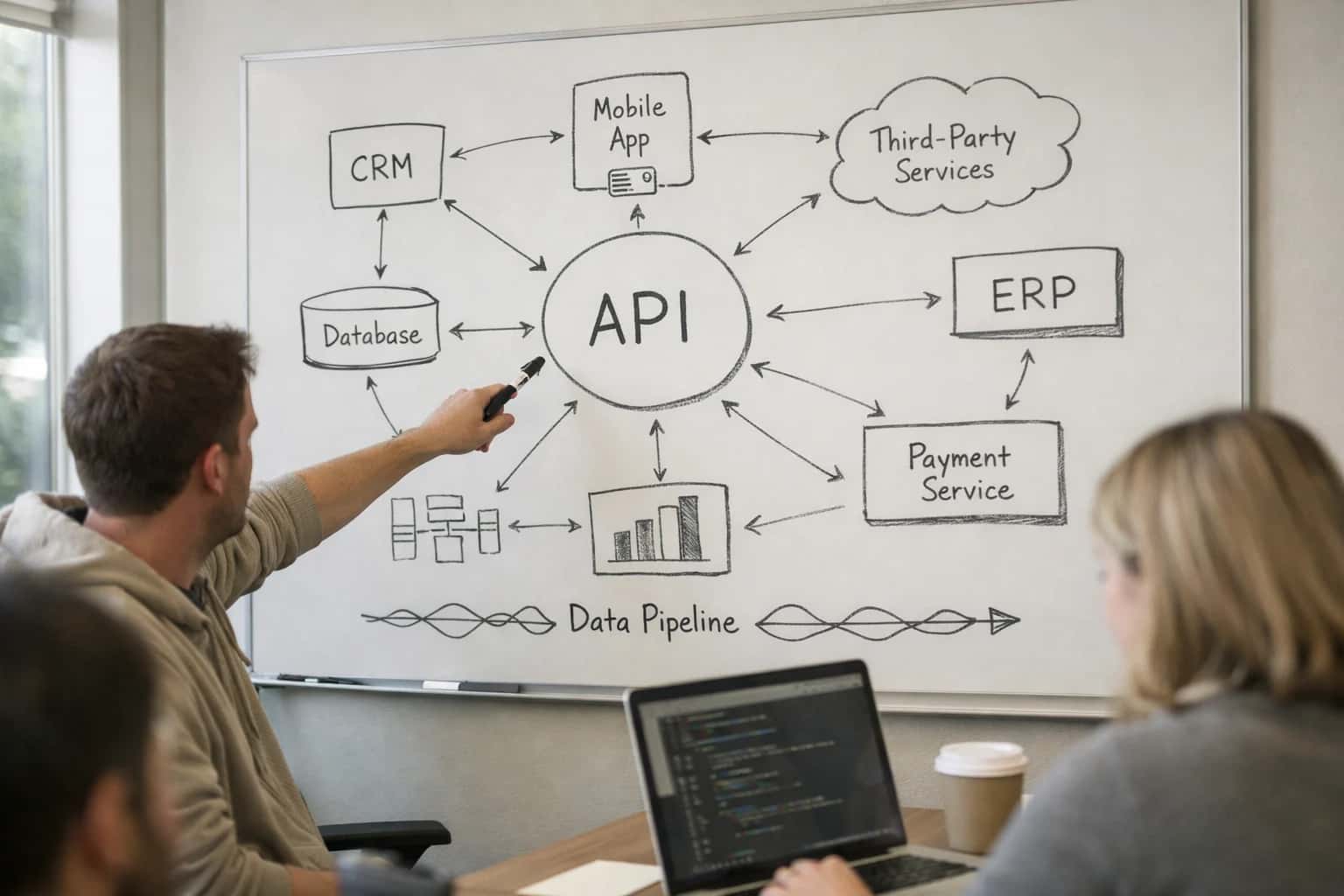
Where AI Fits into Dental Virtual Consultations
A practical blueprint for integrating AI into the pre-appointment workflow to transform initial patient contact into structured, actionable clinical and administrative data.
The core implementation involves a secure middleware layer that orchestrates between the telemedicine platform (e.g., Zoom, Doxy.me), the AI service, and the PMS. This layer handles eventing—when a consultation is booked, it triggers the AI intake; when the visit concludes, it processes the visit summary. Key technical considerations include:
- Data Mapping: Defining how AI-extracted entities (e.g., "pain level: 7", "tooth #30") map to specific clinical note templates and structured data fields in Open Dental or Eaglesoft.
- Consent & Compliance: Logging patient consent for data processing within the PMS audit trail and ensuring PHI is handled in transit according to HIPAA-compliant cloud services.
- Human-in-the-Loop: Designing approval steps where the AI-suggested preliminary treatment education or urgency triage (e.g., "schedule emergency exam" vs. "routine cleaning") is reviewed by a staff member before being actioned, ensuring clinical oversight.
For rollout, start with a single high-volume consultation type, like new patient exams or implant consultations. Integrate the AI's output—the structured intake and preliminary notes—directly into the dentist's workflow by having it appear as a pre-visit summary in the clinical module. The final, critical integration is closing the loop: based on the AI's triage recommendation and provider confirmation, the system should automatically schedule the necessary in-person follow-up appointments (e.g., a comprehensive exam, perio maintenance) within the PMS, populating the schedule with the correct provider, procedure code, and time block. This turns a conversational intake into a booked, billable appointment without manual data re-entry.
Integration Surfaces in Your Dental PMS
Intelligent Pre-Visit Automation
This surface connects to the appointment book and patient information module to automate the initial touchpoints of a virtual consultation. When a patient requests a consultation online or via a chatbot, an AI agent can:
- Parse the request using NLP to determine urgency and required provider type (e.g., general dentist, orthodontist).
- Trigger an intelligent intake form that dynamically adapts questions based on the stated reason for the visit (e.g., tooth pain vs. cosmetic inquiry).
- Check real-time provider availability via the PMS API and propose specific time slots.
- Pre-register the patient by creating a provisional chart or updating an existing record with the intake data, flagging it for the clinical team's review before the virtual meeting.
This automation reduces front-desk phone calls and ensures the clinical team starts the consultation with structured, relevant patient data already in the system.
High‑Value AI Use Cases for Virtual Consults
Integrate AI directly into your virtual consultation workflow to automate intake, personalize education, and convert consults into scheduled exams within your PMS (Dentrix, Eaglesoft, Open Dental, Curve).
Intelligent Patient Intake & Triage
An AI agent reviews patient-submitted photos and descriptions of dental concerns via your portal. It extracts key symptoms, suggests possible conditions (e.g., cracked tooth vs. cavity), and pre-fills the clinical note in the PMS for the dentist to review before the consult.
Automated Insurance & Benefits Pre-Check
Upon scheduling a virtual consult, the AI automatically runs an eligibility check using the patient's insurance data in the PMS. It surfaces estimated coverage for common diagnostic procedures (e.g., exam, X-rays) and flags potential authorization needs before the visit.
Personalized Treatment Education & Case Presentation
Based on the initial intake and patient history from the PMS, the AI generates a tailored visual explainer or brief video about the suspected condition. This is sent pre-consult to improve patient understanding, setting the stage for higher case acceptance during the in-person exam scheduling.
Post-Consult Workflow Orchestration
After the virtual consult, the AI listens for the dentist's recommendation (via note or voice). It then automatically creates the treatment plan in the PMS, sends personalized next-step instructions to the patient, and books the recommended in-person appointment into the schedule, all without manual data entry.
Automated Recall & Reactivation for Consult No-Shows
If a patient misses a scheduled virtual consult, the AI analyzes their history and preferred channel from the PMS. It initiates a personalized reactivation sequence, offering to reschedule and providing educational content about the importance of addressing their initial concern.
Integrated Clinical Decision Support
During the live video consult, an AI copilot listens to the dentist-patient conversation (with consent). It surfaces relevant patient history alerts, suggests diagnostic codes, and can retrieve similar past cases from the PMS chart to support clinical decision-making in real time.
Example AI‑Enhanced Workflows
These workflows illustrate how AI can transform a basic virtual consultation request into a structured, efficient, and personalized patient journey, directly integrated with your practice management system (PMS).
Trigger: Patient submits a virtual consultation request via the practice website or patient portal.
AI Action:
- Context Pull: The AI agent receives the initial request text (e.g., "I have a toothache in my back tooth").
- Triage & Classification: Using NLP, the agent classifies the urgency (e.g.,
urgent,routine,cosmetic inquiry) and the likely dental specialty (e.g.,general,endodontic,periodontic). - Dynamic Form Generation: Based on the classification, the agent generates and serves a tailored digital intake form. For a
toothache, it would include specific questions about pain duration, sensitivity, swelling, and recent trauma. - PMS Update: Upon form completion, the agent creates a new
Patientrecord or updates an existing one in the PMS (Dentrix, Eaglesoft, etc.) via API, populating theChief Complaint,Health History Notes, and attached form PDF.
Human Review Point: The front desk receives a dashboard alert for the new Urgent - Potential Abscess case, prioritized above routine inquiries.
Implementation Architecture & Data Flow
A secure, event-driven architecture to inject AI intelligence into the patient journey before the first in-person visit.
The integration connects to your dental PMS (Dentrix, Eaglesoft, Open Dental, or Curve) via its REST API or direct database connection to listen for new Consultation Request events. When a patient submits an online form or calls to request a virtual consult, the AI workflow is triggered. Key data objects synced include the Patient record, attached Clinical Notes or Radiographs (if provided), and the Appointment slot for the virtual meeting. This initial data payload grounds the AI in the patient's context.
The core AI agent performs three sequential tasks: 1) Intelligent Intake uses NLP to review uploaded documents and patient-submitted forms, extracting key medical history, chief complaint, and insurance details to pre-populate the PMS chart. 2) Preliminary Education generates a personalized, layperson-friendly summary of potential conditions and treatments, referencing the patient's specific data. 3) Scheduling Orchestration analyzes provider schedules, procedure type, and required operatory setup to recommend and book the appropriate follow-up Exam appointment directly in the PMS, sending confirmations via the platform's native messaging.
Governance is built into the flow. All AI-generated content is logged as a System Note in the patient chart with a clear audit trail. For clinical suggestions, a human-in-the-loop review flag is set for the dentist to approve before anything is added to the official treatment plan. The architecture uses a secure, HIPAA-compliant queue (like AWS SQS or Azure Service Bus) to manage workflow state, ensuring no patient data is lost if a service is temporarily unavailable. Rollout typically starts with a single location or provider, using the PMS's user permission sets to control which staff roles can trigger or review the AI-assisted workflows.
Code & Payload Examples
Dynamic Form Generation & Analysis
When a patient initiates a virtual consultation via your practice website or portal, an AI agent can generate a personalized intake form. It queries the PMS via its API to pre-fill known patient data (e.g., patient_id, last_prophylaxis_date) and dynamically adds questions based on the stated reason for visit (e.g., "tooth pain" triggers specific pain scale and history questions).
After submission, the AI analyzes the responses to flag urgent issues, suggest preliminary diagnoses, and prepare a summary for the dentist. This payload is then posted back to the PMS, creating a new virtual_consult record linked to the patient chart.
json// Example Payload to PMS API { "patient_id": "DENTRIX-12345", "consultation_type": "virtual_triage", "submission_data": { "chief_complaint": "Intermittent pain lower right molar", "pain_level": 7, "duration_days": 4, "swelling_present": true }, "ai_analysis": { "urgency_score": 0.8, "flagged_keywords": ["pain", "swelling", "intermittent"], "suggested_preliminary_codes": ["D0140", "D0220"], "recommended_next_step": "schedule_emergency_eval" }, "metadata": { "form_version": "2.1", "submission_timestamp": "2024-05-15T14:30:00Z" } }
Realistic Time Savings & Operational Impact
How AI integration transforms the patient intake and scheduling process, measured by time saved and operational efficiency gains.
| Workflow Stage | Before AI | After AI | Implementation Notes |
|---|---|---|---|
Initial Patient Intake & History | 15-20 min manual form review | 5 min AI-assisted summary | AI parses submitted forms, highlights key medical alerts & chief complaints |
Preliminary Treatment Education | Dentist-led, 10-15 min per consult | AI-generated 2-3 min preview | AI drafts personalized education based on intake data; dentist reviews & finalizes |
Insurance Benefit Estimation | Front desk calls insurer: 10-15 min | AI auto-check: <2 min | AI runs real-time eligibility via PMS integration; estimates patient responsibility |
Appointment Scheduling & Routing | Manual call/portal booking: 5-10 min | AI suggests optimal slots: 1-2 min | AI analyzes schedule, provider skill, and procedure type to recommend slots |
Consultation Note Drafting | Dentist dictates/writes post-call: 5-7 min | AI auto-generates SOAP note draft | AI creates structured note from conversation transcript; dentist edits & signs |
Follow-up Task Assignment | Manual note to front desk/assistant | AI creates & assigns PMS tasks | Tasks for records request, lab work, or pre-auth are auto-created in PMS |
Handoff to In-Person Exam Scheduling | Separate call to schedule exam | Seamless booking at end of virtual consult | AI presents confirmed treatment plan & available in-person slots directly in portal |
Governance, Security & Phased Rollout
Deploying AI for virtual consultations requires a security-first architecture and a controlled rollout to protect patient data and ensure clinical efficacy.
A production integration for dental virtual consultations is built on a zero-trust API layer between your PMS (Dentrix, Eaglesoft, Open Dental, or Curve) and the AI services. Patient data from the PMS—such as health history, appointment details, and uploaded intake forms—is never stored in the AI system. Instead, data is passed via secure, encrypted API calls for real-time processing, with all PHI logged in the PMS's native audit trail. The AI acts as a stateless copilot: it can generate personalized treatment education or draft follow-up notes, but the final clinical decision and data persistence always remain within the PMS, under the dentist's control.
Rollout follows a phased, risk-managed approach. Phase 1 typically automates the pre-consultation intake, using AI to parse uploaded patient forms and medical histories, flagging potential contraindications (e.g., specific medications for implant consults) for hygienist review before the dentist sees them. Phase 2 introduces a secure, AI-assisted chat within the patient portal for post-consultation FAQs and aftercare instructions, with all conversations appended to the patient's chart. Phase 3, after validation, might include preliminary diagnostic support, where AI analyzes submitted intraoral photos against historical radiographs in the PMS to highlight areas of change for the dentist's final assessment.
Governance is managed through the PMS's existing role-based access controls (RBAC). For example, only dentists and treatment coordinators might trigger AI-generated case presentations, while front desk staff can only access scheduling automation. Every AI interaction is tagged with a user ID and timestamp, creating an immutable audit log within the PMS for compliance. A key operational rule is the human-in-the-loop for clinical decisions: AI suggestions for treatment codes or urgency flags are presented as draft recommendations, requiring a dentist's review and sign-off in the PMS before they become part of the official treatment plan or are communicated to the patient.
Enabling Efficiency, Speed & Accuracy
Intelligent Analysis, Decision & Execution
We build AI systems for teams that need search across company data, workflow automation across tools, or AI features inside products and internal software.
Talk to Us
Search across company data
Give teams answers from docs, tickets, runbooks, and product data with sources and permissions.
Useful when people spend too long searching or get different answers from different systems.

Automate internal workflows
Use AI to route work, draft outputs, trigger actions, and keep approvals and logs in place.
Useful when repetitive work moves across multiple tools and teams.

Add AI to products and internal tools
Build assistants, guided actions, or decision support into the software your team or customers already use.
Useful when AI needs to be part of the product, not a separate tool.
FAQ: AI for Dental Virtual Consultations
Practical questions and workflow details for integrating AI into virtual consultation workflows for Dentrix, Eaglesoft, Open Dental, and Curve Dental. Focuses on connecting AI to patient intake, preliminary assessment, and scheduling to convert consultations into booked exams.
AI integrates via the PMS's API or a secure middleware layer to act as a co-pilot for the front desk or clinician. The typical connection points are:
- Patient Intake Forms: AI pre-fills forms by pulling data from the patient's existing record (allergies, medications, insurance) via the PMS API, and uses NLP to extract new information from uploaded documents (ID, insurance card).
- Consultation Scheduling Module: AI reads provider availability and procedure codes from the PMS to suggest optimal in-person exam slots.
- Clinical Note/Chart Module: For follow-ups, AI can draft a preliminary SOAP note based on the virtual consultation transcript and attach it to the patient's chart using the PMS's document or progress note API.
- Messaging/Portal Module: AI triggers automated, personalized follow-up messages (e.g., "Your treatment plan estimate is ready") through the PMS's integrated patient communication channels.
Security Note: All connections use OAuth or API keys with strict RBAC, ensuring AI agents only access the data necessary for the specific consultation workflow.

About the author
Prasad Kumkar
CEO & MD, Inference Systems
Prasad Kumkar is the CEO & MD of Inference Systems and writes about AI systems architecture, LLM infrastructure, model serving, evaluation, and production deployment. Over 5+ years, he has worked across computer vision models, L5 autonomous vehicle systems, and LLM research, with a focus on taking complex AI ideas into real-world engineering systems.
His work and writing cover AI systems, large language models, AI agents, multimodal systems, autonomous systems, inference optimization, RAG, evaluation, and production AI engineering.
Partnered with leading AI, data, and software stack.





How We Work
Custom AI workflows for your Business
One-fit-all AI don't work for modern businesses. At Inferensys, we aim to understand your business & custom requirements; which we use to define most efficient agentic workflows, the data, and the tools for your business.
01
Review the use case
We understand the task, the users, and where AI can actually help.
Read more02
Pick the right approach
We define what needs search, automation, or product integration.
Read more03
Build the first useful version
We implement the part that proves the value first.
Read more04
Improve from there
We add the checks and visibility needed to keep it useful.
Read moreThe first call is a practical review of your use case and the right next step.
Talk to Us