The integration point is the image management workflow itself. When a new study—like a full-mouth series, bitewings, or a CBCT scan—is captured in your imaging software (e.g., Dexis, Schick, or a PACS), the AI service acts as a middleware layer. It listens for DICOM push events or monitors designated network folders, processes the images, and then writes structured findings back to the patient's chart in your PMS (Dentrix, Eaglesoft, etc.). This creates a closed-loop system where radiographic data triggers intelligent analysis without manual export/import steps.

Integration
AI Integration for Dental Imaging Integration
Technical guide to building an AI bridge between dental practice management software (Dentrix, Eaglesoft, Open Dental, Curve) and imaging systems (Dexis, Schick) for automated study analysis, tagging, and clinical findings attachment.
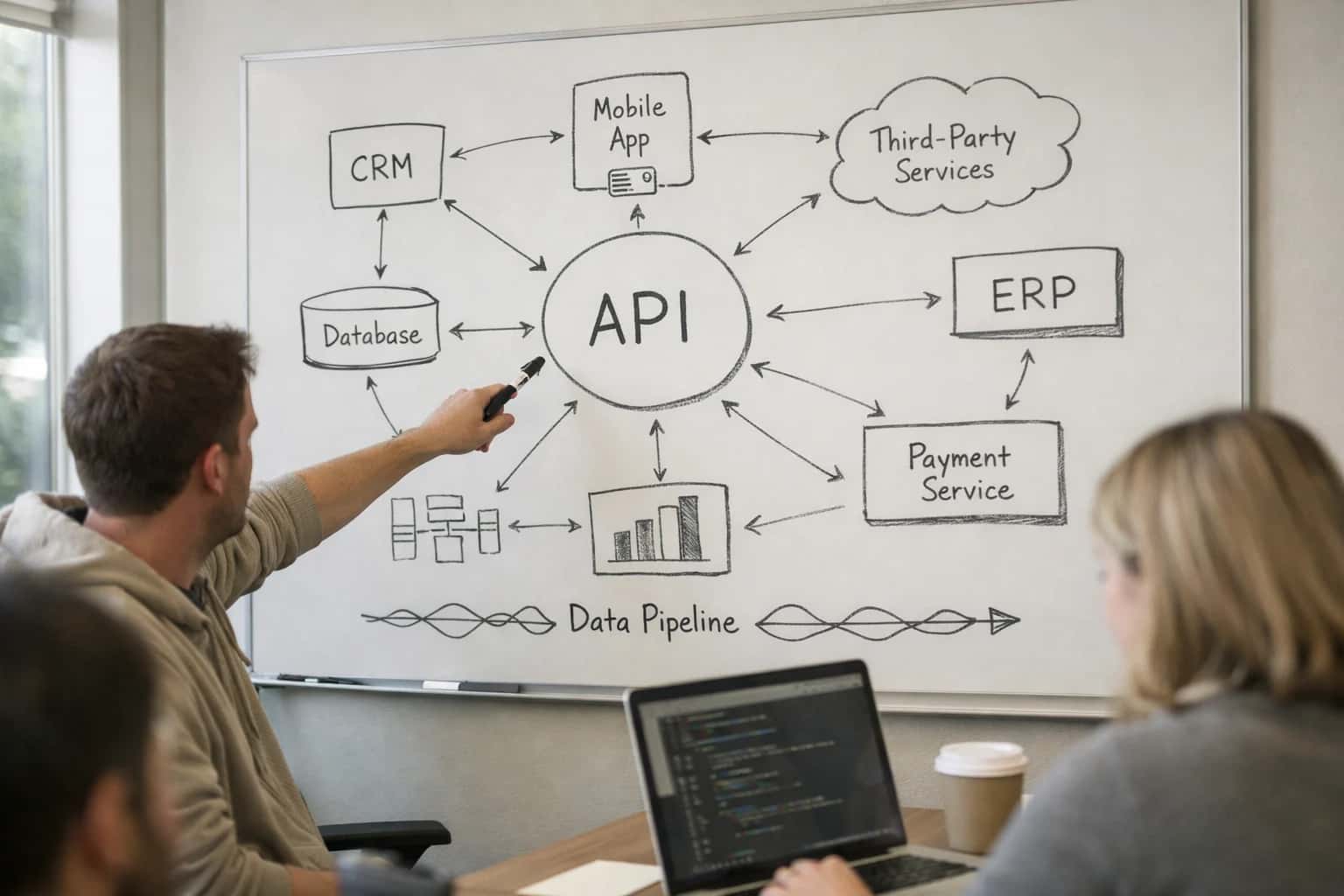
ARCHITECTURE
Where AI Fits Between Dental PMS and Imaging Software
A practical blueprint for using AI as an intelligent bridge between your practice management system and imaging platforms.
Implementation focuses on three key surfaces: 1) Study Triage & Tagging: AI automatically reads DICOM headers and image content to tag studies with descriptors (bitewing, periapical #19, post-op) and urgency flags, populating the PMS document module. 2) Anomaly Detection & Annotation: Pre-trained models analyze pixel data to highlight potential caries, bone loss, calculus, or faulty restorations, generating a preliminary findings report. 3) Chart Attachment & Alerting: The AI bundles its report—including confidence scores and image overlays—and attaches it to the patient's record via the PMS API, optionally creating a task for the dentist's review or triggering a billing alert for additional diagnostic codes.
Rollout requires a secure, on-premise or VPC-hosted agent to handle PHI, with event-driven architecture to avoid latency in clinical workflows. Governance is critical: all AI-generated findings should be clearly marked as "AI-Assisted Preliminary Findings" within the PMS chart, requiring dentist sign-off before becoming part of the official diagnosis. This maintains clinical oversight while turning minutes of manual image review into seconds of prioritized verification. For a deeper technical dive on integrating with specific PMS APIs, see our guide on Dental Practice Management API integrations.
AI BRIDGE ARCHITECTURE
Integration Touchpoints: PMS vs. Imaging Systems
Connecting to the Imaging Repository
AI integration begins at the image management layer. Dental imaging systems (e.g., Dexis, Schick, Sirona) and PACS store radiographs, intraoral scans, and CBCT volumes. The AI bridge connects via DICOM services or vendor-specific APIs to listen for new studies.
Key Integration Points:
- DICOM Modality Worklist (MWL): Pull scheduled patient/procedure data from the PMS to pre-populate imaging software, reducing manual entry errors.
- DICOM Store (C-STORE): Receive completed images automatically. This triggers the AI analysis pipeline for anomaly detection or study tagging.
- Study Metadata: Extract and map DICOM tags (Patient ID, Study Date, Laterality) to the PMS patient record for accurate filing. The AI layer enriches this metadata with its findings (e.g.,
AI Findings: Potential caries on tooth #3).
DENTAL PMS + IMAGING SOFTWARE
High-Value AI Imaging Use Cases
Bridge the gap between your practice management system (Dentrix, Eaglesoft, Open Dental, Curve) and imaging software (Dexis, Schick) to automate workflows, enhance diagnostic support, and attach intelligent findings directly to patient charts.
01
Automated Radiographic Study Tagging
AI automatically reviews incoming X-rays (bitewings, PAs, panoramics) from your imaging software, tags them by tooth number, surface, and procedure type (e.g., #3 MOD restoration), and attaches the structured metadata to the patient's chart in the PMS. Eliminates manual sorting and mis-filed images.
Batch → Real-time
Image processing
02
Anomaly Detection & Prioritization
AI scans new radiographs against prior baselines to flag potential pathologies—interproximal caries, periapical radiolucencies, bone loss patterns. Findings are presented as a prioritized review queue within the PMS charting module, helping clinicians focus on high-probability issues first.
Same-day review
Critical findings
03
Clinical Note & Finding Attachment
When a dentist confirms an AI finding, the system automatically drafts a structured clinical note (e.g., Recurrent caries noted on distal of #19, recommend intervention) and attaches it to the patient's progress notes and treatment plan in the PMS. Creates a seamless audit trail from image to plan.
1 sprint
Charting time saved
04
Insurance Pre-Authorization Support
AI extracts radiographic evidence (bone levels, crown/root ratio) and matches it to procedure codes (D4346, D6010). It then generates a narrative for pre-authorization letters directly within the PMS insurance module, reducing back-and-forth with payers and speeding up case approval.
Hours → Minutes
Narrative drafting
05
Longitudinal Change Analysis
AI compares current images with the patient's historical series stored across your PMS and PACS. It highlights measurable changes in lesion size, bone density, or implant integration, generating a visual report for patient consultation and tracking progression over time.
Batch → Real-time
Comparison workflow
06
Operatory Workflow Orchestration
Integrates imaging events with the PMS schedule. When a hygienist captures a FMX, the AI system triggers automated next steps: alerts the dentist for review, pre-loads the patient's chart, and suggests appropriate appointment types (emergency, follow-up) based on findings severity.
Same day
Care coordination
INTEGRATION BLUEPRINTS
Example AI-Powered Imaging Workflows
These workflows demonstrate how AI can be injected into the daily imaging-to-charting pipeline, connecting your dental PMS (Dentrix, Eaglesoft, Open Dental, Curve) with imaging software (Dexis, Schick, etc.) to automate analysis, tagging, and documentation.
Trigger: A new radiographic series (e.g., FMX, Pano) is saved and associated with a patient record in the imaging software.
Workflow:
- Event Capture: A webhook or file-watcher service detects the new study in the imaging system's designated export or network share folder.
- Context Enrichment: The service queries the PMS API using the patient ID or name/DOB to pull relevant context: medical alerts, existing conditions, previous findings.
- AI Analysis: Images are sent to a vision model (e.g., fine-tuned for caries, bone loss, periapical lesions). The model returns bounding boxes, confidence scores, and textual findings.
- PMS Integration: The system uses the PMS clinical API to:
- Create a new note in the patient's chart under the "Radiographs" tab.
- Append structured findings (e.g.,
#18-Distal: Caries detected (92% confidence)). - Attach the original image and an AI-annotated version as supporting documents.
- Flag the chart for dentist review.
- Human Review Point: The dentist reviews the flagged chart, confirms or edits the AI findings, and signs off, initiating the next clinical step.
CONNECTING PMS AND IMAGING SOFTWARE
Implementation Architecture: The AI Bridge
A practical blueprint for integrating AI between your dental practice management system and imaging software to automate analysis and charting.
The integration architecture functions as a secure middleware layer, typically deployed as a cloud service or on-premises container. It establishes bi-directional connections to both your PMS (e.g., Dentrix, Eaglesoft) via its API and your imaging software (e.g., Dexis, Schick) via DICOM or vendor-specific APIs. When a new X-ray or CBCT study is saved in the imaging system, the bridge automatically retrieves the DICOM files and associated patient metadata, then routes the study to the appropriate AI model for analysis—such as caries detection, bone loss measurement, or implant planning. The AI's findings are structured into a preliminary report, which is then attached as a clinical note or document to the corresponding patient chart in the PMS, often populating structured data fields like Perio Chart or Treatment Plan.
Key implementation details involve managing workflow state and ensuring clinical oversight. The bridge should maintain an audit log of all processed studies and AI inferences. For governance, a common pattern is to implement a human-in-the-loop review queue within the PMS interface, where the dentist or hygienist can quickly verify AI-generated findings (e.g., flagged caries, suggested bone level measurements) before they are permanently committed to the patient record. This review step is critical for clinical validation and liability management. The system can be configured to only auto-tag high-confidence findings or to flag anomalies for urgent review, balancing automation with clinical responsibility.
Rollout typically follows a phased approach: starting with a single operatory or specific procedure type (e.g., bitewing analysis for caries) to validate accuracy and workflow fit. Integration points are often built using event-driven webhooks from the imaging software and scheduled sync jobs with the PMS to handle batch processing. Success depends on mapping the PMS's patient and clinical data model (e.g., PatientID, AppointmentID, Tooth Chart schema) to the DICOM study metadata to ensure findings are correctly associated. For practices using multiple imaging sources, the bridge must normalize data formats and manage routing logic. This architecture not only reduces manual review time but creates a searchable, structured database of radiographic findings over time, enabling longitudinal patient health tracking. For related architectural patterns, see our guide on AI Integration for Dental EHR.
AI INTEGRATION PATTERNS FOR DENTAL IMAGING
Code & Payload Examples
Automating Study Classification and Tagging
When a new X-ray or CBCT scan is saved to your PACS (e.g., Dexis, Schick), an AI service can analyze the image and automatically tag it with metadata. This payload is then sent back to the PMS to update the patient's imaging record, enabling intelligent search and workflow routing.
Example JSON Payload to PMS:
json{ "event_type": "imaging_study_analyzed", "patient_id": "P-78910", "study_id": "IMG-20250415-001", "findings": { "tags": ["bitewing", "posterior", "caries_suspected", "restoration_present"], "anomaly_detected": true, "anomaly_location": "tooth_19_mesial", "confidence_score": 0.92, "recommended_actions": ["Schedule exam for tooth #19", "Add to hygienist notes"] }, "source_system": "ai_imaging_service", "timestamp": "2024-04-15T14:30:00Z" }
This structured output allows the PMS to trigger alerts, populate clinical notes, or prioritize the patient's chart for review.
AI-ENHANCED IMAGING WORKFLOWS
Realistic Time Savings & Clinical Impact
How integrating AI between your dental PMS and imaging software (e.g., Dexis, Schick) transforms daily clinical and administrative tasks.
| Workflow | Before AI Integration | After AI Integration | Clinical & Operational Impact |
|---|---|---|---|
X-ray Study Tagging & Organization | Manual entry of patient name, date, and tooth numbers for each image | Automatic tagging from PMS data and AI-suggested tooth mapping | Reduces prep time per study from 2-3 minutes to seconds; ensures consistent metadata |
Initial Anomaly Detection | Dentist reviews full series to spot potential issues | AI pre-scans images, highlighting areas of interest (e.g., potential caries, bone loss) | Focuses clinical review; can reduce initial scan time by 30-50% for hygiene checks |
Findings Attachment to Chart | Manual note-taking, then typing findings into PMS clinical notes | AI-generated draft findings auto-populated in PMS chart, ready for dentist edit/approval | Cuts charting time from 5+ minutes to 1-2 minutes per patient; improves documentation detail |
Patient Communication Prep | Dentist explains findings verbally, may sketch on a separate printout | AI auto-generates a visual aid (highlighted image + plain-language summary) for chairside review | Improves case acceptance and patient understanding; adds ~30 seconds of valuable consult time |
Billing & Coding Support | Staff manually match radiographic findings to CDT codes after the appointment | AI suggests relevant procedure codes (e.g., D0274, D0330) based on detected findings and attached notes | Reduces coding errors and post-appointment admin work; accelerates claim submission |
Longitudinal Tracking | Manual comparison to prior films side-by-side | AI automatically aligns current and prior images, highlighting changes in lesion size or bone level | Enables faster, more precise monitoring of disease progression or healing at recall visits |
Compliance & Audit Logging | Manual verification that required images are captured and stored per protocol | AI checks study completeness against procedure type and generates an audit trail | Automates compliance checks; reduces risk of missing images for insurance or regulatory audits |
SECURE, CONTROLLED DEPLOYMENT FOR CLINICAL WORKFLOWS
Governance, Compliance & Phased Rollout
A practical framework for implementing AI in dental imaging workflows with appropriate safeguards and measurable milestones.
A production AI integration for dental imaging must be architected with data sovereignty and clinical governance as first principles. This means the AI service should act as a stateless processor: patient images and DICOM metadata are streamed from the imaging software (e.g., Dexis, Schick) or PACS via a secure API, analyzed, and results are returned as structured annotations—never storing PHI long-term. Findings are then written back to a dedicated field or note in the patient's chart within the PMS (Dentrix, Eaglesoft, etc.), with a full audit trail linking the AI inference to the source image, user, and timestamp. Role-based access controls (RBAC) in the PMS govern who can view AI suggestions, ensuring only licensed clinicians can accept findings into the official record.
Rollout follows a phased, risk-managed approach. Phase 1 is a silent pilot: AI runs in the background on a subset of historical radiographs, generating findings that are compared to existing dentist notes to calibrate accuracy and build clinical trust, with zero impact on live workflows. Phase 2 introduces assistive review: AI annotations are presented as non-binding overlays in the imaging software or a sidecar viewer for hygienists and dentists during chart review, requiring explicit clinician approval before any data is committed to the PMS. Phase 3 enables targeted automation: for high-confidence, low-risk tasks like detecting obvious calculus or confirming implant presence, the system can auto-populate charting fields, but always flags the entry as AI-generated for later verification.
Compliance is engineered into the workflow. The system logs all inputs, model versions, and outputs for traceability, supporting HIPAA audit requirements and potential FDA regulatory review for diagnostic aid functions. A human-in-the-loop gate is mandatory for any finding that could influence treatment planning. Integration points are designed to fail gracefully; if the AI service is unavailable, the imaging and PMS workflows continue uninterrupted, queueing analyses for later processing. This controlled, incremental path de-risks adoption, aligns with clinical responsibility, and delivers tangible efficiency gains—reducing manual scan review time—while upholding the standard of care. For a deeper technical dive on connecting to specific platforms, see our guide on Dental Practice Management API integrations.
Enabling Efficiency, Speed & Accuracy
Intelligent Analysis, Decision & Execution
We build AI systems for teams that need search across company data, workflow automation across tools, or AI features inside products and internal software.
Talk to Us
Search across company data
Give teams answers from docs, tickets, runbooks, and product data with sources and permissions.
Useful when people spend too long searching or get different answers from different systems.
Enterprise searchRAGPermissions
Read more
Automate internal workflows
Use AI to route work, draft outputs, trigger actions, and keep approvals and logs in place.
Useful when repetitive work moves across multiple tools and teams.
AI agentsWorkflow automationGovernance
Read more
Add AI to products and internal tools
Build assistants, guided actions, or decision support into the software your team or customers already use.
Useful when AI needs to be part of the product, not a separate tool.
AI integrationDecision supportModel routing
Read moreAI INTEGRATION FOR DENTAL IMAGING
Frequently Asked Questions
Common questions about integrating AI with dental imaging software (e.g., Dexis, Schick) and your practice management system (PMS) for automated analysis, tagging, and charting workflows.
The integration uses a secure, event-driven architecture that doesn't require deep modification of your existing systems.
- Imaging Software Connection: The AI service connects via the imaging software's DICOM export or API. When a new study (e.g., FMX, PANO, BW) is saved, it's automatically pushed to a secure cloud storage bucket.
- AI Processing: The AI model analyzes the images for anomalies (caries, bone loss, lesions), anatomical landmarks, and image quality. It generates structured findings and tags (e.g.,
#potential_mesial_caries_19,#calculus_moderate). - PMS Integration: These findings are sent via a secure webhook or API to your PMS (Dentrix, Eaglesoft, etc.). The system matches the study to the correct patient and appointment using metadata (Patient ID, Date of Service).
- Chart Update: Findings are attached as a clinical note or structured data to the patient's chart. For example, in Dentrix, this could populate the "Clinical Notes" section or create a custom progress note with the AI's observations.
This keeps the imaging and PMS databases separate, with the AI acting as an intelligent bridge, ensuring HIPAA compliance through encrypted data in transit and at rest.

About the author
Prasad Kumkar
CEO & MD, Inference Systems
Prasad Kumkar is the CEO & MD of Inference Systems and writes about AI systems architecture, LLM infrastructure, model serving, evaluation, and production deployment. Over 5+ years, he has worked across computer vision models, L5 autonomous vehicle systems, and LLM research, with a focus on taking complex AI ideas into real-world engineering systems.
His work and writing cover AI systems, large language models, AI agents, multimodal systems, autonomous systems, inference optimization, RAG, evaluation, and production AI engineering.
LinkedIn
Limited slotsGet a Free AI Consultation
Partnered with leading AI, data, and software stack.





How We Work
Custom AI workflows for your Business
One-fit-all AI don't work for modern businesses. At Inferensys, we aim to understand your business & custom requirements; which we use to define most efficient agentic workflows, the data, and the tools for your business.
01
Review the use case
We understand the task, the users, and where AI can actually help.
Read more02
Pick the right approach
We define what needs search, automation, or product integration.
Read more03
Build the first useful version
We implement the part that proves the value first.
Read more04
Improve from there
We add the checks and visibility needed to keep it useful.
Read moreThe first call is a practical review of your use case and the right next step.
Talk to Us