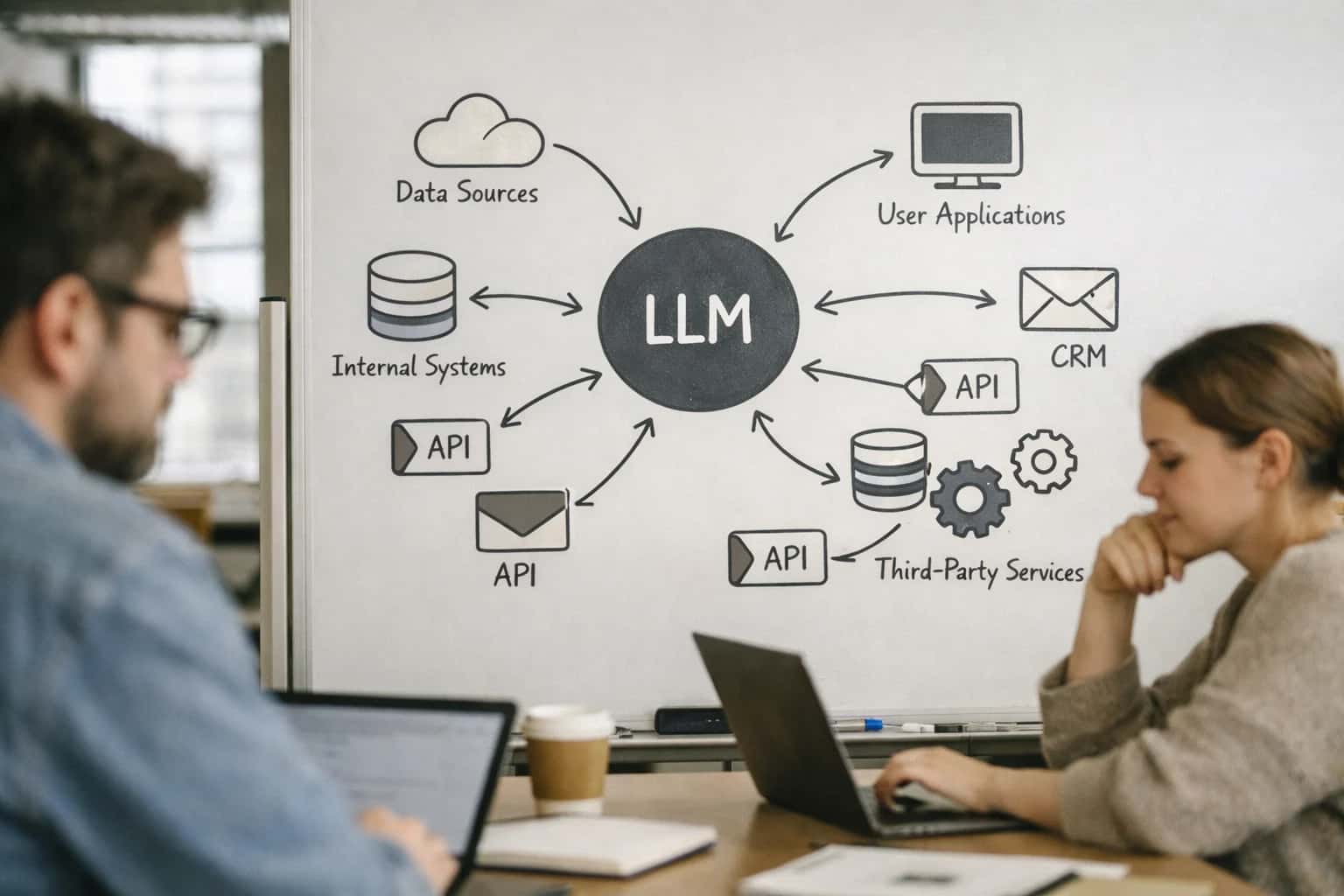
In a cloud-native PMS like Curve Dental, AI integrations connect primarily through its webhook eventing system and RESTful API. The key surfaces for automation are the patient record, appointment scheduler, clinical charting module, and insurance/billing engine. AI services act as stateless microservices that subscribe to events—like a new appointment booking or a finalized clinical note—process the data, and return enriched information or trigger follow-up actions back into the PMS. This architecture ensures the core system remains stable while intelligence is injected at the workflow edges.

Integration
AI Integration for Cloud-based Dental Software
Architecture for injecting AI into cloud-native dental PMS like Curve Dental using secure webhooks, scalable microservices, and multi-tenant data isolation for scheduling, patient engagement, and revenue cycle automation.
ARCHITECTURE & ROLLOUT
Where AI Fits in Cloud-Native Dental PMS
A practical guide to integrating AI into cloud-based dental practice management systems like Curve Dental, focusing on secure, scalable event-driven architecture.
A typical production rollout starts with a single, high-impact workflow. For example, an AI-powered patient intake agent can be triggered via a webhook when a new patient is created. The agent calls an LLM to analyze the uploaded insurance card image via OCR, performs a real-time eligibility check via a payer API, and populates the patient's coverage details and benefits directly into the Curve Dental record. This reduces front-desk manual work from 10-15 minutes to near-instantaneous. Governance is managed through a central API gateway, enforcing rate limits, audit logging, and multi-tenant data isolation to ensure PHI never leaks between dental practice clients.
For DSOs or multi-location groups, the model scales by deploying a centralized AI orchestration layer that routes events from multiple Curve Dental instances. This allows for shared intelligence—like a predictive no-show model trained on aggregated, de-identified data—while executing actions with strict, practice-specific context and permissions. The integration is managed through Infrastructure-as-Code, allowing for consistent deployment and rollback. Success hinges on starting with a well-defined event, building idempotent handlers, and establishing a human-in-the-loop review step for clinical or financial decisions before full automation.
ARCHITECTURE FOR CLOUD-NATIVE DENTAL SOFTWARE
Key Integration Surfaces in Cloud Dental PMS
Core Scheduling and Patient Data
Cloud-native platforms like Curve Dental expose RESTful APIs for patient records and appointment books. This is the primary surface for injecting AI into front-office workflows.
Key API Endpoints for AI:
GET /patients&POST /patients: Retrieve patient history or create/update records from AI-driven intake forms.GET /appointments&POST /appointments: Read the schedule for optimization or create appointments from AI-powered online booking or rescheduling agents.GET /patient/{id}/documents: Access attached forms, insurance cards, and IDs for intelligent document processing.
Integrate AI here to power predictive scheduling (no-show risk scoring), automated patient intake (form pre-filling), and intelligent recall campaigns by analyzing visit history and engagement patterns.
CLOUD-NATIVE INTEGRATION PATTERNS
High-Value AI Use Cases for Cloud Dental Practices
For practices on cloud-native platforms like Curve Dental, AI integration leverages secure webhooks, scalable microservices, and multi-tenant data isolation to inject intelligence directly into clinical and administrative workflows without disrupting the core system.
01
Intelligent Appointment Optimization
AI analyzes the schedule, patient history, and procedure types to dynamically suggest optimal sequencing and buffer times. It integrates via the platform's scheduling API to reduce gaps, minimize overtime, and improve operatory utilization in real-time.
Hours -> Minutes
Schedule optimization
02
Automated Insurance Verification & Claim Scrub
An AI microservice listens for patient_scheduled webhooks, automatically runs eligibility checks, and pre-scrubs claims by parsing clinical notes against payer rules. It updates the patient record and flags potential denials before submission, cutting down manual front-desk work.
Batch -> Real-time
Verification workflow
03
Clinical Note Summarization & Coding Support
Integrates with the clinical charting module via API. After a procedure, AI transcribes voice notes, summarizes the SOAP note, and suggests accurate CDT codes based on the narrative and radiographic data, reducing charting time and improving billing accuracy.
Same day
Note completion
04
Predictive Recall & Reactivation
Leverages patient visit history, engagement data, and periodontal status from the PMS to score reactivation priority. AI orchestrates personalized multi-channel recall campaigns (SMS, email, portal) via the platform's communication APIs, targeting hygiene column fill rates.
1 sprint
Campaign ROI visibility
05
Intelligent Document Processing for Patient Onboarding
A secure service processes uploaded documents (insurance cards, IDs, health forms) via the patient portal. AI extracts key fields, classifies document type, and populates the corresponding patient record fields via API, eliminating manual data entry for front-office staff.
Hours -> Minutes
Intake processing
06
Centralized AI Orchestration for Multi-Location DSOs
A cloud-based orchestration layer provides centralized intelligence with localized execution. It securely routes events from multiple practice instances, applies AI models for tasks like no-show prediction or A/R prioritization, and pushes actions back to each tenant's isolated PMS database.
Batch -> Real-time
Cross-practice analytics
CLOUD-NATIVE DENTAL PMS
Example AI Automation Workflows
These workflows illustrate how AI services can be injected into cloud-based dental practice management platforms like Curve Dental using secure webhooks and microservices. Each flow is designed for multi-tenant isolation, event-driven execution, and minimal disruption to existing user interfaces.
Trigger: A new appointment is booked or an existing appointment is edited in the PMS schedule.
Context Pulled: The AI service receives a webhook payload containing:
- Patient ID, appointment time/date, provider, procedure code
- Patient's historical attendance rate, preferred communication channel (SMS/email)
- Time until appointment (e.g., 72 hours out)
AI Action: A lightweight model scores the appointment's no-show risk (low, medium, high) based on historical patterns. For medium/high-risk appointments, the system automatically drafts and sends a personalized confirmation message via the PMS's communication API.
System Update: If the patient confirms or requests a change via reply, the AI agent parses the intent and either:
- Logs the confirmation in the patient record.
- Triggers a rescheduling workflow, presenting available times to the patient.
Human Review Point: Any patient reply indicating clinical concern (e.g., "tooth is hurting more") is immediately flagged and routed to a clinical staff queue in the PMS.
CLOUD-NATIVE INTEGRATION PATTERN
Implementation Architecture: Webhooks, Microservices, and Data Isolation
A secure, scalable blueprint for connecting AI services to cloud-based dental PMS like Curve Dental.
Integrating AI with a cloud-native platform like Curve Dental requires an architecture built for its event-driven, API-first design. The core pattern uses webhooks from the PMS to trigger AI microservices. For example, a patient.appointment.scheduled webhook can fire an AI agent to predict no-show risk and suggest confirmation strategies, while a clinical.note.created event can trigger automated coding and summarization. This keeps the AI layer decoupled, reacting to real-time changes in the PMS without intrusive polling or direct database access.
Each AI capability—like insurance verification, note summarization, or recall personalization—should be deployed as an independent, stateless microservice. This allows for granular scaling, independent updates, and resilient failure handling. A central orchestration layer (often built with tools like n8n or Azure Logic Apps) manages multi-step workflows, such as: 1) receiving a new patient intake form, 2) calling an OCR service to extract data, 3) invoking an LLM to populate the Curve Dental patient record via its REST API, and 4) logging all actions for audit. This approach ensures business logic is maintained outside the PMS, simplifying governance and iteration.
For multi-tenant DSOs, data isolation is non-negotiable. Each microservice must enforce strict context boundaries, using practice-specific API keys and encrypting data in transit and at rest. AI models should be served from a dedicated cloud environment (e.g., Azure AI or AWS SageMaker) with private endpoints, ensuring patient data never traverses public LLM APIs uncontrolled. A well-architected integration also includes a human-in-the-loop review queue for high-stakes outputs (like treatment codes) before they are written back to Curve Dental, providing a critical safety and compliance checkpoint. This architecture delivers intelligent automation while maintaining the security and scalability expected of a modern cloud practice.
CLOUD-NATIVE INTEGRATION PATTERNS
Code and Payload Examples
Ingesting PMS Events for AI Processing
Cloud-native dental platforms like Curve Dental expose webhooks for key events. A secure, scalable event handler is the entry point for AI workflows. This Python FastAPI example listens for a patient.appointment.scheduled event, validates the payload, and enqueues it for AI processing.
pythonfrom fastapi import FastAPI, HTTPException, Header, Request import hmac import hashlib import json from pydantic import BaseModel from datetime import datetime app = FastAPI() WEBHOOK_SECRET = os.getenv('WEBHOOK_SECRET') class AppointmentEvent(BaseModel): event_type: str practice_id: str patient_id: str appointment_id: str scheduled_time: datetime provider_id: str procedure_code: str def verify_signature(payload_body: bytes, signature_header: str) -> bool: digest = hmac.new(WEBHOOK_SECRET.encode(), payload_body, hashlib.sha256).hexdigest() return hmac.compare_digest(f'sha256={digest}', signature_header) @app.post('/webhooks/curve') async def handle_curve_webhook(request: Request, x_curve_signature: str = Header(...)): payload_body = await request.body() if not verify_signature(payload_body, x_curve_signature): raise HTTPException(status_code=401, detail='Invalid signature') event_data = json.loads(payload_body) # Enqueue for AI processing (e.g., no-show risk scoring) ai_payload = { 'source': 'curve_dental', 'event': 'appointment_scheduled', 'data': { 'practice_id': event_data['practiceId'], 'appointment_id': event_data['appointmentId'], 'patient_id': event_data['patientId'], 'procedure': event_data.get('procedureCode') } } # Publish to internal queue (e.g., AWS SQS, Google Pub/Sub) # queue_client.send_message(MessageBody=json.dumps(ai_payload)) return {'status': 'queued_for_ai'}
CLOUD-NATIVE DENTAL PMS
Realistic Time Savings and Operational Impact
Measurable improvements from integrating AI agents with cloud-based dental practice management software like Curve Dental, focusing on administrative and patient-facing workflows.
| Workflow / Metric | Before AI Integration | After AI Integration | Implementation Notes |
|---|---|---|---|
Insurance Verification | Manual phone calls or portal checks (5-15 min per patient) | Automated API checks at scheduling (30-60 sec) | Triggers on new appointment; updates patient record via webhook |
Patient Intake Form Processing | Staff manually transcribe data from PDFs/portals | AI extracts and populates fields (90%+ accuracy) | Human review for exceptions; integrates with PMS patient module |
Appointment Confirmation & Recall | Batch SMS/email blasts, manual call lists for no-shows | Personalized, two-way messaging with rescheduling links | Uses historical attendance data; reduces no-shows by 15-25% |
Clinical Note Drafting | Dentist/Hygienist dictates or types during/after exam | Voice-to-text draft with auto-coding suggestions | SOAP note template populated; final sign-off required |
Claim Scrubbing & Submission | Manual review of codes and notes before electronic submission | AI pre-scrub for errors and compliance (CDC, HIPAA) | Flags potential denials; submits via PMS clearinghouse integration |
Payment Posting Reconciliation | Manual matching of EOBs to open claims in PMS | AI matches electronic payments and suggests posting | Flags discrepancies for staff review; updates A/R aging |
Patient FAQ & Triage | Front desk handles calls for routine questions (hours/day) | Chatbot handles 40-60% of inquiries, escalates complex issues | HIPAA-compliant; logs interactions to patient record for context |
ARCHITECTING FOR PRODUCTION
Governance, Security, and Phased Rollout
A secure, governed approach to integrating AI with cloud-native dental PMS like Curve Dental, built for multi-tenant data isolation and controlled adoption.
For cloud-based platforms like Curve Dental, security is non-negotiable. Your integration architecture must enforce strict data isolation between practices (tenants) and ensure all AI interactions are logged, auditable, and reversible. We design around the platform's native webhook eventing system and REST API, using a dedicated microservice layer that acts as a secure broker. This layer handles authentication via OAuth 2.0, encrypts PHI in transit and at rest, and maintains a complete audit trail of every AI-generated suggestion, note, or action before it's written back to the PMS. All AI models operate within a zero-trust network, and prompts are engineered to never include raw patient identifiers in calls to external LLM APIs.
A successful rollout follows a phased, value-driven path, minimizing disruption to daily practice operations:
- Phase 1: Non-Clinical Automation – Start with high-volume, low-risk workflows like automating patient SMS reminders for recalls or appointment confirmations. This builds trust and demonstrates immediate time savings for front-desk staff.
- Phase 2: Administrative Augmentation – Layer in AI for insurance claim scrubbing and payment posting reconciliation. Use the PMS's billing engine APIs to pre-scrub claims, flag potential CDT coding errors, and match electronic remittance advices (ERAs) to open claims, reducing manual follow-up.
- Phase 3: Clinical Support – Finally, introduce clinical co-pilots, such as SOAP note summarization from voice dictation or radiographic finding flags. These workflows are deployed in "assistive mode" first, where suggestions are presented to the dentist or hygienist for review and approval before being committed to the patient chart module.
Governance is continuous. We implement human-in-the-loop (HITL) approval gates for any AI action that modifies clinical records or financial data. Role-based access controls (RBAC) ensure only authorized staff can approve AI suggestions. Performance is monitored through dashboards tracking accuracy (e.g., claim denial rates pre/post-AI), user adoption, and system latency. This phased, governed approach de-risks the integration, aligns AI adoption with practice readiness, and ensures the technology delivers measurable operational lift without compromising security or compliance.
Enabling Efficiency, Speed & Accuracy
Intelligent Analysis, Decision & Execution
We build AI systems for teams that need search across company data, workflow automation across tools, or AI features inside products and internal software.
Talk to Us
Search across company data
Give teams answers from docs, tickets, runbooks, and product data with sources and permissions.
Useful when people spend too long searching or get different answers from different systems.
Enterprise searchRAGPermissions
Read more
Automate internal workflows
Use AI to route work, draft outputs, trigger actions, and keep approvals and logs in place.
Useful when repetitive work moves across multiple tools and teams.
AI agentsWorkflow automationGovernance
Read more
Add AI to products and internal tools
Build assistants, guided actions, or decision support into the software your team or customers already use.
Useful when AI needs to be part of the product, not a separate tool.
AI integrationDecision supportModel routing
Read moreCLOUD DENTAL PMS INTEGRATION
Frequently Asked Questions
Practical questions for technical and operational leaders planning AI integration with cloud-native dental practice management software like Curve Dental.
Cloud-native PMS platforms like Curve Dental are designed for secure, API-first integration. The standard architecture involves:
- API Gateway & Webhooks: The PMS exposes a RESTful API and webhook system for event-driven integration (e.g.,
appointment.created,claim.submitted). Your AI service subscribes to relevant webhooks. - OAuth 2.0 / API Keys: Authentication is handled via OAuth 2.0 for user context or scoped API keys for service-level access, ensuring principle of least privilege.
- Secure Microservice: Your AI logic runs in a secure, cloud-hosted microservice (e.g., AWS Lambda, Azure Function). It receives webhook payloads, calls AI models (OpenAI, Anthropic, etc.), processes the response, and makes authorized API calls back to the PMS.
- Data Isolation: A multi-tenant data layer ensures patient data from different practices is logically separated, never co-mingled in prompts or vector stores.
This approach avoids VPNs or direct database connections, leveraging the platform's modern, secure integration surface.

About the author
Prasad Kumkar
CEO & MD, Inference Systems
Prasad Kumkar is the CEO & MD of Inference Systems and writes about AI systems architecture, LLM infrastructure, model serving, evaluation, and production deployment. Over 5+ years, he has worked across computer vision models, L5 autonomous vehicle systems, and LLM research, with a focus on taking complex AI ideas into real-world engineering systems.
His work and writing cover AI systems, large language models, AI agents, multimodal systems, autonomous systems, inference optimization, RAG, evaluation, and production AI engineering.
LinkedIn
Limited slotsGet a Free AI Consultation
Partnered with leading AI, data, and software stack.





How We Work
Custom AI workflows for your Business
One-fit-all AI don't work for modern businesses. At Inferensys, we aim to understand your business & custom requirements; which we use to define most efficient agentic workflows, the data, and the tools for your business.
01
Review the use case
We understand the task, the users, and where AI can actually help.
Read more02
Pick the right approach
We define what needs search, automation, or product integration.
Read more03
Build the first useful version
We implement the part that proves the value first.
Read more04
Improve from there
We add the checks and visibility needed to keep it useful.
Read moreThe first call is a practical review of your use case and the right next step.
Talk to Us