AI integration targets the mapping specification and transformation logic within Informatica PowerCenter and IICS. This includes the mapping designer, transformation developer, and the underlying session configuration where AI can assist in generating complex expressions for Expression, Filter, and Router transformations, or suggesting optimal Joiner and Aggregator settings based on source profiling. For cloud-native workflows in Informatica Cloud Application Integration (CAI), AI can draft integration processes, map JSON/XML payloads, and recommend error handling paths.

Integration
AI Integration for Informatica Data Transformation
A technical blueprint for enterprise data teams to augment Informatica PowerCenter and IICS with AI for intelligent mapping generation, logic optimization, and automated refactoring, cutting development cycles from weeks to days.
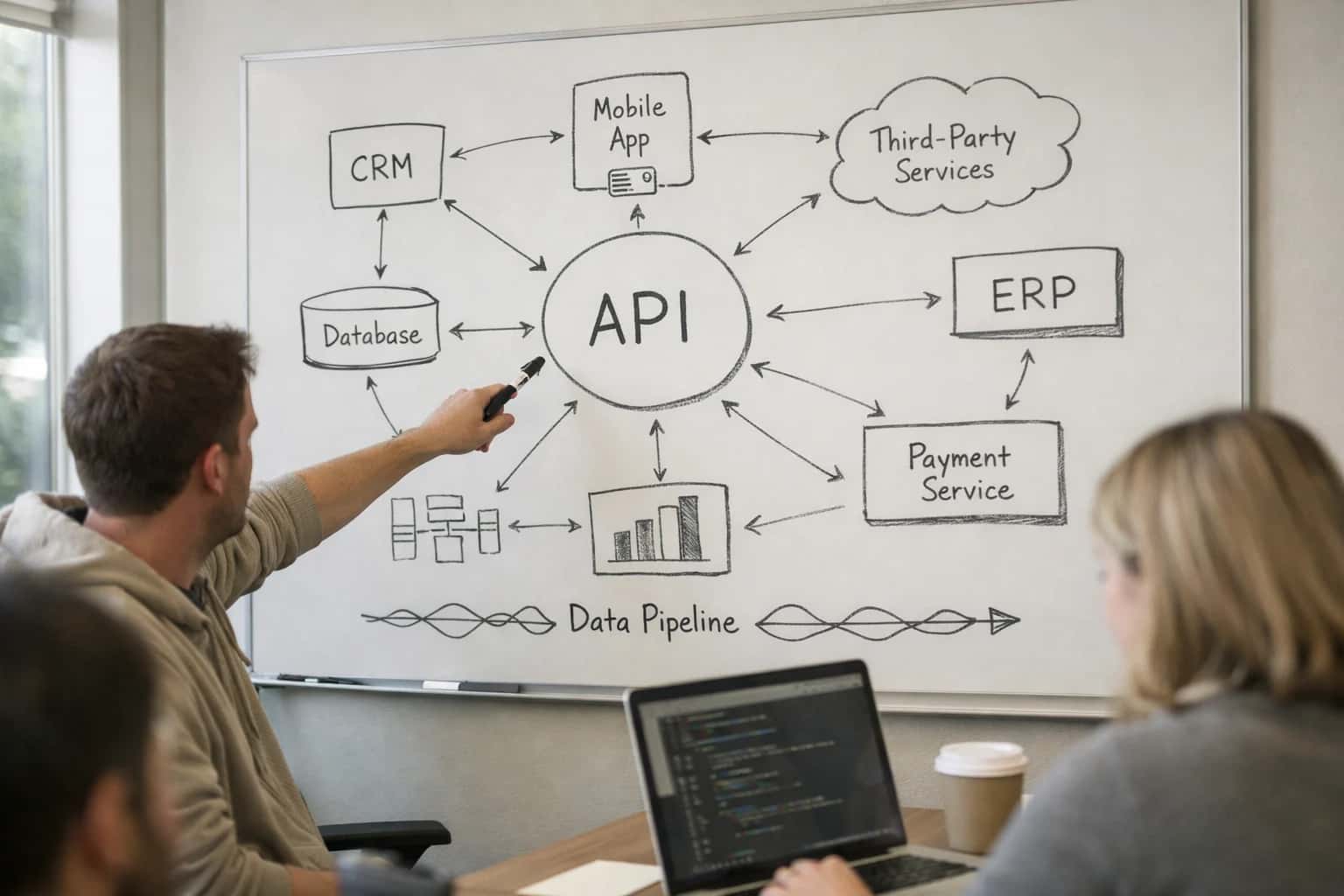
ARCHITECTURE BLUEPRINT
Where AI Fits into Informatica's Transformation Layer
A practical guide to augmenting Informatica's core data transformation logic with AI, focusing on mapping generation, logic optimization, and operational resilience.
Implementation typically involves an AI-assisted development loop: a developer drafts a mapping in Informatica Designer, and an AI agent—accessed via a custom plugin or external API—reviews the logic. The agent can suggest performance optimizations (e.g., pushing filters source-side), generate documentation for derived fields, or propose alternative transformation patterns for data cleansing. For ongoing operations, AI monitors workflow logs and session statistics to predict bottlenecks, recommending adjustments to commit intervals, buffer memory, or partitioning keys to improve throughput. This turns reactive tuning into a proactive, data-driven practice.
Rollout requires a governed sandbox. Start by applying AI to non-production mapping projects, using a human-in-the-loop review for all generated logic before promotion. Key governance checkpoints include validating AI-suggested joins against referential integrity rules and auditing any logic changes in the repository metadata. A successful pilot often focuses on high-volume, complex mappings—like customer 360 consolidations or product attribute harmonization—where AI can reduce development time from days to hours. For teams managing legacy PowerCenter mappings, AI can also assist in refactoring and modernization, analyzing existing mapplets and worklets to suggest optimizations for cloud migration to IICS. Explore our related guide on AI Integration for Informatica Data Quality for extending this pattern to profiling and cleansing rules.
ARCHITECTURE BLUEPRINT
AI Touchpoints in Informatica's Transformation Stack
Automating Complex Mapping Logic
AI agents can dramatically accelerate the design of PowerCenter mappings and IICS transformations. By analyzing source and target schemas, an LLM can generate initial mapping specifications, suggest transformation rules, and even produce reusable mapplets. This is particularly valuable for complex nested structures (JSON/XML) or when integrating new SaaS APIs.
For example, an agent can ingest a sample payload from a REST API and a target Snowflake table DDL, then output a recommended mapping with appropriate parsers, routers, and expression transformations. This reduces manual analysis from hours to minutes. The AI can also flag potential data type mismatches or suggest performance optimizations, like recommending a Joiner transformation over multiple Lookups.
INTELLIGENT DATA WORKFLOWS
High-Value AI Use Cases for Informatica Transformations
Integrate AI directly into Informatica PowerCenter and Intelligent Cloud Services (IICS) to automate complex mapping logic, optimize job performance, and accelerate data pipeline development.
01
AI-Generated Mapping Specifications
Use LLMs to analyze source and target schemas, then automatically generate initial Informatica Mapping Specifications or IICS taskflows. This reduces manual analysis for complex JSON, XML, or legacy mainframe data structures, turning a days-long discovery process into a first draft in hours.
Days -> Hours
Specification time
02
Transformation Logic Refactoring
Augment developers with an AI copilot that reviews existing PowerCenter mappings or Cloud Data Integration (CDI) transformations. It suggests optimizations for performance (e.g., pushing logic to the database), identifies redundant expressions, and helps debug complex Expression or Aggregator transformations.
1 sprint
Accelerated optimization
03
Intelligent Pipeline Recovery
Build an AIOps layer for IICS task monitoring. Analyze failure logs and runtime metrics to predict job failures, suggest root causes (e.g., source connectivity, data type conversion errors), and automatically execute predefined recovery workflows or rerun dependencies.
Batch -> Auto-remediate
Failure response
04
Dynamic Data Quality Rule Generation
Enhance Informatica Data Quality (IDQ) with AI that profiles incoming data streams and suggests context-aware validation rules. For example, automatically generate patterns for address cleansing, product SKU standardization, or anomaly detection in financial feeds, reducing manual rule configuration.
Hours -> Minutes
Rule setup
05
Metadata Enrichment for Governance
Integrate LLMs with Informatica Enterprise Data Catalog (EDC) to auto-generate column descriptions, infer business glossary terms, and identify potential PII from discovered metadata. This populates the catalog for better search and compliance, linking technical assets to business context.
80% Coverage
Auto-classification
06
AI-Ready Data Pipeline Orchestration
Design IICS workflows that prepare data specifically for AI consumption. Orchestrate jobs that generate vector embeddings from text fields, create feature store tables, or trigger external model endpoints (e.g., Azure OpenAI, SageMaker) to enrich records before loading to a data warehouse or lake.
Weeks -> Days
Pipeline setup
INFORMATICA POWERCENTER & IICS
Example AI-Augmented Transformation Workflows
These workflows illustrate how AI agents can be embedded into Informatica's transformation layer to automate complex logic generation, optimize performance, and reduce manual development cycles from days to hours.
Trigger: A developer opens a new mapping in Informatica PowerCenter Designer or IICS Data Integration.
Context/Data Pulled: The agent receives the source definition (e.g., a complex SAP BAPI structure or a nested JSON file) and the target table schema from the data warehouse (e.g., Snowflake, Redshift).
Model or Agent Action: An LLM analyzes the source and target schemas, infers semantic relationships between fields (e.g., CUST_NAME → CUSTOMER_FULL_NAME), and suggests transformation logic. It generates:
- A complete mapping with connected transformations (Source Qualifier, Expression, Lookup, Router).
- Expression logic for data type conversions, concatenations, and conditional splits.
- Initial lookup SQL statements for dimension key retrieval.
- Comments explaining the mapping logic for future maintainers.
System Update or Next Step: The suggested mapping is presented to the developer within the IDE. The developer can review, adjust, and deploy the mapping directly.
Human Review Point: The developer must validate and approve the AI-generated mapping before it is saved or promoted to a higher environment. The agent logs all suggestions for model feedback.
A BLUEPRINT FOR ENTERPRISE DATA TEAMS
Implementation Architecture: Wiring AI into the Informatica Dev Lifecycle
A practical guide to embedding AI agents and LLMs directly into Informatica PowerCenter and IICS development workflows.
Integrating AI into Informatica’s development lifecycle means connecting LLMs to the surfaces where data engineers and analysts spend their time: the Mapping Designer, Workflow Manager, and Repository Manager. The architecture typically involves an AI orchestration layer that listens for events—like a new mapping creation or a workflow failure—via Informatica’s REST API or by monitoring the repository database. This layer can call LLMs (like GPT-4 or Claude) through a secure gateway to generate mapping logic, suggest performance optimizations for transformations, or draft SQL override logic for Source Qualifiers and Lookups. For example, an agent can be triggered when a developer opens a complex Joiner transformation, offering to analyze the cardinality and propose an optimized join order.
A production implementation wires this AI layer into the CI/CD pipeline for Informatica content. When a developer checks in a XML mapping specification or a Workflow definition, an AI validation agent can review it for common anti-patterns, such as inefficient Aggregator usage or missing commit intervals, and post suggestions directly into the ticketing system (e.g., Jira). For rollout, start with a read-only “copilot” mode in a development environment, where suggestions require explicit approval. Governance is critical: all AI-generated code must be logged with prompt context, model version, and user acceptance in an audit table. Access to the AI service should be scoped via RBAC in Informatica, ensuring only authorized developers or projects can trigger generation, and all data sent to external models should be scrubbed of sensitive PII or masked using Informatica’s Data Masking capabilities.
The impact is operational: reducing the time to build a complex PowerCenter mapping from hours to minutes, especially for standard patterns like SCD Type 2 or fact table loads. It also lowers the barrier for junior developers to adhere to enterprise standards. For ongoing operations, AI can monitor Workflow logs in IICS to predict failures based on historical patterns—like a slowly growing source table—and automatically suggest adjustments to the session’s buffer memory or recommend partitioning. This turns reactive support into proactive pipeline management. To explore related patterns for data quality and governance, see our guides on AI Integration for Informatica Data Quality and AI Integration for Informatica Data Governance.
AI-ENHANCED INFORMATICA WORKFLOWS
Code and Payload Examples
AI-Assisted Mapping Logic
Use LLMs to generate or refactor complex Informatica PowerCenter or IICS mapping logic. This is particularly useful for nested XML/JSON sources or when creating mappings from natural language specifications.
Example Python script to generate mapping XML snippets:
pythonimport openai from informatica_sdk import MappingSpec # Define source/target schema from IDMC catalog source_schema = get_source_schema('SALESFORCE_ACCOUNT') target_schema = get_target_schema('SNOWFLAKE_DIM_ACCOUNT') prompt = f"""Generate Informatica mapping logic to transform: Source: {source_schema} Target: {target_schema} Include business rules: - Concatenate FirstName and LastName into FullName - Standardize CountryCode to ISO format - Calculate CustomerTier based on AnnualRevenue """ response = openai.ChatCompletion.create( model="gpt-4", messages=[{"role": "user", "content": prompt}] ) # Parse AI response into mapping specification mapping_xml = parse_ai_response_to_xml(response.choices[0].message.content) mapping_spec = MappingSpec.from_xml(mapping_xml) mapping_spec.validate()
This pattern reduces mapping development time from hours to minutes, especially for complex hierarchical transformations.
AI-AUGMENTED DATA TRANSFORMATION DEVELOPMENT
Realistic Time Savings and Operational Impact
How AI integration reduces manual effort and improves quality in Informatica PowerCenter and IICS transformation development.
| Metric | Before AI | After AI | Notes |
|---|---|---|---|
Mapping logic generation | Manual SQL/transformation coding | Assisted generation from natural language specs | Developer reviews and finalizes AI-suggested logic |
Data quality rule creation | Manual profiling and rule definition | AI-suggested rules based on data patterns | Steward approves and tunes rules; reduces oversight blind spots |
Transformation performance tuning | Manual analysis of execution logs | AI-powered bottleneck identification and rewrite suggestions | Focuses engineer effort on high-impact optimizations |
Schema evolution handling | Manual impact analysis and mapping updates | AI-assisted drift detection and change propagation | Reduces regression risk during source system upgrades |
Documentation and lineage | Manual metadata entry post-development | Auto-generated mapping summaries and column-level lineage | Ensures governance compliance without extra project time |
Error triage and debugging | Manual log inspection and root cause analysis | AI-classified errors with suggested remediation steps | Cuts mean-time-to-resolution for failed jobs |
Code review and standardization | Peer review of complex mapping logic | AI-powered linting for best practices and naming conventions | Enforces team standards and reduces technical debt |
ENTERPRISE DATA WORKFLOWS
Governance, Security, and Phased Rollout
A practical framework for deploying AI-enhanced data transformations in regulated environments.
Integrating AI with Informatica PowerCenter or IICS transformations introduces new governance touchpoints. We architect these workflows to operate within your existing data security and compliance guardrails. This typically involves:
- Secure Model Access: Using private endpoints for LLM APIs (e.g., Azure OpenAI, AWS Bedrock) with VPC peering to keep prompts and data on your network.
- Audit Trails: Logging all AI-generated mapping logic, transformation suggestions, and user approvals within Informatica's metadata repository or an external system like Collibra.
- RBAC Integration: Tying AI tool access to existing Informatica role-based permissions, ensuring only authorized developers can generate or apply AI-suggested changes to production mappings.
A phased rollout mitigates risk and builds organizational trust. We recommend starting with a non-critical development environment and a single, high-value use case, such as automating the generation of staging-to-core table mappings. The typical progression is:
- Assist Phase: AI acts as a copilot for senior developers, suggesting mapping logic and transformation rules within the Informatica Designer, with all changes requiring manual review and commit.
- Augment Phase: For trusted patterns (e.g., standard date formatting, address cleansing), AI-generated components are auto-applied in development, with results validated by automated data quality jobs before promotion.
- Automate Phase: In production, AI agents monitor mapping performance and data drift, automatically suggesting optimization or flagging anomalies for human review, creating a closed-loop improvement system.
This approach ensures AI augments—rather than disrupts—your established SDLC. Changes follow existing change management tickets, and all AI-influenced artifacts are versioned in your source control (e.g., Git). The final architecture positions AI as a governed component within your broader data fabric, improving velocity for complex transformations while maintaining the control required for enterprise data operations. For related patterns on governing AI across your data estate, see our guide on AI Integration for Data Governance and Privacy Platforms.
Enabling Efficiency, Speed & Accuracy
Intelligent Analysis, Decision & Execution
We build AI systems for teams that need search across company data, workflow automation across tools, or AI features inside products and internal software.
Talk to Us
Search across company data
Give teams answers from docs, tickets, runbooks, and product data with sources and permissions.
Useful when people spend too long searching or get different answers from different systems.
Enterprise searchRAGPermissions
Read more
Automate internal workflows
Use AI to route work, draft outputs, trigger actions, and keep approvals and logs in place.
Useful when repetitive work moves across multiple tools and teams.
AI agentsWorkflow automationGovernance
Read more
Add AI to products and internal tools
Build assistants, guided actions, or decision support into the software your team or customers already use.
Useful when AI needs to be part of the product, not a separate tool.
AI integrationDecision supportModel routing
Read moreIMPLEMENTATION BLUEPRINT
Frequently Asked Questions (FAQ)
Practical questions for data architects and ETL developers planning to augment Informatica with generative AI for data transformation.
AI integrates with Informatica PowerCenter and Intelligent Cloud Services (IICS) primarily through three surfaces:
- Mapping Specification Task (MST) & Mapplets: Use an external AI service (e.g., via a REST connector or custom transformation) to generate or optimize mapping logic. An agent can ingest source/target metadata and produce initial XMCL (XML Mapping Configuration Language) or suggest optimizations for complex joins and expressions.
- Expression and Transformation Logic: For complex business rules within an
ExpressionorJavatransformation, an AI agent can be called to draft, refactor, or debug the logic based on natural language requirements. - Pre- and Post-Session Commands: Invoke AI-powered validation scripts before a workflow runs (e.g., to check source data quality) or after to generate summaries of processed records and data quality metrics.
Example Payload to an LLM for Mapping Generation:
json{ "task": "generate_informatica_mapping", "source_schema": [ { "name": "CUSTOMER_ID", "type": "NUMBER", "description": "Unique customer identifier" }, { "name": "ORDER_DATE", "type": "DATE" } ], "target_schema": [ { "name": "CUST_KEY", "type": "INTEGER" }, { "name": "ORDER_YEAR", "type": "INTEGER" } ], "business_rules": "Map CUSTOMER_ID to CUST_KEY. Extract year from ORDER_DATE into ORDER_YEAR." }
The response would include suggested transformation logic and port mappings.

About the author
Prasad Kumkar
CEO & MD, Inference Systems
Prasad Kumkar is the CEO & MD of Inference Systems and writes about AI systems architecture, LLM infrastructure, model serving, evaluation, and production deployment. Over 5+ years, he has worked across computer vision models, L5 autonomous vehicle systems, and LLM research, with a focus on taking complex AI ideas into real-world engineering systems.
His work and writing cover AI systems, large language models, AI agents, multimodal systems, autonomous systems, inference optimization, RAG, evaluation, and production AI engineering.
LinkedIn
Limited slotsGet a Free AI Consultation
Partnered with leading AI, data, and software stack.





How We Work
Custom AI workflows for your Business
One-fit-all AI don't work for modern businesses. At Inferensys, we aim to understand your business & custom requirements; which we use to define most efficient agentic workflows, the data, and the tools for your business.
01
Review the use case
We understand the task, the users, and where AI can actually help.
Read more02
Pick the right approach
We define what needs search, automation, or product integration.
Read more03
Build the first useful version
We implement the part that proves the value first.
Read more04
Improve from there
We add the checks and visibility needed to keep it useful.
Read moreThe first call is a practical review of your use case and the right next step.
Talk to Us