Integrating generative AI into platforms like Ironclad, Icertis, Agiloft, or DocuSign CLM introduces powerful automation for clause extraction, redlining, and obligation tracking. However, treating these AI models as a black box is a critical error. Legal professional responsibility, regulatory compliance (like GDPR in vendor contracts or HIPAA in BAAs), and the need for a defensible audit trail demand that every AI action—from a suggested edit in a redline to a risk score on a clause—is traceable, explainable, and controllable. This means your integration architecture must include explicit governance layers: model versioning to track which LLM or fine-tuned model made a decision, prompt management to ensure consistent, compliant instructions, and human-in-the-loop (HITL) review gates for high-stakes or novel clauses.

Integration
AI Integration for Contract AI Governance
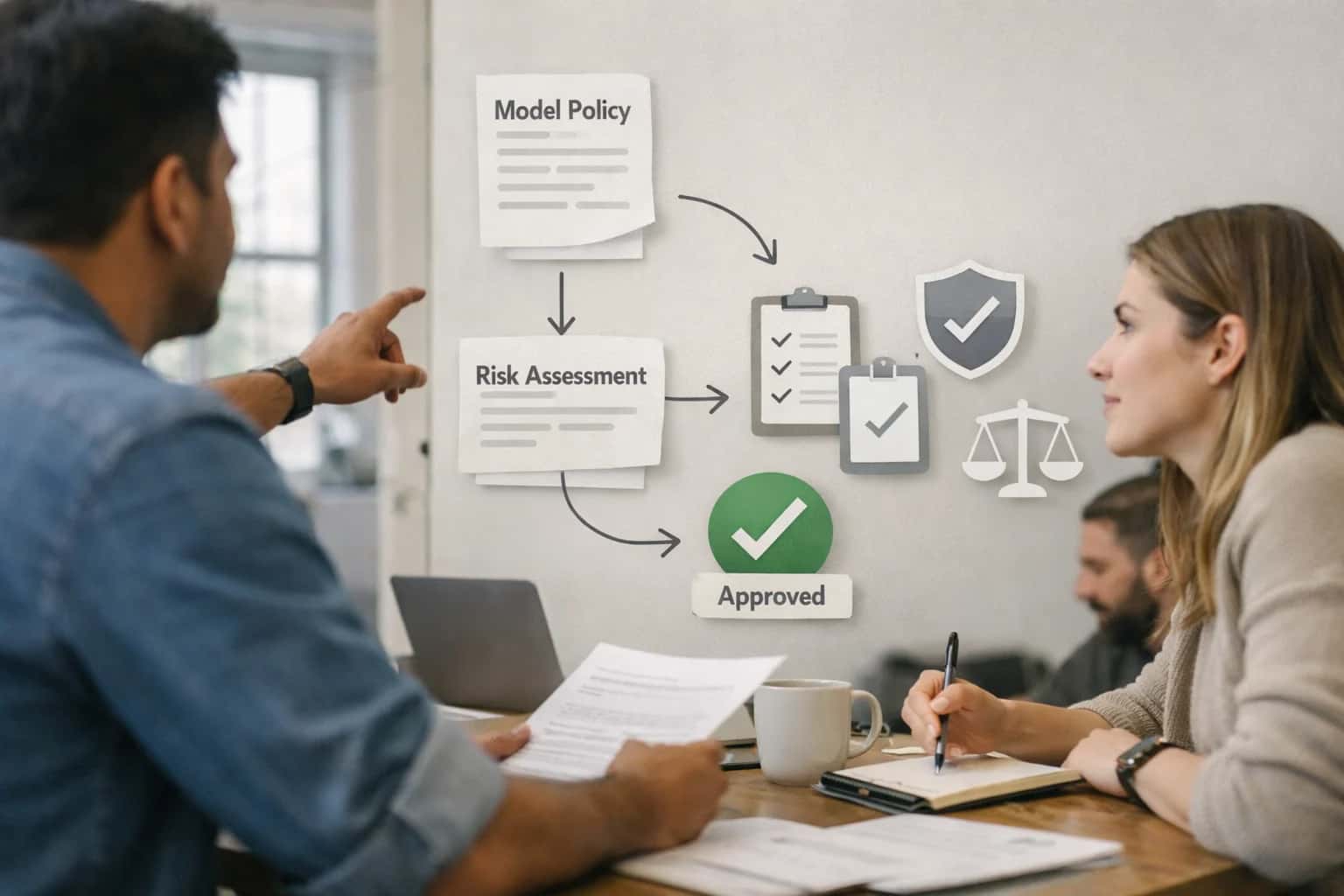
Why AI Governance is Non-Negotiable for CLM Integrations
Implementing AI for contract review without a governance framework exposes legal and procurement teams to unacceptable risk.
A production-ready AI-CLM integration wires governance directly into the platform's native workflows. For example, in Icertis, an AI agent might extract a liability cap from a supplier agreement. The governance system should log the exact text snippet provided to the model, the prompt used, the model's output, and its confidence score. This data is attached to the contract record. If the confidence is below a pre-set threshold, the task is automatically routed via Icertis's workflow engine to a procurement specialist for validation. All overrides are captured, creating a feedback loop to retrain the model. Similarly, in Ironclad, a generative AI draft of a playbook clause must be presented with a change justification that references the underlying policy document, allowing legal ops to approve or reject with full context.
Rolling out AI without this governance foundation leads to 'shadow AI' risks and compliance gaps. A structured pilot program should define allowed use cases (e.g., NDA review vs. complex joint venture agreements), establish RBAC for who can approve AI outputs, and implement continuous evaluation against ground-truth data. The goal isn't to slow down automation but to make it auditably reliable. By baking governance into the integration from the first proof of concept—using tools for tracing like Weights & Biases or building custom audit logs into your CLM's object model—you ensure the AI augments your legal team's judgment without compromising their oversight, turning contract intelligence into a controlled, scalable asset. For related patterns, see our guides on AI Integration for Contract AI Security and AI Integration for Contract AI Audit Trail.
Governance Touchpoints Across CLM Platforms
Managing AI Models and Prompts in CLM
Governance begins with controlling the AI models and prompts used for contract tasks. Within platforms like Ironclad's AI Assistant or Icertis AI Studio, you must manage which model versions (GPT-4, Claude 3, fine-tuned variants) are deployed for specific tasks like clause extraction versus summarization. This includes:
- Version Control: Track model versions and roll back if accuracy degrades. Log which model processed each contract version.
- Prompt Management: Centralize and version prompts for tasks like risk detection or obligation extraction. Use a system like a prompt registry to ensure consistency and auditability.
- Testing & Validation: Implement a QA pipeline to test new models/prompts against a golden set of contracts before production deployment.
This layer ensures the AI's "brain" is known, approved, and performing as expected, which is critical for legal professional responsibility.
High-Value Governance Use Cases for Contract AI
Integrating AI into contract lifecycle management requires robust governance to manage risk, ensure accuracy, and maintain legal accountability. These patterns establish the guardrails for production AI-CLM workflows.
Prompt Management & Version Control
Govern the LLM prompts used for clause extraction and summarization. Track prompt versions, A/B test performance, and roll back changes. Ensures consistent, auditable AI outputs across thousands of contract reviews.
Human-in-the-Loop Review Gates
Configure the CLM workflow engine to automatically route AI-extracted data or redline suggestions for human attorney review based on configurable risk scores (e.g., high-value contracts, non-standard clauses). Maintains professional responsibility.
AI Action Audit Trail
Log every AI interaction—input context, model call, raw output, and final human decision—directly to the contract's activity log in Ironclad or Icertis. Creates a defensible record for compliance audits and model retraining.
Model Performance & Drift Monitoring
Continuously evaluate extraction accuracy (e.g., F1 scores for obligation identification) against a golden set of contracts. Trigger alerts in the CLM or a dedicated dashboard when performance degrades, signaling the need for model retraining.
RBAC for AI Feature Access
Integrate AI tool access with the CLM platform's existing role-based permissions. For example, only senior counsel can enable generative drafting, while paralegals may only use pre-approved summarization features.
Compliance-Preserving Data Redaction
Automatically redact PII, PHI, or sensitive financial terms from contract text before sending to an external LLM for analysis. Governs data residency and privacy, often using a preprocessing service call within the CLM workflow.
Governed AI Workflow Examples
These governed workflows illustrate how AI can be integrated into your CLM platform with proper controls, human oversight, and auditability. Each pattern follows a trigger-action-review structure to ensure legal professional responsibility is maintained.
Trigger: A vendor or partner submits an NDA via a webform connected to the CLM (e.g., Ironclad's Webforms).
Context Pulled: The AI system retrieves the submitting party's details from the intake form and checks the CLM for any existing agreements with that entity.
AI Agent Action:
- A pre-configured AI model extracts key clauses (e.g., term length, jurisdiction, IP ownership, liability caps).
- The agent scores the document against the company's standard NDA playbook, flagging any high-risk deviations.
- It generates a summary and a recommendation:
Standard,Low-Risk Review, orHigh-Risk Legal Review.
System Update: The CLM workflow is automatically updated:
StandardNDAs are routed for e-signature.Low-RiskNDAs are assigned to a paralegal for a 5-minute review.High-RiskNDAs are assigned to a specific attorney based on jurisdiction.
Human Review Point: The AI's scoring, extracted clauses, and recommendation are logged in the CLM's audit trail. The assigned reviewer can see the AI's rationale and override the classification, which feeds back into model training.
Implementation Architecture: The Governance Layer
A practical framework for governing AI use within CLM integrations, focusing on model control, human oversight, and compliance with legal professional responsibility.
Effective AI governance for contracts is built on a three-tiered control layer that sits between the CLM platform (Ironclad, Icertis, Agiloft, DocuSign CLM) and the AI models. This layer manages: 1) Model & Prompt Versioning to track which model (GPT-4, Claude, fine-tuned internal model) and prompt template was used for each extraction or analysis; 2) Human-in-the-Loop (HITL) Gates that route high-risk clauses, deviations from playbooks, or low-confidence extractions to a legal reviewer within the existing CLM workflow; and 3) Immutable Audit Logs that record the input document hash, the AI's raw output, the reviewer's decision, and the final data written to the CLM's custom object or metadata field.
Implementation requires integrating with the CLM's API-driven workflow engine and event webhooks. For example, when a new contract version is uploaded to Ironclad, a webhook triggers the governance layer. The AI service processes the document, but instead of writing directly to Ironclad's clause library, it posts a structured payload—including confidence scores and suggested redlines—to a dedicated review queue object. An approval workflow, using the CLM's native tasking system, notifies the responsible attorney. Only upon their approval (or override) are the AI-generated terms written to the final contract record, with the entire decision chain preserved. This pattern ensures the final authority rests with the legal professional, while AI handles the heavy lifting of initial review and data surfacing.
Rollout should start with a controlled pilot on a single contract type (e.g., NDAs). Define clear governance rules in code: for instance, 'any clause with a liability cap must be reviewed' or 'extractions with <95% confidence go to HITL.' Use the CLM's reporting modules to generate dashboards tracking AI-assisted vs. fully manual review times, override rates, and error corrections. This data is critical for demonstrating ROI, refining models, and satisfying internal audit or compliance teams that the AI is operating as a controlled tool, not an autonomous decision-maker.
Code and Configuration Examples
Centralized Prompt Management
Governance starts with controlling the prompts and models used in production. Instead of hardcoding prompts, manage them as versioned assets in a configuration store or feature flag system. This allows for A/B testing, rollback, and audit trails.
Example Configuration (YAML):
yamlprompt_version: v2.1 model_provider: azure-openai model_name: gpt-4-turbo system_prompt: | You are a contract analysis assistant. Your role is to identify clauses related to liability and indemnification. You must: - Cite the exact section number and text. - Flag any language deviating from our standard playbook (ID: LIAB-PLAYBOOK-2024). - Do not provide legal advice or interpretation. - Output in JSON format. temperature: 0.1 max_tokens: 1000 allowed_tools: ["clause_lookup", "playbook_validator"] approval_workflow: "legal_ops_review"
This configuration is fetched by your integration service before each AI call, ensuring consistency and enabling centralized updates without code deployment.
Governance Impact: Risk Reduction vs. Process Overhead
This table compares the operational and compliance impacts of integrating governed AI into a Contract Lifecycle Management (CLM) platform, balancing risk reduction with the practical overhead of new governance processes.
| Governance Activity | Before AI Integration | After AI Integration | Key Considerations |
|---|---|---|---|
Clause Review & Deviation Detection | Manual, sample-based audits; high risk of missing non-standard terms. | Continuous, AI-powered scanning of 100% of contracts; flagged exceptions routed for review. | Requires initial playbook codification and ongoing tuning of detection models. |
Obligation Tracking & Compliance | Spreadsheet-based or reactive; obligations often missed until a breach occurs. | Automated extraction and creation of tracked tasks with deadline alerts in CLM or project tools. | Integration with operational systems (ERP, CRM) needed for closed-loop tracking. |
Approval Workflow Routing | Generic routing based on contract type or value; legal team bottlenecks common. | AI-scored risk determines routing; low-risk, standard agreements auto-approved. | Human-in-the-loop override must be preserved for high-stakes or novel agreements. |
Audit Trail & Change Justification | Manual notes in CLM or email; difficult to reconstruct decision rationale. | Comprehensive, immutable logs of AI suggestions, human actions, and model versions. | Logs must be structured for regulatory inquiries and internal model governance reviews. |
Model & Prompt Management | N/A (no AI models in production). | Centralized registry for model versions, prompt templates, and performance metrics. | Introduces new LLMOps overhead but enables controlled experimentation and rollback. |
Regulatory & Policy Compliance Checks | Periodic manual reviews against new regulations; slow to implement changes. | AI monitors active contracts against a dynamic rulebook; generates compliance reports. | Rulebook must be maintained by legal/compliance as regulations and policies evolve. |
Third-Party/Vendor Risk Assessment | Manual questionnaire collection and review; infrequent updates. | AI analyzes contract terms and external data to score vendor risk continuously. | Risk scoring logic must be transparent and explainable to procurement and legal teams. |
Training & User Enablement | Training focused on CLM platform use and legal process. | Additional training on AI assistant interaction, interpreting AI suggestions, and override protocols. | Change management is critical to ensure trust and appropriate reliance on AI outputs. |
Governance and Phased Rollout Strategy
A practical framework for deploying AI in CLM platforms with appropriate oversight, risk management, and measurable impact.
Start with a tightly scoped pilot on a single, high-volume contract type—like NDAs or simple MSAs—within your Ironclad, Icertis, Agiloft, or DocuSign CLM instance. This initial phase should focus on a single AI capability, such as clause extraction or playbook deviation flagging. Implement a human-in-the-loop (HITL) review step where all AI suggestions are presented as recommendations that a legal ops analyst must approve or reject before any system action is taken. Log every AI inference, user decision, and override in an immutable audit trail within the CLM's native audit log or a dedicated LLMOps platform like Arize AI or Weights & Biases.
For the production rollout, establish clear governance guardrails. This includes model versioning to track which AI model (e.g., GPT-4, Claude 3, a fine-tuned internal model) generated a suggestion, and prompt management to ensure all system prompts are version-controlled and reviewed for compliance. Integrate the AI workflow with your CLM's existing role-based access controls (RBAC) and approval matrices. For instance, AI-generated redlines on a high-value sales contract might require a senior counsel's approval before being sent to the counterparty, while AI-extracted metadata for procurement contracts may auto-populate after a procurement manager's review.
A phased approach mitigates risk and builds organizational trust. Phase 1 could be AI-assisted review and summarization (read-only). Phase 2 introduces drafting and redlining suggestions with mandatory HITL. Phase 3 enables conditional, automated approvals for low-risk, standard agreements based on AI scoring. Each phase should have defined success metrics—like reduction in manual review time, increase in clause extraction accuracy, or decrease in contract cycle days—measured against the pre-AI baseline. This structured, governed rollout ensures AI augments legal professional responsibility without compromising control or compliance.
Enabling Efficiency, Speed & Accuracy
Intelligent Analysis, Decision & Execution
We build AI systems for teams that need search across company data, workflow automation across tools, or AI features inside products and internal software.
Talk to Us
Search across company data
Give teams answers from docs, tickets, runbooks, and product data with sources and permissions.
Useful when people spend too long searching or get different answers from different systems.

Automate internal workflows
Use AI to route work, draft outputs, trigger actions, and keep approvals and logs in place.
Useful when repetitive work moves across multiple tools and teams.

Add AI to products and internal tools
Build assistants, guided actions, or decision support into the software your team or customers already use.
Useful when AI needs to be part of the product, not a separate tool.
Frequently Asked Questions on CLM AI Governance
Practical questions from legal, procurement, and IT leaders on deploying and governing AI within Contract Lifecycle Management platforms like Ironclad, Icertis, Agiloft, and DocuSign CLM.
Governance starts with a model registry and routing logic. A typical implementation includes:
- Central Model Registry: Maintain a controlled list of approved models (e.g., GPT-4, Claude 3, fine-tuned internal model) with version tracking.
- Attribute-Based Routing: Direct contract tasks to specific models based on:
- Data Sensitivity: Use local or private models for PII/PHI-heavy contracts.
- Task Complexity: Route simple clause extraction to a cost-efficient model, and complex negotiation analysis to a more capable (and expensive) model.
- Jurisdiction: Comply with data residency requirements by routing contracts from specific regions to models deployed in corresponding geographies.
- CLM Integration Point: This logic is embedded in a middleware layer or directly within the CLM platform's workflow engine using custom actions. The AI call is never made directly from the user's browser; it's orchestrated through a governed API gateway.
Example Payload to Routing Service:
json{ "clm_platform": "Ironclad", "contract_id": "CT-2024-5678", "task_type": "obligation_extraction", "data_classification": "internal_use", "requesting_team": "procurement" }
The service returns the endpoint and API key for the appropriate model to use.

About the author
Prasad Kumkar
CEO & MD, Inference Systems
Prasad Kumkar is the CEO & MD of Inference Systems and writes about AI systems architecture, LLM infrastructure, model serving, evaluation, and production deployment. Over 5+ years, he has worked across computer vision models, L5 autonomous vehicle systems, and LLM research, with a focus on taking complex AI ideas into real-world engineering systems.
His work and writing cover AI systems, large language models, AI agents, multimodal systems, autonomous systems, inference optimization, RAG, evaluation, and production AI engineering.
Partnered with leading AI, data, and software stack.





How We Work
Custom AI workflows for your Business
One-fit-all AI don't work for modern businesses. At Inferensys, we aim to understand your business & custom requirements; which we use to define most efficient agentic workflows, the data, and the tools for your business.
01
Review the use case
We understand the task, the users, and where AI can actually help.
Read more02
Pick the right approach
We define what needs search, automation, or product integration.
Read more03
Build the first useful version
We implement the part that proves the value first.
Read more04
Improve from there
We add the checks and visibility needed to keep it useful.
Read moreThe first call is a practical review of your use case and the right next step.
Talk to Us