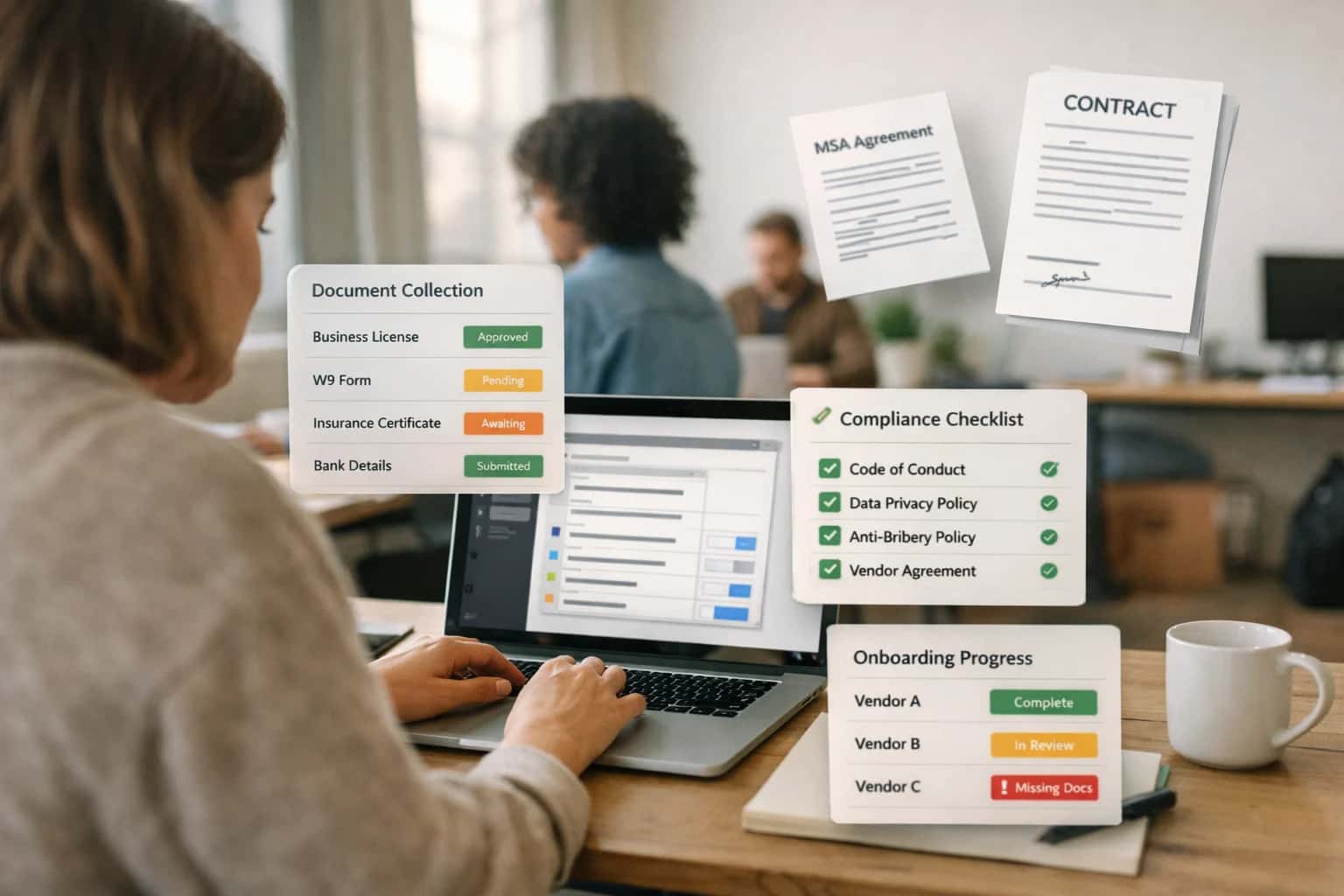
For technology companies, AI integration connects at three primary layers of the CLM stack: the intake and creation surface, the review and negotiation workflow engine, and the post-signature repository and analytics layer. In platforms like Ironclad, Icertis, Agiloft, or DocuSign CLM, this means using AI to parse webform submissions or CRM opportunities (e.g., from Salesforce) to auto-select the correct NDA, MSA, or Order Form template. The AI agent validates deal attributes against a configured playbook, populates key metadata fields like Effective Date, Renewal Term, and Governing Law, and triggers the appropriate approval routing—sending standard agreements for auto-approval and flagging non-standard terms for legal review.

Integration
AI Integration for CLM Platforms in Technology
A technical blueprint for SaaS and technology companies to integrate AI with Ironclad, Icertis, Agiloft, and DocuSign CLM. Automate high-volume contract review, link obligations to CPQ and billing, and accelerate deal velocity.
ARCHITECTURE AND ROLLOUT
Where AI Fits in the Technology CLM Stack
A practical guide to integrating AI into your Contract Lifecycle Management (CLM) platform to automate high-volume SaaS agreement workflows.
The core implementation involves building a RAG (Retrieval-Augmented Generation) pipeline that grounds an LLM (like GPT-4 or Claude) in your company's specific clause library, historical negotiated terms, and entitlement data from systems like Zuora or Salesforce CPQ. This pipeline powers use cases such as: - Intelligent Redlining: An AI copilot suggests specific edits to incoming vendor paper, highlighting deviations from your standard SaaS playbook and explaining the business risk.
- Obligation Extraction: AI parses executed contracts to identify key deliverables, reporting requirements, and SLA terms, creating tracked tasks in the CLM or syncing milestones to project tools like Jira.
- High-Volume Processing: For NDAs and simple MSAs, an AI classifier can review, extract counterparty data, and route for signature in minutes, reducing manual triage for legal operations.
Rollout requires a phased, governed approach. Start with a pilot on a single, high-volume contract type (e.g., NDAs) within a controlled user group. Implement a human-in-the-loop review step for all AI-generated outputs during the pilot, logging overrides to a dedicated audit trail for model tuning. Governance is critical; ensure your AI integration adheres to data residency requirements and redacts sensitive PII/PHI before processing. A successful integration doesn't replace legal judgment but shifts the team's focus from manual data entry and initial review to overseeing exceptions and strategic negotiation, turning the CLM from a system of record into an intelligent system of execution. For a deeper technical blueprint, see our guide on AI Integration for Contract Lifecycle Management Platforms.
TECHNOLOGY SECTOR
AI Integration Surfaces by CLM Platform
Automating High-Volume Contract Creation
For SaaS and technology companies, the intake and drafting of standard agreements (NDAs, MSAs, Order Forms) is a prime AI integration surface. AI can connect to webforms, CRM opportunities (like Salesforce), or CPQ outputs to trigger contract generation.
Key Integration Points:
- Webhook Triggers: Initiate a draft when a deal reaches a specific stage in Salesforce CPQ or a request is submitted via a portal.
- Template Assembly: Use AI to dynamically populate clause libraries (e.g., Ironclad's) based on deal attributes like product, jurisdiction, and customer tier.
- Playbook Enforcement: Codify legal playbooks into AI rules that check for missing exhibits, non-standard liability caps, or incorrect termination terms before routing for review.
Example Workflow: An AE updates an Opportunity to "Contracting." An AI agent, via the CLM API, pulls the product SKUs and pricing from the CPQ quote, selects the appropriate MSA template, populates the commercial terms, and routes it to Legal with a pre-scored risk summary.
FOR SAAS AND TECH COMPANIES
High-Value AI Use Cases for Technology CLM
For technology companies, CLM platforms like Ironclad, Icertis, and DocuSign CLM manage the commercial engine—MSAs, SLAs, NDAs, and license agreements. AI integration automates high-volume review, ensures compliance with revenue recognition rules, and creates a closed-loop system between contracts, CPQ, and entitlement platforms.
01
Automated NDA and Low-Risk MSA Review
AI agents triage inbound agreements from a webform or email, classify document type, and extract key parties, terms, and dates. For standard NDAs and low-risk MSAs, the system compares clauses against a pre-approved playbook, flags deviations, and can auto-approve or route for legal review. Typical workflow: Intake → AI Classification & Extraction → Playbook Comparison → Automated Routing/Approval.
Hours -> Minutes
Review cycle
02
SLA and Credit Schedule Extraction for CPQ
AI parses executed order forms and SOWs within the CLM to identify service level agreements (SLAs), credit schedules, and usage tiers. This data is structured and pushed via API to the Configure Price Quote (CPQ) platform (e.g., Salesforce CPQ) and entitlement systems (e.g., Zuora) to ensure billing, provisioning, and support tiers are automatically aligned with contract terms, eliminating manual configuration errors.
Eliminate Manual Sync
CPQ to CLM
03
Renewal Forecasting & Negotiation Intelligence
An AI model analyzes the entire contract portfolio—terms, historical amendments, usage data from product—to predict renewal likelihood, optimal timing, and potential negotiation points. It surfaces at-risk contracts to account teams via CRM integration and provides a negotiation brief summarizing prior concessions and standard positions for the upcoming renewal.
Same-Day Insights
For QBRs
04
Obligation Tracking for Implementation & Support
AI extracts specific customer obligations (e.g., data provisioning, environment readiness) and vendor commitments (e.g., implementation milestones, training sessions) from SOWs and MSAs. It then creates tracked tasks in project management tools (Jira, Asana) and service platforms (ServiceNow), triggering alerts for owners as dates approach and logging completion for audit trails.
Proactive vs. Reactive
Milestone management
05
IP & Licensing Clause Library Management
For technology licensing agreements, AI maintains and enriches a dynamic clause library within the CLM. It scans new contracts to detect non-standard IP grant-backs, indemnification, or open-source language, suggesting preferred language from the library. Over time, the AI identifies trends in third-party paper, helping legal teams update playbooks based on what is actually being accepted in market negotiations.
Centralized Intelligence
For global legal
06
Revenue Recognition & ASC 606 Compliance Prep
AI extracts performance obligations, transaction prices, and variable consideration terms from customer contracts. It structures this data and prepares summaries for finance teams, accelerating the month-end close by providing clear, auditable inputs for revenue recognition under ASC 606. The system flags contracts with complex terms (e.g., bundled services, discounts) for manual accounting review.
Accelerate Month-End
Close support
FOR TECHNOLOGY & SAAS COMPANIES
Example AI-Augmented Contract Workflows
For SaaS and technology companies, the contract lifecycle is a core revenue and risk operation. These AI-augmented workflows demonstrate how to embed intelligence into CLM platforms like Ironclad, Icertis, Agiloft, and DocuSign CLM to automate high-volume, repetitive tasks while maintaining legal and commercial guardrails.
Trigger: A counterparty submits an NDA via a webform connected to the CLM (e.g., Ironclad's Workflow Designer).
Context Pulled: The AI system extracts the submitting party's domain, the NDA document text, and any pre-filled form data (e.g., relationship type: vendor, partner, customer).
Agent Action:
- A pre-configured AI agent classifies the NDA as
Mutual,Incoming (One-Way), orOutgoing (One-Way). - It runs the document against the company's NDA playbook, checking for:
- Non-standard liability caps
- Overly broad IP definitions
- Unacceptable governing law clauses
- The agent generates a risk score (
Low,Medium,High) and a summary of flagged clauses.
System Update: Based on the risk score and classification, the CLM workflow automatically routes the NDA:
Low-Risk/Mutual Standard: Auto-approved and sent for e-signature.Medium-Risk: Routes to a paralegal or procurement specialist queue with the AI summary.High-Risk: Escalates to a specific attorney in the legal ops team.
Human Review Point: All Medium and High risk NDAs require human review. The AI summary and clause highlights are presented within the CLM's review interface to accelerate the lawyer's analysis.
CLM INTEGRATION BLUEPRINT
Implementation Architecture: Data Flow & Integration Patterns
A practical guide to wiring AI into your CLM platform for automated contract review, risk detection, and obligation tracking.
For a technology company, the core integration surfaces are the CLM's contract repository API, workflow engine, and metadata model. The typical data flow starts when a new contract (MSA, SLA, NDA) is uploaded or drafted. An AI agent, triggered via webhook, extracts the document for processing. Using a RAG pipeline grounded in your approved clause library and historical agreements, the AI performs key tasks: identifying parties, dates, and financial terms for metadata population; extracting and classifying clauses against your playbook; and scoring the document for standard vs. non-standard language. This structured output is posted back to the CLM, populating custom fields in platforms like Ironclad or Icertis and creating initial risk flags.
The integration pattern then connects this intelligence to downstream systems. For example, extracted obligation dates can create tasks in a project tool like Asana via API; pricing terms from a license agreement can be validated against the configured product in Salesforce CPQ; and renewal triggers can initiate a workflow in your marketing automation platform. The architecture should employ a central orchestration layer (often using tools like n8n or a custom service) to manage these cross-system calls, handle retries, and maintain an audit log. This ensures the AI's insights don't just sit in the CLM but activate operational workflows in CPQ, entitlement, and support systems.
Rollout requires a phased approach. Start with a single, high-volume contract type (e.g., NDAs) to validate the extraction accuracy and workflow integration. Implement a human-in-the-loop review step for all AI outputs during the pilot, using the CLM's native approval tasks. Governance is critical: establish clear RBAC for who can override AI suggestions, maintain a versioned prompt library, and ensure all AI-touched data flows comply with your data residency and security policies. For a deeper dive on grounding AI responses in your specific contract library, see our guide on RAG for CLM platforms.
TECHNOLOGY CONTRACT WORKFLOWS
Code & Payload Examples
Automating High-Volume NDA Review
For SaaS companies, NDAs are high-volume, low-risk agreements. An AI agent can handle the initial intake, review, and routing, freeing legal ops for complex deals.
Typical Workflow:
- NDA submitted via webform or email to CLM (e.g., Ironclad).
- AI agent is triggered via webhook, fetches the document via CLM API.
- Agent extracts key parties, term, and indemnity clauses.
- Based on playbook rules, it either auto-approves standard NDAs or routes exceptions with a risk summary.
Example Payload to AI Service:
json{ "event": "contract.created", "contract_id": "NDA-2024-00123", "platform": "ironclad", "document_url": "https://storage.ironcladapp.com/nda.pdf", "metadata": { "submitted_by": "[email protected]", "counterparty": "Startup ABC Inc." } }
The AI service returns a structured analysis, determining routing path and populating CLM fields for tracking.
FOR TECHNOLOGY COMPANIES
Realistic Time Savings & Operational Impact
How AI integration for CLM platforms accelerates core contract workflows for SaaS and technology businesses, based on typical implementation patterns.
| Workflow / Task | Before AI Integration | After AI Integration | Implementation Notes |
|---|---|---|---|
Initial NDA Review & Approval | 1-2 business days manual legal check | Same-day automated routing | AI scores risk, flags non-standard terms; legal only reviews exceptions |
MSA/SLA Clause Extraction & Population | Manual review and data entry (2-3 hours per contract) | Automated extraction to CLM fields (15-20 minutes) | AI maps clauses to playbook; human validates key financial/liability terms |
Contract Redlining Against Playbook | Manual comparison (3-4 hours for complex agreements) | AI-powered deviation analysis (30-45 minutes) | AI suggests edits and explains rationale; negotiator makes final call |
Obligation Identification & Task Creation | Manual reading and spreadsheet tracking | Automated extraction and task assignment in CLM/CRM | AI parses for deliverables, dates, and reports; creates tasks in Asana or Jira |
High-Volume NDA/Order Form Intake | Manual triage and template selection | AI classification & auto-routing (minutes) | Webform submissions processed via AI; only non-standard flows require ops review |
Renewal Forecasting & Package Assembly | Manual contract review and spreadsheet analysis | AI-driven prediction and draft generation | AI analyzes terms and usage; generates renewal package with key terms highlighted |
Contract Repository Q&A for Sales | Manual search and legal team inquiries | RAG-powered chatbot answers in seconds | AI grounds answers in approved playbooks and historical contracts; reduces legal ticket volume |
IMPLEMENTATION BLUEPRINT
Governance, Security, and Phased Rollout
A practical framework for deploying AI in your CLM platform with control and measurable impact.
For technology companies, AI governance starts at the data layer. Your CLM platform (Ironclad, Icertis, Agiloft, DocuSign CLM) houses sensitive MSAs, SLAs, and NDAs. A secure integration uses the platform's native APIs and webhooks to process documents within your existing security perimeter. AI models should never receive raw, unfiltered contract files. Instead, implement a pipeline that first redacts sensitive PII or confidential commercial terms, then sends sanitized text chunks for analysis. All AI actions—clause extraction, risk scoring, summarization—must be logged back to the CLM's audit trail, creating a complete chain of custody for compliance reviews and model performance tracking.
A phased rollout is critical for adoption and risk management. Start with a high-volume, low-risk process like NDA intake and triage. Deploy an AI agent that classifies incoming NDAs against your standard playbook, flags non-standard clauses for legal review, and auto-routes compliant agreements for signature. This delivers immediate time savings for legal ops and builds trust. Phase two targets SLA and MSA review, where AI provides a redlining copilot that suggests edits based on approved fallback language and highlights deviations from your standard terms. The final phase integrates AI-driven obligation extraction with downstream systems like your CPQ (e.g., Salesforce CPQ) or entitlement platform, automatically creating tracked milestones and syncing key dates to ensure service delivery aligns with contract terms.
Maintain a human-in-the-loop (HITL) approval layer for all AI-generated outputs, especially during initial phases. Configure your CLM's workflow engine to require a legal or deal desk review for any contract the AI scores as high-risk or outside tolerance. This controlled approach allows you to measure AI accuracy (e.g., reduction in manual review time, increase in clause extraction precision) and gradually expand its authority. For a deeper technical dive on architecting these secure, phased integrations, see our guide on AI Integration for Contract Lifecycle Management Platforms.
Enabling Efficiency, Speed & Accuracy
Intelligent Analysis, Decision & Execution
We build AI systems for teams that need search across company data, workflow automation across tools, or AI features inside products and internal software.
Talk to Us
Search across company data
Give teams answers from docs, tickets, runbooks, and product data with sources and permissions.
Useful when people spend too long searching or get different answers from different systems.
Enterprise searchRAGPermissions
Read more
Automate internal workflows
Use AI to route work, draft outputs, trigger actions, and keep approvals and logs in place.
Useful when repetitive work moves across multiple tools and teams.
AI agentsWorkflow automationGovernance
Read more
Add AI to products and internal tools
Build assistants, guided actions, or decision support into the software your team or customers already use.
Useful when AI needs to be part of the product, not a separate tool.
AI integrationDecision supportModel routing
Read moreIMPLEMENTATION AND OPERATIONS
Frequently Asked Questions
Practical questions from technology company leaders planning AI integration for their CLM platform.
Start with high-volume, lower-risk agreements to build confidence and refine the pipeline.
Recommended Phasing:
- Phase 1: NDAs & Simple Order Forms. Use AI for intake, data extraction, and routing. Low complexity, high volume, minimal risk.
- Phase 2: Standard MSAs & SLAs. Introduce AI for clause extraction against playbooks, redlining suggestions, and obligation identification. Involve legal for review of AI outputs.
- Phase 3: Complex Agreements (Partnerships, Licensing). Deploy AI for summarization, key term extraction, and obligation tracking. Maintain strong human-in-the-loop review.
Key Consideration: Align each phase with a specific business unit (e.g., Phase 1 with Sales Ops, Phase 2 with Procurement) to manage change and measure impact clearly.

About the author
Prasad Kumkar
CEO & MD, Inference Systems
Prasad Kumkar is the CEO & MD of Inference Systems and writes about AI systems architecture, LLM infrastructure, model serving, evaluation, and production deployment. Over 5+ years, he has worked across computer vision models, L5 autonomous vehicle systems, and LLM research, with a focus on taking complex AI ideas into real-world engineering systems.
His work and writing cover AI systems, large language models, AI agents, multimodal systems, autonomous systems, inference optimization, RAG, evaluation, and production AI engineering.
LinkedIn
Limited slotsGet a Free AI Consultation
Partnered with leading AI, data, and software stack.





How We Work
Custom AI workflows for your Business
One-fit-all AI don't work for modern businesses. At Inferensys, we aim to understand your business & custom requirements; which we use to define most efficient agentic workflows, the data, and the tools for your business.
01
Review the use case
We understand the task, the users, and where AI can actually help.
Read more02
Pick the right approach
We define what needs search, automation, or product integration.
Read more03
Build the first useful version
We implement the part that proves the value first.
Read more04
Improve from there
We add the checks and visibility needed to keep it useful.
Read moreThe first call is a practical review of your use case and the right next step.
Talk to Us