In enterprise operations, a critical disconnect often exists between the legal terms in a vendor contract and the operational reality in IT Service Management (ITSM) platforms like ServiceNow. Key obligations—such as service-level agreements (SLAs), security review schedules, data handling requirements, and renewal notification windows—are locked in PDFs within your Contract Lifecycle Management (CLM) system (e.g., Ironclad, Icertis). An AI integration acts as the connective tissue, parsing executed contracts to identify these actionable IT obligations and automatically creating corresponding records in the ITSM platform. This transforms static contract data into live, tracked work items for IT, procurement, and vendor management teams.

Integration
AI Integration for CLM and ITSM Integration
Bridge the gap between legal agreements and IT operations. Use AI to automatically extract service terms, SLAs, and obligations from contracts in your CLM and create, update, and manage corresponding records, tasks, and alerts in ServiceNow.
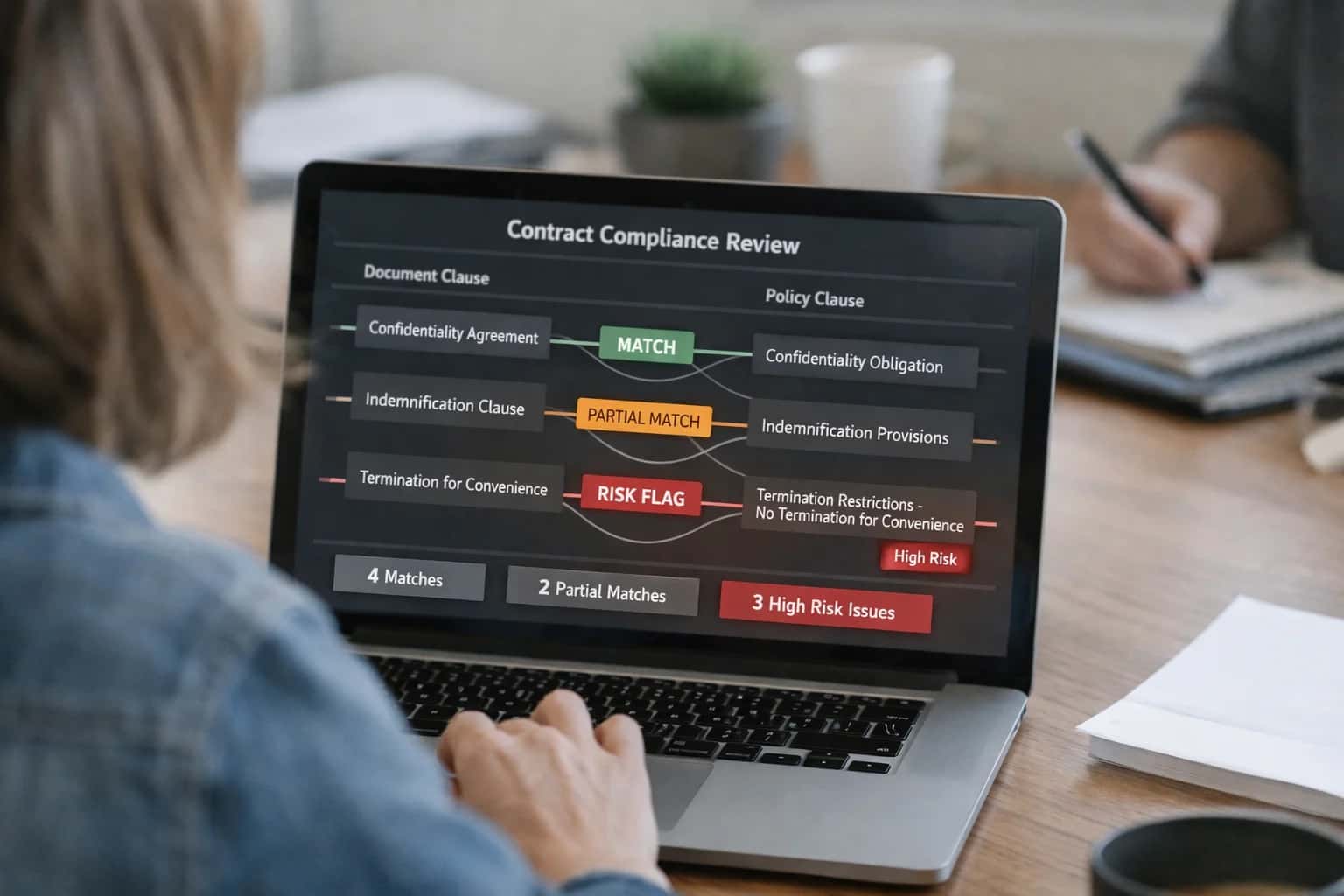
CLM AND ITSM INTEGRATION
Closing the Loop Between Contract Terms and IT Delivery
An AI integration blueprint to automatically translate contract obligations into actionable IT service tasks and performance SLAs.
The implementation centers on a secure middleware layer or agent that monitors the CLM platform's webhooks or API for contract status changes (e.g., status: executed). Upon trigger, the AI pipeline extracts the document, uses a fine-tuned model or RAG system grounded in your clause library to identify IT-relevant obligations, and structures the output. For example, it can create a ServiceNow Change Request for a new software implementation mandated by the contract, generate a Vendor Performance task in a custom application with linked SLA metrics, or schedule recurring Security Review tickets in the IT calendar based on the stipulated frequency. The AI ensures the right data—parties, dates, specific technical requirements—flows accurately into the corresponding ITSM fields, eliminating manual data entry and interpretation errors.
Governance is paramount. This integration should be designed with a human-in-the-loop approval step for high-risk or high-value obligation creation. All AI-extracted terms and generated ITSM records must be logged to a secure audit trail, linking back to the source contract version. Rollout typically begins with a pilot on a single, high-volume contract type (e.g., SaaS vendor agreements) within a specific business unit, measuring success by the reduction in manual work order creation time and the improvement in SLA compliance visibility. This closes the operational loop, ensuring the promises made in the contract are systematically delivered by IT.
INTEGRATION PATTERN
Where AI Connects: CLM Triggers and ITSM Actions
Extracting Actionable Terms for ITSM
The integration begins by using AI to parse executed contracts within the CLM platform (Ironclad, Icertis, Agiloft, DocuSign CLM). The AI model is trained to identify specific, actionable obligations relevant to IT service delivery, such as:
- Service Level Agreements (SLAs): Response times, resolution times, uptime commitments.
- Provisioning Requirements: User license counts, software access, environment setup details.
- Security & Compliance Mandates: Required security controls, audit rights, data handling procedures.
- Support Terms: Designated support channels, escalation paths, maintenance windows.
These extracted terms are structured into a JSON payload, mapping each obligation to a target system-of-record in the ITSM platform (e.g., ServiceNow). This creates the foundational data layer for automated workflow creation.
AUTOMATED WORKFLOW ORCHESTRATION
High-Value Use Cases for CLM-ITSM AI Integration
Integrating AI across Contract Lifecycle Management (CLM) and IT Service Management (ITSM) platforms automates the handoff from signed agreement to operational execution. These patterns turn static contract terms into dynamic, actionable workflows in systems like ServiceNow.
01
Automated Service Provisioning
AI parses executed contracts in the CLM (e.g., Ironclad, Icertis) to identify entitlements, SLAs, and technical specifications. It then automatically generates and routes ServiceNow catalog requests or change tickets to provision accounts, set up environments, or allocate resources, eliminating manual intake and configuration errors.
Days -> Hours
Provisioning lead time
02
SLA & Obligation Monitoring
An AI agent continuously monitors active contracts in the CLM for performance obligations and SLA terms (e.g., uptime, response times). It correlates this with live incident and performance data from ServiceNow CMDB and Event Management, automatically generating breach risk alerts and initiating remediation workflows before issues escalate.
Reactive -> Proactive
Compliance posture
03
Vendor Support Ticket Enrichment
When a vendor-related incident is logged in ServiceNow, AI instantly queries the CLM to retrieve the relevant contract, contacts, escalation paths, and support terms. It pre-populates the ticket with this context, ensuring the support team operates with the correct agreement and leverages contracted support channels from the first touch.
Minutes saved per ticket
Agent efficiency
04
Intelligent Contract Renewal Operations
AI analyzes upcoming renewals in the CLM and assesses historical ticket volume, cost, and SLA performance from ServiceNow. It generates a renewal brief with data-driven recommendations (renegotiate, terminate, expand) and can automatically create a project or change record in ServiceNow to orchestrate the technical transition.
Data-Driven
Renewal decisions
05
Software License Compliance & Reclamation
AI reconciles license entitlements and usage rights from software contracts in the CLM with actual user and installation data from ServiceNow Software Asset Management (SAM). It identifies unused or underutilized licenses, triggers reclamation workflows, and prevents audit exposure by ensuring deployments stay within contractual bounds.
Cost Avoidance
Primary impact
06
Security & Access Review Triggers
Upon contract termination or a change in vendor relationship status within the CLM, AI automatically creates a review task in ServiceNow's GRC or Security Operations module. This triggers coordinated workflows to revoke system access, archive data per retention clauses, and update risk registers, ensuring contractual and security policies are enforced in sync.
Policy Enforcement
Automated
CLM AND ITSM INTEGRATION PATTERNS
End-to-End AI Workflow Examples
These concrete workflows demonstrate how AI bridges Contract Lifecycle Management (CLM) and IT Service Management (ITSM) platforms, automating service provisioning, SLA enforcement, and vendor performance tracking based on executed contract terms.
Trigger: A vendor contract is fully executed and marked as 'Active' in the CLM platform (e.g., Ironclad, Icertis).
AI Agent Action:
- The integration's AI agent is triggered via a webhook from the CLM.
- It extracts key provisioning data using a pre-trained model: vendor name, technical contacts, service start date, list of entitled services/software (e.g., 'Oracle Database Enterprise Edition, 50 users'), and access level requirements.
- The agent validates the extracted data against a master service catalog in the ITSM platform (ServiceNow) to map services to specific CI (Configuration Item) models and request templates.
System Update: 4. The agent uses the ITSM API to: - Create a new Vendor record in the CMDB, linking it to the contract's unique ID. - Generate and auto-approve a standard Change Request for service enablement. - Trigger a catalog task to create user accounts and assign licenses in the target systems (e.g., Active Directory, SaaS admin consoles). - Create a subscription record in the ITSM asset module for tracking and renewal.
Human Review Point: The Change Request is logged for audit. The agent sends a summary report to the procurement and IT operations managers for awareness.
CLM-ITSM BRIDGE
Implementation Architecture: Data Flow & AI Layer
A practical blueprint for connecting Contract Lifecycle Management (CLM) and IT Service Management (ITSM) platforms with an intelligent orchestration layer.
The core integration pattern establishes a bidirectional data flow between your CLM system (e.g., Ironclad, Icertis) and your ITSM platform (e.g., ServiceNow). Key data objects are synchronized: contract metadata (vendor, effective/expiry dates), extracted obligations (SLAs, reporting requirements, security controls), and performance milestones flow from the CLM to the ITSM. In return, ticket data (incidents, service requests), SLA compliance metrics, and asset inventory from the ITSM enrich the contract record, enabling proactive management. This sync is typically managed via REST APIs, webhooks, or a middleware layer like Azure Logic Apps or MuleSoft, ensuring systems remain the single source of truth for their respective domains.
The AI layer acts as the intelligent orchestrator, sitting between these systems. Its primary functions are:
- Obligation-to-Workflow Mapping: Using NLP models fine-tuned on legal and IT terminology, the AI parses contract clauses to identify actionable IT obligations. For example, it extracts a
"24/7 monitoring required"clause and automatically creates a corresponding ServiceNow catalog item or Configuration Item (CI) relationship for the vendor's service. - Proactive Provisioning & Alerting: Based on contract effective dates and renewal windows, the AI triggers automated workflows in the ITSM to provision user access, schedule vendor onboarding tasks, or generate change requests for service modifications.
- Performance & Compliance Monitoring: The AI continuously analyzes ITSM ticket data (resolution times, breach counts) against contractual SLA terms. It can generate risk scores, flag potential breaches to contract owners in the CLM, and even draft initial breach notification content.
Governance and rollout require a phased approach. Start with a read-only integration for a single contract type (e.g., SaaS vendor agreements) to populate ITSM CMDB fields. Then, enable one-way automation, such as auto-creating ServiceNow tasks for security review upon contract execution. Full bidirectional orchestration should be piloted with a controlled group of high-value vendors. Critical to success is establishing a human-in-the-loop review for AI-extracted obligations before they trigger system changes, and maintaining a detailed audit trail within the ITSM's audit log for all AI-initiated actions to ensure accountability and simplify troubleshooting.
CLM-ITSM INTEGRATION PATTERNS
Code & Payload Examples
From Contract Obligation to ServiceNow Incident
When a new obligation is extracted in your CLM platform (e.g., a vendor SLA requiring a quarterly security review), an AI agent can automatically create a corresponding ServiceNow incident. This ensures IT tasks are initiated the moment a contract is executed, not when someone remembers to check.
Example JSON Payload (CLM Webhook to ServiceNow):
json{ "contract_id": "CT-2024-0456", "vendor_name": "CloudSecure Inc.", "obligation_type": "Security Review", "frequency": "Quarterly", "next_due_date": "2024-07-01", "responsible_party": "IT Security Team", "clm_record_url": "https://clm.company.com/contracts/CT-2024-0456" }
An integration service receives this payload, maps the obligation_type to a ServiceNow template, and uses the ServiceNow REST API to create an incident with the due date set as the target resolution date. The incident description is enriched with a link back to the source contract in the CLM.
CLM-ITSM INTEGRATION
Realistic Time Savings & Operational Impact
This table illustrates the tangible operational improvements when connecting a Contract Lifecycle Management (CLM) platform like Ironclad or Icertis with an IT Service Management (ITSM) platform like ServiceNow using AI. The focus is on automating IT service provisioning, SLA enforcement, and vendor performance tracking based on executed contract terms.
| Workflow / Metric | Before AI Integration | After AI Integration | Implementation Notes |
|---|---|---|---|
IT Service Provisioning Request | Manual review of contract PDFs by IT admin to locate approved services and SLAs | AI auto-extracts approved services & SLAs from CLM, auto-creates ServiceNow catalog item | Triggered on contract execution in CLM; human review optional for high-value services |
SLA & OLA Setup | Manual entry of SLA terms from contract into ServiceNow CMDB and SLA modules | AI populates ServiceNow SLA definitions and OLA templates from parsed contract obligations | Requires mapping contract clause types to standardized ServiceNow SLA metrics |
Vendor Performance Dashboard Creation | Quarterly manual compilation of contract KPIs and ticket data for review | AI correlates ServiceNow incident/request data with contract SLA terms for real-time dashboards | Dashboard auto-flags potential breaches for vendor management review |
Software License & Access Fulfillment | Help desk manually validates user eligibility against contract annexes before granting access | AI validates user role/entitlement against contract terms, auto-approves standard requests in ServiceNow | Integrates with IAM (e.g., Okta) for automated user provisioning; exceptions routed to admin |
Contract Renewal & Amendment Trigger for IT | Reactive; IT notified weeks after procurement/legal initiates renewal | AI monitors contract expiry & usage in ServiceNow, creates proactive renewal task in CLM 90 days out | Bidirectional workflow: CLM triggers IT review, IT usage data informs CLM negotiation |
Vendor Support Ticket Triage | All tickets treated equally; criticality based on user input, not contractual priority | AI tags incoming vendor tickets with contractual priority/SLA based on CLM data, auto-routes to correct queue | Reduces mean time to resolution (MTTR) for contractually critical issues |
Security & Compliance Audit Evidence | Manual collection of contract documents and corresponding ServiceNow records for audits | AI links executed contract clauses (e.g., security requirements) to implemented ServiceNow controls & tickets | Automates evidence gathering for SOC2, ISO 27001, or vendor risk audits |
ENTERPRISE INTEGRATION ARCHITECTURE
Governance, Security, and Phased Rollout
A secure, governed approach to connecting AI intelligence between your CLM and ITSM platforms.
Integrating AI between a CLM like Ironclad or Icertis and an ITSM like ServiceNow requires a clear data governance model. The AI agent acts as a secure orchestrator, accessing contract objects (e.g., Obligation, Service Level Agreement, Vendor records) via the CLM's API and translating them into actionable ITSM items like Change Request, Catalog Item, or Vendor Performance task. All data flows must be encrypted in transit, and the AI's access should be scoped using role-based access controls (RBAC) native to each platform to ensure it only interacts with authorized contract and ticket data.
A phased rollout mitigates risk and demonstrates value. Start with a pilot focused on a single, high-volume workflow, such as automated service provisioning from executed vendor contracts. In this phase, the AI parses a newly executed contract in the CLM, identifies the approved services and technical specifications, and creates a pre-populated Service Catalog Request in ServiceNow for IT fulfillment. This limited scope allows teams to validate extraction accuracy, refine approval gates, and establish the audit trail before expanding to more complex use cases like SLA monitoring or compliance breach ticketing.
Governance is maintained through a human-in-the-loop (HITL) layer for critical decisions. For example, the AI can suggest a Priority 1 incident ticket for a missed SLA obligation, but a manager in the ITSM platform must approve its creation. All AI actions—data queries, generated summaries, created tickets—are logged with traceability back to the source contract and user session. This controlled approach ensures the integration augments operations without creating unmanaged automation sprawl, providing the auditability required for legal and IT compliance.
Enabling Efficiency, Speed & Accuracy
Intelligent Analysis, Decision & Execution
We build AI systems for teams that need search across company data, workflow automation across tools, or AI features inside products and internal software.
Talk to Us
Search across company data
Give teams answers from docs, tickets, runbooks, and product data with sources and permissions.
Useful when people spend too long searching or get different answers from different systems.
Enterprise searchRAGPermissions
Read more
Automate internal workflows
Use AI to route work, draft outputs, trigger actions, and keep approvals and logs in place.
Useful when repetitive work moves across multiple tools and teams.
AI agentsWorkflow automationGovernance
Read more
Add AI to products and internal tools
Build assistants, guided actions, or decision support into the software your team or customers already use.
Useful when AI needs to be part of the product, not a separate tool.
AI integrationDecision supportModel routing
Read moreCLM AND ITSM INTEGRATION
Frequently Asked Questions
Practical questions for architects and operations leaders planning to connect Contract Lifecycle Management (CLM) with IT Service Management (ITSM) platforms like ServiceNow using AI.
The most common trigger is the execution of a vendor or software contract within the CLM platform (e.g., Ironclad, Icertis).
- Event: A contract changes status to "Fully Executed" or "Active."
- AI Action: An AI agent, listening via webhook, is triggered. It retrieves the contract document and uses a Retrieval-Augmented Generation (RAG) pipeline over the CLM's knowledge base to extract specific ITSM-relevant terms.
- Key Data Extracted:
- Vendor name and technical contacts
- Service descriptions and SKUs
- Service Level Agreement (SLA) targets (e.g., uptime %, response times)
- Support tiers and escalation paths
- Contract start/end dates and renewal terms
- Output: A structured JSON payload containing the validated extraction is sent to the ITSM platform's API (e.g., ServiceNow's
cmdb_ci_serviceorast_contracttables).

About the author
Prasad Kumkar
CEO & MD, Inference Systems
Prasad Kumkar is the CEO & MD of Inference Systems and writes about AI systems architecture, LLM infrastructure, model serving, evaluation, and production deployment. Over 5+ years, he has worked across computer vision models, L5 autonomous vehicle systems, and LLM research, with a focus on taking complex AI ideas into real-world engineering systems.
His work and writing cover AI systems, large language models, AI agents, multimodal systems, autonomous systems, inference optimization, RAG, evaluation, and production AI engineering.
LinkedIn
Limited slotsGet a Free AI Consultation
Partnered with leading AI, data, and software stack.





How We Work
Custom AI workflows for your Business
One-fit-all AI don't work for modern businesses. At Inferensys, we aim to understand your business & custom requirements; which we use to define most efficient agentic workflows, the data, and the tools for your business.
01
Review the use case
We understand the task, the users, and where AI can actually help.
Read more02
Pick the right approach
We define what needs search, automation, or product integration.
Read more03
Build the first useful version
We implement the part that proves the value first.
Read more04
Improve from there
We add the checks and visibility needed to keep it useful.
Read moreThe first call is a practical review of your use case and the right next step.
Talk to Us