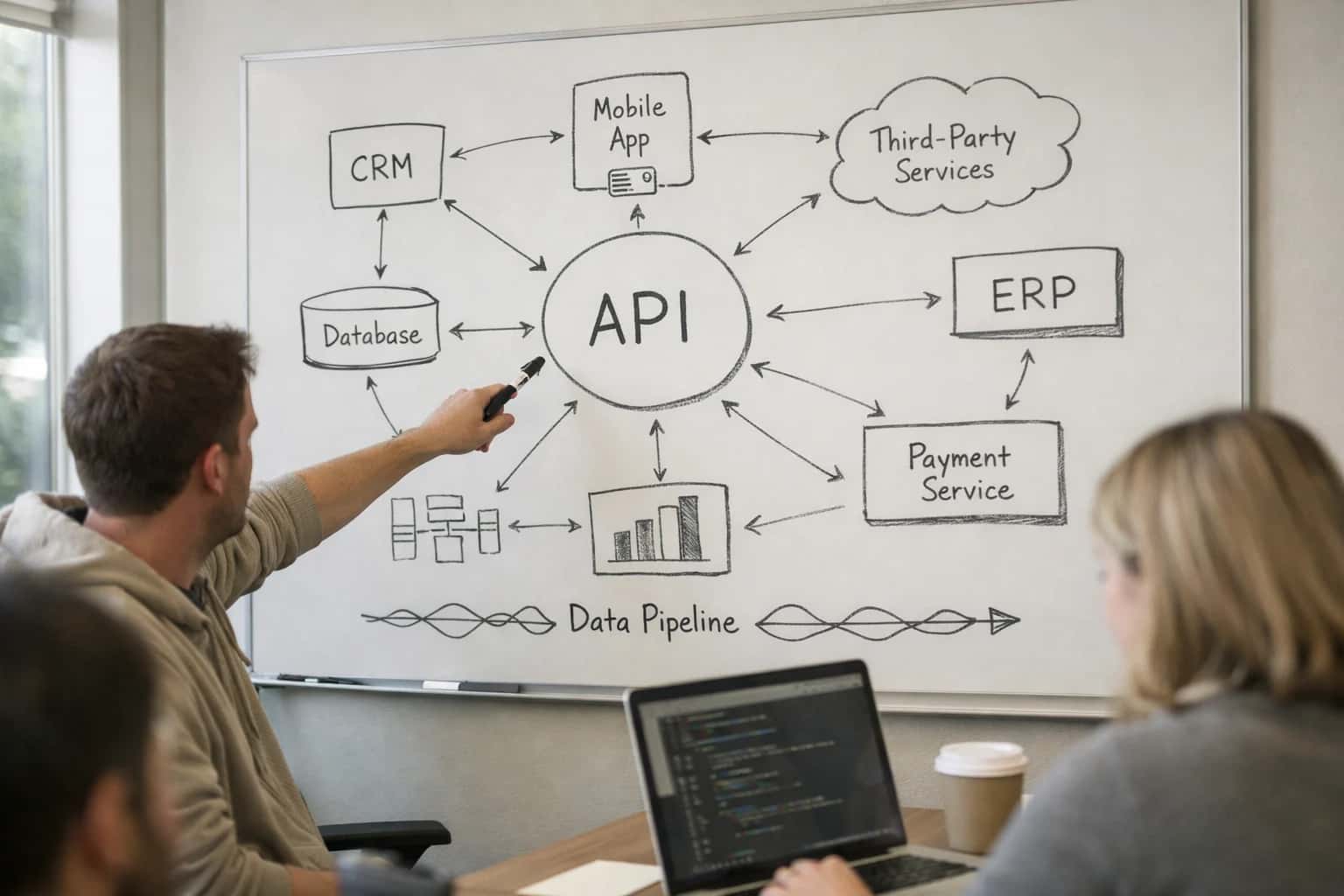
AI integration connects to the core data and workflow surfaces of your tournament management system—whether it's IGT Advantage Tournament Manager, Aristocrat Oasis 360, or a custom platform. The key connection points are the tournament registration API, player tracking database, leaderboard engine, and communications module. AI agents can be triggered by events like registration opens, blind level increases, or manual operator requests to execute tasks such as predicting final table timing, drafting player communications, or scanning for collusion patterns in betting histories.

Integration
AI for Casino Tournament Management Systems
A technical guide for casino poker and tournament managers on integrating AI to automate registration forecasting, optimize tournament structures, update leaderboards, detect collusion, and personalize player communications.
ARCHITECTURE AND ROLLOUT
Where AI Fits in Tournament Operations
A practical blueprint for integrating AI into tournament management systems to automate operations and enhance player experiences.
Implementation typically involves a middleware layer that subscribes to tournament system webhooks and maintains a real-time view of the tournament state. For example, an AI workflow could:
- Ingest real-time registration data to predict final player count and adjust structure recommendations.
- Monitor the leaderboard feed to automatically generate and post congratulatory messages for chip leaders at breaks.
- Analyze player hand histories and betting patterns from the table game system to flag potential collusion for review by the tournament director.
- Trigger personalized SMS or email communications through the casino's CRM for players who bust out, offering a tailored re-entry offer or next tournament suggestion.
Rollout should be phased, starting with a single, high-volume tournament type (e.g., daily poker tournaments) to validate data pipelines and user acceptance. Governance is critical: all AI-generated communications, structural adjustments, or collusion flags should be logged with a human-in-the-loop approval step initially. This ensures compliance with gaming regulations and allows floor managers to build trust in the system's recommendations. The final architecture should treat the AI as a copilot for the tournament director, automating repetitive tasks while leaving strategic decisions and final approvals in human hands.
CASINO MANAGEMENT PLATFORMS
Key Integration Surfaces in Tournament Systems
Core Registration Modules
AI integrates directly into the tournament registration engine, typically accessed via the casino management system's API (e.g., Aristocrat CMS Tournament Module, IGT Advantage Tournament Manager). Key surfaces include:
- Registration APIs: Ingest real-time and historical sign-up data to predict final field sizes, enabling dynamic pricing adjustments for late registration or overlay management.
- Pricing Tables: AI models recommend optimal buy-in and fee structures by analyzing player elasticity, day-of-week trends, and competing events.
- Waitlist Automation: Intelligent agents manage waitlists, predicting no-shows and automatically filling seats to maximize revenue and player satisfaction.
Implementation Pattern: A microservice polls the tournament system's registration endpoint, runs forecasting models, and posts recommended adjustments back via a secure API. This allows for same-day pricing shifts based on live demand signals.
POKER AND TOURNAMENT OPERATIONS
High-Value AI Use Cases for Tournament Management
Integrate AI directly into your tournament management system (TMS) to automate manual workflows, optimize pricing and structures, and enhance player security. These patterns connect to core TMS modules for registration, leaderboards, communications, and financial reconciliation.
01
Predictive Player Registration & Dynamic Pricing
Analyze historical registration patterns, player tier data, and local events to forecast tournament demand. Use AI to recommend optimal buy-in levels, guarantee sizes, and satellite structures to maximize field size and prize pool yield. Integrates with the TMS pricing module to adjust parameters days in advance.
Batch -> Proactive
Pricing Strategy
02
Automated Leaderboard & Payout Calculations
Connect AI to the TMS results feed to automatically validate finishes, calculate chop agreements, and generate payout schedules. Agents can draft player communications for wire details and tax forms (W-2G, 1042-S), reducing manual back-office work post-event. Ties into cage and accounting systems.
Hours -> Minutes
Post-Event Close
03
Collusion & Soft-Play Pattern Detection
Monitor real-time hand history and table observation data fed from the electronic table game (ETG) system or dealer inputs. AI models identify statistical anomalies indicative of chip dumping, signaling, or soft play. Alerts are routed to the surveillance and tournament director dashboards with supporting evidence.
Manual -> Automated
Integrity Monitoring
04
Intelligent Player Communications & Support
Deploy an AI agent integrated with the TMS player database and communication channels (email, SMS, in-app). It handles common FAQs about structure, rules, and schedules, provides personalized registration status, and automates reminders for starting times and table draws. Reduces front-desk and phone volume.
80% Deflection
Common Inquiries
05
Tournament Structure Optimization
Feed post-tournament analytics (blind level duration, bust-out rates, player feedback) into an AI model to recommend structural adjustments for future events. Suggests optimal starting stacks, blind schedules, and break structures to balance player experience with operational efficiency and rake targets.
Data-Driven
Structural Planning
06
VIP Host Task Automation & Touchpoints
Integrate AI with the host CRM module of the TMS. It analyzes player tournament history and theoretical win to prioritize host follow-ups, generate personalized recap emails for high-value players, and suggest re-entry or satellite offers for upcoming series. Keeps hosts focused on high-impact relationships.
Same day
Player Follow-up
CONCRETE IMPLEMENTATION PATTERNS
Example AI-Powered Tournament Workflows
These workflows illustrate how AI agents and automations connect to core tournament management modules—like registration, leaderboards, and financials—to reduce manual effort, optimize yield, and enhance player experience. Each pattern is designed to be triggered by system events and update records via API.
Trigger: Tournament director initiates planning for a new series.
Context Pulled:
- Historical registration data for similar events (player count, buy-in tiers, day/time).
- Current player database segments and their recent play activity.
- Competing event schedules from internal calendars.
Agent Action:
- An AI model forecasts expected registration volume and player mix.
- A second agent analyzes the forecast against profitability targets and suggests optimal:
- Buy-in price points
- Guaranteed prize pool adjustments
- Starting stack sizes
- Re-entry or re-buy structures
System Update:
- Recommended structure is presented in the tournament management console for review.
- Upon approval, the agent auto-populates the tournament template in the system (e.g., IGT Tournament Manager, Bally Table View tournament module).
Human Review Point: Tournament director must approve or modify the AI-suggested structure before creation.
FROM TOURNAMENT DATABASE TO AI-ENHANCED OPERATIONS
Implementation Architecture: Data Flow and System Wiring
A practical blueprint for connecting AI models to your tournament management system's core data and workflows.
The integration connects at three primary layers of the tournament management system (TMS): the registration and player database, the real-time scoring and leaderboard engine, and the tournament director console. Data flows from the TMS (e.g., player buy-ins, table assignments, blind levels, chip counts) via secure APIs or a dedicated message queue (like RabbitMQ or Apache Kafka) to an AI processing layer. This layer hosts models for predictive registration, collusion pattern detection, and dynamic structure optimization, which analyze the ingested data to generate insights and recommended actions.
For a production rollout, we implement a phased approach. Phase 1 wires the AI to the registration module to predict late sign-ups, allowing the director's console to suggest optimal starting table counts. Phase 2 integrates with the scoring API to monitor chip movements and flag anomalous collusion patterns for review in a dedicated surveillance dashboard. Phase 3 connects to the pricing and structure engine, using AI to simulate different blind schedules and recommend adjustments that maximize player satisfaction and house revenue. Each phase includes a human-in-the-loop approval step within the TMS interface before any AI-suggested change is executed, ensuring director control.
Governance is critical. All AI inferences and director actions are logged to an immutable audit trail linked to the tournament ID. The system enforces role-based access, so only authorized pit managers can approve structural changes. We recommend a shadow mode for the first 30-60 days, where AI predictions are displayed alongside human decisions without auto-execution, allowing the casino to validate model accuracy and build operator trust. This architecture ensures the AI augments—never replaces—the tournament director's expertise, turning data into a decisive operational advantage.
AI INTEGRATION PATTERNS
Code and Payload Examples
Ingest Player Data for Tournament Forecasting
This example shows a Python service that pulls historical player data from the tournament management system's database to predict registration for an upcoming event. The AI model analyzes factors like past participation, player tier, and recent win/loss activity.
pythonimport pandas as pd from inference_systems import llm_orchestrator # Query player and tournament history from the CMS data warehouse player_query = """ SELECT player_id, tier_level, total_tournaments_played_last_90d, avg_buy_in, last_participation_date, theoretical_win FROM player_tournament_history WHERE casino_id = %s """ # Enrich with upcoming tournament details tournament_context = { "buy_in": 500, "game_type": "NLHE", "guaranteed_pool": 100000, "start_time": "2024-06-15 14:00:00" } # Call orchestration layer to score registration likelihood payload = { "player_dataframe": player_df.to_dict(orient='records'), "tournament_context": tournament_context, "model": "registration_prediction_v1" } prediction_response = llm_orchestrator.predict(payload) # Returns: {player_id: "12345", registration_probability: 0.82, predicted_buy_in_source: "cash"}
Output feeds into the tournament module to adjust marketing spend and structure waitlist logic.
AI-ENHANCED TOURNAMENT OPERATIONS
Realistic Time Savings and Operational Impact
This table illustrates the tangible operational improvements when integrating AI into a casino tournament management system. It focuses on reducing manual effort, accelerating decision cycles, and enhancing the quality of player interactions.
| Workflow / Task | Before AI Integration | After AI Integration | Implementation Notes |
|---|---|---|---|
Tournament Structure & Pricing Analysis | Manual spreadsheet modeling, takes 2-3 days per tournament | AI-generated models with scenario analysis in 2-3 hours | Analyst reviews and adjusts AI recommendations; uses historical registration and prize pool data |
Player Registration Forecasting | Gut-feel estimates based on last year's event | Predictive model updates daily, 85-90% accuracy on final count | Integrates with player CRM and past tournament attendance data |
Leaderboard Updates & Player Communications | Manual data entry and batch email blasts, next-day updates | Automated real-time updates via API; triggered personalized messages | Human reviews critical communications; system handles 80% of routine updates |
Collusion & Anomaly Pattern Detection | Post-event manual review by surveillance, often missed | Real-time alerts on suspicious betting/play patterns during event | Alerts sent to tournament director and surveillance for investigation |
Prize Payout Calculation & Reconciliation | Manual verification against paper records, 4-6 hour process post-event | Automated calculation with audit trail, ready in <1 hour | Finance team performs spot audit; system generates payout reports and tax forms |
Dynamic Schedule Optimization | Fixed schedule set weeks in advance, unable to adapt to demand | AI suggests real-time adjustments (e.g., add turbo side event) based on registration pace | Tournament director has final approval; uses real-time floor traffic and waitlist data |
Player Support & Rule Inquiry Handling | Staffed phone line and podium, high volume during peak times | AI chatbot handles 60% of common FAQs (rules, schedule, points) via kiosk/app | Complex/escalated queries routed to live staff; chatbot integrated with tournament software knowledge base |
IMPLEMENTING AI IN A REGULATED ENVIRONMENT
Governance, Security, and Phased Rollout
Deploying AI for tournament management requires a controlled, auditable approach that respects gaming regulations and protects sensitive player data.
A production integration typically layers AI agents and models outside the core tournament system (e.g., IGT Tournament Manager, Bally Tournament Edition), interacting via secure APIs and webhooks. This preserves the integrity of the certified gaming system while enabling new intelligence. Key governance surfaces include:
- Player Data Access: AI models query anonymized or aggregated player profiles and historical play data from the CMS via read-only APIs, never writing directly to player accounts.
- Tournament Configuration: AI-generated recommendations for structure, pricing, or scheduling are routed through a human-in-the-loop approval workflow within the tournament module before any changes are committed.
- Audit Trail Integration: Every AI-generated action—from a predicted registration count to a collusion alert—is logged with a distinct
source: ai_agenttag in the system’s audit log, maintaining a complete chain of custody for regulators.
Security is architected around the principle of least privilege and data minimization. AI agents operate with service accounts scoped to specific data objects: Tournament_Definition, Player_Registration, Leaderboard_Entry, Chip_Transaction. Real-time data for collusion detection is often processed in a dedicated stream (e.g., Kafka) with PII stripped, and alerts are surfaced to surveillance dashboards for investigation, not autonomous action. Communication workflows, like automated player updates, are templated and reviewed by compliance teams before being triggered via the casino’s approved comms platform.
A phased rollout mitigates risk and builds operational trust. A common pattern is:
- Phase 1 – Insight Generation: Deploy read-only AI models that analyze historical tournament data to produce reports on optimal structures and pricing. No operational changes are automated.
- Phase 2 – Assisted Workflows: Integrate AI predictions (e.g., registration forecasts) into the tournament manager’s UI as a decision-support copilot. Implement AI-driven leaderboard updates with a manager approval step.
- Phase 3 – Conditional Automation: Automate low-risk, high-volume tasks like personalized registration confirmations and waitlist management. Roll out collusion pattern monitoring in alert-only mode for the surveillance team.
- Phase 4 – Closed-Loop Optimization: Enable AI to suggest and, upon approval, execute minor real-time adjustments to tournament parameters based on live registration flow, always within pre-defined governance guardrails.
This structured approach ensures the integration delivers operational efficiency—reducing manual planning from hours to minutes and enabling same-day tournament adjustments—without compromising regulatory compliance or security. The result is a system where AI augments the tournament manager's expertise, providing data-driven intelligence while keeping human oversight firmly in the loop for all critical decisions.
Enabling Efficiency, Speed & Accuracy
Intelligent Analysis, Decision & Execution
We build AI systems for teams that need search across company data, workflow automation across tools, or AI features inside products and internal software.
Talk to Us
Search across company data
Give teams answers from docs, tickets, runbooks, and product data with sources and permissions.
Useful when people spend too long searching or get different answers from different systems.
Enterprise searchRAGPermissions
Read more
Automate internal workflows
Use AI to route work, draft outputs, trigger actions, and keep approvals and logs in place.
Useful when repetitive work moves across multiple tools and teams.
AI agentsWorkflow automationGovernance
Read more
Add AI to products and internal tools
Build assistants, guided actions, or decision support into the software your team or customers already use.
Useful when AI needs to be part of the product, not a separate tool.
AI integrationDecision supportModel routing
Read moreAI INTEGRATION FOR TOURNAMENT SYSTEMS
Frequently Asked Questions
Common technical and operational questions about integrating AI into poker and tournament management platforms like PokerTek, Table Trac, or proprietary systems.
AI typically integrates via the tournament platform's APIs or database exports. The most common patterns are:
- API Polling/Webhooks: Your AI service polls the tournament system's REST API for real-time data (e.g., registration lists, blind levels, player bust-outs) or receives webhooks for key events.
- Database Replication: For systems without robust APIs, a secure, read-only replica of the tournament database is created. An ETL pipeline (using tools like Fivetran or Airbyte) streams this data to a cloud data warehouse for AI processing.
- File Export Ingestion: If APIs are limited, scheduled CSV/XML exports from the tournament software are automatically uploaded to cloud storage (S3, Blob) and processed by the AI system.
Example API Payload for Player Registration:
json{ "tournament_id": "WSOP-2025-001", "player_id": "PLR-88432", "player_tier": "Diamond", "registration_time": "2025-07-10T14:22:00Z", "buy_in_amount": 10000, "rebuys_used": 0 }
The AI system uses this data to feed predictive models for attendance, prize pool forecasting, and player communication triggers.

About the author
Prasad Kumkar
CEO & MD, Inference Systems
Prasad Kumkar is the CEO & MD of Inference Systems and writes about AI systems architecture, LLM infrastructure, model serving, evaluation, and production deployment. Over 5+ years, he has worked across computer vision models, L5 autonomous vehicle systems, and LLM research, with a focus on taking complex AI ideas into real-world engineering systems.
His work and writing cover AI systems, large language models, AI agents, multimodal systems, autonomous systems, inference optimization, RAG, evaluation, and production AI engineering.
LinkedIn
Limited slotsGet a Free AI Consultation
Partnered with leading AI, data, and software stack.





How We Work
Custom AI workflows for your Business
One-fit-all AI don't work for modern businesses. At Inferensys, we aim to understand your business & custom requirements; which we use to define most efficient agentic workflows, the data, and the tools for your business.
01
Review the use case
We understand the task, the users, and where AI can actually help.
Read more02
Pick the right approach
We define what needs search, automation, or product integration.
Read more03
Build the first useful version
We implement the part that proves the value first.
Read more04
Improve from there
We add the checks and visibility needed to keep it useful.
Read moreThe first call is a practical review of your use case and the right next step.
Talk to Us