This integration connects Twilio's Programmable Messaging and Voice APIs to the guest profile and reservation objects in your core platform—be it Campspot, ResNexus, Staylist, or Campground Master. The AI layer sits between these systems, listening for webhook events (like a new booking confirmation or a check-in reminder) and orchestrating personalized, two-way conversations. Key operational surfaces include the booking engine for conversational Q&A, the guest folio for payment and policy updates, and the operations calendar for dispatching proactive alerts about weather or site readiness.

Integration
Campground Integration with Twilio AI
A technical blueprint for enhancing guest SMS and voice communications by connecting Twilio's AI capabilities to Campspot, ResNexus, and Staylist for conversational booking, automated check-in instructions, and proactive alerts.
ARCHITECTURE AND ROLLOUT
Where AI-Enhanced Communications Fit into Campground Operations
Integrating Twilio's AI-powered messaging and voice services directly into your campground management platform creates a seamless, automated communication layer for guest interactions.
Implementation typically involves a middleware service that subscribes to platform webhooks and uses Twilio's AI agents (built with Twilio Autopilot or Twilio Studio with LLM integration) to handle intent recognition and dynamic response generation. For example, when a guest texts a question about pet policies, the AI agent can query the campground platform's site_attributes and property_rules tables via a secure API, then respond with accurate, context-aware information. High-impact workflows include automated pre-arrival instructions, dynamic check-in/out workflows (e.g., sending keypad codes), and proactive issue resolution (e.g., alerting guests of maintenance delays and offering compensation options).
Rollout should be phased, starting with low-risk, high-volume outbound notifications (e.g., booking confirmations) before enabling inbound conversational AI. Governance is critical: all AI-generated messages should be logged against the guest record for audit trails, and a human-in-the-loop escalation path must be configured for complex issues—often routing to a ticket in the platform's built-in task system or to a connected tool like Zendesk. This approach ensures communications are reliable, personalized, and scalable, turning guest messaging from a manual chore into a managed, intelligent system.
ARCHITECTURE BLUEPRINT
Key Integration Surfaces: Twilio + Campground Platform APIs
Connecting to Guest Booking Data
Integrate with the core reservation objects in Campspot, ResNexus, and Staylist to enable AI-driven guest communications. Key API surfaces include:
- Reservation endpoints to retrieve upcoming stays, guest details, site assignments, and balance information.
- Booking modification endpoints to allow AI agents to handle date changes or add-ons via conversational SMS.
- Webhook subscriptions to trigger proactive messages for new bookings, modifications, or cancellations.
This layer provides the context needed for AI to answer questions like "When is my check-in?" or "Can I switch to a pull-through site?" without requiring staff lookup.
python# Example: Fetch reservation context for an incoming SMS reservation = campspot_api.get_reservation_by_phone(inbound_phone) guest_name = reservation['guest']['firstName'] check_in_date = reservation['arrivalDate'] site_number = reservation['site']['siteNumber'] # Use this context to personalize the AI agent's response
TWILIO AI INTEGRATION
High-Value Use Cases for AI-Powered Guest Communications
Integrating Twilio's AI-powered messaging and voice APIs directly with your campground management platform (Campspot, ResNexus, Staylist, Campground Master) automates high-volume guest conversations, reduces front-desk load, and improves the pre-arrival experience. Below are specific workflows where AI-driven SMS and voice deliver operational impact.
01
Automated Pre-Arrival Check-in & Site Instructions
Trigger a Twilio SMS conversation 24 hours before arrival. The AI agent confirms guest details, sends digital check-in links, and provides site-specific instructions (e.g., 'Site A-12, pull-through, 50-amp hookup'). Integrates with the platform's reservation API to validate identity and update the check-in status.
Batch -> Real-time
Instruction delivery
02
Conversational Booking & Modification via SMS
Guests can text questions like 'Do you have any RV sites available next weekend?' or 'Can I add an extra night to my reservation?'. The AI agent, connected to the platform's availability and booking APIs, checks real-time inventory, generates a secure payment link via Twilio, and updates the reservation record—all within the SMS thread.
Hours -> Minutes
Booking inquiry resolution
03
Proactive Alerting for Weather & Operations
Connect Twilio to weather APIs and your platform's operational calendar. The AI system automatically sends proactive voice or SMS alerts for high-impact events: 'This is an automated alert from [Park Name]. A storm warning is in effect for tomorrow. Please secure your awning.' Can also notify of pool closures or gate maintenance.
Same day
Critical communication
04
Post-Stay Review & Feedback Collection
After checkout, trigger an AI-driven SMS or voice call to solicit feedback. The conversation adapts based on stay data (e.g., asks cabin guests about cleanliness, asks RV guests about hookup functionality). Positive sentiment routes to review site links; critical feedback creates a low-priority ticket in the platform's guest log for follow-up.
1 sprint
Review response rate lift
05
Voice-Activated FAQ & Policy Hotline
Offer a 24/7 Twilio-powered voice hotline for common questions (pet policies, quiet hours, wifi). The AI voice agent answers using grounded data from the platform's policy documents and knowledge base. For complex issues (billing), it creates a ticket in the platform and texts a reference number to the guest.
Hours -> Minutes
After-hours call handling
06
Group Booking & Event Coordination Hub
For group leads, establish a dedicated SMS thread managed by an AI agent. It can send contract drafts, collect attendee lists via structured forms, and answer logistical questions by querying the platform's group booking module. Reduces manual email triage for sales staff. Learn more about automating these complex workflows in our guide on Campground Group Booking and Event Management AI.
Batch -> Real-time
Lead communication
TWILIO AI + CAMPGROUND PLATFORMS
Example AI Agent Workflows: From Trigger to Resolution
These concrete workflows show how an AI agent, powered by Twilio's APIs and connected to your campground management system (Campspot, ResNexus, Staylist, or Campground Master), can automate guest conversations from initial trigger to final resolution.
Trigger: A guest texts a keyword (e.g., "BOOK") or a question ("Any sites open for July 4th?") to your campground's Twilio phone number.
Context Pulled: The AI agent uses the guest's phone number to query the campground platform's API for:
- Existing guest profile (if found).
- Real-time availability for the requested or inferred dates.
- Site types (RV, tent, cabin) and amenities.
Agent Action: The LLM, grounded in availability data, crafts a conversational response:
- Acknowledges the inquiry.
- Lists 2-3 available site options with key details (price, hookups, proximity to amenities).
- Asks qualifying questions ("How many people?", "RV length?") if needed.
- Provides a secure link to a pre-filled booking page or offers to proceed via SMS.
System Update: If the guest clicks the link or confirms via text, the agent can trigger a POST to the platform's API to create a tentative hold on the site, sending a confirmation text with a reservation ID.
Human Review Point: Complex requests (large group, multiple sites, ADA requirements) are automatically flagged. The agent informs the guest that a specialist will follow up and creates a task in the platform's notes for staff.
CONNECTING TWILIO AI TO CAMPSPOT AND RESNEXUS
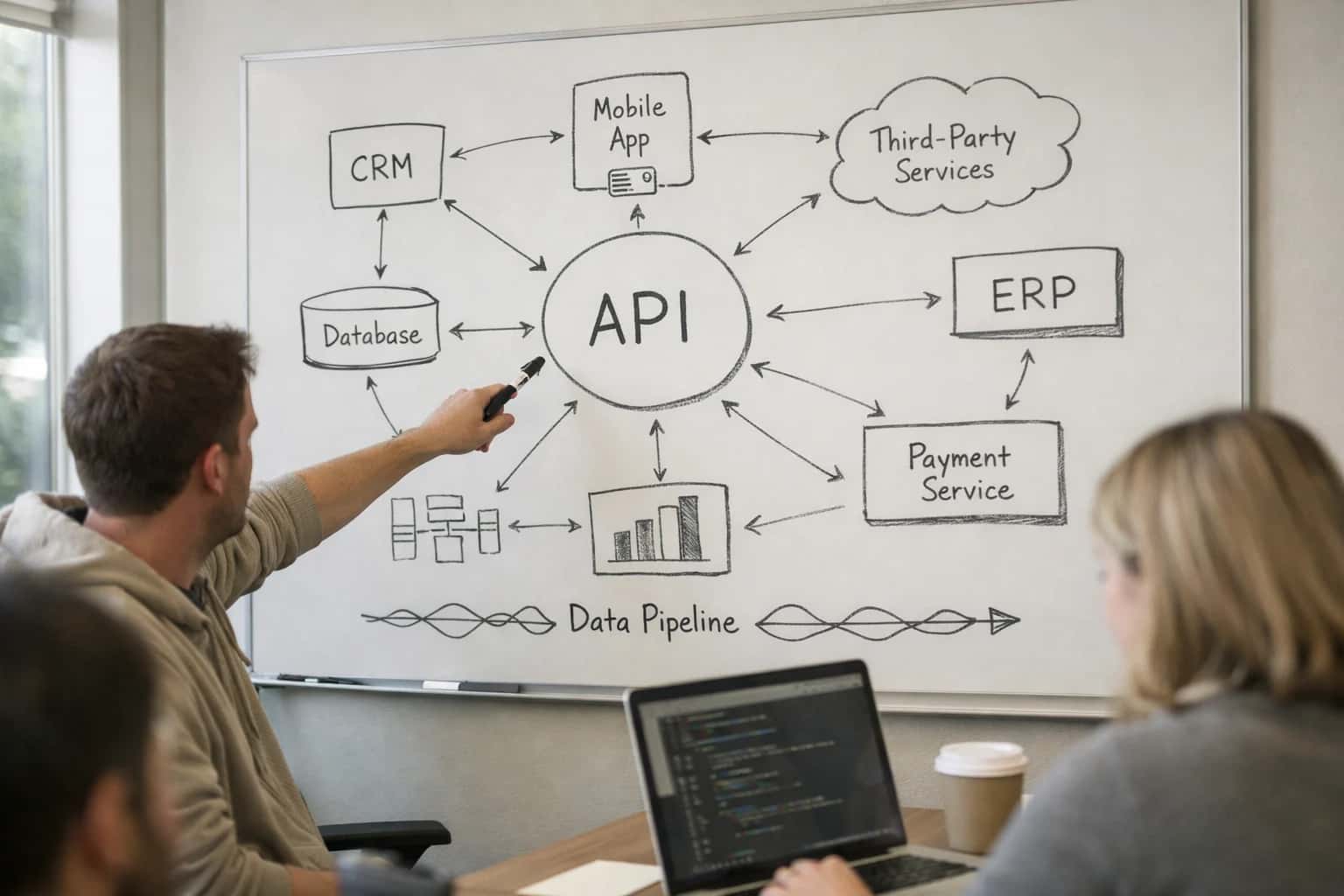
Implementation Architecture: Data Flow and System Components
A production-ready architecture for embedding conversational AI into campground guest communications via SMS and voice.
The integration connects Twilio's Programmable Messaging and Voice APIs to your campground management platform's core data objects. For Campspot, this means syncing with the Reservation, Guest, and Site objects via its REST API. For ResNexus, the integration taps into the ReservationDetails, Customer, and Unit endpoints. A central orchestration layer—often a cloud function or lightweight microservice—acts as the bridge. It receives inbound SMS/voice events from Twilio, enriches the request with real-time reservation context from Campspot/ResNexus, routes it through an LLM (like GPT-4) with a campground-specific prompt chain, and returns a structured response back through Twilio for delivery. All guest interactions are logged back to a custom CommunicationLog object or a dedicated audit table within the PMS for a complete history.
Key system components include: 1) Event Ingestion: Twilio webhooks configured for your campground's dedicated phone numbers. 2) Context Enrichment Service: Fetches the guest's upcoming reservation, site details, balance, and any special notes from the PMS API using the caller's phone number as the key. 3) AI Agent Core: An LLM endpoint (OpenAI, Anthropic, or Azure OpenAI) with a system prompt defining the campground's policies, amenities, and allowed actions (e.g., "you can provide check-in instructions but cannot process refunds"). 4) Action Router: Parses the LLM's intent—if the guest requests a real action like "cancel my booking," the router creates a ticket in the PMS or posts to a human review queue via the platform's API. 5) Audit & Compliance Layer: All prompts, responses, and data accesses are logged with timestamps and user IDs for compliance and continuous model tuning.
Rollout is typically phased: start with read-only Q&A (e.g., "What time is check-in?") to build trust and validate the data pipeline. Phase two introduces simple transactional workflows like modifying an add-on or reporting a maintenance issue, which create tickets in Campspot's Tasks or ResNexus's Work Orders. Governance requires defining clear boundaries: the AI should never disclose full payment details or modify core reservation dates without human-in-the-loop approval. Implement rate limiting per guest and sentiment analysis to escalate frustrated guests to live staff. The final architecture reduces front-desk call volume by handling routine inquiries, while ensuring complex or high-stakes conversations are seamlessly handed off with full context to your team.
TWILIO AI + CAMPGROUND PLATFORMS
Code and Payload Examples
Handling Guest Booking Questions via SMS
When a guest texts a question like "Are there any RV sites available next weekend?", this webhook handler receives the Twilio payload, queries the campground platform's API for availability, and uses an LLM to craft a natural, actionable response.
pythonimport os from flask import Flask, request from twilio.twiml.messaging_response import Messaging_response import requests from openai import OpenAI app = Flask(__name__) @app.route('/sms-booking', methods=['POST']) def sms_booking(): incoming_msg = request.form.get('Body') guest_number = request.form.get('From') # 1. Extract intent & dates using LLM client = OpenAI(api_key=os.getenv('OPENAI_API_KEY')) extraction_response = client.chat.completions.create( model="gpt-4o-mini", messages=[ {"role": "system", "content": "Extract check-in date, check-out date, and site type (RV, tent, cabin) from the user's message. Return JSON."}, {"role": "user", "content": incoming_msg} ] ) booking_intent = json.loads(extraction_response.choices[0].message.content) # 2. Query Campspot/ResNexus API for availability campspot_api_url = f"https://api.campspot.com/v1/availability?startDate={booking_intent['check_in']}&endDate={booking_intent['check_out']}&type={booking_intent['site_type']}" headers = {"Authorization": f"Bearer {os.getenv('CAMPSPOT_API_KEY')}"} availability_data = requests.get(campspot_api_url, headers=headers).json() # 3. Generate friendly SMS response prompt = f"Guest asked: '{incoming_msg}'. Available sites: {availability_data['available_sites']}. Craft a short, helpful SMS reply inviting them to book a specific site or suggesting alternatives." reply_generation = client.chat.completions.create( model="gpt-4o-mini", messages=[{"role": "user", "content": prompt}] ) reply_text = reply_generation.choices[0].message.content # 4. Send response via Twilio resp = Messaging_response() resp.message(reply_text) return str(resp)
This pattern turns a simple SMS into a conversational booking assistant, reducing front-desk call volume.
TWILIO AI FOR CAMPGROUNDS
Realistic Time Savings and Operational Impact
How connecting Twilio's AI to Campspot or ResNexus transforms guest communications from reactive to proactive, saving staff hours and improving the guest experience.
| Metric | Before AI | After AI | Notes |
|---|---|---|---|
Booking inquiry via SMS | Manual reply in 2-4 hours | AI-assisted reply in <2 minutes | Agent drafts responses; staff reviews high-value or complex requests |
Check-in instructions delivery | Batch email or manual call | Proactive, personalized SMS sequence | Triggered by reservation status in Campspot; includes gate codes and site maps |
Common policy FAQs (quiet hours, pet rules) | Repeated manual answers | AI handles 70-80% of queries | Trained on campground knowledge base; escalates unresolved issues to staff |
Proactive weather/closure alerts | Manual list compilation & calling | Automated segmentation & broadcast | AI segments guests by arrival date/location from ResNexus; sends via Twilio |
Post-stay review solicitation | Manual email campaign | Automated, triggered SMS follow-up | Sent 2 days after checkout; includes personalized thank you and review link |
Group booking coordination | Back-and-forth calls/emails over days | AI-assisted intake & FAQ over SMS | Qualifies lead, collects basic info, and schedules a call for contract review |
Staff time spent on comms | 4-6 hours per day in peak season | 1-2 hours for review & exceptions | Time savings allow reallocation to on-site guest service and operations |
ARCHITECTING A CONTROLLED DEPLOYMENT
Governance, Security, and Phased Rollout
Integrating Twilio AI with your campground management platform requires a deliberate approach to data security, user privacy, and operational stability.
A production-ready integration is built on secure, auditable connections between Twilio's Programmable Messaging/Voice APIs and your core reservation system (Campspot, ResNexus, etc.). This involves:
- API Key Management: Using scoped, short-lived tokens to authenticate calls between your AI orchestration layer and both Twilio and your campground platform.
- Data Flow Governance: Ensuring PII (guest names, phone numbers, reservation details) is only passed to the LLM within a secure, zero-retention context and is never used for model training.
- Audit Logging: Logging all AI-generated interactions, including the initial guest message, the AI's response, and any subsequent system actions (like a reservation modification via the Campspot API) for compliance and quality review.
We recommend a phased rollout to de-risk the implementation and build user trust:
- Phase 1: Read-Only Assistant (Weeks 1-2): Deploy an AI agent that can answer common pre-arrival questions ("What are your check-in times?") by accessing the campground platform's knowledge base and public FAQs. It provides information but takes no actions on reservations.
- Phase 2: Assisted Workflows (Weeks 3-4): Enable the AI to handle simple, low-risk transactions, such as processing a request for late check-out. The agent uses the Twilio conversation to gather details, then creates a draft work order in Staylist or adds a note to the ResNexus reservation for staff approval before any system update is committed.
- Phase 3: Automated Execution (Ongoing): Gradually grant the AI authority to execute predefined, rule-based actions autonomously, such as sending a check-in SMS with a gate code 24 hours before arrival. These workflows are gated by clear business logic (e.g., reservation must be paid in full) and include a human-in-the-loop escalation path for any ambiguity.
Establishing clear ownership and monitoring is critical. Designate a "Conversation Steward"—often a front-desk manager or marketing lead—to review weekly audit logs and sentiment analysis from the AI's interactions. Use this feedback to refine prompts and adjust the agent's scope. This governance model ensures the integration remains a useful tool that augments your team, rather than an opaque automation that creates new problems. For related architectural patterns, see our guide on Campground API Automation and Integration Hubs with AI.
Enabling Efficiency, Speed & Accuracy
Intelligent Analysis, Decision & Execution
We build AI systems for teams that need search across company data, workflow automation across tools, or AI features inside products and internal software.
Talk to Us
Search across company data
Give teams answers from docs, tickets, runbooks, and product data with sources and permissions.
Useful when people spend too long searching or get different answers from different systems.
Enterprise searchRAGPermissions
Read more
Automate internal workflows
Use AI to route work, draft outputs, trigger actions, and keep approvals and logs in place.
Useful when repetitive work moves across multiple tools and teams.
AI agentsWorkflow automationGovernance
Read more
Add AI to products and internal tools
Build assistants, guided actions, or decision support into the software your team or customers already use.
Useful when AI needs to be part of the product, not a separate tool.
AI integrationDecision supportModel routing
Read moreIMPLEMENTATION GUIDE
Frequently Asked Questions
Common technical and operational questions about connecting Twilio's AI-powered messaging and voice services to your campground management platform (Campspot, ResNexus, Staylist, or Campground Master).
The integration is designed with a zero-trust data architecture to protect sensitive guest information.
Key Security Patterns:
- Data Minimization: The AI agent receives only the necessary context (e.g.,
reservation_id,guest_first_name,site_number) from the campground platform via a secure webhook. Full payment details or government IDs are never passed to the AI model. - Tokenized References: For operations requiring payment (like processing a deposit via SMS), the system uses tokenized payment IDs stored in your payment gateway (e.g., Stripe). The AI workflow calls a secure internal API with the token, not the raw card number.
- Audit Trail: All AI-generated messages and voice interactions are logged back to a dedicated
ai_communication_logobject in your campground platform, linked to the guest record, with timestamps and the AI's confidence score. - Compliance Boundaries: The Twilio AI layer operates within Twilio's SOC 2 and HIPAA-ready environments. We configure message and call logs to be retained according to your data retention policy, automatically redacting sensitive data in logs.
Implementation Check: Ensure your webhook endpoints from Campspot/ResNexus to the AI service are behind API gateway authentication and use HTTPS exclusively.

About the author
Prasad Kumkar
CEO & MD, Inference Systems
Prasad Kumkar is the CEO & MD of Inference Systems and writes about AI systems architecture, LLM infrastructure, model serving, evaluation, and production deployment. Over 5+ years, he has worked across computer vision models, L5 autonomous vehicle systems, and LLM research, with a focus on taking complex AI ideas into real-world engineering systems.
His work and writing cover AI systems, large language models, AI agents, multimodal systems, autonomous systems, inference optimization, RAG, evaluation, and production AI engineering.
LinkedIn
Limited slotsGet a Free AI Consultation
Partnered with leading AI, data, and software stack.





How We Work
Custom AI workflows for your Business
One-fit-all AI don't work for modern businesses. At Inferensys, we aim to understand your business & custom requirements; which we use to define most efficient agentic workflows, the data, and the tools for your business.
01
Review the use case
We understand the task, the users, and where AI can actually help.
Read more02
Pick the right approach
We define what needs search, automation, or product integration.
Read more03
Build the first useful version
We implement the part that proves the value first.
Read more04
Improve from there
We add the checks and visibility needed to keep it useful.
Read moreThe first call is a practical review of your use case and the right next step.
Talk to Us