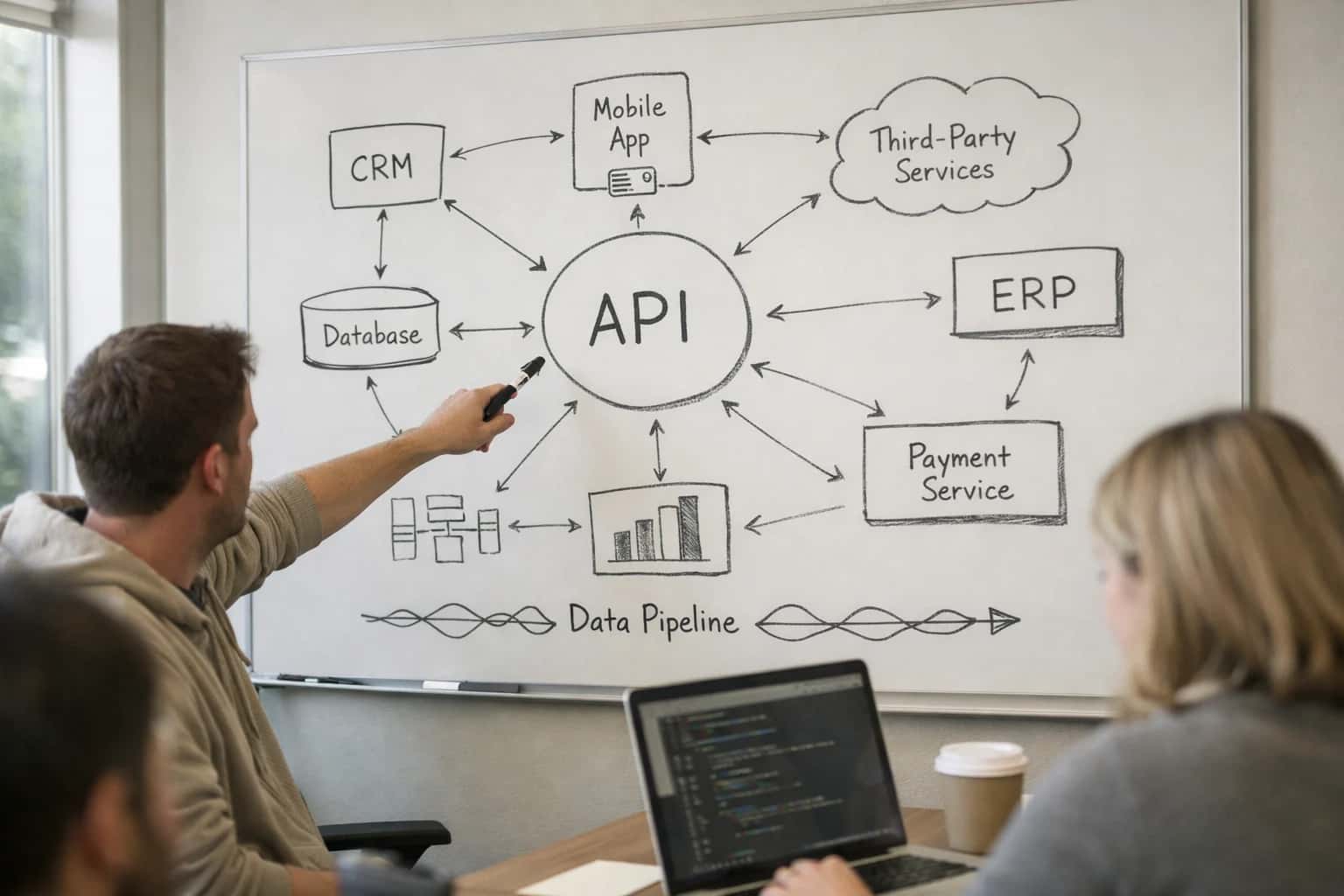
The integration connects at the Attendee Registration and Event Session object level within Fonteva's Salesforce-native architecture. As a member registers for an event, an AI agent analyzes their profile data—such as job title, past session attendance, declared interests in their member record, and community forum activity—against the session catalog. This creates a real-time, personalized recommendation score for each available session, which is surfaced directly within the Fonteva event portal and mobile app. The system uses a RAG (Retrieval-Augmented Generation) layer on top of session descriptions, speaker bios, and past attendee feedback to ground its reasoning and provide contextual explanations for each suggestion.

Integration
AI Integration with Fonteva for Event Session Recommendations
Build AI-driven session recommendation engines into Fonteva event apps to personalize agendas, increase engagement, and connect attendees with relevant content and peers.
ARCHITECTURE FOR PERSONALIZED AGENDAS
Where AI Fits into Fonteva Event Management
Integrating AI-driven session recommendations directly into Fonteva's event workflows transforms static agendas into dynamic, personalized experiences that boost engagement and networking.
From an implementation standpoint, the AI service typically runs as a serverless function or microservice, triggered by registration webhooks from Fonteva. It queries the platform's APIs for attendee and session data, processes it through the recommendation model, and writes the scored suggestions back to a custom object or a dedicated field on the registration record. This allows Fonteva's native workflows, reports, and automations to leverage the AI output. For example, you can build a Flow that sends a personalized "Your Top Sessions" email 48 hours before the event, or create a dashboard widget showing the most recommended sessions across all attendees to help planners adjust room capacities.
Rollout should be phased, starting with a pilot event where AI suggestions are presented as "AI-Powered Picks" alongside the standard agenda. This allows for A/B testing on engagement metrics like session add rates and post-event survey scores. Governance is critical: ensure the AI's logic is auditable, with logs tracking which data points influenced each recommendation. Implement a human-in-the-loop review for the first few events, allowing planners to override or adjust suggestions, which also serves as valuable training feedback for the model. This approach mitigates risk while demonstrating clear value—turning a generic schedule into a curated experience that makes each attendee feel the agenda was built just for them.
EVENT SESSION RECOMMENDATIONS
Fonteva Modules and Surfaces for AI Integration
Core Data Objects for Personalization
AI-driven recommendations require structured data from Fonteva's Salesforce-native objects. The primary surfaces are the Event, Session, and Registration objects.
Key fields for session analysis include:
- Session Metadata: Title, description, track, tags, speaker, difficulty level, and room.
- Historical Engagement: Past session ratings, attendance counts, and waitlist data.
- Attendee Profile: Job title, industry, membership tier, and self-selected interests captured during registration or in their member profile.
AI models use this data to build embeddings for semantic matching. For example, a session titled "Advanced Fundraising Analytics" with tags #nonprofit, #data, #finance can be matched to an attendee whose profile indicates a "Director of Development" role and past high ratings for data-centric webinars. This data is typically accessed via Salesforce SOQL queries or the Fonteva/Salesforce REST APIs for real-time recommendation engines.
FONTEVA EVENT MODULES
High-Value Use Cases for AI-Powered Recommendations
Integrate AI-driven recommendation engines directly into Fonteva's event registration, agenda builder, and mobile app surfaces to personalize the attendee experience, boost session engagement, and foster meaningful networking.
01
Personalized Session Agenda Builder
At registration, an AI agent analyzes the member's profile, past event attendance from Fonteva records, and stated learning goals. It then recommends a customized conference agenda, ranking sessions by relevance and avoiding schedule conflicts. The recommendations are surfaced in the registration flow and the event app.
Manual -> Automated
Agenda planning
02
Real-Time Networking Matchmaking
During the event, an AI engine continuously analyzes attendee profiles, session interests, and networking goals. It suggests 1:1 connections or small group meetups via the Fonteva event app, explaining the mutual benefit (e.g., 'Both interested in nonprofit advocacy tech').
Serendipity -> Intentional
Connection quality
03
Dynamic Session Switching & Alternatives
For sessions that reach capacity or when an attendee's plans change, the AI provides personalized alternative recommendations. It uses real-time waitlist data and similarity scoring to suggest other relevant sessions, workshops, or roundtables, keeping engagement high.
Frustration -> Opportunity
Attendee experience
04
Post-Event Content & Learning Pathways
After the event, the AI analyzes which sessions an attendee actually visited (via app check-in) and combines it with post-event survey feedback. It then generates a personalized learning pathway, recommending on-demand recordings, related community discussions in Fonteva, and follow-up articles to continue the education.
One-off -> Continuous
Value extension
05
Exhibitor & Sponsor Relevance Scoring
For attendees, the AI scores and ranks exhibitors and sponsors based on the attendee's job function, interests, and session attendance. It pushes targeted booth recommendations to the app, increasing lead quality for sponsors. For event organizers, it provides analytics on which sponsor pairings generated the most engagement.
Spray & Pray -> Targeted
Sponsor ROI
06
Speaker & Topic Discovery for Future Events
Analyzes aggregated, anonymized session recommendation and attendance data across all events to identify emerging topic trends and high-potential speakers from within the member community. Provides event planning teams in Fonteva with data-driven insights for next year's conference agenda.
Guesswork -> Data-Driven
Planning confidence
FONTEVA EVENT PERSONALIZATION
Example AI Recommendation Workflows
These workflows detail how to architect AI-driven session and networking recommendations within Fonteva's event modules, moving beyond static agendas to dynamic, personalized attendee experiences that drive engagement and satisfaction.
Trigger: A member completes registration for a multi-track conference in Fonteva Events.
Context Pulled: The AI agent queries:
- The attendee's Fonteva member profile (job title, industry, committee memberships).
- Past event attendance and session ratings from the Fonteva database.
- The conference's published session catalog (title, description, track, speaker, tags).
- Real-time session capacity from the Fonteva registration module.
Agent Action: A recommendation model (e.g., collaborative filtering or content-based) scores all available sessions. It generates a ranked, personalized agenda with a confidence score for each suggestion.
System Update: The ranked list is injected into:
- A personalized "My Agenda" view in the Fonteva event portal.
- A daily digest email generated via Fonteva's marketing automation, highlighting top picks.
- The Fonteva mobile app's schedule, with AI-suggested sessions visually highlighted.
Human Review Point: For sessions with low confidence scores (e.g., new attendee with little history), the system can flag for manual review by a staff member who can make a curated suggestion via an internal Fonteva task.
FROM EVENT DATA TO PERSONALIZED AGENDAS
Implementation Architecture and Data Flow
A production-ready architecture for injecting AI-driven session recommendations into Fonteva's event registration and mobile app workflows.
The integration connects at two key surfaces within the Fonteva platform: the Event Registration object and the Fonteva Events Mobile App. A background process, triggered upon registration or app login, ingests structured attendee profile data (job title, company, declared interests from custom fields) and unstructured data (past session attendance, community forum posts). This data is vectorized and stored in a dedicated session recommendation engine—a separate microservice that maintains a semantic index of all conference sessions, including descriptions, speaker bios, and tags.
For each attendee, the engine performs a real-time similarity search against the session index. The resulting recommendations are ranked by relevance and contextualized with a brief explanation (e.g., "Matches your interest in 'non-dues revenue'"). These are delivered via a secure API call back to Fonteva, where they populate a custom Lightning component on the attendee's event portal and are pushed as personalized agenda suggestions within the mobile app. The entire flow is logged to a custom Recommendation_Audit__c object in Salesforce for analysis and to respect data privacy preferences.
Rollout is typically phased, starting with a pilot group of attendees for a single large conference. Governance is critical: we implement a human-in-the-loop review step where association staff can review and adjust the AI's top recommendations before they go live, ensuring alignment with event goals. Post-event, the audit logs are analyzed to measure recommendation engagement (clicks, adds-to-schedule) and iteratively refine the underlying models for future events.
FONTEVA EVENT SESSION RECOMMENDATIONS
Code and Payload Examples
Real-Time Session Scoring Endpoint
This API call is triggered when a member views the event agenda in the Fonteva mobile app or portal. It queries the member's profile, past event attendance, and expressed interests to score all available sessions.
python# Example: Python call to a session recommendation service import requests # Payload sent from Fonteva via a custom Apex trigger or middleware payload = { "member_id": "a0x3E000001VKzqQAG", "event_id": "a0x3E000002LK9pQAG", "member_attributes": { "job_role": "Marketing Director", "industry": "Technology", "certifications": ["CAE", "CMP"] }, "historical_signals": { "past_session_attendance": ["a0x3E000003MJ8kQAG", "a0x3E000004NJ9lQAH"], "community_engagement_topics": ["digital_strategy", "member_retention"] } } # Call to Inference Systems' recommendation engine response = requests.post( "https://api.inferencesystems.com/recommend/sessions", json=payload, headers={"Authorization": "Bearer YOUR_API_KEY"} ) # Returns a scored list of session IDs for personalization recommendations = response.json() # e.g., {"sessions": [{"id": "...", "score": 0.92}, ...]}
The response is used to reorder the session list in the UI or tag sessions as "Recommended for You."
EVENT PERSONALIZATION
Realistic Time Savings and Business Impact
How AI-driven session recommendations transform event planning and attendee engagement workflows within Fonteva.
| Workflow / Metric | Before AI | After AI | Implementation Notes |
|---|---|---|---|
Personalized agenda creation per attendee | Manual review of profiles & session catalogs | AI-generated recommendations in seconds | Leverages Fonteva member data, past event history, and expressed interests |
Session popularity & capacity forecasting | Post-event analysis & manual trend spotting | Real-time predictions during registration | AI analyzes registration patterns to flag potential overcrowding or low-interest sessions |
Speaker & topic gap analysis | Manual committee review and subjective judgment | AI-driven analysis of abstract submissions and member interests | Identifies underrepresented topics or over-saturated tracks for program planning |
Networking matchmaking for attendees | Self-service directory search or random connections | AI-suggested connections based on profile, interests, and goals | Integrated into Fonteva event app to drive community engagement |
Post-event session feedback synthesis | Manual compilation of survey comments | Automated sentiment analysis and thematic clustering | Delivers actionable insights to event managers within hours instead of weeks |
Dynamic waitlist management for full sessions | First-come, first-served manual process | AI prioritizes waitlist based on member tier and relevance | Increases satisfaction and optimizes session utilization |
Content tagging for session library | Manual keyword entry by event staff | AI auto-tags sessions for future search and recommendation | Builds a reusable knowledge asset for year-round member education |
ARCHITECTING A CONTROLLED DEPLOYMENT
Governance, Security, and Phased Rollout
A production-ready AI integration for Fonteva requires a structured approach to data security, user acceptance, and operational governance.
Implementation begins by mapping the Fonteva data model—specifically the Event Session, Attendee, Member Profile, and Registration objects—to a secure vector index. This ensures session recommendations are grounded in your actual event catalog and member data. All AI operations should be executed via a dedicated service layer that enforces Salesforce platform permissions and logs all recommendation generation events back to a custom AI_Interaction__c object for auditability and model feedback.
A phased rollout is critical for user adoption and risk management. Start with a low-risk pilot in a controlled environment, such as a small committee meeting or a pre-conference workshop. Use this phase to:
- Validate recommendation accuracy against a human-curated 'gold standard' list.
- Gather qualitative feedback on the relevance of suggested sessions and connections.
- Monitor system performance and API latency within the Fonteva event app framework.
- Refine prompts and ranking algorithms based on real user behavior.
For governance, establish clear human-in-the-loop checkpoints. For example, the AI can suggest a networking match, but the initial connection request should require attendee approval. Similarly, session recommendations should be presented as 'suggestions' with clear explanations (e.g., 'Because you attended last year's leadership track'). Implement a feedback loop where users can thumbs-up/down recommendations, feeding directly into a continuous evaluation dataset to detect and correct model drift over time.
Enabling Efficiency, Speed & Accuracy
Intelligent Analysis, Decision & Execution
We build AI systems for teams that need search across company data, workflow automation across tools, or AI features inside products and internal software.
Talk to Us
Search across company data
Give teams answers from docs, tickets, runbooks, and product data with sources and permissions.
Useful when people spend too long searching or get different answers from different systems.
Enterprise searchRAGPermissions
Read more
Automate internal workflows
Use AI to route work, draft outputs, trigger actions, and keep approvals and logs in place.
Useful when repetitive work moves across multiple tools and teams.
AI agentsWorkflow automationGovernance
Read more
Add AI to products and internal tools
Build assistants, guided actions, or decision support into the software your team or customers already use.
Useful when AI needs to be part of the product, not a separate tool.
AI integrationDecision supportModel routing
Read moreIMPLEMENTATION GUIDE
Frequently Asked Questions
Practical questions for technical teams planning to add AI-driven session recommendations to Fonteva-powered event apps and portals.
The integration pulls member and event data from Fonteva's Salesforce-native objects via API or a scheduled sync. Key data sources include:
- Member Profile Data: Job title, industry, self-selected interests (from custom fields), past event attendance records, and certification tracks.
- Session Data: Agenda items, speaker bios, topics, tags, and historical ratings/feedback from past events.
- Real-time Context: The member's current agenda (registered sessions) and live engagement signals from the event app (e.g., session check-ins).
This data is typically indexed in a vector database (like Pinecone or Weaviate) to enable semantic search. The AI model compares a member's profile vector against session description vectors to find the best matches. For a production setup, we recommend a nightly batch sync for core data and a real-time API for live session additions or member profile updates.

About the author
Prasad Kumkar
CEO & MD, Inference Systems
Prasad Kumkar is the CEO & MD of Inference Systems and writes about AI systems architecture, LLM infrastructure, model serving, evaluation, and production deployment. Over 5+ years, he has worked across computer vision models, L5 autonomous vehicle systems, and LLM research, with a focus on taking complex AI ideas into real-world engineering systems.
His work and writing cover AI systems, large language models, AI agents, multimodal systems, autonomous systems, inference optimization, RAG, evaluation, and production AI engineering.
LinkedIn
Limited slotsGet a Free AI Consultation
Partnered with leading AI, data, and software stack.





How We Work
Custom AI workflows for your Business
One-fit-all AI don't work for modern businesses. At Inferensys, we aim to understand your business & custom requirements; which we use to define most efficient agentic workflows, the data, and the tools for your business.
01
Review the use case
We understand the task, the users, and where AI can actually help.
Read more02
Pick the right approach
We define what needs search, automation, or product integration.
Read more03
Build the first useful version
We implement the part that proves the value first.
Read more04
Improve from there
We add the checks and visibility needed to keep it useful.
Read moreThe first call is a practical review of your use case and the right next step.
Talk to Us