
Inferensys

Integration

AI Integration with Weights and Biases Project Organization

Structure W&B projects, runs, and reports to support a portfolio of LLM applications across business units, enabling both centralized oversight and decentralized team autonomy.
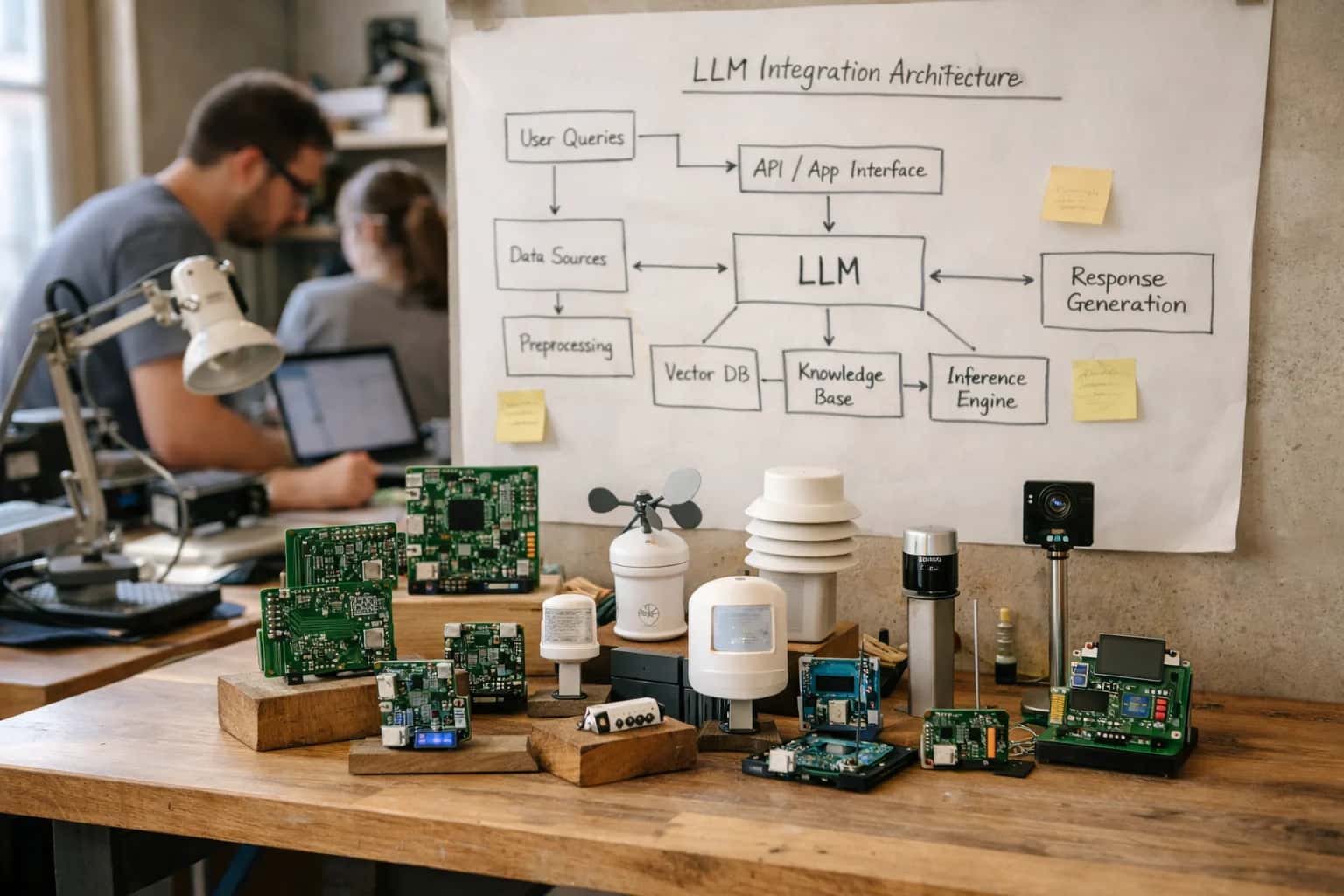
Hardware engineer integrating LLM with IoT sensors, circuit boards on desk, soldering iron nearby, maker lab aesthetic.
STRUCTURING W&B FOR SCALABLE AI OPERATIONS

Where Project Organization Fits in Your LLM Governance Stack

Weights & Biases Project Organization provides the foundational structure for governing a portfolio of LLM applications, balancing centralized oversight with team autonomy.

In a mature AI program, LLM applications are rarely monolithic. Different business units—support, sales, legal, marketing—each deploy their own agents, fine-tuned models, and RAG systems. A flat list of experiments in W&B becomes unmanageable. Project Organization is the critical first layer of governance, where you map your W&B hierarchy (Entity > Project > Run) to your operational reality. A common structure is:

  • Entity: Your company (e.g., acme-inc).
  • Project: Per business unit or product line (e.g., support-copilot, sales-assistant, legal-research).
  • Run: Individual experiments, fine-tuning jobs, or production pipeline executions within that project. This structure enables RBAC at the project level, ensuring the support team only sees their experiments, while central AI leadership has a cross-portfolio view.


Within each project, you standardize what gets logged to create a consistent audit trail. This includes:

  • Model Registry entries for each promoted LLM variant, linked to their source runs.
  • Artifacts for versioned prompt templates, evaluation datasets, and vector store indexes.
  • Reports and Dashboards that track project-specific KPIs (e.g., ticket deflection rate for support, lead qualification score for sales). By enforcing this logging schema, you create a reproducible lineage for every production prediction. When a model underperforms, you can trace it back to the exact training data, hyperparameters, and prompt version—a necessity for debugging and regulatory inquiries.

Rollout and governance depend on this organized foundation. Central Platform teams can use W&B's API to automate compliance checks, scanning all projects for unregistered models or missing bias evaluation runs. Project-level dashboards feed into executive summaries in W&B, showing cost trends and performance SLAs across the portfolio. This structure also enables safe, decentralized development: a product team can iterate rapidly within their sandboxed project, while the governance workflow ensures that any model promoted to a production alias in the registry has passed centralized risk assessments. Ultimately, effective Project Organization turns W&B from a science notebook into the system of record for controlled, scalable AI operations.

AI INTEGRATION BLUEPRINT

Key W&B Surfaces for Organizational Structure

Structuring for Business Unit Autonomy

Weights & Biases Projects are the primary container for organizing LLM work. For enterprise integration, we map these to business units, product lines, or functional teams (e.g., support-copilot, sales-assistant, legal-review). This creates isolated workspaces where teams can run experiments, track models, and generate reports without cross-contamination.

Key integration surfaces include:

  • Project-level RBAC: Integrate with your corporate SSO (Okta, Entra ID) to enforce who can view, edit, or administer projects, aligning with internal data governance policies.
  • Team-level Artifacts: Use W&B Teams to group related projects (e.g., europe-ai-products), enabling shared access to base models, evaluation datasets, and report templates.
  • Unified Billing Tags: Apply W&B tags to projects for granular cost attribution back to department budgets, a critical FinOps requirement for managing LLM experimentation spend.
OPERATIONAL PATTERNS

High-Value Use Cases for Structured W&B Organization

A well-structured Weights & Biases organization is foundational for scaling LLM development across teams. These patterns show how to connect W&B's project hierarchy to real-world governance, collaboration, and deployment workflows.

01

Multi-Team Experiment Isolation with Shared Baselines

Structure W&B projects by business unit (e.g., support-ai, sales-copilot) while maintaining a central llm-baselines project for approved model versions and prompt templates. This enables decentralized development with centralized governance, allowing teams to iterate independently while benchmarking against company-standard models logged as artifacts.

1 sprint
To establish governance
02

CI/CD Gate with Model Registry Promotions

Integrate W&B Model Registry stage transitions (staging -> production) with your CI/CD pipeline (e.g., GitHub Actions, Jenkins). Automate validation tests—latency, cost, and evaluation score checks—upon promotion requests, creating an auditable, code-driven deployment process for LLM chains and fine-tuned adapters.

Batch -> Automated
Promotion workflow
03

Cross-Functional Reporting Dashboards

Build dedicated W&B reports and dashboards for different stakeholders by leveraging project tags and filters. Provide engineers with granular trace views, product owners with cost/accuracy trendlines, and compliance teams with lineage reports—all sourced from the same structured runs, eliminating data silos.

Same day
Stakeholder visibility
04

Reproducible RAG Pipeline Lineage

Use W&B Artifacts to version and link every component of a Retrieval-Augmented Generation pipeline: the raw document snapshot, the embedding model used, the vector store index, and the final prompt chain. This creates complete lineage, allowing you to trace a production answer back to the exact data and code version, crucial for debugging and audits.

Hours -> Minutes
Root cause analysis
05

Cost Attribution and FinOps Visibility

Structure projects and use W&B's logging SDK to tag all LLM API calls (OpenAI, Anthropic) and GPU fine-tuning jobs by team, application, and environment. Build custom charts to visualize spend trends, attribute costs, and set automated alerts for budget overruns, turning opaque AI expenses into manageable operational data.

Batch -> Real-time
Spend tracking
06

Centralized Prompt Template Management

Treat prompts as configuration-as-code by storing versioned prompt templates and their evaluation results as W&B Artifacts within a prompt-library project. Integrate this library with deployment systems to allow safe, rollback-capable updates to prompts across all production agents without redeploying application code.

Hours -> Minutes
Prompt deployment
STRUCTURING W&B FOR ENTERPRISE LLM OPERATIONS

Example Workflows: From Chaos to Governed Collaboration

A well-organized Weights & Biases (W&B) project structure is the backbone for scaling LLM applications across business units. These workflows illustrate how to move from ad-hoc experimentation to a governed, collaborative environment that balances team autonomy with centralized oversight.

Trigger: A product team completes fine-tuning a new customer support agent model and needs to promote it to staging.

Workflow:

  1. The team logs the final model artifact, evaluation metrics, and the exact training dataset version as a W&B Artifact in their team-specific project (e.g., support-ai/chatbot-v2).
  2. They register the model in a central, company-wide W&B Model Registry (e.g., company-llm-registry/production-models). The registry entry links to the team's project run, capturing full lineage.
  3. A CI/CD pipeline (e.g., GitHub Actions) is triggered by the registry stage change (staging). It runs a standardized battery of integration and security tests defined in a shared W&B sweep configuration.
  4. Upon test pass, the pipeline automatically deploys the model to the staging inference endpoint and updates a central W&B Dashboard (LLM Production Health) with the new model version and baseline metrics.
  5. The registry's RBAC ensures only authorized team members can promote models, while the centralized dashboard gives the AI Platform team visibility into all staged models.

Human Review Point: A mandatory approval gate in the Model Registry is required to transition the model from staging to production. This triggers a ticket in the compliance team's system, linking to the W&B report for review.

STRUCTURING FOR SCALE AND GOVERNANCE

Implementation Architecture: Mapping Your Org to W&B

A practical framework for organizing Weights & Biases to support a portfolio of LLM applications across decentralized teams while maintaining centralized oversight.

Start by mapping your W&B organization and project hierarchy to your company's operational structure. A common pattern is to create a top-level organization for the company, then establish separate team-level projects for each business unit or product group (e.g., marketing-copilots, support-agents, internal-knowledge-base). Within each project, use experiment runs to track individual development efforts—like fine-tuning a model, optimizing a prompt chain, or testing a new RAG configuration. For production monitoring, create dedicated production projects (e.g., prod-support-agents) to separate live inference logs from experimental data, ensuring clean dashboards for operations teams.

Implement a consistent tagging and metadata strategy across runs using W&B's config and tags. Key dimensions to capture include: llm-provider (OpenAI, Anthropic), model-version (gpt-4-turbo, claude-3-opus), use-case-type (classification, summarization, tool-calling), and environment (dev, staging, prod). This enables federated querying; a central AI governance team can, for instance, query all runs tagged with use-case-type:underwriting across any team's project to audit model performance and compliance. Integrate W&B's API with your CI/CD pipeline to automatically tag runs with the Git commit hash, Jira ticket, and promoting engineer, creating an immutable lineage from code change to model behavior.

Governance and rollout are managed through W&B's model registry and access controls. Promote vetted model versions from a team's experimental project to a shared, organization-wide registry (e.g., company-llm-registry). Gate promotions with automated validation tests and require manual approval via W&B's UI or integrated Slack alerts. Use W&B's RBAC to grant teams autonomy within their projects while restricting registry write access to a central MLOps group. For executive reporting, build consolidated dashboard reports that aggregate key metrics—like daily inference cost, latency SLO adherence, and evaluation scores—across all production projects, providing a single pane of glass for AI portfolio health.

STRUCTURING W&B FOR LLM PORTFOLIO MANAGEMENT

Code & Configuration Examples

Defining a Scalable W&B Project Structure

Organize W&B projects to mirror your business and technical domains, enabling both autonomy and oversight. A common pattern is a three-tier hierarchy:

  • Organization-Level Project (llm-portfolio): Contains high-level dashboards aggregating cost, performance, and compliance metrics across all business units. This is the single pane of glass for AI leadership.
  • Business Unit / Product Area Projects (e.g., support-copilot, sales-assistant): Owned by individual product teams. Contain all experiments, model registry entries, and reports specific to that application.
  • Environment-Specific Projects (e.g., sales-assistant-prod): Dedicated to production monitoring. Linked to the main application project but filtered to only show runs and models promoted to live environments.

Key Configuration: Use W&B's group and job_type run parameters to filter and segment within projects. For example, tag all RAG pipeline experiments with job_type: rag-optimization.

This structure allows decentralized teams to iterate while providing centralized governance teams with read-only access to the portfolio-level project for audit and reporting.

WEIGHTS & BIASES PROJECT ORGANIZATION

Operational Impact: Before and After Structured Organization

How structuring W&B projects, runs, and reports transforms LLM development and operations from chaotic to controlled.

MetricBefore AI GovernanceAfter AI GovernanceNotes

Project Discovery

Scattered runs across personal accounts

Centralized, team-based project hierarchy

Enables portfolio view and cross-team learning

Model Lineage

Manual tracking in spreadsheets

Automatic lineage from code commit to deployed model

Critical for debugging, audits, and reproducibility

Experiment Comparison

Ad-hoc screenshots and notes

Standardized reports with shared filters and panels

Accelerates model selection and hyperparameter tuning

Cost Attribution

Lumped API bills, unclear team spend

Project-tagged cost tracking per experiment and model

Enables FinOps and accurate budget forecasting

Promotion to Production

Manual checklist and email approvals

Integrated registry with stage gates and audit trails

Reduces deployment risk and ensures compliance

Stakeholder Reporting

Manual slide deck creation

Automated, role-based dashboards in W&B

Provides self-service visibility for product and compliance teams

Incident Root Cause

Days of log digging across systems

Traces production issue to specific experiment run in minutes

Links performance drift to a data change or prompt version

STRUCTURING FOR SCALE AND CONTROL

Governance, Security, and Phased Rollout

A disciplined project organization in Weights & Biases is foundational for governing a portfolio of LLM applications across business units, balancing team autonomy with centralized oversight.

Start by mapping your W&B project hierarchy to your organizational structure. Create a top-level project for each major business unit or product line (e.g., customer-support-agents, sales-copilots, internal-knowledge-qa). Within each, use experiment tracking runs to isolate different LLM approaches—comparing fine-tuned models against prompt-engineered base LLMs, or testing various RAG retrieval strategies. Use W&B's tags and groups to categorize runs by use case, model provider, or deployment stage (dev, staging, prod). This structure allows decentralized teams to iterate independently while providing a unified namespace for centralized FinOps, security, and compliance reviews.

Implement role-based access control (RBAC) and Single Sign-On (SSO) at the project level to enforce data segregation. Ensure that sensitive PII or PHI used in fine-tuning runs is confined to projects with strict access lists. Use W&B Artifacts to version and store not just model weights, but also the prompt templates, evaluation datasets, and vector store indexes used in each experiment, creating an immutable lineage. Integrate W&B's API with your CI/CD pipeline (e.g., GitHub Actions, Jenkins) to automatically log training metadata, enabling reproducible builds and automated promotion gates based on performance metrics logged to the W&B Model Registry.

Adopt a phased rollout strategy using W&B's reporting and comparison features. For a new LLM agent, begin with a small-scale shadow deployment, logging its inferences alongside the legacy system's outputs to a dedicated W&B project for evaluation. Use W&B Reports to create dashboards comparing key business metrics—deflection rate, user satisfaction score, operational cost—between the old and new systems. Only after statistical significance is achieved should you progress to a canary release, using W&B's model registry aliases (like staging and production) to control traffic routing. This controlled, evidence-based rollout, governed by a clear W&B project lineage, mitigates risk and builds stakeholder confidence in AI initiatives.

IMPLEMENTATION & GOVERNANCE

Frequently Asked Questions

Practical questions for teams structuring Weights & Biases to manage a portfolio of LLM applications across multiple business units.

A common pattern is to mirror your organizational and application boundaries within W&B's hierarchy.

Recommended Structure:

  1. Organization Level: Your company's main W&B account.
  2. Team Level: Create teams for each Business Unit (BU) or Product Line (e.g., team-bu-finance, team-bu-support). This enforces access control and resource segregation.
  3. Project Level: Within each team, create projects for distinct LLM Applications or Workflow Types.
    • Example for a Support BU: bu-support/chatbot-copilot, bu-support/ticket-summarization, bu-support/knowledge-base-rag.
    • Example for a Finance BU: bu-finance/report-generation, bu-finance/anomaly-detection-llm.

Central Oversight: Create a separate, cross-functional team (e.g., team-ai-governance) with read-only access to all BU projects. This team manages centralized dashboards and reports in W&B for executive visibility into cost, performance, and experiment trends across the entire portfolio.

Prasad Kumkar

About the author

Prasad Kumkar

CEO & MD, Inference Systems

Prasad Kumkar is the CEO & MD of Inference Systems and writes about AI systems architecture, LLM infrastructure, model serving, evaluation, and production deployment. Over 5+ years, he has worked across computer vision models, L5 autonomous vehicle systems, and LLM research, with a focus on taking complex AI ideas into real-world engineering systems.

His work and writing cover AI systems, large language models, AI agents, multimodal systems, autonomous systems, inference optimization, RAG, evaluation, and production AI engineering.


