In a mature LLM stack, model benchmarking is not a one-time research activity but a continuous, automated process integrated into your CI/CD pipeline and change management workflows. It sits between your model registry (where versions are stored) and your serving layer (where models are deployed). For teams running multiple models—such as a mix of GPT-4, Claude 3, fine-tuned Llama 3, and embedding variants—a W&B benchmarking suite becomes the objective gatekeeper. It automatically evaluates candidate models against a golden dataset of production-like queries, measuring not just accuracy but cost per 1k tokens, p95 latency, and output consistency across regions. This transforms model selection from a subjective debate into a data-driven promotion decision, logged as a W&B Artifact linked to the model registry entry.

Integration
AI Integration with Weights and Biases Model Benchmarking
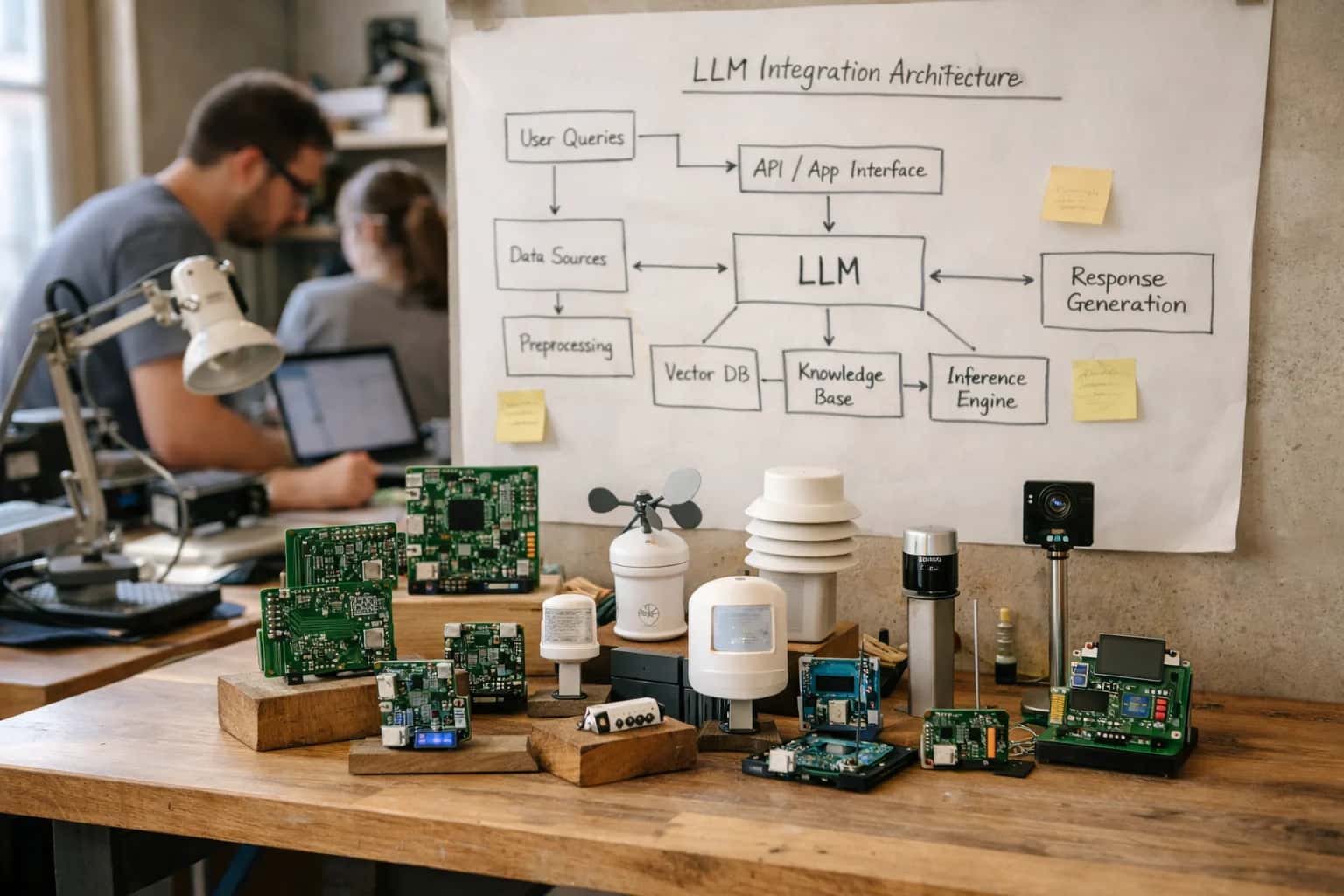
Where Model Benchmarking Fits in Your LLM Stack
A standardized Weights & Biases benchmarking suite is the decision engine for selecting, versioning, and retiring LLMs in production.
The implementation involves creating a versioned benchmark job that pulls the latest candidate models from your registry or API configuration, runs them against your test suite, and publishes results to a dedicated W&B project. Key integrations include:
- Triggering from your CI/CD system (e.g., GitHub Actions) when a new model is registered or a provider API version changes.
- Feeding results into approval workflows in tools like Jira or ServiceNow, where a lead engineer or product owner reviews the trade-offs before signing off on a production rollout.
- Updating operational dashboards to reflect the new baseline for latency and cost SLOs that your AIOps or FinOps teams monitor.
Without this automated benchmark layer, teams risk performance regression, cost overruns, and inconsistent user experiences when swapping models.
Governance and rollout require treating benchmark results as a contract. Define pass/fail thresholds for critical metrics (e.g., accuracy must not drop >5%, latency must remain under 2s p95). Use W&B's reporting features to generate a model comparison report for stakeholder review. For regulated use cases, this report becomes part of your audit trail, proving due diligence in model selection. Finally, integrate the winning model's configuration and benchmark artifact into your infrastructure-as-code templates (Terraform, Helm charts) for a reproducible, governed deployment to staging and production environments. This closes the loop, ensuring every model in production has a clear, benchmarked justification for its place in your stack.
Key W&B Surfaces for Benchmarking Integration
Logging and Comparing LLM Benchmarks
Integrate your benchmarking pipeline directly with W&B Runs to log performance, cost, and latency metrics for each model variant. This creates a centralized, versioned history of all experiments.
Key Integration Points:
wandb.init()at the start of each benchmark job, tagging runs with model identifiers (e.g.,llama3-70b-instruct,gpt-4-turbo).wandb.log()to record metrics per evaluation dataset (e.g.,{'mmlu_acc': 0.85, 'cost_per_1k_tokens': 0.12, 'p95_latency_ms': 1250}).wandb.sweep()to automate hyperparameter searches for fine-tuning or RAG pipeline parameters (chunk size, top-k).
This surface turns ad-hoc model comparisons into a reproducible, auditable process, essential for team collaboration and regulatory traceability.
High-Value Benchmarking Use Cases
Establish a systematic, data-driven process for selecting the optimal LLM for each application by integrating Weights & Biases into your development and deployment pipelines. These use cases show how to move from ad-hoc testing to governed, reproducible benchmarking.
Open-Source vs. Commercial API Cost-Performance Trade-off
Benchmark self-hosted open-source models (e.g., Llama 3, Mixtral) against commercial APIs (OpenAI, Anthropic) on your specific tasks. Use W&B to track inference latency, token throughput, and accuracy metrics, visualizing the total cost of ownership to inform build-vs-buy decisions.
Fine-Tuned Model Validation Suite
Automate the evaluation of new fine-tuned model checkpoints against a fixed golden dataset. Log accuracy, hallucination rates, and task-specific scores (e.g., code correctness, factual consistency) to W&B runs, enabling rapid comparison against the base model and previous iterations to prevent regressions.
RAG Pipeline Component Benchmarking
Isolate and benchmark each component of your Retrieval-Augmented Generation pipeline. Use W&B sweeps to test different embedding models, chunking strategies, and vector stores, measuring end-to-end answer quality and latency to architect the most efficient system.
Multi-Objective Model Selection for Production
Define a weighted scoring formula combining accuracy, p95 latency, cost per query, and fairness metrics. Run benchmark suites for candidate models and use W&B's reporting to rank them, creating a clear, auditable record for why a specific model version was promoted to production.
Drift-Aware Benchmarking for Model Refreshes
Integrate benchmark execution into your MLOps pipeline. Periodically re-run your core benchmark suite on the latest model variants and document corpora using W&B's pipeline integrations. Detect performance drift early and trigger retraining or re-indexing workflows.
Governed Model Registry with Benchmark Evidence
Use the W&B Model Registry as the source of truth for approved models. Link each registered model version to the specific W&B run containing its full benchmark results, evaluation metrics, and code snapshot. This creates an immutable lineage for compliance audits and rollback decisions.
Example Benchmarking Workflows
These workflows detail how to integrate a Weights & Biases benchmarking suite into your LLM development lifecycle to systematically compare models and make data-driven selection decisions.
Trigger: A new open-source LLM (e.g., Llama 3.1, Qwen 2.5) is released on Hugging Face.
Workflow:
- Data & Context Pull: The pipeline automatically pulls the new model card and a standardized evaluation dataset (e.g., MT-Bench, MMLU, a custom business Q&A set) from a versioned W&B Artifact.
- Model & Agent Action: A batch inference job runs the model against the dataset, logging all prompts, completions, token usage, and latency to a new W&B Run. A separate evaluation agent scores outputs using LLM-as-a-judge with a custom rubric.
- System Update: Results (accuracy, latency, cost/speed estimates) are logged as W&B Run metrics and summary tables. The run is linked to the model's artifact in the W&B Model Registry with a
candidatestage. - Human Review Point: A W&B Report is auto-generated comparing the new model's performance against the current
productionbaseline. The AI engineering team reviews the report to decide on promotion tostagingfor further integration testing.
Implementation Architecture: Building the Benchmarking Pipeline
A production-ready benchmarking pipeline automates the evaluation of LLM candidates against your specific cost, speed, and accuracy requirements.
The core of the integration is a CI/CD-aligned pipeline that treats new models as code. When a new open-source model is released, a fine-tuning job completes, or a commercial API plan changes, an automated workflow is triggered. This pipeline uses the Weights & Biases (W&B) SDK to create a new experiment run, systematically executing a predefined benchmark suite against the candidate. The suite typically includes: a set of representative prompts from your production logs, a golden dataset for accuracy evaluation, latency probes under simulated load, and cost calculation using the provider's pricing model. All inputs, outputs, metrics, and system stats are logged automatically to W&B as a single, comparable run.
Architecturally, the pipeline runs on orchestration tools like Airflow or GitHub Actions, often leveraging GPU clusters for local model testing. For commercial APIs, it manages API keys and rate limits. The key outcome is a W&B Project Dashboard that visualizes all model candidates across critical dimensions: accuracy scores (e.g., using LLM-as-a-judge), p95 latency, cost per 1k tokens, and any custom business metrics. This enables data-driven selection; you can easily see if a new fine-tuned Llama 3 variant offers a 15% accuracy boost for a 50ms latency trade-off, or if a switch to a newer GPT-4 Turbo model reduces costs by 40% with equivalent performance.
For governance, each benchmark run is linked to the exact model artifact (Hugging Face repo, internal registry path) and evaluation dataset version in W&B Artifacts, creating full lineage. Before a model is promoted, the pipeline can enforce gating criteria—for example, requiring a minimum accuracy score and a maximum cost threshold—and automatically update the W&B Model Registry. This integrated approach moves model selection from ad-hoc spreadsheet analysis to a governed, reproducible process, giving engineering and product leaders confidence in their LLM roadmap decisions.
Code and Configuration Patterns
Defining Your Benchmark Suite in W&B
A standardized benchmark suite is the core of your model selection process. In W&B, you define this as a configuration artifact, often a YAML or JSON file, that specifies the exact tests, datasets, and metrics for each candidate model.
Key components to version in W&B Artifacts:
- Evaluation Datasets: Reference datasets for factual accuracy, reasoning, and safety.
- Prompt Templates: Standardized prompts for each task category (e.g., summarization, classification, code generation).
- Metric Definitions: The exact calculation for cost (USD/token), speed (tokens/sec), and accuracy (exact match, LLM-as-a-judge score).
- Scoring Weights: Business-defined weights for each metric (e.g., 40% accuracy, 35% cost, 25% latency).
This artifact becomes the single source of truth for all comparative runs, ensuring every model is evaluated under identical conditions.
Operational Impact: Before and After Standardized Benchmarking
How a standardized model benchmarking suite in Weights & Biases transforms the LLM evaluation and selection process from an ad-hoc, manual effort into a governed, data-driven operation.
| Metric | Before AI | After AI | Notes |
|---|---|---|---|
Model Selection Cycle Time | 2-4 weeks per evaluation | 2-3 days for a full benchmark suite | Automated runs across cost, latency, and accuracy dimensions |
Evaluation Consistency | Ad-hoc scripts and spreadsheets per team | Centralized, versioned benchmark definitions | Ensures fair comparison and reproducible results |
Decision Confidence | Gut feel and limited sample testing | Statistical analysis across 1000s of prompts | Data-driven go/no-go for production deployment |
Cost Tracking | Manual API bill reconciliation | Per-model, per-experiment cost attribution in W&B | Enables FinOps and budget forecasting for AI projects |
Stakeholder Visibility | Email threads and slide decks | Shared W&B dashboards with real-time results | Self-service access for engineering, product, and compliance |
Governance & Audit Trail | Scattered experiment notes | Immutable lineage linking models to data, code, and results | Critical for regulatory inquiries and internal reviews |
Team Collaboration | Siloed model development | Unified project workspace for comparing open-source, fine-tuned, and commercial APIs | Accelerates knowledge sharing and reduces duplicate work |
Governance, Security, and Phased Rollout
A disciplined approach to implementing a Weights & Biases benchmarking suite for secure, auditable LLM evaluation and selection.
Integrating a W&B benchmarking suite requires a secure data pipeline. This begins with a dedicated service that orchestrates evaluation jobs, pulling approved test datasets from a governed data lake (e.g., S3 with Lake Formation tags) and executing them against candidate models—whether hosted APIs like OpenAI or fine-tuned models in a private VPC. All prompts, completions, latencies, and costs are logged to W&B runs with strict tags linking to the model version and data snapshot. Access to the benchmarking workspace is controlled via W&B's SSO and RBAC, ensuring only authorized MLOps engineers and data scientists can view or modify experiments.
A phased rollout mitigates risk. Phase 1 establishes a baseline by benchmarking your current production model against 2-3 alternatives on a core set of 5-10 accuracy and business metrics. Phase 2 expands the suite to include cost-per-1k-tokens and latency SLOs under simulated load, integrating the W&B sweep controller for hyperparameter optimization of fine-tuning jobs. Phase 3 automates the pipeline, where CI/CD triggers a benchmark on every new model candidate, and promotion to staging requires the W&B report to be attached to a ServiceNow change ticket, reviewed by the model governance board.
Governance is enforced through W&B's Model Registry and integrated audit trails. Each production candidate is registered as a candidate stage, with its W&B run containing the full benchmark report. Promotion to staging or production stages requires manual approval in the registry, which triggers an update in Credo AI to log the decision for compliance. This creates an immutable lineage from the benchmark results to the deployed model, crucial for regulatory inquiries and internal audits. Regular reviews of benchmark metrics against production monitoring data in Arize AI ensure the evaluation suite remains predictive of real-world performance.
Enabling Efficiency, Speed & Accuracy
Intelligent Analysis, Decision & Execution
We build AI systems for teams that need search across company data, workflow automation across tools, or AI features inside products and internal software.
Talk to Us
Search across company data
Give teams answers from docs, tickets, runbooks, and product data with sources and permissions.
Useful when people spend too long searching or get different answers from different systems.

Automate internal workflows
Use AI to route work, draft outputs, trigger actions, and keep approvals and logs in place.
Useful when repetitive work moves across multiple tools and teams.

Add AI to products and internal tools
Build assistants, guided actions, or decision support into the software your team or customers already use.
Useful when AI needs to be part of the product, not a separate tool.
Frequently Asked Questions
Practical questions for teams establishing a standardized LLM benchmarking suite with Weights & Biases to drive model selection and deployment decisions.
Adding a new model involves a standardized, automated pipeline to ensure consistent evaluation.
- Trigger & Registration: A new model candidate (e.g., a fine-tuned Llama 3 variant, a new GPT-4-turbo version) is registered in your W&B project, tagged with metadata like
source,base_model, andparameter_count. - Data & Task Execution: Your orchestration system (e.g., Airflow, Metaflow) runs the model against your standardized evaluation dataset—a curated mix of tasks relevant to your use cases (e.g., SQL generation, customer email summarization, code completion).
- Metric Logging: For each task, the pipeline logs key metrics to W&B as a new run:
- Accuracy/Quality: Scores from LLM-as-a-judge evaluations or task-specific metrics (BLEU, code execution success).
- Performance: P95 latency and throughput measured under a controlled load.
- Cost: Estimated cost per 1k tokens (for API models) or GPU-hour (for self-hosted).
- Comparative Analysis: The new run is automatically linked to a W&B Sweep or Report that visualizes its performance against the existing model portfolio across all dimensions.
- Decision Gate: The benchmark report, accessible via a shared W&B dashboard, becomes the data source for a go/no-go decision on further testing or production deployment.

About the author
Prasad Kumkar
CEO & MD, Inference Systems
Prasad Kumkar is the CEO & MD of Inference Systems and writes about AI systems architecture, LLM infrastructure, model serving, evaluation, and production deployment. Over 5+ years, he has worked across computer vision models, L5 autonomous vehicle systems, and LLM research, with a focus on taking complex AI ideas into real-world engineering systems.
His work and writing cover AI systems, large language models, AI agents, multimodal systems, autonomous systems, inference optimization, RAG, evaluation, and production AI engineering.
Partnered with leading AI, data, and software stack.





How We Work
Custom AI workflows for your Business
One-fit-all AI don't work for modern businesses. At Inferensys, we aim to understand your business & custom requirements; which we use to define most efficient agentic workflows, the data, and the tools for your business.
01
Review the use case
We understand the task, the users, and where AI can actually help.
Read more02
Pick the right approach
We define what needs search, automation, or product integration.
Read more03
Build the first useful version
We implement the part that proves the value first.
Read more04
Improve from there
We add the checks and visibility needed to keep it useful.
Read moreThe first call is a practical review of your use case and the right next step.
Talk to Us