In a production LLM stack, Arize AI Concept Drift acts as a real-time sentinel. It ingests inference logs from your RAG pipelines, agentic workflows, or fine-tuned models—whether deployed via LangChain, LlamaIndex, or custom APIs. Its job is to detect when the statistical relationship between user inputs (e.g., customer queries, support tickets, document content) and expected model outputs begins to shift. This shift often precedes a measurable drop in business metrics like customer satisfaction or task completion rates.

Integration
AI Integration for Arize AI Concept Drift
Detect when your production LLM's understanding of the world changes—due to new products, regulations, or user behavior—using Arize AI's concept drift monitoring. Automate alerts and trigger prompt or model updates to maintain performance.
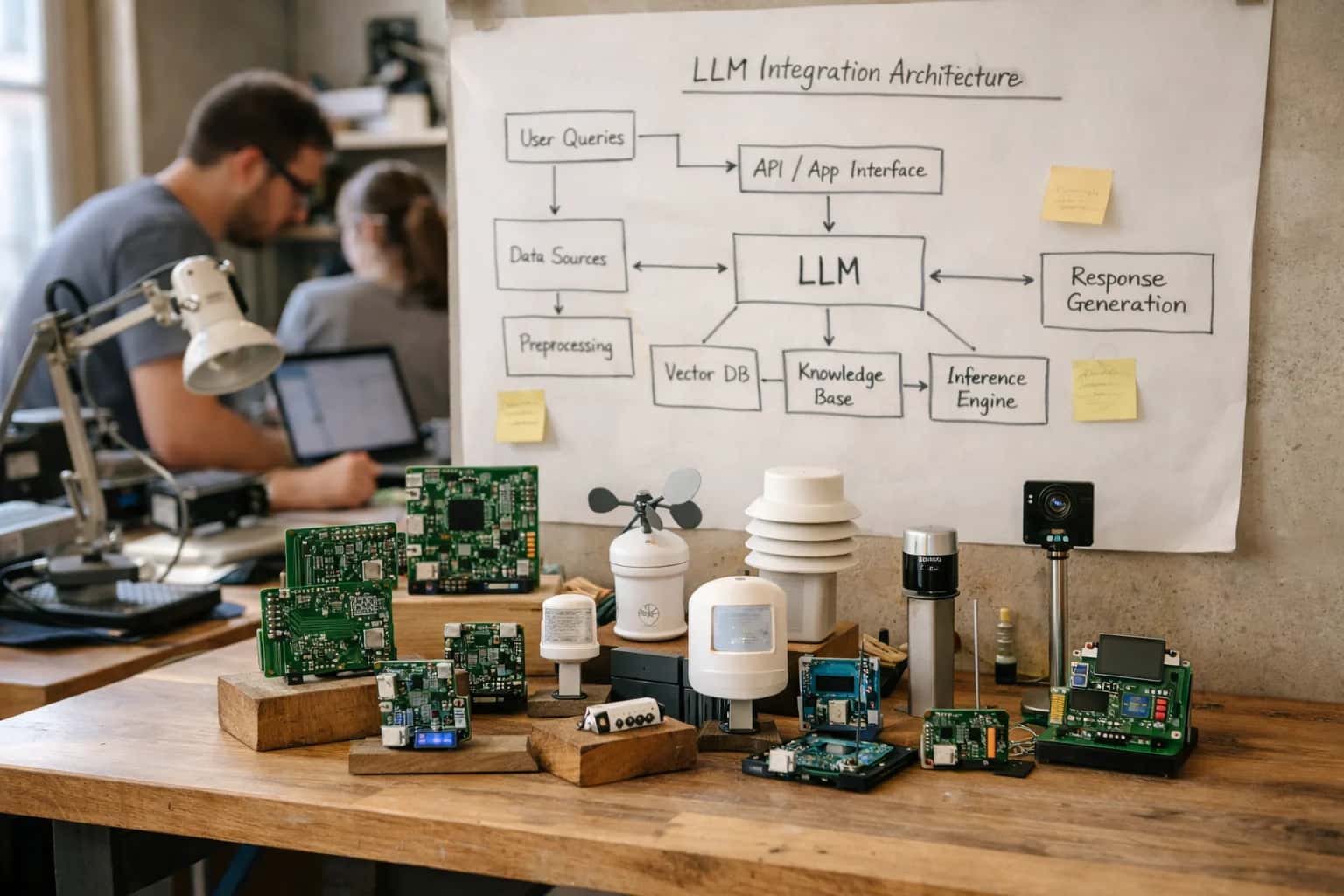
ARCHITECTURE & OPERATIONS
Where Concept Drift Monitoring Fits in Your LLM Stack
Concept drift monitoring is a critical production control layer, sitting between your live LLM applications and your model management pipeline.
The integration typically involves instrumenting your LLM serving layer (e.g., FastAPI endpoints, LangSmith-traced chains) to send payloads—prompts, responses, metadata, and optional ground truth—to Arize via its SDK or API. Key monitoring surfaces include:
- Embedding Distributions: Detecting drift in the semantic space of user questions, which can break RAG retrieval.
- LLM Output Characteristics: Monitoring shifts in response length, sentiment, or refusal rates.
- Business-defined Features: Tracking changes in input metadata like product category, user region, or ticket priority that correlate with performance.
When drift is detected, the system triggers automated workflows. Alerts can route to Slack or PagerDuty for on-call engineers, or kick off retraining pipelines in Weights & Biases by promoting a new experiment. For prompt-based applications, drift can signal the need for a LangChain prompt template update. This creates a closed-loop system: monitor → detect → alert → retrain/update → redeploy → monitor, ensuring your AI applications remain effective as user behavior and business contexts evolve.
LLM APPLICATION MONITORING
Arize AI Surfaces for Concept Drift Integration
Monitor Prompt Effectiveness and Response Drift
Concept drift in LLM applications often manifests as a degradation in the quality or relevance of outputs, even when the underlying model remains unchanged. This occurs when user queries evolve (e.g., new product features, updated regulations) or the knowledge base becomes stale.
Integrate Arize AI to monitor key surfaces:
- Prompt Template Performance: Track success metrics (e.g., correct structured output generation, user satisfaction scores) for each versioned prompt template. A/B test new prompts against baselines to detect which versions are drifting.
- LLM-as-a-Judge Evaluations: Automatically score production LLM outputs using another LLM configured with a custom rubric. Monitor the distribution of these scores for sudden shifts indicating a change in answer quality or alignment.
- Business Metric Correlation: Link LLM outputs to downstream business outcomes (e.g., support ticket resolution, lead conversion). Drift in this correlation is a strong signal that the LLM's utility has changed, necessitating a prompt or retrieval update.
This surface provides the first alert that your application's "concepts"—the relationship between inputs and desired outputs—are shifting.
ARIZE AI INTEGRATION PATTERNS
High-Value Use Cases for LLM Concept Drift Detection
Detecting when an LLM's understanding of a task has shifted is critical for maintaining performance. These patterns show where to integrate Arize AI's drift detection to automate monitoring and trigger corrective actions.
01
Customer Support Intent Drift
Monitor for shifts in customer query patterns (e.g., new product issues, updated policies) that degrade your support chatbot's intent classification and routing accuracy. Integrate Arize AI to track embedding drift on incoming tickets and alert when retraining or prompt updates are needed.
Batch -> Real-time
Detection Cadence
02
RAG Knowledge Freshness
Ensure your Retrieval-Augmented Generation system's answers stay accurate as source documents evolve. Use Arize AI to detect concept drift between the embeddings of your live knowledge base chunks and a reference set, triggering re-indexing workflows when significant drift is detected.
1 sprint
Catch regressions
03
Dynamic Pricing & Compliance Logic
Safeguard LLMs that generate pricing recommendations or compliance summaries. Integrate Arize AI to monitor for drift in the model's interpretation of regulatory text or market conditions, providing an audit trail and alerts before outdated logic impacts decisions.
Same day
Policy shift detection
04
Product Feature & Taxonomy Shift
Track how LLM-powered features like search, tagging, or content moderation degrade as your product catalog or content taxonomy changes. Connect Arize AI to your product feed to detect embedding drift, signaling the need for model retraining on new categories.
05
Automated Content Generation Quality
Maintain quality for LLMs generating marketing copy, product descriptions, or report summaries. Use Arize AI to monitor drift in output characteristics (sentiment, readability, keyword adherence) against a golden set, alerting content teams to review and adjust prompts.
Hours -> Minutes
Review trigger
06
Fraud & Risk Model Decay
Protect LLMs used in fraud analysis or risk assessment from decaying as attacker tactics evolve. Integrate Arize AI to perform statistical drift detection on model scores and explanations, automatically routing anomalous cases for human review and model recalibration.
AUTOMATED GOVERNANCE LOOPS
Example Workflows: From Drift Detection to Resolution
Concept drift in production LLMs is not a one-time alert—it's a trigger for a governed operational workflow. Below are concrete automation patterns that connect Arize AI's detection capabilities to downstream actions, ensuring your AI applications adapt reliably.
Trigger: Arize AI detects a statistically significant drop in a key performance indicator (e.g., response_relevance_score) for a specific prompt template version over a 24-hour window.
Workflow:
- Arize webhook sends alert payload to an internal orchestration service (e.g., n8n, a custom API).
- Orchestrator validates the alert, checks if the drift is isolated to a single prompt variant in an A/B test.
- It calls the Prompt Management System's API (e.g., LangSmith, a internal registry) to:
- Get the current production traffic distribution.
- Programmatically reduce traffic to the degraded prompt variant to 0%.
- Increase traffic to the previous stable prompt version to 100%.
- Orchestrator creates a ticket in Jira/ServiceNow for the prompt engineering team to investigate root cause.
- A confirmation message is posted to a dedicated Slack channel (
#ai-ops-alerts).
Key Integration Points: Arize Webhooks, Prompt Registry API, Internal Orchestrator, Ticketing System API.
CONNECTING DRIFT DETECTION TO PRODUCTION LLM WORKFLOWS
Implementation Architecture: Data Flow and System Design
A practical blueprint for integrating Arize AI's concept drift monitoring into live LLM applications to trigger prompt updates and model retraining.
The integration architecture establishes a continuous feedback loop between your production LLM endpoints and Arize AI's monitoring platform. Core data flows include:
- Inference Logging: Your application's inference service (e.g., a FastAPI endpoint serving a RAG pipeline) is instrumented to send every LLM request and response to Arize AI via its Python SDK or API. This payload includes the raw user query, the retrieved context (for RAG), the final completion, and any extracted structured outputs.
- Ground Truth & Feedback Collection: To measure drift, you need a signal of correctness. This is achieved by piping labeled data into Arize, which can come from multiple sources:
- Human review platforms where agents score LLM outputs.
- Implicit feedback signals (e.g., "thumbs down" in a UI, conversation escalation rates).
- Business outcome data from downstream systems (e.g., a
lead_convertedflag from Salesforce for a sales qualification bot).
- Drift Detection Configuration: In Arize, you configure monitors for prediction drift (shifts in the distribution of LLM outputs) and data drift (shifts in user query patterns or retrieved document embeddings). For concept drift specifically, you set up a performance metric (like accuracy or a custom score) and alert on its degradation over time, correlated with drift in the input or output distributions.
Under the hood, the system design must ensure scalability and isolation. A common pattern uses a message queue (e.g., Apache Kafka, AWS Kinesis) to decouple your high-volume inference services from the monitoring pipeline. Events are published asynchronously, consumed by a dedicated service that batches and sends them to Arize, preventing monitoring from impacting user-facing latency. For embedding drift detection—critical for RAG—you configure Arize to monitor the vector representations of your knowledge base chunks, alerting when the semantic "meaning space" of your documents shifts, which can degrade retrieval quality. Alerts from Arize are routed via webhooks to your incident management (PagerDuty, Opsgenie) and orchestration tools (e.g., triggering a retraining pipeline in Airflow or notifying prompt engineers in Slack).
Rollout and governance require careful staging. Start by integrating drift monitoring for a single, high-value LLM use case (e.g., a customer support triage agent). Establish a baseline of "normal" drift over a 2-4 week period before setting aggressive alert thresholds to avoid alert fatigue. Governance is enforced by treating Arize alert triggers as inputs to a formal change management process. For instance, a confirmed concept drift alert could automatically create a ticket in Jira Service Management for the AI engineering team, kick off a diagnostic workflow, and require a sign-off from a model validator before a new prompt or model version is deployed. This closes the loop, ensuring drift detection directly drives maintainable, auditable updates to your AI systems.
IMPLEMENTING DRIFT DETECTION
Code and Configuration Examples
Logging Inference Data to Arize
The first step is instrumenting your LLM application to send production inference data to Arize for baseline comparison. Use the Arize Python SDK within your serving logic. The payload must include the model version, features (inputs), and prediction (output). For concept drift, tracking the timestamp is critical.
pythonimport arize from arize.utils.types import ModelTypes, Environments # Initialize client client = arize.Client(api_key=os.environ['ARIZE_API_KEY'], space_key=os.environ['ARIZE_SPACE_KEY']) # Log a prediction after your LLM call response = client.log( model_id="customer-support-llm", model_version="v2.1", model_type=ModelTypes.GENERATIVE_LLM, environment=Environments.PRODUCTION, prediction_id=str(uuid.uuid4()), prediction_label=llm_response_text, # The LLM's generated output features={ "user_query": customer_message, "query_intent": classified_intent, "retrieved_chunk_count": len(context_chunks) }, timestamp=datetime.datetime.now() )
This creates the foundational dataset Arize uses to compute drift metrics against your training or golden dataset.
CONCEPT DRIFT DETECTION
Realistic Impact: Time Saved and Risk Reduced
How integrating Arize AI for concept drift monitoring transforms the LLM operations lifecycle from reactive firefighting to proactive governance.
| Metric | Before AI | After AI | Notes |
|---|---|---|---|
Drift Detection Timeline | Weeks to months (post-incident analysis) | Hours to days (proactive alerting) | Alerts trigger on statistical shifts in input/output distributions. |
Root Cause Analysis Effort | Manual log sifting across multiple systems | Segmented analysis in a unified dashboard | Drill down from performance alert to problematic data slices or feature attributions. |
Model Update Decision Latency | Ad-hoc, based on user complaints | Data-driven, based on health score thresholds | Automated reports compare new model/prompt variants against baselines using business metrics. |
Regulatory Audit Preparation | Manual evidence collection over weeks | Automated audit trail generation | Credo AI integration maps drift events to compliance controls and generates documentation. |
Mean Time To Resolution (MTTR) | High variability; days for complex issues | Predictable; hours for common drift patterns | Integrated alerting with PagerDuty/Slack and pre-defined runbooks for engineering teams. |
Cost of Undetected Performance Decay | Unquantified revenue impact and user churn | Tracked correlation between KPIs and business outcomes | Arize AI links model health scores to operational metrics like support deflection rate or lead qualification score. |
Governance Workflow Overhead | Manual risk assessments for each model change | Automated gates in CI/CD pipelines | Credo AI risk scores integrated with deployment tools to provide go/no-go checks. |
PRODUCTION-READY DRIFT MANAGEMENT
Governance, Security, and Phased Rollout
Deploying Arize AI concept drift detection requires a governance-first approach to ensure alerts are actionable, secure, and integrated into existing MLOps workflows.
Integrating Arize AI for LLM concept drift detection touches critical surfaces: your inference logging pipeline, vector database or embedding service, and model retraining or prompt management systems. Governance starts by defining what constitutes a 'concept' for your application—this could be a shift in user query intent, a change in retrieved document relevance scores, or a degradation in the accuracy of structured outputs parsed from LLM completions. Access to Arize's monitoring dashboards and alert configurations should be controlled via RBAC, aligning with your existing data science and AI platform teams.
A phased rollout is essential to avoid alert fatigue. Start by instrumenting a single, high-value LLM workflow—such as a customer support RAG pipeline or a document classification agent—and configure Arize to monitor for embedding drift on your knowledge base chunks and prediction drift on key output fields. Use Arize's segmentation features to slice data by user cohort or data source, establishing a baseline before enabling organization-wide alerts. Integrate Arize alerts with your incident management platform (e.g., PagerDuty, ServiceNow) but gate them behind a manual review step initially, allowing your team to triage and validate drift signals.
For security, ensure all data sent to Arize's APIs is scrubbed of PII and sensitive business information before ingestion. Leverage Arize's private cloud or VPC deployment options if required. The integration should create an immutable audit trail: each drift alert should be traceable back to the specific model version, prompt hash, and data slice. Finally, close the loop by connecting Arize's drift detection to your CI/CD pipelines and model registry (e.g., Weights & Biases). A confirmed concept drift alert can automatically trigger a Jira ticket for the prompt engineering team or kick off a retraining pipeline for a fine-tuned model, turning monitoring into a controlled operational workflow.
Enabling Efficiency, Speed & Accuracy
Intelligent Analysis, Decision & Execution
We build AI systems for teams that need search across company data, workflow automation across tools, or AI features inside products and internal software.
Talk to Us
Search across company data
Give teams answers from docs, tickets, runbooks, and product data with sources and permissions.
Useful when people spend too long searching or get different answers from different systems.
Enterprise searchRAGPermissions
Read more
Automate internal workflows
Use AI to route work, draft outputs, trigger actions, and keep approvals and logs in place.
Useful when repetitive work moves across multiple tools and teams.
AI agentsWorkflow automationGovernance
Read more
Add AI to products and internal tools
Build assistants, guided actions, or decision support into the software your team or customers already use.
Useful when AI needs to be part of the product, not a separate tool.
AI integrationDecision supportModel routing
Read moreARIZE AI CONCEPT DRIFT INTEGRATION
Frequently Asked Questions (FAQ)
Common questions about detecting and responding to concept drift in production LLM applications using Arize AI.
Arize AI concept drift alerts are triggered when statistical tests (like PSI, KS) detect a significant shift between your production data distribution and a reference baseline (e.g., last month's data).
Typical Response Workflow:
- Alert Routing: The alert is sent to a designated channel (e.g., Slack, PagerDuty) for the AI engineering or data science on-call.
- Initial Triage: The engineer uses Arize's Root Cause Analysis (RCA) and Segment Analysis tools to isolate the drift—is it in user query topics, retrieved document content, or a specific customer segment?
- Impact Assessment: Correlate the drift with key performance metrics in Arize (e.g., drop in answer relevance score, increase in user thumbs-down).
- Remediation Action:
- Prompt Update: If drift is in query intent, update and A/B test new prompt templates via your LangChain Prompt Management system.
- Knowledge Base Refresh: If source documents are outdated, trigger a re-indexing of your RAG vector store.
- Model Retraining: For severe drift, initiate a fine-tuning pipeline, logging the new experiment in Weights & Biases.
- Governance Log: Document the incident and action in Credo AI to maintain an audit trail for compliance.

About the author
Prasad Kumkar
CEO & MD, Inference Systems
Prasad Kumkar is the CEO & MD of Inference Systems and writes about AI systems architecture, LLM infrastructure, model serving, evaluation, and production deployment. Over 5+ years, he has worked across computer vision models, L5 autonomous vehicle systems, and LLM research, with a focus on taking complex AI ideas into real-world engineering systems.
His work and writing cover AI systems, large language models, AI agents, multimodal systems, autonomous systems, inference optimization, RAG, evaluation, and production AI engineering.
LinkedIn
Limited slotsGet a Free AI Consultation
Partnered with leading AI, data, and software stack.





How We Work
Custom AI workflows for your Business
One-fit-all AI don't work for modern businesses. At Inferensys, we aim to understand your business & custom requirements; which we use to define most efficient agentic workflows, the data, and the tools for your business.
01
Review the use case
We understand the task, the users, and where AI can actually help.
Read more02
Pick the right approach
We define what needs search, automation, or product integration.
Read more03
Build the first useful version
We implement the part that proves the value first.
Read more04
Improve from there
We add the checks and visibility needed to keep it useful.
Read moreThe first call is a practical review of your use case and the right next step.
Talk to Us