Human-in-the-loop (HITL) integration is a critical control layer for LangChain applications moving from prototype to production. It typically intercepts the agent workflow at three key junctures: before execution for policy checks on planned tool calls (e.g., a SQLDatabaseToolkit query), during processing for validation of intermediate reasoning steps logged via LangSmith callbacks, and after generation for approval of final outputs destined for users or downstream systems like a CRM or ERP. This creates a secure airlock for actions with financial, legal, or customer impact.

Integration
AI Integration for LangChain Human-in-the-Loop
Implement robust human review workflows for LangChain agents to handle low-confidence outputs, high-stakes decisions, and edge cases. Route AI-generated content to human operators for approval before final delivery.
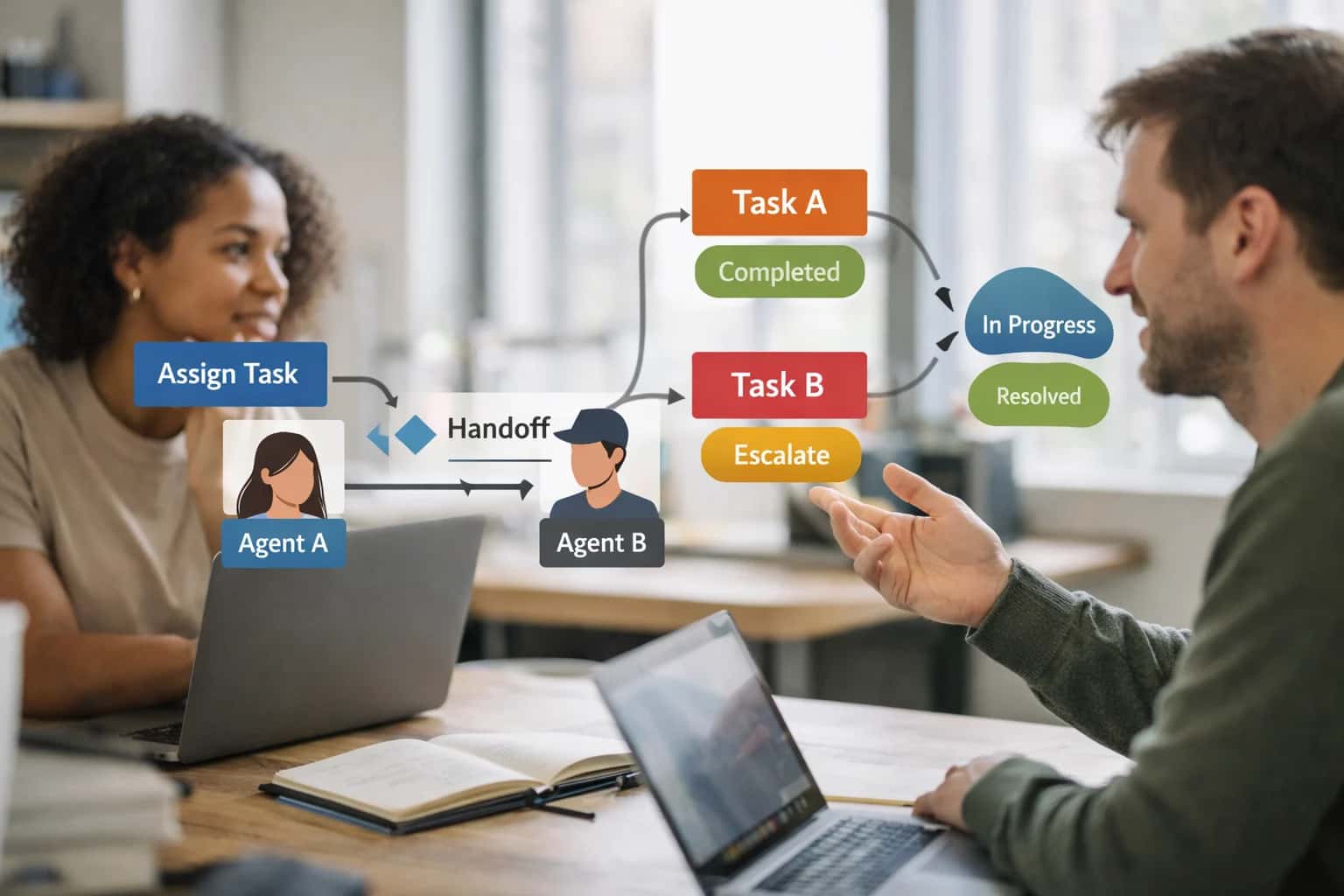
ARCHITECTURE FOR CONTROLLED AGENTS
Where Human-in-the-Loop Fits in LangChain Applications
Integrating human review workflows into LangChain agents to govern high-stakes decisions, validate low-confidence outputs, and ensure operational safety.
Implementation involves routing logic that evaluates confidence scores, cost thresholds, or content policies to queue items for review. A common pattern uses a dedicated review queue service (built with tools like n8n or Prefect) that ingests LangSmith traces or agent output payloads. The service presents the context—original query, agent's chain-of-thought, proposed action or answer—to a human operator via a dashboard or integrated ticketing system like ServiceNow. Once approved, rejected, or edited, the workflow resumes, with the decision logged back to LangSmith for audit and model improvement.
Rollout requires careful governance. Start with a shadow mode where all agent outputs are logged and reviewed post-hoc to establish baselines for automation confidence. Then, implement canary releases for HITL gates on non-critical workflows, measuring the impact on latency and operator workload. Finally, enforce RBAC and audit trails so review decisions are attributable and reversible. This staged approach balances automation benefits with necessary oversight, ensuring LangChain agents operate safely within enterprise guardrails.
ARCHITECTING CONTROLLED AGENT WORKFLOWS
Integration Points for Human Review in LangChain
Direct Integration with LangSmith Tracing
LangSmith's callback system is the primary integration surface for routing agent outputs to human review. By implementing a custom BaseCallbackHandler, you can intercept LLM responses, tool calls, and chain outputs at key decision points.
Key Integration Patterns:
- Confidence Scoring Intercept: After an agent generates a final answer, evaluate confidence via a secondary LLM call or heuristic. If below threshold, log the trace to LangSmith with a
human_review_requiredtag. - Tool Execution Validation: Wrap sensitive tool calls (e.g., database writes, API purchases) with validation logic. Route the proposed action and context to a review queue before execution.
- Trace Metadata Enrichment: Attach business context (user tier, transaction value, regulatory flags) to LangSmith runs. Use this metadata to create priority-based routing rules in your review dashboard.
This approach keeps your LangChain application logic clean while leveraging LangSmith's built-in tracing infrastructure for auditability.
CONTROLLED AI OPERATIONS
High-Value Use Cases for LangChain Human Review
Integrating human-in-the-loop (HITL) workflows into LangChain agents is critical for high-stakes, regulated, or complex decision-making. These patterns route low-confidence outputs, policy violations, or irreversible actions to human operators for approval, creating a safety net for production AI.
01
Financial Document Review & Approval
Route LangChain-generated loan summaries, risk assessments, or compliance reports to a human underwriter or compliance officer for final sign-off before submission. The agent extracts key figures and clauses, but a human validates the accuracy and context before the decision is logged.
Batch -> Real-time
Review workflow
02
Customer Support Escalation Gateway
Configure a LangChain support agent to automatically escalate conversations to a live agent based on sentiment analysis, query complexity, or low confidence in the retrieved knowledge base article. The human agent receives a full interaction summary and suggested resolution path.
Same day
Critical issue resolution
03
Regulated Content Moderation
For user-generated content platforms, use a LangChain agent to flag potentially harmful or non-compliant content (e.g., in healthcare, finance). All flagged content is queued in a human review dashboard with the agent's reasoning and relevant policy excerpts highlighted for faster adjudication.
Hours -> Minutes
Triage time
04
Contract Clause Redlining Assistance
A LangChain agent suggests edits or identifies risks in contract drafts by comparing against a clause library. Instead of auto-applying changes, it creates a review task for a legal professional, presenting the suggested edit, the original text, and the rationale side-by-side for approval.
1 sprint
Implementation cycle
05
Clinical Note Draft Validation
In healthcare settings, a LangChain agent can draft clinical encounter notes from a transcript. Before integration into the EHR, the draft is routed to the clinician for review and signature. The workflow ensures AI assists documentation without bypassing clinician oversight and liability.
Structured Output
SOAP note format
06
Multi-Step Agentic Workflow Checkpoint
In complex LangChain orchestrations involving multiple tool calls (e.g., place an order, update CRM, send a confirmation), insert a human review checkpoint before executing irreversible actions like purchases or data writes. The human sees the planned sequence and can approve, modify, or cancel.
Prevent Errors
Before system execution
IMPLEMENTATION PATTERNS
Example Human-in-the-Loop Workflows
These workflows illustrate how to integrate LangChain agents with LangSmith or custom systems to route low-confidence or high-stakes outputs to human operators for review, approval, or correction before final execution.
Trigger: A LangChain agent generates a response to a customer support ticket pulled from Zendesk or Salesforce Service Cloud.
Context Pulled: Agent has access to the ticket history, knowledge base articles via RAG, and the customer's tier/entitlement.
Agent Action: The agent drafts a resolution answer. A separate classification chain scores the response's confidence (0-1) based on factors like answer specificity, citation relevance, and sentiment alignment.
Human Review Point: If confidence score is below a configured threshold (e.g., 0.7), or if the action involves a high-cost resolution (like issuing a refund above a limit), the draft response and its confidence metadata are routed to a human review queue in a platform like LangSmith or a custom dashboard.
System Update: The human reviewer approves, edits, or rejects the response. The approved final response is posted back to the ticketing system via its API. The original prompt, low-confidence output, and human-corrected version are logged to a dataset for future fine-tuning or prompt adjustment.
BUILDING CONTROLLED AGENTIC WORKFLOWS
Implementation Architecture: Data Flow and Decision Points
A practical blueprint for integrating human review into LangChain agents, ensuring high-stakes decisions are routed for approval.
The core architecture involves instrumenting your LangChain agents to emit confidence scores or decision flags at key steps. This is typically done by wrapping critical chains or tools with a custom callback handler that logs the agent's proposed action and its associated metadata (e.g., source citations, parsed parameters, cost) to a workflow queue like RabbitMQ, AWS SQS, or a database table. For example, an agent processing a refund request over $500 or generating a legal clause would push a HumanReviewTask payload containing the query context, the agent's recommended action, and the supporting evidence.
A separate orchestrator service polls this queue, evaluates tasks against predefined routing rules (stored in a configuration service or feature flag platform), and directs them to the appropriate destination. Low-confidence tasks or those matching high-risk categories are routed to a human-in-the-loop dashboard (built with tools like LangSmith's UI, Retool, or a custom React app). Approved or modified decisions from human operators are fed back into the system via a webhook, allowing the original agent to proceed or a downstream service to execute the final action. This creates a closed-loop system where the agent's output is a recommendation, not an autonomous execution.
Governance is enforced by integrating this flow with your existing audit and compliance platforms. Every HumanReviewTask and its resolution should be logged to your central logging system (e.g., Datadog, Splunk) with a correlation ID, and the final decision recorded in an immutable ledger or your primary database. This architecture allows you to start with manual review for critical paths and gradually automate more as confidence increases, while maintaining full visibility and control. For teams using LangSmith, this can be built by extending its tracing capabilities to trigger webhooks for specific trace tags, creating a native integration point for human review workflows.
LANGCHAIN HUMAN REVIEW WORKFLOWS
Code Patterns and Integration Examples
Implementing Conditional Routing
Use LangSmith's trace data to programmatically route low-confidence agent outputs to a human review queue. The key is to define routing criteria based on evaluation scores, token usage, or the presence of specific tool calls.
pythonfrom langsmith import Client from your_review_system import create_review_ticket client = Client() def evaluate_and_route(run_id: str): """Fetch a LangChain run and route if confidence is low.""" run = client.read_run(run_id) # Example routing logic if run.outputs: # Check for low confidence score from an evaluator confidence = run.outputs.get('confidence_score', 1.0) if confidence < 0.7: # Extract context for the human reviewer review_data = { 'input': run.inputs, 'agent_output': run.outputs, 'trace_url': run.url, 'tools_called': run.extra.get('invoked_tools', []) } ticket_id = create_review_ticket(review_data) return {'needs_review': True, 'ticket_id': ticket_id} return {'needs_review': False}
This pattern allows you to intercept agent execution, apply business logic, and seamlessly integrate with ticketing systems like Jira or ServiceNow for human intervention.
LANGCHAIN AGENT GOVERNANCE
Operational Impact: Before and After Human-in-the-Loop
How integrating human review workflows with LangChain agents changes operational dynamics, balancing automation with control.
| Metric | Before AI | After AI | Notes |
|---|---|---|---|
High-Stakes Decision Review | Manual, ad-hoc process for all outputs | Automated routing of low-confidence outputs only | Human effort focused on exceptions requiring judgment |
Agent Error Detection Latency | Post-production user reports | Real-time monitoring with confidence scoring | Issues caught before impacting end-users |
Agent Iteration & Tuning Cycle | Weeks to gather feedback and retrain | Days to review edge cases and adjust prompts | Feedback loop integrated into LangSmith trace review |
Compliance Evidence Collection | Manual screenshot and log compilation | Automated audit trail from LangSmith and approval logs | Immutable records for regulated use cases |
Agent Deployment Confidence | Limited, based on synthetic tests | Validated with real-world human-in-the-loop data | Canary releases with human oversight for new workflows |
Operational Cost of Oversight | High, from constant human monitoring | Optimized, proportional to exception volume | Scales with automation maturity and agent reliability |
Mean Time to Resolve Agent Failures | Hours to days for triage and root cause | Minutes to hours with pre-classified errors | Integrated with ticketing systems like Jira for assigned review |
CONTROLLED AGENT DEPLOYMENT
Governance, Security, and Phased Rollout
Implementing LangChain human-in-the-loop workflows requires a security-first architecture and a phased rollout to manage risk.
A production-ready architecture for LangChain human-in-the-loop (HITL) typically involves a routing agent that evaluates LLM outputs against confidence thresholds or predefined risk rules. Low-confidence responses, high-stakes decisions (e.g., financial approvals, medical advice), or outputs triggering content safety filters are automatically queued in a system like LangSmith or a custom task management platform (e.g., ServiceNow, Jira) for human review. This ensures the agent's autonomy is gated by policy, creating an immutable audit trail of all automated actions and human overrides.
Security is enforced at multiple layers: the routing logic must have RBAC-integrated access to determine which reviewers are authorized for specific queues or decision types. Inputs and outputs should be logged to a secure, encrypted store with data retention policies aligned to regulations like GDPR or HIPAA. When integrating with external tools, implement strict validation and rate limiting on the agent's API calls to prevent cost overruns or unauthorized data access. The human review interface itself should redact or mask sensitive data (PII, PHI) based on the reviewer's clearance level.
A phased rollout is critical for trust and operational learning. Start with a shadow mode, where the agent's suggested actions are logged but not executed, allowing you to measure its proposed accuracy against existing human workflows. Next, move to a co-pilot phase where the agent drafts responses or recommendations for a human to approve and send within the existing platform (e.g., a Zendesk ticket, a Salesforce case). Finally, graduate to limited autonomy for low-risk, high-volume tasks, with a clear escalation path and continuous monitoring of HITL loopback rates and reviewer feedback to iteratively refine confidence thresholds and routing rules.
Enabling Efficiency, Speed & Accuracy
Intelligent Analysis, Decision & Execution
We build AI systems for teams that need search across company data, workflow automation across tools, or AI features inside products and internal software.
Talk to Us
Search across company data
Give teams answers from docs, tickets, runbooks, and product data with sources and permissions.
Useful when people spend too long searching or get different answers from different systems.
Enterprise searchRAGPermissions
Read more
Automate internal workflows
Use AI to route work, draft outputs, trigger actions, and keep approvals and logs in place.
Useful when repetitive work moves across multiple tools and teams.
AI agentsWorkflow automationGovernance
Read more
Add AI to products and internal tools
Build assistants, guided actions, or decision support into the software your team or customers already use.
Useful when AI needs to be part of the product, not a separate tool.
AI integrationDecision supportModel routing
Read moreLANGCHAIN HUMAN-IN-THE-LOOP
Frequently Asked Questions
Common questions about implementing and scaling human review workflows for LangChain agents, covering architecture, security, rollout, and governance.
The decision point is typically placed after the LLM generates a response but before it's returned to the user or written to a system of record. Common integration patterns include:
- Confidence-Based Routing: Add a step in your
LangChainchain that evaluates the agent's output confidence (e.g., via a separate LLM call or heuristic). If below a threshold, route the payload (input, context, proposed output) to a review queue via a webhook. - Structured Output Validation: Use
LangChain'sPydanticOutputParserorStructuredOutputParser. If the output fails schema validation, automatically flag it for human review. - Content Policy Triggers: Integrate a content moderation layer. If the agent's response triggers a policy (e.g., contains potential PII, uses uncertain language like "I think..."), route it for review.
The review system (like LangSmith or a custom dashboard) should receive the full chain context—the user query, retrieved documents, agent's reasoning trace, and the proposed final answer.

About the author
Prasad Kumkar
CEO & MD, Inference Systems
Prasad Kumkar is the CEO & MD of Inference Systems and writes about AI systems architecture, LLM infrastructure, model serving, evaluation, and production deployment. Over 5+ years, he has worked across computer vision models, L5 autonomous vehicle systems, and LLM research, with a focus on taking complex AI ideas into real-world engineering systems.
His work and writing cover AI systems, large language models, AI agents, multimodal systems, autonomous systems, inference optimization, RAG, evaluation, and production AI engineering.
LinkedIn
Limited slotsGet a Free AI Consultation
Partnered with leading AI, data, and software stack.





How We Work
Custom AI workflows for your Business
One-fit-all AI don't work for modern businesses. At Inferensys, we aim to understand your business & custom requirements; which we use to define most efficient agentic workflows, the data, and the tools for your business.
01
Review the use case
We understand the task, the users, and where AI can actually help.
Read more02
Pick the right approach
We define what needs search, automation, or product integration.
Read more03
Build the first useful version
We implement the part that proves the value first.
Read more04
Improve from there
We add the checks and visibility needed to keep it useful.
Read moreThe first call is a practical review of your use case and the right next step.
Talk to Us