In production, a LangChain chain is not just a Python script—it's a critical service component that orchestrates prompts, LLM calls, tool execution, and data parsing. Managing it requires the same rigor as application code: version control in Git, CI/CD pipelines for automated testing, and immutable deployments. Key surfaces to govern include the LLMChain or SequentialChain objects, their underlying prompt templates, the configured tools and retrievers, and the output parsers that shape data for downstream systems like CRMs or databases. Without this discipline, prompt tweaks become untraceable, and chain failures are difficult to debug.

Integration
AI Integration for LangChain Chain Management
Treat complex LangChain sequences as versioned, deployable application code with integrated testing, canary deployment, and rollback capabilities for reliable AI operations.
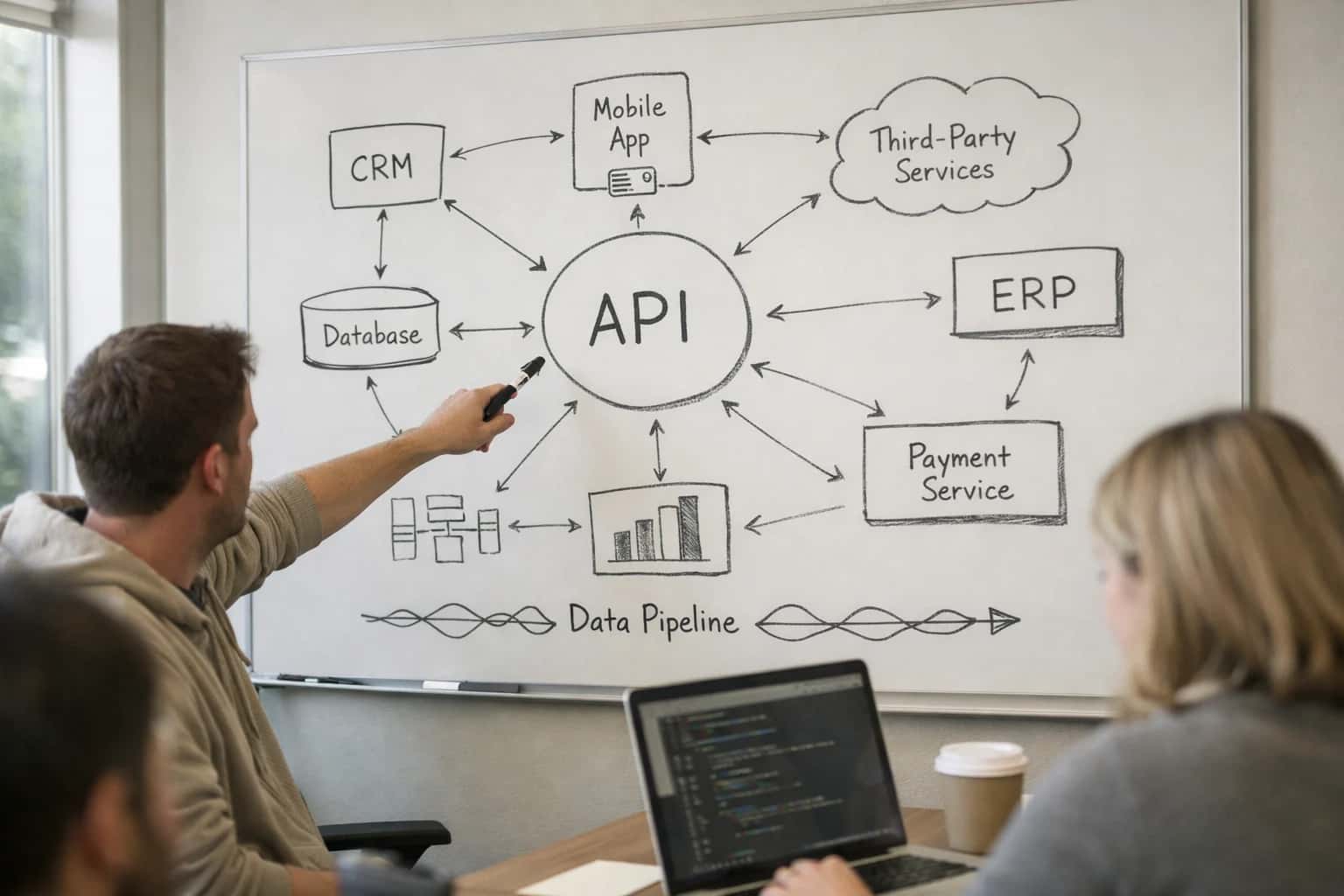
AI INTEGRATION FOR LANGCHAIN CHAIN MANAGEMENT
From Prototype to Production: Managing LangChain Chains as Critical Code
Treat LangChain chains as versioned, deployable assets with integrated testing, canary deployment, and rollback capabilities to ensure reliable AI operations.
A production rollout integrates the chain with an LLMOps platform like Weights & Biases or LangSmith for lineage and a vector database like Pinecone for RAG context. Implementation steps typically involve:
- Packaging the chain and its dependencies into a containerized service.
- Instrumenting callback handlers to stream execution traces (token usage, intermediate steps, errors) to a monitoring dashboard.
- Implementing feature flags or a model registry to manage staged promotions from development to staging to production.
- Setting up automated evaluation runs against a golden dataset to validate accuracy and cost before each deployment.
Governance is enforced by treating the chain's configuration—prompts, model parameters, tool permissions—as code. This allows for:
- Rollback Capability: Instant reversion to a previous, known-good chain version if monitoring detects a spike in error rates or latency.
- Canary Deployment: Routing a small percentage of live traffic to a new chain variant and comparing key performance indicators (KPIs) like user satisfaction or support ticket deflection rate before full rollout.
- Audit Trails: Logging every chain execution with inputs, outputs, and the specific code version, creating an immutable record for compliance reviews and root cause analysis. This approach transforms experimental chains into dependable, scalable services that engineering and AI ops teams can trust.
TREATING CHAINS AS CRITICAL APPLICATION CODE
Key LangChain Surfaces for Production Chain Management
Chain Versioning & Registry
Treat LangChain sequences as versioned, deployable assets by integrating with a model registry like Weights & Biases or a custom Git-based system. Each chain—comprising prompts, LLM configurations, and tool bindings—should be stored as a serialized object with a unique version tag, commit hash, and metadata (owner, creation date, dependencies). This enables:
- Rollback Capability: Instantly revert to a previous chain version if a new prompt causes regressions.
- Environment Promotion: Promote validated chains from development to staging to production using stage gates.
- Lineage Tracking: Trace any production prediction back to the exact chain definition, code, and data used.
Integrate this registry with your CI/CD pipeline to automate validation tests before deployment, ensuring chains meet performance and safety thresholds.
PRODUCTION-READY CHAIN MANAGEMENT
High-Value Use Cases for Managed LangChain Chains
Treating LangChain sequences as versioned, deployable assets unlocks enterprise-grade reliability, governance, and continuous improvement. These use cases illustrate how managed chains transform AI application development from experimental scripts to governed production services.
01
Versioned Prompt Deployment & A/B Testing
Manage prompt templates and chain logic as configuration-as-code. Deploy new versions with canary releases, automatically split traffic, and evaluate performance against business KPIs (e.g., conversion rate, user satisfaction) using integrated metrics from LangSmith. Roll back instantly if a new prompt degrades quality.
1 sprint
From experiment to production
02
Governed RAG Pipeline Orchestration
Orchestrate complex Retrieval-Augmented Generation workflows—from document ingestion and chunking to vector search and synthesis—as a single, versioned chain. Implement automated data quality checks, monitor retrieval accuracy and hallucination rates, and trigger re-indexing when source documents change. Ensures knowledge bases remain accurate and traceable.
Batch -> Real-time
Knowledge updates
03
Multi-Agent System Supervision
Deploy and monitor collaborative agent systems where specialized chains (research, analysis, writing) work together under a supervisor. The managed chain provides end-to-end tracing, handles error propagation between agents, and enforces execution timeouts and cost budgets. Critical for automating multi-step customer operations or internal workflows.
Hours -> Minutes
Workflow execution
04
Structured Output Integration for Downstream Systems
Deploy chains that reliably generate validated JSON or Pydantic objects for integration with databases, APIs, and business applications (e.g., creating a Salesforce Case, populating a NetSuite record). Managed deployment includes schema validation, retry logic for parsing failures, and monitoring of integration success rates to ensure downstream system integrity.
Same day
New integration live
05
Controlled Tool-Calling Workflows
Package chains that securely call external APIs (e.g., CRM updates, payment processing, data queries) as governed assets. Implement pre-call validation, rate limiting, and comprehensive execution logging. Version control ensures tool behavior is predictable, and rollback protects against faulty integrations that could cause data corruption or cost overruns.
Governed
API access & spend
06
Conversational Agent with Managed Memory
Deploy chat agents with persistent, secure memory as a versioned service. The chain manages context window optimization, integrates with vector databases for long-term memory, and enforces data retention policies for compliance (GDPR, CCPA). Updates to memory logic or summarization strategies are deployed with testing and rollback safety.
Context-Aware
Personalized interactions
LANGCHAIN CHAIN MANAGEMENT
Example Production Workflows with Managed Chains
Treating LangChain sequences as versioned, deployable assets requires integrating them into robust CI/CD pipelines. These workflows illustrate how to manage chains from development through production with testing, canary deployment, and rollback capabilities.
Trigger: A developer merges a pull request updating a LangChain prompt template or logic into the main branch of a Git repository.
Workflow:
- CI Pipeline Activation: A GitHub Actions or GitLab CI pipeline is triggered. It packages the new chain code and its dependencies into a versioned artifact (e.g., a Docker container).
- Integrated Validation Suite: The pipeline executes a battery of tests:
- Unit Tests: Validate individual chain components and tools.
- Integration Tests: Run the chain against a mocked vector database and external APIs.
- Evaluation with LangSmith: Execute the chain against a golden dataset of example queries, logging outputs, costs, and latencies to LangSmith for automated scoring against metrics like relevance and faithfulness.
- Registry Promotion: If all tests pass and evaluation scores meet a defined threshold, the artifact is promoted to a model registry (like Weights & Biases Model Registry) with a new semantic version (e.g.,
support-agent-chain:v1.2.0). - Deployment Trigger: The registry update triggers a deployment job to a staging environment.
Outcome: Chains are only promoted if they pass functional and performance gates, preventing regressions from reaching users.
FROM EXPERIMENT TO PRODUCTION
Implementation Architecture: CI/CD for LangChain Chains
Treat LangChain chains as versioned, deployable assets with integrated testing, canary deployment, and rollback capabilities.
A production-ready LangChain chain is more than a Python script; it's a composite asset comprising a prompt template, a model configuration, a sequence of tools or retrievers, and parsing logic. Managing this asset requires a CI/CD pipeline that version-controls the entire chain definition, runs automated validation (e.g., unit tests for output structure, integration tests for tool calls), and packages it as a deployable artifact—often a container image or a versioned entry in a model registry like Weights & Biases Model Registry. This shift from ad-hoc notebooks to versioned chain artifacts is the foundation for reliable, auditable agentic workflows.
The deployment phase uses a canary release pattern. A new chain version is first routed to a small percentage of production traffic (e.g., 5%) while its performance is monitored against key metrics logged to Arize AI or LangSmith. Automated gates check for regressions in latency, cost-per-session, and business-specific quality scores. If metrics remain within SLOs, traffic is gradually increased. This controlled rollout is managed via feature flags or a service mesh, allowing instant rollback to the previous chain version if anomalies are detected, minimizing user impact.
Governance is enforced at each stage. The CI pipeline integrates with Credo AI to run policy checks, ensuring the new chain doesn't introduce unacceptable risks (e.g., calling unauthorized APIs). Post-deployment, drift detection monitors the distribution of user queries and retrieved document relevance, triggering alerts if the chain's operating context shifts. This end-to-end lifecycle—code, test, package, deploy, monitor, govern—ensures LangChain applications evolve safely, with full audit trails for compliance and the operational rigor expected of critical business software.
LANGCHAIN CHAIN MANAGEMENT
Code Patterns for Versioned Chain Deployment
Treating Chains as Versioned Configuration
LangChain chains are often defined as code, mixing logic with prompts and parameters. For production governance, treat the chain's structure—its sequence, conditional routing, and prompt templates—as declarative configuration. Store this config in a version-controlled repository (like Git) alongside your application code.
Use a pattern where the chain is assembled at runtime from this config. This allows you to:
- Roll back to a previous chain version instantly if a new deployment causes regressions.
- A/B test different chain architectures (e.g., with or without a web search tool) by promoting different config versions to canary environments.
- Audit changes through standard code review processes, linking chain modifications to Jira tickets or compliance requirements.
Example config snippet:
yamlchain_version: "1.2" components: - type: "prompt_template" id: "classifier" template: "Classify intent: {{query}}" - type: "tool" id: "search_api" condition: "intent == 'research'"
Integrate this with a CI/CD pipeline that validates the config, runs smoke tests, and deploys to a staging environment before production.
LANGCHAIN GOVERNANCE
Operational Impact: Before and After Formal Chain Management
How treating LangChain sequences as versioned, deployable assets changes development velocity, risk, and operational control for AI engineering teams.
| Metric | Before AI | After AI | Notes |
|---|---|---|---|
Chain Deployment Cycle | Manual script execution, ad-hoc validation | CI/CD pipeline with automated testing and canary rollout | Rollback to last known good version in minutes |
Prompt Version Control | Spreadsheet or code comments; manual tracking | Git-integrated prompt registry with semantic versioning | Audit trail for every change; A/B test across versions |
Performance Regression Detection | Manual spot checks after user complaints | Automated evaluation against business KPIs on every deployment | Integrated with LangSmith tracing; alerts on latency or cost spikes |
Incident Root Cause Analysis | Hours of log diving across systems | Traced from user query to specific chain step and model call | Link errors to prompt version, tool failure, or data drift |
Compliance Evidence Collection | Manual screenshots and narrative reports for audits | Automated generation of model cards, lineage reports, and policy checks | Evidence pulled from integrated W&B, Arize AI, and Credo AI platforms |
Cross-team Collaboration | Shared documents and fragile handoff processes | Centralized chain catalog with role-based access and shared dashboards | Product, engineering, and compliance work from a single source of truth |
Cost Attribution & Forecasting | Monthly API bill surprise; manual tagging | Per-chain, per-team token usage tracking with budget alerts | Forecasting based on deployment history and usage trends |
TREATING CHAINS AS PRODUCTION CODE
Governance and Phased Rollout Strategy
A disciplined approach to deploying, monitoring, and governing LangChain sequences as versioned, critical application assets.
Treat LangChain chains as first-class, versioned software artifacts. This means integrating them into your existing CI/CD pipelines using a model registry like Weights & Biases or a dedicated artifact store. Each chain—defined by its prompt templates, LLM configuration, tool bindings, and retrieval logic—should be packaged, versioned (e.g., chain-customer-support:v1.2.3), and promoted through environments (dev → staging → production) with automated unit and integration tests that validate structured output schemas and tool-calling behavior.
Implement a phased, canary-based rollout strategy to mitigate risk. Start by deploying a new chain version to a small percentage of production traffic or a specific user segment, using Arize AI or LangSmith to monitor key performance indicators (KPIs) like latency, cost per execution, and business-specific success metrics (e.g., ticket deflection rate). Route a shadow copy of live requests to the new chain to compare outputs with the current version without impacting users. Establish automatic rollback triggers based on performance thresholds or error rates, ensuring failed deployments don't cause widespread service degradation.
Govern chain execution with runtime guardrails and audit trails. Integrate a policy engine like Credo AI to enforce content filters, PII redaction, and fairness checks before outputs are returned. Log every chain execution—including the full prompt, retrieved context, tool calls, and final output—to an immutable audit log, linking it to the specific chain version and user session. This creates a lineage trail essential for debugging, compliance inquiries, and demonstrating control for frameworks like NIST AI RMF. Establish a formal change management process, requiring approvals from engineering, product, and compliance stakeholders for promotions that alter chain logic or impact high-stakes decisions.
Enabling Efficiency, Speed & Accuracy
Intelligent Analysis, Decision & Execution
We build AI systems for teams that need search across company data, workflow automation across tools, or AI features inside products and internal software.
Talk to Us
Search across company data
Give teams answers from docs, tickets, runbooks, and product data with sources and permissions.
Useful when people spend too long searching or get different answers from different systems.
Enterprise searchRAGPermissions
Read more
Automate internal workflows
Use AI to route work, draft outputs, trigger actions, and keep approvals and logs in place.
Useful when repetitive work moves across multiple tools and teams.
AI agentsWorkflow automationGovernance
Read more
Add AI to products and internal tools
Build assistants, guided actions, or decision support into the software your team or customers already use.
Useful when AI needs to be part of the product, not a separate tool.
AI integrationDecision supportModel routing
Read moreIMPLEMENTATION AND GOVERNANCE
Frequently Asked Questions: LangChain Chain Management
Practical questions for teams managing LangChain sequences as production-grade, versioned assets with integrated testing, deployment, and rollback.
Treat chains as application code with a CI/CD pipeline.
- Store as Code: Define chains in Python modules (or serialized JSON/YAML) stored in Git. Include the chain logic, prompt templates, and configuration (model names, temperature, retriever settings).
- Version with Git: Use Git tags or commit SHAs as the chain version. Link this version to experiment tracking in platforms like Weights & Biases.
- Promotion Pipeline:
- Development: Chains run in a sandbox with mock tools and a test vector store.
- Staging: Chains deploy to a staging environment that mirrors production APIs and data sources (with safe guards). Automated integration tests run here.
- Production: Promotion requires a pull request review and passes all tests. Deployment uses a canary strategy, routing a small percentage of traffic to the new chain version via a feature flag or routing layer.
- Artifact Registry: Use W&B Artifacts or a similar registry to store the final, promoted chain definition alongside its model dependencies (embedding model version, LLM API config).

About the author
Prasad Kumkar
CEO & MD, Inference Systems
Prasad Kumkar is the CEO & MD of Inference Systems and writes about AI systems architecture, LLM infrastructure, model serving, evaluation, and production deployment. Over 5+ years, he has worked across computer vision models, L5 autonomous vehicle systems, and LLM research, with a focus on taking complex AI ideas into real-world engineering systems.
His work and writing cover AI systems, large language models, AI agents, multimodal systems, autonomous systems, inference optimization, RAG, evaluation, and production AI engineering.
LinkedIn
Limited slotsGet a Free AI Consultation
Partnered with leading AI, data, and software stack.





How We Work
Custom AI workflows for your Business
One-fit-all AI don't work for modern businesses. At Inferensys, we aim to understand your business & custom requirements; which we use to define most efficient agentic workflows, the data, and the tools for your business.
01
Review the use case
We understand the task, the users, and where AI can actually help.
Read more02
Pick the right approach
We define what needs search, automation, or product integration.
Read more03
Build the first useful version
We implement the part that proves the value first.
Read more04
Improve from there
We add the checks and visibility needed to keep it useful.
Read moreThe first call is a practical review of your use case and the right next step.
Talk to Us