Arize AI's anomaly detection sits as a post-inference monitoring layer, consuming logs from your LLM serving infrastructure (e.g., VLLM, SageMaker, direct API calls) and vector databases. It monitors key operational signals like p95/p99 latency, token consumption, error rate (4XX/5XX), and user feedback scores sent via SDK or API. For RAG applications, you can extend monitoring to retrieval latency and chunk relevance scores. This creates a unified telemetry stream where Arize applies statistical process control (SPC) and machine learning detectors to identify deviations from established baselines.

Integration
AI Integration for Arize AI Anomaly Detection
Set up Arize AI's statistical detectors and custom metrics to identify anomalous spikes in LLM latency, error rates, or user feedback scores, integrating alerts with PagerDuty or Slack for on-call responders.
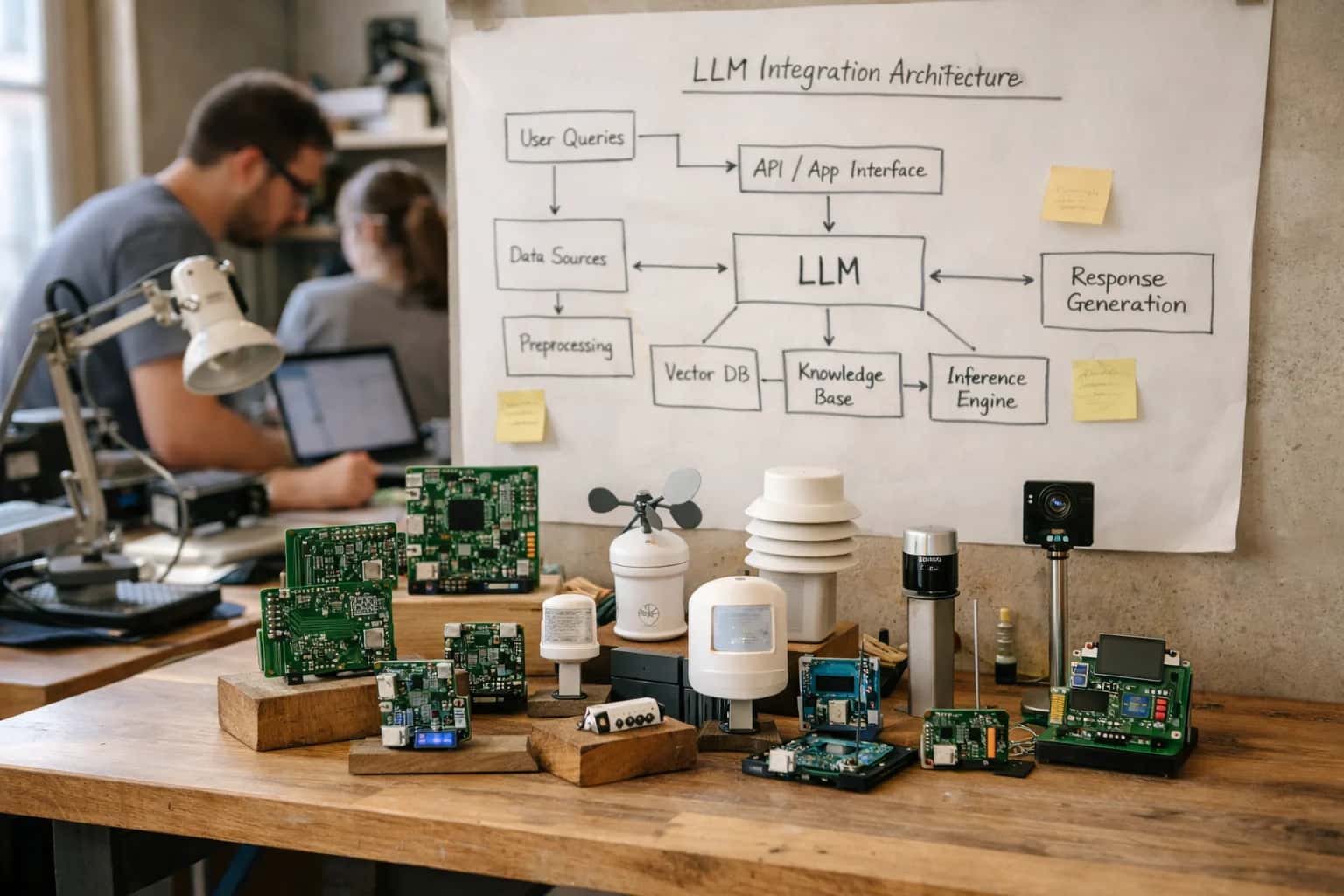
ARCHITECTURE AND ROLLOUT
Where Anomaly Detection Fits in Your LLM Operations Stack
Integrating Arize AI's anomaly detection provides a critical signal layer for production LLM health, connecting statistical alerts to on-call workflows.
Implementation involves instrumenting your inference endpoints to send payloads and performance metadata to Arize's APIs. A typical architecture uses a sidecar agent or a centralized logging service (like OpenTelemetry Collector) to batch and forward data, ensuring minimal latency impact. You then configure detectors in the Arize UI or via Terraform for specific metrics and severity thresholds. For example, a detector might trigger a PagerDuty incident if LLM error rates spike 3 standard deviations above the 7-day rolling average for more than 5 minutes, or send a Slack alert to the AI engineering channel if user thumbs-down feedback for a specific agent model exceeds 10% in an hour.
Rollout should be phased: start with core service health metrics (latency, errors) for your most critical LLM application, then expand to business-oriented metrics (feedback scores, cost per query) and finally to RAG-specific signals. Governance requires defining alert ownership, escalation paths, and runbooks. Since detectors can generate noise, implement alert deduplication and cooldown periods in your downstream incident management platform. The integration's value is operational clarity: it shifts AIOps from manual dashboard checking to automated, statistically-grounded alerts, letting teams focus on root cause analysis—whether it's a model regression, a downstream API failure, or a data drift event in the retrieval pipeline.
MONITORING SURFACES
Key Arize AI Surfaces for Anomaly Detection Integration
Core Latency, Error, and Cost Tracking
Integrate Arize AI to monitor the foundational operational metrics of your LLM services. This surface focuses on statistical anomaly detection for:
- Inference Latency: Track p50, p95, and p99 response times across model providers (OpenAI, Anthropic) and deployment regions. Set detectors for unexpected spikes that could indicate infrastructure issues or model provider degradation.
- Error Rates: Monitor HTTP error codes (429, 500, 503) and application-level failures (parsing errors, context window overflows). Correlate error spikes with deployment events or upstream service health.
- Token Usage & Cost: Ingest token counts per request to calculate real-time cost per query. Detect anomalous usage patterns that could signal prompt injection attacks, inefficient prompts, or a sudden shift in user behavior leading to budget overruns.
Integration typically involves instrumenting your LLM client or proxy layer to send these metrics as prediction records to Arize's API, tagged with model version, endpoint, and team identifiers for segmentation.
ARIZE AI INTEGRATION PATTERNS
High-Value Anomaly Detection Use Cases for LLMs
Integrate Arize AI's statistical detectors to identify and alert on anomalous LLM behavior across production systems. These patterns connect drift, performance, and business metrics to operational workflows for rapid response.
01
Real-Time Latency & Error Spike Detection
Monitor LLM API endpoints for sudden increases in p95/p99 latency or error rates (5xx, timeouts). Configure Arize AI detectors on metrics ingested from your API gateway or application logs. Automatically trigger PagerDuty alerts to the on-call SRE team when thresholds are breached, enabling sub-30-minute MTTR instead of manual dashboard checks.
Hours -> Minutes
Mean Time to Detection
02
LLM Cost Anomaly & Token Usage Drift
Track daily/weekly token consumption and cost per user or session. Set up Arize AI custom metrics to detect unexpected spikes that indicate inefficient prompts, looping agents, or potential abuse. Integrate alerts with Slack to notify engineering and FinOps teams, enabling same-day investigation and cost containment before the billing cycle closes.
Batch -> Real-time
Spend Visibility
03
RAG Retrieval Quality & Hallucination Rate Drift
Monitor key RAG quality metrics like retrieval precision, answer faithfulness, and hallucination rate calculated via LLM-as-a-judge or human feedback. Use Arize AI to establish baselines and detect degradation, which often signals embedding drift or outdated knowledge bases. Route alerts to the AI engineering team's Jira to trigger a re-indexing pipeline.
1 sprint
Proactive remediation lead time
04
User Feedback & Sentiment Score Anomalies
Ingest thumbs-up/down ratings or sentiment scores from your LLM application's UI. Configure Arize AI to detect statistically significant drops in positive feedback for specific user segments, model versions, or query topics. This surfaces UX issues or model regressions that pure latency monitoring misses. Integrate with a CRM webhook to automatically create a support ticket for follow-up.
Same day
Issue identification
05
Input/Output Data Distribution Drift
Detect shifts in the statistical distribution of LLM inputs (user query length, topics) and outputs (response length, tone). Arize AI's data drift detectors can compare production data against a training or reference window. Alert on drift that may degrade model performance, prompting a review of prompts or fine-tuning datasets. Connect findings to your experiment tracking platform in Weights & Biases for lineage.
Batch -> Real-time
Drift detection cadence
06
Business Metric Correlation Alerts
Define custom Arize AI metrics that tie LLM performance to business outcomes—like support ticket deflection rate for a chatbot or lead qualification score for a sales copilot. Set anomaly detectors to flag when these key results deviate, indicating the AI's business impact is changing. Feed alerts into business intelligence dashboards in Tableau or Power BI for executive review.
Hours -> Minutes
Business insight latency
PRODUCTION AIOPS
Example Anomaly Detection and Response Workflows
Integrating Arize AI's anomaly detection with your LLM operations platform creates a closed-loop system for identifying and responding to performance issues. Below are concrete workflows that connect statistical alerts to automated actions and human review, moving from monitoring to remediation.
Trigger: Arize AI's statistical detector fires an alert for a 95th percentile latency increase exceeding 200% for the gpt-4-turbo model variant over a 15-minute sliding window.
Context Pulled: The alert payload includes the model ID, endpoint, and latency distribution. An agent fetches current cloud metrics (CPU, memory) from the model serving platform (e.g., SageMaker, vLLM) and checks the regional health status from the LLM provider's status page.
Agent Action: A governance agent evaluates the alert against a rule set:
- If cloud metrics are normal and the LLM provider status is green, the agent classifies this as a potential model-specific performance degradation.
- It executes a pre-approved mitigation: calling the load balancer API to temporarily reduce traffic weight to the affected model variant by 50%, shifting traffic to a stable
claude-3-opusfallback.
System Update: The agent logs the action (model, timestamp, adjusted weight) to the /integrations/ai-governance-and-llmops-platforms/ai-integration-with-credo-ai-audit-trails for compliance and posts a summary to the #ai-ops Slack channel.
Human Review Point: The on-call engineer is paged via PagerDuty. The incident ticket is auto-created with the Arize AI alert link, agent action log, and a prompt to investigate root cause (e.g., embedding drift, prompt change).
CONNECTING DETECTORS TO ON-CALL WORKFLOWS
Implementation Architecture: Data Flow and Integration Points
A production-ready architecture for Arize AI anomaly detection integrates statistical monitoring directly with LLM inference pipelines and incident management tools.
The integration begins by instrumenting your LLM application code—whether a custom service, LangChain agent, or RAG pipeline—to send inference data to Arize AI. This includes payloads with prompts, completions, token usage, latency, error flags, and custom business metrics (e.g., user feedback scores). Arize ingests this data via its Python SDK or REST API, where you configure detectors on key performance indicators. For example, a z-score or IQR detector can be set on p95_latency_seconds to flag API slowdowns, while a threshold-based detector on error_rate catches credential or model provider outages.
When a detector triggers, Arize generates an alert event. This event is routed via a webhook integration to your operations stack. A common pattern is to send the alert payload to a middleware service (like a lightweight Node.js or Python listener) that enriches it with context—such as the affected service name, recent deployment history from GitHub, or related dashboard links—before creating an incident in PagerDuty or posting a formatted message to a Slack channel designated for AI operations. The alert payload includes metadata for triage: the anomalous metric value, baseline, timestamp, and a direct link to the Arize UI for root cause analysis.
Governance is enforced through RBAC in Arize to control who can configure detectors and access sensitive inference data, while alert routing rules ensure only validated, deduplicated incidents reach on-call engineers. For rollout, we recommend a phased approach: start with non-critical metrics in a staging environment, validate alert accuracy and noise levels, then gradually expand to production LLM endpoints. This architecture creates a closed-loop monitoring system where anomalies in AI performance automatically trigger human-in-the-loop review, reducing mean time to detection (MTTD) for LLM degradation from days to minutes.
ARIZE AI ANOMALY DETECTION
Code and Configuration Examples
Sending Inference Data for Monitoring
Integrate Arize AI's Python SDK into your LLM service to log predictions and performance metrics. The core pattern is to call log after each inference, sending the model's input, output, and any ground truth or feedback you collect later. This enables Arize to calculate your custom metrics and run statistical detectors.
pythonimport arize from arize.utils.types import ModelTypes, Environments # Initialize the client client = arize.Client(api_key=os.environ['ARIZE_API_KEY'], space_key=os.environ['ARIZE_SPACE_KEY']) # After an LLM call, log the prediction response = client.log( model_id="support-chatbot-v2", model_type=ModelTypes.SCORE_CATEGORICAL, environment=Environments.PRODUCTION, prediction_id=str(uuid.uuid4()), prediction_label=llm_response, features={ "user_query": user_message, "session_id": session_id }, tags={ "model_version": "gpt-4-turbo", "latency_ms": 1250, "total_tokens": 450 } )
This creates the foundational data layer for Arize to monitor latency spikes, token usage anomalies, and error rate changes.
LLMOPS MONITORING
Realistic Operational Impact and Time Savings
How integrating Arize AI for anomaly detection changes the operational workflow for teams managing production LLMs.
| Metric | Before AI | After AI | Notes |
|---|---|---|---|
Mean Time to Detect (MTTD) Latency Spikes | Hours to next business day | Minutes to 1 hour | Automated statistical detectors trigger alerts via PagerDuty/Slack for on-call. |
Root Cause Analysis for Performance Degradation | Manual log correlation across systems | Segmented analysis in unified dashboard | Drill down by model version, region, or user cohort to isolate issue. |
Model Performance Review Cadence | Weekly or monthly manual report generation | Daily automated health score & digest | Composite score weights latency, errors, and custom business metrics. |
Alert Fatigue & False Positives | High volume of generic infra alerts | Tuned, LLM-specific anomaly detection | Custom detectors filter noise, focusing on statistically significant drift. |
Validation of Model/Prompt Changes | Post-deployment manual spot checks | Automated A/B test analysis with statistical significance | Arize compares new model/prompt against baseline on key business KPIs. |
Compliance & Audit Evidence Gathering | Manual screenshot collection for reports | Automated timeline of performance, alerts, and resolutions | Immutable logs of detection events and remediation actions for auditors. |
Engineer On-Call Burden | Reactive, high-stress firefighting | Proactive, context-rich alerting | Alerts include relevant charts, segment links, and suggested first steps. |
PRODUCTION-READY ANOMALY DETECTION
Governance, Security, and Phased Rollout
Deploying Arize AI for LLM observability requires a strategy that balances rapid insight with operational control and data security.
A production integration with Arize AI begins by instrumenting your LLM endpoints—whether they are RAG pipelines, agentic workflows, or fine-tuned models—to emit inference data to Arize's APIs. This includes payloads (prompts, responses), metadata (model version, session ID), and key performance indicators like latency, token usage, and error codes. For governance, we implement a data filtering layer to strip out sensitive fields (e.g., PII, internal IDs) before transmission, ensuring only sanitized, business-safe data flows to the monitoring platform. Access to Arize is then gated by SSO and RBAC, aligning permissions with your existing MLOps and engineering roles.
The rollout is typically phased. Phase 1 establishes baseline monitoring for core LLM services, focusing on operational metrics (latency, errors) and simple anomaly detectors on volume. Phase 2 layers on business-specific metrics, such as user feedback scores or downstream conversion rates, and configures Arize's custom detectors for statistical anomalies in these signals. Phase 3 integrates the alerting webhooks with your on-call systems like PagerDuty or Slack, creating tiered escalation paths—e.g., a drift alert goes to the data science team channel, while a latency spike triggers a PagerDuty incident for the platform engineering on-call.
Governance is maintained by treating Arize configurations—detectors, dashboards, metrics—as code. Changes are version-controlled and deployed via CI/CD, with peer review required for modifications to critical alert thresholds. An audit trail of who changed what detector and when is preserved. Finally, we design a feedback loop where Arize's RCA findings (e.g., a specific user segment causing high error rates) automatically create tickets in your engineering backlog (Jira, Linear) for investigation, closing the loop from detection to remediation.
Enabling Efficiency, Speed & Accuracy
Intelligent Analysis, Decision & Execution
We build AI systems for teams that need search across company data, workflow automation across tools, or AI features inside products and internal software.
Talk to Us
Search across company data
Give teams answers from docs, tickets, runbooks, and product data with sources and permissions.
Useful when people spend too long searching or get different answers from different systems.
Enterprise searchRAGPermissions
Read more
Automate internal workflows
Use AI to route work, draft outputs, trigger actions, and keep approvals and logs in place.
Useful when repetitive work moves across multiple tools and teams.
AI agentsWorkflow automationGovernance
Read more
Add AI to products and internal tools
Build assistants, guided actions, or decision support into the software your team or customers already use.
Useful when AI needs to be part of the product, not a separate tool.
AI integrationDecision supportModel routing
Read moreIMPLEMENTATION BLUEPRINT
Frequently Asked Questions (FAQ)
Practical questions for teams integrating Arize AI's anomaly detection with production LLM services, vector stores, and operational workflows.
Integration is typically done via Arize's Python SDK or API, instrumenting your inference code. For a production setup:
- Wrap your inference calls: Add Arize logging to your service layer, capturing:
python
# Example for an OpenAI chat completion response = openai.chat.completions.create(...) # Log to Arize arize_client.log( prediction_id=str(uuid.uuid4()), prediction_label=response.choices[0].message.content, features={"query": user_query, "model": "gpt-4-turbo"}, tags={"environment": "prod", "workflow": "support_agent"}, # Log performance metrics shap_values={"latency_ms": latency, "total_tokens": response.usage.total_tokens} ) - For batch/async jobs: Use the
log_bulkAPI or the Arize AI Observability Pipeline for high-throughput logging from queues or data lakes. - Vector Store Monitoring: Log metadata (e.g.,
retrieved_chunk_count,top_similarity_score) from your retrieval step to monitor embedding and search performance drift. - Ground Truth: Feed back business outcomes (e.g.,
ticket_resolved,user_thumbs_up) via the sameprediction_idto correlate LLM outputs with real-world results.

About the author
Prasad Kumkar
CEO & MD, Inference Systems
Prasad Kumkar is the CEO & MD of Inference Systems and writes about AI systems architecture, LLM infrastructure, model serving, evaluation, and production deployment. Over 5+ years, he has worked across computer vision models, L5 autonomous vehicle systems, and LLM research, with a focus on taking complex AI ideas into real-world engineering systems.
His work and writing cover AI systems, large language models, AI agents, multimodal systems, autonomous systems, inference optimization, RAG, evaluation, and production AI engineering.
LinkedIn
Limited slotsGet a Free AI Consultation
Partnered with leading AI, data, and software stack.





How We Work
Custom AI workflows for your Business
One-fit-all AI don't work for modern businesses. At Inferensys, we aim to understand your business & custom requirements; which we use to define most efficient agentic workflows, the data, and the tools for your business.
01
Review the use case
We understand the task, the users, and where AI can actually help.
Read more02
Pick the right approach
We define what needs search, automation, or product integration.
Read more03
Build the first useful version
We implement the part that proves the value first.
Read more04
Improve from there
We add the checks and visibility needed to keep it useful.
Read moreThe first call is a practical review of your use case and the right next step.
Talk to Us