Lovable's core workflow—where users visually design an interface—becomes the prompt for an AI integration that generates the corresponding React frontend, Node.js/Express backend, and database schema. The integration point is Lovable's design-to-code export layer. Instead of producing static HTML/CSS, an integrated AI system consumes the component tree and user flow definitions to generate a functional application skeleton. This skeleton is then extended with integration code for target systems, such as connecting a form to a Salesforce Lead object via its REST API, wiring a data table to a PostgreSQL instance, or adding OAuth 2.0 flows for platforms like Okta.

Integration
AI Integration for Lovable
Connect Lovable's visual app builder to enterprise data, authentication, and backend services using AI. Generate full-stack code, automate deployments, and build production-ready applications from designs in hours, not weeks.
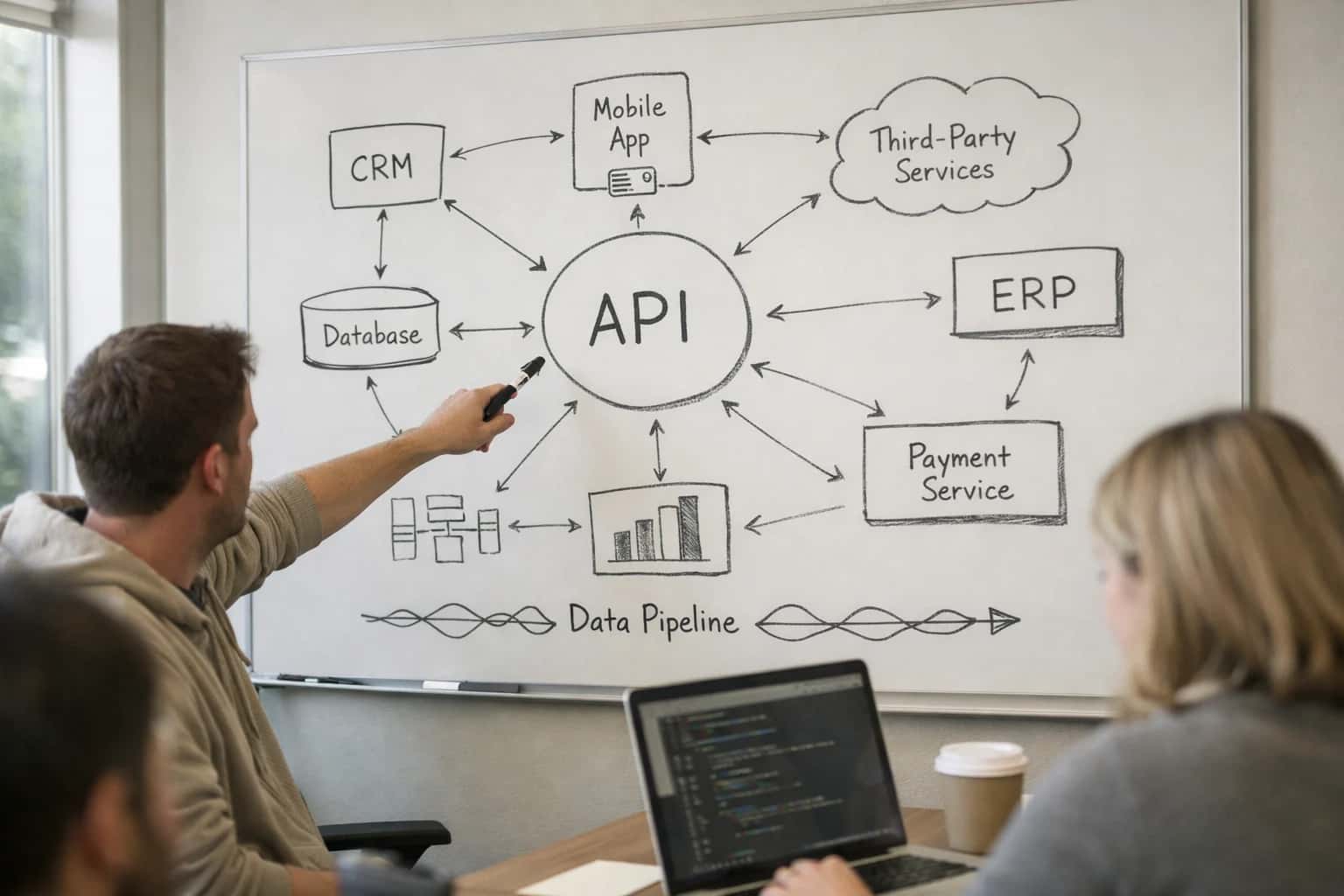
FROM VISUAL DESIGN TO PRODUCTION-READY CODE
Where AI Fits in the Lovable Stack
Integrating AI with Lovable transforms its visual app builder into a full-stack development engine, connecting designs to live data, authentication, and backend services.
For production use, the AI must be context-aware of the target stack. This means providing it with API documentation, environment variables, data model schemas, and security requirements. For example, when building a customer portal that pulls data from NetSuite, the AI needs the SuiteTalk WSDL or RESTlet endpoints to generate accurate service classes and data transformation logic. The integration typically works as a post-design step: after layout in Lovable, the design JSON is sent to an orchestration service that calls LLMs (like GPT-4 or Claude 3) with specific prompts for frontend components, backend routes, and deployment scripts (e.g., Dockerfiles, vercel.json).
Governance and rollout require a controlled pipeline. Generated code should be pushed to a Git repository for review, run through linters and security scans, and deployed via CI/CD to a cloud platform like Vercel or AWS. A human-in-the-loop approval step is critical for business logic and data handling. The value isn't just speed—it's consistency. AI ensures generated apps follow your team's architectural patterns, error handling standards, and API client libraries, turning a one-off prototype into a maintainable codebase. For teams, this shifts effort from writing boilerplate to reviewing and refining AI-generated integrations, enabling same-day delivery of internal tools that connect Lovable UIs to critical enterprise systems.
CONNECTING VISUAL APPS TO ENTERPRISE SYSTEMS
AI Integration Touchpoints in Lovable
Connect Visual Designs to Live Data
Lovable generates frontend React code, but production apps need backend logic. AI integration focuses on generating the serverless functions, API clients, and data-fetching logic that connect Lovable's UI to your systems.
Key Integration Points:
- API Client Generation: Automatically create TypeScript/JavaScript clients for your REST or GraphQL endpoints (e.g., Salesforce, Shopify, internal microservices).
- Serverless Function Stubs: Generate boilerplate for Vercel, AWS Lambda, or Cloudflare Workers to handle authentication, webhooks, and business logic.
- Data Transformation: Write code to map API responses to your UI component props, handling pagination, error states, and loading skeletons.
This turns static prototypes into live, data-driven applications by bridging the visual builder to your existing tech stack.
BRIDGE VISUAL DESIGN TO PRODUCTION SYSTEMS
High-Value AI Integration Use Cases
Lovable accelerates front-end creation, but production apps need live data, user authentication, and backend logic. These integration patterns connect Lovable's AI-generated interfaces to the enterprise systems that power real business workflows.
01
Generate Full-Stack Connectors to CRM APIs
Use Lovable's AI to visually design a lead dashboard, then automatically generate the production-ready backend code (Node.js/Python) to fetch and mutate data from Salesforce, HubSpot, or Pipedrive APIs. The AI writes the API client, authentication layer, and data transformation logic, turning a mockup into a live app in hours.
1 sprint
Typical development time
02
Automate Deployment to Cloud Platforms
Bridge the gap from Lovable's preview environment to a scalable cloud deployment. Configure the AI to generate Infrastructure-as-Code (Terraform, CloudFormation) and CI/CD pipelines (GitHub Actions, AWS CodePipeline) that package and deploy the generated application to AWS, Vercel, or Google Cloud with proper environment variables and security groups.
Hours -> Minutes
Deployment automation
03
Build Custom Auth & RBAC Middleware
Visually design admin and user portals in Lovable, then generate the secure backend middleware that integrates with Okta, Auth0, or Microsoft Entra ID. The AI produces code for protected routes, role-based access control (RBAC) checks, and session management, ensuring the UI connects to enterprise identity providers from the start.
Same day
Integration foundation
04
Connect to Database & Real-Time Feeds
Move beyond static mock data. Instruct Lovable's AI to generate the data access layer (DAL) and WebSocket handlers needed to connect visual components to live PostgreSQL, MongoDB, or Firebase databases. This enables building real-time dashboards, inventory trackers, or live chat interfaces with proper connection pooling and subscription logic.
Batch -> Real-time
Data flow upgrade
05
Orchestrate Backend Workflows with RPA
Design a process automation console in Lovable, then generate the integration code that triggers and monitors UiPath, Power Automate, or n8n workflows. The AI creates the webhook listeners, status pollers, and result handlers, allowing a visual admin panel to control complex, multi-system business processes.
Hours -> Minutes
Workflow control
06
Embed Analytics & BI Widgets
Create custom operational dashboards in Lovable by generating the code to embed and interact with analytics platforms like Power BI, Tableau, or Looker. The AI writes the iframe embedding logic, authentication passthrough, and event handlers to make BI visualizations interactive within the generated application context.
1 sprint
From mockup to live data
FROM VISUAL DESIGN TO FULL-STACK DEPLOYMENT
Example AI-Augmented Workflows
Lovable accelerates app development by turning designs into code. These workflows show how AI can extend that capability, connecting the generated application to live backend systems, automating deployment, and enriching the app with intelligent features.
Trigger: A designer creates a customer dashboard mockup in Lovable, specifying data visualizations for account history, support tickets, and order status.
AI Action & Context:
- Lovable's AI generates the React/Vue frontend code for the dashboard components.
- An Inference Systems agent analyzes the design labels (e.g., "Recent Orders," "Open Tickets") and maps them to a target CRM's data model (e.g., Salesforce
OrderandCaseobjects, HubSpotDealandTicketobjects). - The agent then generates the necessary backend service code (Node.js/Python) with:
- Secure API client configuration for the target CRM (OAuth 2.0).
- Data-fetching functions with proper querying and field selection.
- A REST API layer for the frontend to call.
System Update: The generated full-stack code is packaged with environment variables for API credentials and deployed to a specified cloud platform (e.g., Vercel, AWS). The live app now displays real, read-only CRM data.
Human Review Point: Security review of the generated OAuth flow and data access scopes before connecting to production CRM.
FROM VISUAL DESIGN TO PRODUCTION-READY CODE
Implementation Architecture: Data Flow and Guardrails
A practical blueprint for connecting Lovable's AI-generated app prototypes to live data sources, external APIs, and secure deployment environments.
A production integration for Lovable moves beyond its visual builder to connect the generated React/Vue frontend and Node.js/Python backend to your actual systems. The core architecture involves three flows: 1) Data Ingestion, where Lovable's backend services connect via REST APIs or SDKs to sources like your CRM (e.g., Salesforce), database, or authentication provider (e.g., Auth0) to fetch live data; 2) Tool Calling, where Lovable's AI agent is configured to call external functions—like checking inventory via a NetSuite API or sending a notification via Twilio—based on user actions in the app; and 3) Deployment Orchestration, where the generated code bundle is automatically containerized and pushed to a cloud platform like Vercel, AWS Amplify, or a private Kubernetes cluster via CI/CD pipelines.
Key implementation details include setting up a secure context layer. This involves providing Lovable's AI with structured context files (e.g., OpenAPI specs for your APIs, database schema definitions, environment variable templates) so it can generate accurate integration code. For example, giving it your Stripe API spec allows it to build a functional checkout flow. Guardrails are implemented at the pipeline stage: code is scanned for security flaws (e.g., exposed secrets in generated code), linted against your style guide, and run through integration tests that mock API calls before deployment. A human-in-the-loop approval gate for the final build artifact is recommended before promoting to production.
Rollout should follow a phased approach. Start with a read-only pilot—a Lovable-built internal dashboard that pulls data from a single, non-critical API. This validates the data flow and security model. Next, progress to a simple transactional app, like a form that writes to a sandboxed database, introducing authentication and write operations. Governance focuses on audit trails (logging all AI-generated code commits and the context used) and cost control (monitoring API call volumes from the deployed apps). The goal is not to replace your core engineering but to let Lovable rapidly generate the connective tissue—the custom UIs and middleware—that links your systems, reducing prototype-to-production time from weeks to days for specific use cases.
CONNECTING VISUAL DESIGNS TO LIVE DATA
Code and Payload Examples
Generate Secure Backend API Clients
Lovable's AI can generate the full-stack code to connect your visual app to external REST APIs. This includes OAuth 2.0 authentication flows, typed API clients, and error handling. The AI analyzes your design's data fields and maps them to API endpoints, creating a secure middleware layer.
javascript// Lovable-generated API client for a CRM (e.g., Pipedrive) import axios from 'axios'; class CRMClient { constructor(apiKey) { this.client = axios.create({ baseURL: 'https://api.pipedrive.com/v1', headers: { Authorization: `Bearer ${apiKey}` } }); } async getDeals(stageId) { // AI infers query params from your UI filter components const response = await this.client.get('/deals', { params: { stage_id: stageId, limit: 50 } }); return response.data.data.map(deal => ({ id: deal.id, title: deal.title, value: deal.value, // Maps API fields to your component's prop names status: deal.status })); } async updateDeal(dealId, payload) { // Payload structure derived from your form design return this.client.put(`/deals/${dealId}`, payload); } } export default CRMClient;
This auto-generated client handles token management, request/response transformation, and provides a clean interface for your frontend components.
FROM VISUAL DESIGN TO PRODUCTION APP
Realistic Time Savings and Business Impact
This table illustrates the operational impact of integrating AI with Lovable's visual app builder, focusing on reducing development friction and accelerating the delivery of custom, data-connected applications.
| Development Phase | Traditional Workflow | With AI Integration | Key Impact |
|---|---|---|---|
Frontend-Backend Wiring | Manual API client coding, state management | AI generates integration code from visual components | Reduces wiring effort from hours to minutes per screen |
External Data Source Connection | Manual API exploration, authentication setup | AI suggests connection patterns & generates secure client code | Cuts initial connection time from 1-2 days to same-day |
Deployment Pipeline Creation | Manual YAML/script configuration for cloud platforms | AI generates platform-specific deployment manifests | Automates setup, reducing pipeline creation from days to hours |
CRUD Interface Generation | Manual form, table, and action coding for each object | AI scaffolds full-stack CRUD modules from data model | Accelerates internal tool delivery from weeks to days |
Authentication & RBAC Integration | Manual wiring of auth providers and role checks | AI generates secure middleware and UI guard logic | Standardizes security, reducing implementation risk and rework |
App Logic & Workflow Scripting | Manual business rule coding in backend services | AI suggests and drafts serverless functions/endpoints | Shifts focus from syntax to business logic validation |
Production Bug Diagnosis | Manual log tracing and state debugging | AI-assisted root cause analysis using app context | Reduces mean time to resolution for integration issues |
ARCHITECTING FOR PRODUCTION
Governance, Security, and Phased Rollout
Integrating AI into Lovable's visual app builder requires a secure, governed approach to connect generated applications to live systems.
A production-ready integration treats Lovable's AI as a code generation layer that must be governed before deployment. This involves intercepting the generated full-stack code (React frontend, Node.js/Python backend, infrastructure-as-code) for security review, dependency scanning, and compliance checks against your internal standards. The integration architecture typically includes a CI/CD pipeline gate that validates API credentials, data model permissions, and environment variables before the Lovable-built app is deployed to a staging or production cloud environment like Vercel, AWS, or Google Cloud.
For security, the integration must manage secret injection and API key rotation for the backend services (e.g., CRM, database, authentication) that the Lovable app connects to. Instead of hardcoding credentials, the system should use a secrets manager (e.g., AWS Secrets Manager, HashiCorp Vault) and generate service-specific access tokens with least-privilege scopes. All AI-generated code that handles PII or business logic should be audited, with logs for data access and mutations sent to your SIEM or monitoring platform.
A phased rollout is critical. Start by using the integration to generate internal tools or read-only dashboards that connect to a sandbox instance of your target system (e.g., Salesforce Sandbox, development database). This validates the connectivity patterns without risk. Next, progress to apps with mutational operations (like updating a CRM record) but behind a human-in-the-loop approval step or within a controlled user group. Finally, scale to full self-service by implementing robust error handling, user feedback loops, and automated rollback procedures for the deployed applications. This controlled approach ensures the AI-assisted development velocity of Lovable aligns with your operational security and reliability requirements.
Enabling Efficiency, Speed & Accuracy
Intelligent Analysis, Decision & Execution
We build AI systems for teams that need search across company data, workflow automation across tools, or AI features inside products and internal software.
Talk to Us
Search across company data
Give teams answers from docs, tickets, runbooks, and product data with sources and permissions.
Useful when people spend too long searching or get different answers from different systems.
Enterprise searchRAGPermissions
Read more
Automate internal workflows
Use AI to route work, draft outputs, trigger actions, and keep approvals and logs in place.
Useful when repetitive work moves across multiple tools and teams.
AI agentsWorkflow automationGovernance
Read more
Add AI to products and internal tools
Build assistants, guided actions, or decision support into the software your team or customers already use.
Useful when AI needs to be part of the product, not a separate tool.
AI integrationDecision supportModel routing
Read moreIMPLEMENTATION BLUEPRINT
Frequently Asked Questions
Practical questions for teams integrating AI with Lovable to build full-stack applications connected to live data and business systems.
The integration acts as a bridge between Lovable's generated front-end code and your enterprise backend. A typical workflow:
- Trigger: A user interacts with a UI component (e.g., a form, button) in the Lovable-generated application.
- Context Pull: The integration layer captures the event and relevant application state (form data, user ID).
- AI/Agent Action: An orchestration service (using an LLM) determines the required backend operation. It may:
- Generate the correct API endpoint call (e.g.,
POST /api/leads). - Structure the request payload from the form data.
- Handle authentication tokens (OAuth, API keys).
- Generate the correct API endpoint call (e.g.,
- System Update: The generated request is executed against your target system (e.g., Salesforce, a custom microservice).
- UI Response: The result (success/error) is returned to the Lovable app to update the UI state.
This often involves deploying a lightweight middleware service that hosts the integration logic, prompt templates, and secure credential management.

About the author
Prasad Kumkar
CEO & MD, Inference Systems
Prasad Kumkar is the CEO & MD of Inference Systems and writes about AI systems architecture, LLM infrastructure, model serving, evaluation, and production deployment. Over 5+ years, he has worked across computer vision models, L5 autonomous vehicle systems, and LLM research, with a focus on taking complex AI ideas into real-world engineering systems.
His work and writing cover AI systems, large language models, AI agents, multimodal systems, autonomous systems, inference optimization, RAG, evaluation, and production AI engineering.
LinkedIn
Limited slotsGet a Free AI Consultation
Partnered with leading AI, data, and software stack.





How We Work
Custom AI workflows for your Business
One-fit-all AI don't work for modern businesses. At Inferensys, we aim to understand your business & custom requirements; which we use to define most efficient agentic workflows, the data, and the tools for your business.
01
Review the use case
We understand the task, the users, and where AI can actually help.
Read more02
Pick the right approach
We define what needs search, automation, or product integration.
Read more03
Build the first useful version
We implement the part that proves the value first.
Read more04
Improve from there
We add the checks and visibility needed to keep it useful.
Read moreThe first call is a practical review of your use case and the right next step.
Talk to Us