Spectrum awareness is the real-time understanding of the radio frequency (RF) environment. In congested settings—urban centers, battlefields, or dense IoT deployments—traditional monitoring fails. AI provides the necessary signal separation and modulation recognition to identify emitters, detect interference, and enable dynamic spectrum access. This capability is foundational for electronic warfare, wireless security, and cognitive radio systems, forming a core application of RF Machine Learning (RFML).

Guide
How to Implement AI for Spectrum Awareness in Congested Environments
A step-by-step developer guide to building an AI system for real-time RF spectrum monitoring, signal separation, and modulation recognition in dense urban or battlefield environments.
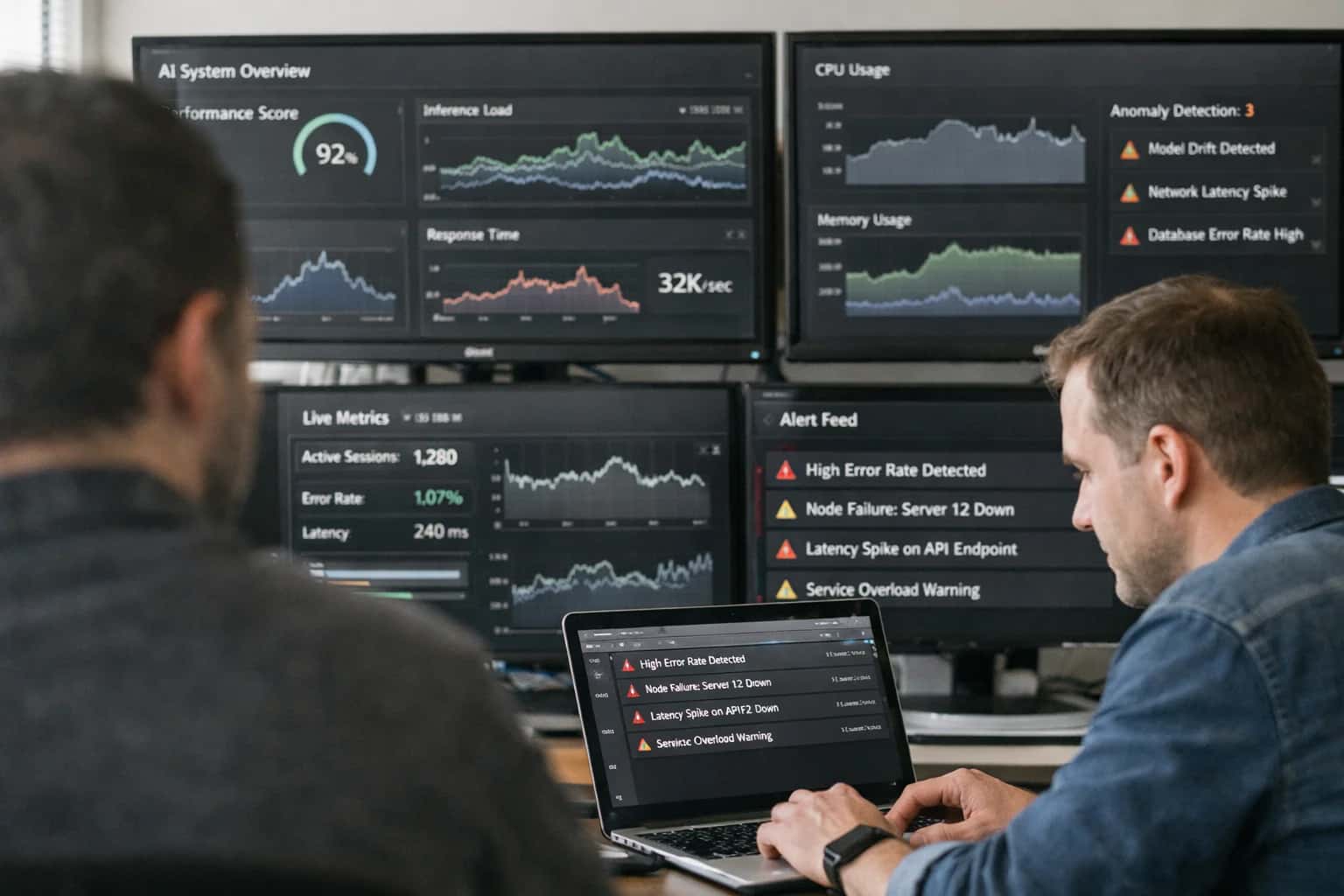
SPECTRUM AWARENESS
Introduction
This guide explains how to deploy AI models for real-time spectrum monitoring and classification in dense RF environments like urban areas or battlefields.
Implementing this system requires a pipeline: acquire raw IQ data via a software-defined radio (SDR), preprocess it into features like spectrograms, and classify signals using a deep learning model. You will use tools like GNU Radio for signal processing and frameworks like PyTorch for model deployment. The outcome is a production system that provides actionable situational awareness, identifying threats and optimizing spectrum use. For foundational knowledge, see our guide on building a production RFML pipeline.
IMPLEMENTATION GUIDE
Key Concepts for Spectrum Awareness AI
Master the core technical concepts required to deploy AI for real-time spectrum monitoring and signal classification in dense, contested RF environments.
01
Signal Separation & Blind Source Separation (BSS)
In congested environments, signals overlap in time and frequency. Blind Source Separation (BSS) techniques like Independent Component Analysis (ICA) are used to isolate individual emitters from a mixed signal. This is the first critical step before classification.
- Key Tools: Use Python libraries like
scikit-learnfor ICA or specialized signal processing toolkits within GNU Radio. - Real-World Application: Separating a drone control signal from background Wi-Fi and cellular traffic in an urban area.
02
Modulation Recognition with Deep Learning
AI models classify the modulation scheme (e.g., QPSK, 16-QAM, OFDM) of a separated signal, which reveals the type of device or protocol. Convolutional Neural Networks (CNNs) are state-of-the-art, often trained on spectrogram or raw IQ data representations.
- Standard Approach: Architectures like ResNet or custom CNNs applied to time-frequency representations (spectrograms).
- Implementation: Train models using PyTorch or TensorFlow on datasets like RadioML 2018.01A. For production, link to our guide on building a production RFML pipeline.
03
Spectrum Occupancy & Duty Cycle Analysis
Beyond identifying what is transmitting, you must understand how the spectrum is being used. Duty cycle analysis calculates the percentage of time a frequency band is active, enabling dynamic spectrum access decisions.
- Core Metric:
Duty Cycle = (Active Time / Total Observation Time) * 100%. - Actionable Output: Identifies underutilized bands for opportunistic use or detects anomalous, persistent transmissions that could indicate jamming.
04
Real-Time Inference Architecture
Spectrum awareness demands low-latency processing. This requires an edge inference architecture where signal processing and lightweight models run on SDR-adjacent hardware (e.g., NVIDIA Jetson, Intel NUC).
- Data Flow: SDR → Preprocessing (Filtering, Decimation) → Feature Extraction → Model Inference → Alert/Visualization.
- Critical Consideration: Model optimization via pruning and quantization is essential to meet latency budgets. Learn more in our guide on real-time signal classification at the edge.
05
Anomaly Detection for Threat Identification
Not all threats are known signals. Unisupervised anomaly detection models establish a baseline of 'normal' spectrum activity and flag deviations that could indicate interference, spoofing, or new, unknown emitters.
- Common Techniques: Autoencoders trained to reconstruct normal spectrum profiles; large reconstruction error indicates an anomaly.
- Operational Value: Provides a first line of defense against zero-day RF threats or sophisticated electronic warfare tactics.
06
Synthetic Data for Robust Model Training
Real-world labeled RF data from congested scenarios is scarce. Synthetic data generation using tools like MATLAB/Simulink or GNU Radio is essential to create diverse, labeled training datasets that include noise, fading, and interference.
- Key Benefit: Enables training of models to recognize signals under conditions you cannot physically or legally replicate.
- Best Practice: Use domain randomization and augmentation to bridge the sim-to-real gap. This technique is explored in depth in our sibling guide on using synthetic RF data for SIGINT training.
PRACTICAL IMPLEMENTATION
Step 1: Set Up Signal Acquisition with GNU Radio
The first step in building an AI for spectrum awareness is capturing clean, real-world RF data. This guide shows you how to configure a GNU Radio flowgraph to acquire and condition signals from a software-defined radio (SDR).
Signal acquisition is the foundation of any RF Machine Learning (RFML) system. You must capture raw In-phase and Quadrature (IQ) samples from your SDR, which preserve the complete amplitude and phase information of the signal. In GNU Radio, you'll use source blocks like UHD: USRP Source for Ettus hardware or Osmocom Source for RTL-SDRs. Configure the center frequency, sample rate, and gain to target your environment of interest. The output is a continuous stream of complex numbers representing the electromagnetic spectrum.
To prepare data for your AI model, you must condition the signal stream. Use the Low Pass Filter block to isolate your band of interest and reduce noise. The Throttle block regulates the flow to prevent system overload. Finally, employ the File Sink to write the IQ samples to disk in a binary format. This creates your raw dataset for the next step: feature extraction. For a deeper dive on hardware selection, see our guide on selecting SDRs for RF fingerprinting.
MODEL SELECTION
AI Model Architecture Comparison for Spectrum Awareness
Trade-offs between deep learning architectures for real-time signal classification and occupancy analysis in congested RF environments.
| Architecture / Metric | Convolutional Neural Network (CNN) | Recurrent Neural Network (RNN/LSTM) | Vision Transformer (ViT) | Hybrid CNN-RNN |
|---|---|---|---|---|
Primary Input Format | Spectrogram (2D image) | IQ time-series sequence | Spectrogram patches | Spectrogram + IQ sequence |
Temporal Dependency Capture | Limited (via positional encoding) | |||
Spatial Feature Extraction | ||||
Training Data Efficiency | Moderate (10k+ samples) | High (5k+ samples) | Low (50k+ samples) | Low-Moderate (15k+ samples) |
Inference Latency (on GPU) | < 5 ms | 10-50 ms | 5-15 ms | 15-30 ms |
Explainability (XAI) Support | High (Grad-CAM on spectrograms) | Moderate (attention weights) | High (attention maps) | Moderate (complex) |
Best For | Modulation recognition, static signal snapshots | Sequential signal analysis, protocol decoding | Large-scale, multi-class signal databases | Complex emitters with both spatial & temporal features |
Common Pitfall | Misses temporal patterns | Vanishing gradients on long sequences | Overfits with small datasets | Increased complexity, harder to tune |
Enabling Efficiency, Speed & Accuracy
Intelligent Analysis, Decision & Execution
We build AI systems for teams that need search across company data, workflow automation across tools, or AI features inside products and internal software.
Talk to Us
Search across company data
Give teams answers from docs, tickets, runbooks, and product data with sources and permissions.
Useful when people spend too long searching or get different answers from different systems.
Enterprise searchRAGPermissions
Read more
Automate internal workflows
Use AI to route work, draft outputs, trigger actions, and keep approvals and logs in place.
Useful when repetitive work moves across multiple tools and teams.
AI agentsWorkflow automationGovernance
Read more
Add AI to products and internal tools
Build assistants, guided actions, or decision support into the software your team or customers already use.
Useful when AI needs to be part of the product, not a separate tool.
AI integrationDecision supportModel routing
Read moreTROUBLESHOOTING
Common Mistakes
Implementing AI for spectrum awareness is a complex integration of signal processing and machine learning. These are the most frequent technical pitfalls developers encounter and how to fix them.
This is the sim-to-real gap. Synthetic data often lacks the noise, multipath effects, and hardware imperfections of real RF environments.
Fix: Implement domain adaptation techniques.
- Use channel modeling tools (e.g., MATLAB's WLAN Toolbox,
ray-tracingingym-pybullet) to inject realistic impairments like phase noise, clock drift, and Rayleigh fading into your synthetic data. - Apply data augmentation specific to RF: add controlled Gaussian noise, simulate frequency offsets, and apply random time shifts.
- Start with a pre-trained model on a large, diverse real-world dataset (like RadioML) and fine-tune it with your limited real data. Our guide on using synthetic RF data for SIGINT model training details advanced bridging strategies.

About the author
Prasad Kumkar
CEO & MD, Inference Systems
Prasad Kumkar is the CEO & MD of Inference Systems and writes about AI systems architecture, LLM infrastructure, model serving, evaluation, and production deployment. Over 5+ years, he has worked across computer vision models, L5 autonomous vehicle systems, and LLM research, with a focus on taking complex AI ideas into real-world engineering systems.
His work and writing cover AI systems, large language models, AI agents, multimodal systems, autonomous systems, inference optimization, RAG, evaluation, and production AI engineering.
LinkedIn
Limited slotsGet a Free AI Consultation
Partnered with leading AI, data, and software stack.





How We Work
Custom AI workflows for your Business
One-fit-all AI don't work for modern businesses. At Inferensys, we aim to understand your business & custom requirements; which we use to define most efficient agentic workflows, the data, and the tools for your business.
01
Review the use case
We understand the task, the users, and where AI can actually help.
Read more02
Pick the right approach
We define what needs search, automation, or product integration.
Read more03
Build the first useful version
We implement the part that proves the value first.
Read more04
Improve from there
We add the checks and visibility needed to keep it useful.
Read moreThe first call is a practical review of your use case and the right next step.
Talk to Us