An AI-powered grid stability monitor processes high-frequency phasor measurement unit (PMU) data to detect anomalies like oscillations and voltage instability in real-time. This system uses spectral analysis and machine learning models to identify subtle patterns preceding failures, transforming raw sensor streams into a continuous stability score. The core challenge is distinguishing normal fluctuations from dangerous precursors, requiring models trained on historical fault events and synthetic disturbance data.

Guide
How to Design an AI-Powered Grid Stability and Resilience Monitor
A step-by-step developer guide to building a real-time AI system that processes PMU data, detects grid oscillations, predicts voltage instability, and delivers actionable insights to control room operators.
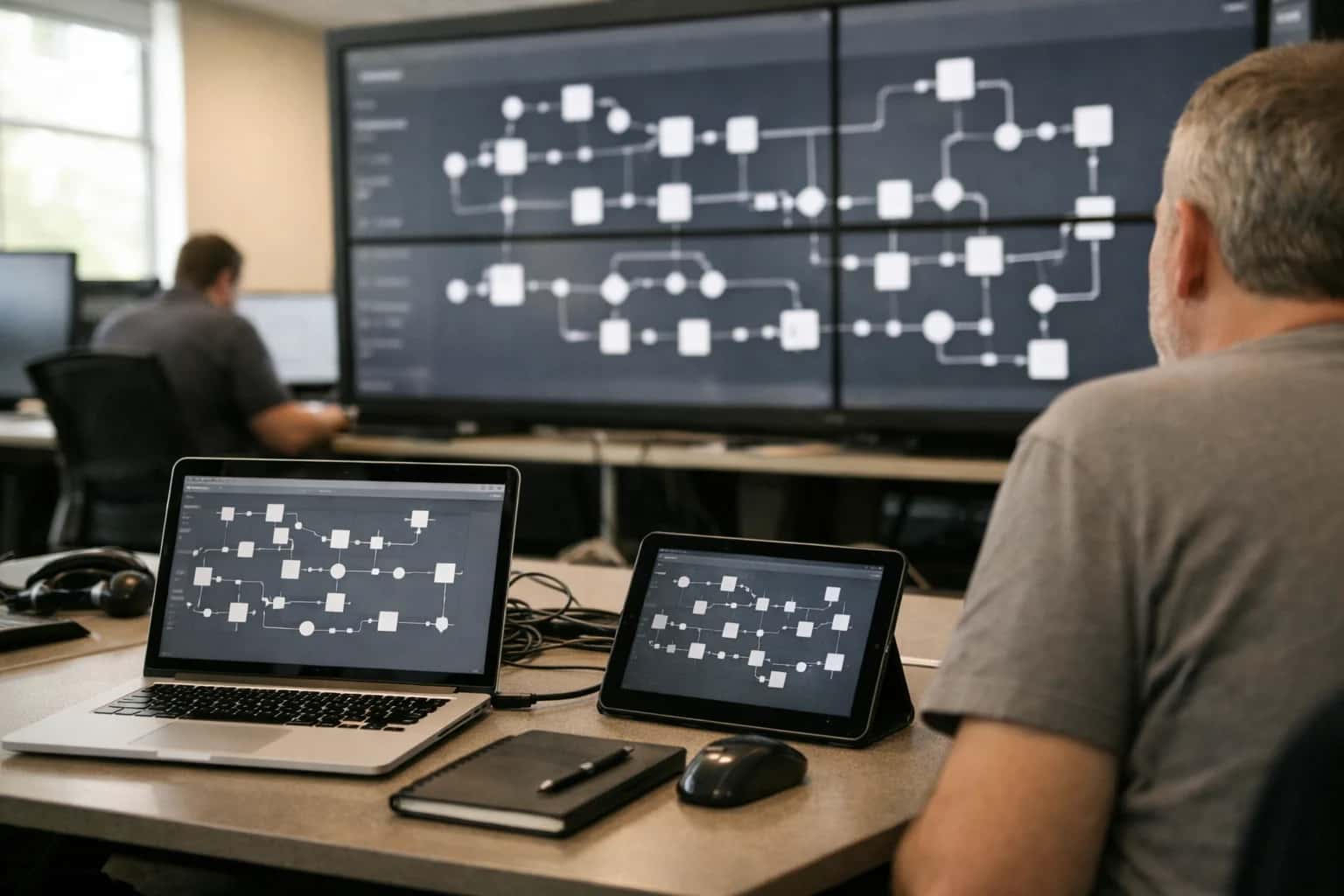
Build a real-time monitoring system that uses AI to assess grid stability and predict resilience to disturbances, providing actionable insights to control room operators.
You'll implement this by building a data ingestion pipeline for PMU streams, training detection models like isolation forests or LSTMs, and creating alerting dashboards. Integration with a digital twin of the grid allows for simulating disturbance impacts. Crucially, you must design outputs that reduce cognitive load for human operators, providing clear, prioritized recommendations rather than raw alerts, as detailed in our guide on Cognitive Load Reduction for Human Operators.
MONITORING FUNDAMENTALS
Key Concepts: Grid Stability Signals
A grid stability monitor processes real-time sensor data to detect and predict instability. These are the core technical concepts you must master to build a reliable system.
02
Spectral Analysis for Oscillation Detection
Small, persistent oscillations can cascade into major blackouts. Spectral analysis identifies these dangerous patterns in frequency and power flow data.
- Use Fast Fourier Transform (FFT) or Wavelet Transforms to decompose signals into frequency components.
- Machine learning models, like Isolation Forests or SVM classifiers, can then flag anomalous oscillations (e.g., 0.2–0.8 Hz) indicative of poorly damped control modes.
Continuous monitoring detects issues like sub-synchronous resonance before they trigger protection schemes.
03
Voltage Stability Indices & Machine Learning
Voltage collapse is a primary failure mode. AI models predict instability by calculating proximity indices from real-time PMU data.
- L-index and V/V0 are traditional metrics calculated from power flow.
- Supervised learning (e.g., Gradient Boosting) can be trained on historical events to predict collapse minutes in advance using features like load increase rate and reactive power reserves.
- This predictive capability is critical for integrating our guide on Cognitive Load Reduction for Human Operators to provide actionable early warnings.
04
Real-Time Contingency Analysis with AI Surrogates
Traditional 'N-1' contingency analysis is computationally heavy. AI surrogate models provide near-instant risk assessments.
- Train a deep neural network or graph neural network (GNN) on thousands of simulated grid outages.
- The model learns to map real-time grid state to a ranked list of most critical contingencies.
- This enables operators to focus on the highest-risk scenarios, a core principle for effective Human-in-the-Loop (HITL) Governance Systems.
05
Resilience Metrics & Disturbance Prediction
Resilience is the grid's ability to withstand and recover from high-impact, low-probability events. Quantifying it requires probabilistic AI models.
- Random Forests or XGBoost can predict failure propagation using topology, weather (wind, ice), and asset condition data.
- Metrics include Expected Energy Not Served (EENS) and Time to Restoration.
- These models feed into the broader architecture of a Self-Healing Grid.
06
Alerting Dashboards & Anomaly Visualization
Raw signals are useless without clear interpretation. The dashboard must triage and contextualize alerts for operators.
- Implement multi-level severity scoring (e.g., warning, critical) based on anomaly confidence and potential impact.
- Use geospatial visualization to plot PMU data and instability hotspots on a grid map.
- Root-cause suggestion features, powered by a knowledge graph of past events, reduce diagnostic time. This directly applies techniques from our pillar on Cognitive Load Reduction for Human Operators.
FOUNDATION
Step 1: Define the System Architecture
The architecture is the blueprint that determines your system's reliability, scalability, and ability to process real-time data. A well-defined architecture separates concerns and ensures each component can be developed, tested, and scaled independently.
A robust AI-powered grid monitor requires a microservices-based architecture to handle diverse, high-velocity data streams like Phasor Measurement Unit (PMU) telemetry. Core components include a streaming data ingestion layer (e.g., Apache Kafka), a real-time processing engine for spectral analysis, a machine learning inference service for anomaly detection, and a time-series database for historical context. This separation allows the ML model serving and alerting logic to scale independently from data ingestion, which is critical for handling grid disturbances.
The architecture must integrate with existing Supervisory Control and Data Acquisition (SCADA) systems and provide outputs to a dashboard for human operators. Design the data flow from raw sensor input through feature extraction, model inference, and finally to actionable insights. This clear pipeline is essential for debugging and meeting the low-latency requirements of real-time stability assessment, forming the technical foundation for all subsequent steps in this guide.
MODEL SELECTION
AI Model Comparison for Grid Stability Tasks
This table compares the suitability of different AI model families for core tasks in a real-time grid stability monitor. The choice balances prediction accuracy, explainability, and computational latency.
| Task / Metric | Physics-Informed Neural Networks (PINNs) | Gradient Boosting (XGBoost/LightGBM) | Deep Learning (LSTMs/Transformers) | Hybrid Neuro-Symbolic |
|---|---|---|---|---|
Voltage Instability Prediction | ||||
Oscillation Mode Detection | ||||
Real-time Inference Latency | < 100 ms | < 50 ms | 200-500 ms | 150-300 ms |
Model Explainability | Medium (Physics-guided) | High (Feature importance) | Low (Black box) | High (Symbolic traces) |
Training Data Requirement | Low-Medium | Medium | High | Medium |
Handles Missing Sensor Data | Good (Physics constraints) | Poor | Fair (Imputation layers) | Excellent (Logic rules) |
Integration with Optimal Power Flow (OPF) | Direct (Embedded in solver) | Indirect (Forecast input) | Indirect (Forecast input) | Direct (Rule-based coupling) |
Primary Use Case | Spectral analysis & stability margins | Feature-based anomaly alerts | Multivariate time-series forecasting | High-stakes, auditable decisions for Cognitive Load Reduction |
Enabling Efficiency, Speed & Accuracy
Intelligent Analysis, Decision & Execution
We build AI systems for teams that need search across company data, workflow automation across tools, or AI features inside products and internal software.
Talk to Us
Search across company data
Give teams answers from docs, tickets, runbooks, and product data with sources and permissions.
Useful when people spend too long searching or get different answers from different systems.
Enterprise searchRAGPermissions
Read more
Automate internal workflows
Use AI to route work, draft outputs, trigger actions, and keep approvals and logs in place.
Useful when repetitive work moves across multiple tools and teams.
AI agentsWorkflow automationGovernance
Read more
Add AI to products and internal tools
Build assistants, guided actions, or decision support into the software your team or customers already use.
Useful when AI needs to be part of the product, not a separate tool.
AI integrationDecision supportModel routing
Read moreGRID AI MONITORING
Common Mistakes
Building an AI-powered grid stability monitor is a high-stakes engineering challenge. These are the most frequent technical pitfalls that undermine system reliability and operator trust.
The most common failure is treating Phasor Measurement Unit (PMU) data like batch analytics. PMUs stream synchrophasor data at 30-120 Hz, creating a massive, high-velocity data firehose.
Mistakes:
- Using a database (e.g., PostgreSQL) as the primary ingestion point, causing backpressure and data loss.
- Not implementing data validation at the edge for bad timestamps or out-of-range values.
- Failing to handle network jitter, which breaks the time-synchronized nature of the data.
Fix: Architect a streaming-first pipeline. Use Apache Kafka or Apache Pulsar as the durable ingestion buffer. Implement a lightweight schema (e.g., Protobuf) and validate data quality (completeness, plausibility) in the first processing stage before any complex analysis. Decouple raw ingestion from analytical processing to maintain system stability under load.

About the author
Prasad Kumkar
CEO & MD, Inference Systems
Prasad Kumkar is the CEO & MD of Inference Systems and writes about AI systems architecture, LLM infrastructure, model serving, evaluation, and production deployment. Over 5+ years, he has worked across computer vision models, L5 autonomous vehicle systems, and LLM research, with a focus on taking complex AI ideas into real-world engineering systems.
His work and writing cover AI systems, large language models, AI agents, multimodal systems, autonomous systems, inference optimization, RAG, evaluation, and production AI engineering.
LinkedIn
Limited slotsGet a Free AI Consultation
Partnered with leading AI, data, and software stack.





How We Work
Custom AI workflows for your Business
One-fit-all AI don't work for modern businesses. At Inferensys, we aim to understand your business & custom requirements; which we use to define most efficient agentic workflows, the data, and the tools for your business.
01
Review the use case
We understand the task, the users, and where AI can actually help.
Read more02
Pick the right approach
We define what needs search, automation, or product integration.
Read more03
Build the first useful version
We implement the part that proves the value first.
Read more04
Improve from there
We add the checks and visibility needed to keep it useful.
Read moreThe first call is a practical review of your use case and the right next step.
Talk to Us