A hybrid cloud-edge AI system strategically partitions intelligence between IoT devices and centralized cloud servers. The core architectural decision is the inference routing logic, which determines where each AI task runs based on latency requirements, data sensitivity, and network conditions. You define this logic by profiling your models: lightweight anomaly detection runs perpetually on-device using optimized micro-models, while complex analysis requiring large context windows is offloaded to the cloud. This split minimizes bandwidth usage and ensures core functionality during network outages, a principle central to our guide on Edge Inference and Distributed Computing Grids.

Guide
How to Architect a Hybrid Cloud-Edge AI System for IoT
A developer's guide to building resilient IoT AI by splitting workloads between edge devices and the cloud. Learn to optimize for latency, bandwidth, and power with actionable code and architecture patterns.
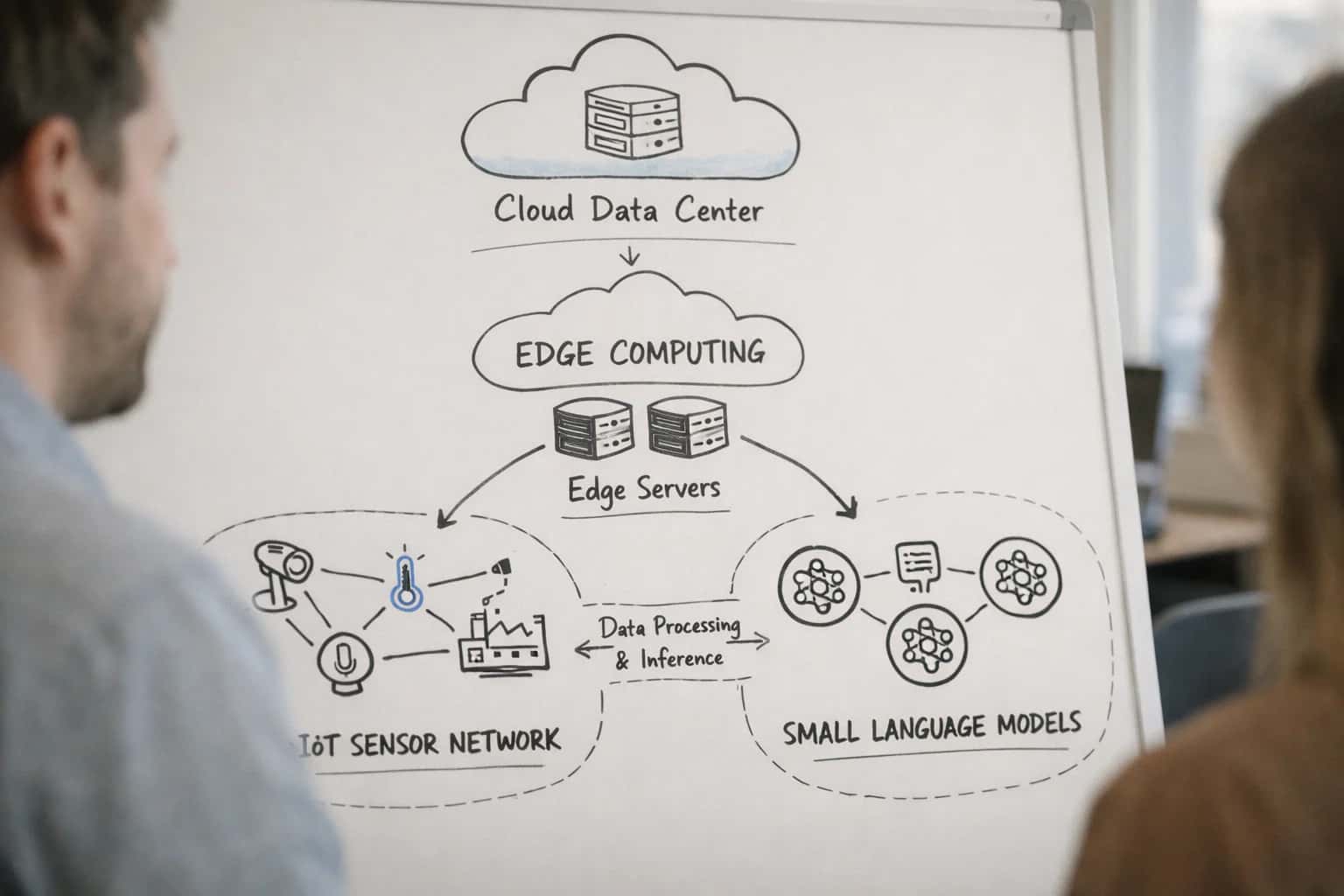
A practical guide to designing resilient AI systems that split workloads between constrained devices and the cloud to optimize latency, bandwidth, and power.
Implementation requires designing efficient data sync protocols and a robust model versioning strategy across the fleet. Use a message broker like MQTT for state synchronization and implement a fallback strategy where edge devices cache critical inferences and retry cloud communication. Manage different model versions using a registry, and deploy updates via over-the-air (OTA) mechanisms detailed in our sibling topic. This architecture creates a self-healing system that maintains operation through disconnections, directly supporting the goals of Ultra-Low-Power AI for Wearables and IoT.
ARCHITECTURE PRIMER
Key Architectural Concepts
Master the core principles for splitting AI workloads between resource-constrained edge devices and the cloud to build resilient, efficient IoT systems.
01
Workload Partitioning Logic
The first architectural decision is defining which tasks run where. Latency-critical inferences (e.g., anomaly detection) must run on-device, while data-intensive training and complex analytics belong in the cloud. Implement a decision router that evaluates input data complexity, required confidence, and current network state to route each inference request. For example, a simple sensor reading classification can be processed locally, but a complex pattern requiring historical context is sent to the cloud.
02
Data Sync Protocol Design
Efficient data movement is critical. Design protocols that prioritize delta updates and compression to minimize bandwidth and power consumption. Use a store-and-forward mechanism with local buffering for reliable operation during network disconnections. Key techniques include:
- Selective syncing: Only transmit features or model updates, not raw data streams.
- Adaptive batching: Dynamically adjust batch sizes based on connection quality and battery level.
- Priority queues: Ensure critical alerts are transmitted before routine telemetry.
03
Model Versioning & Fleet Management
Managing different AI model versions across thousands of devices requires a robust strategy. Implement a centralized model registry that tracks versions, performance metrics, and deployment status. Key components:
- A/B testing canaries: Roll out new models to a subset of devices to validate performance before full deployment.
- Compatibility layers: Ensure new models can handle data formats from older device firmware.
- Automatic rollback: Define metrics (e.g., accuracy drop, crash rate) that trigger an automatic revert to a stable model version. This connects directly to best practices in MLOps for agentic systems.
04
Graceful Fallback Strategies
Network and cloud failures are inevitable. Architect for resilience with multi-tiered fallbacks. The primary strategy is local edge inference. If the device is overloaded, the secondary strategy is to offload to a nearby edge server or fog node. The final fallback is a cached, simplified model on-device that provides basic functionality. Implement heartbeat monitoring and circuit breakers to detect cloud service degradation and trigger fallback modes without user interruption.
05
Power-Aware Communication
Radio usage is a primary power drain. Architect communication to maximize device sleep time. Techniques include:
- Wake-on-event: Only activate the radio when a local AI inference exceeds a confidence threshold.
- Scheduled sync windows: Aggregate non-urgent data and transmit during pre-defined, infrequent intervals.
- Low-power wide-area networks (LPWAN): For devices with minimal data needs, leverage protocols like LoRaWAN or NB-IoT designed for ultra-low power. This is a core consideration when selecting hardware for ultra-low-power AI.
06
Unified Observability & Telemetry
Gain system-wide visibility by instrumenting both edge and cloud components. Emit standardized telemetry for device health, model performance, inference latency, and power consumption. Aggregate this data in a cloud dashboard to:
- Detect model drift or data distribution shifts across the fleet.
- Identify devices with anomalous power drain.
- Correlate system performance with network conditions. This observability layer is essential for proactive maintenance and connects to the principles of AI-First IT Operations (AIOps).
ARCHITECTURE FOUNDATION
Step 1: Define the Workload Split
The first and most critical decision in a hybrid system is determining which AI tasks run on the edge device versus the cloud. This split dictates your system's latency, bandwidth use, and power efficiency.
Define the split by analyzing each AI task's latency tolerance, data volume, and computational cost. Real-time tasks like anomaly detection must run on the edge to guarantee sub-second response and operate during network outages. Complex, non-time-sensitive analysis, such as long-term trend modeling, should be offloaded to the cloud. This decision directly impacts your device's power budget, as radio transmission for data offload is often the largest energy consumer.
Implement this logic with a routing agent on the edge device. This agent evaluates input data—using metrics like confidence scores or data entropy—to decide the inference path. For example, a high-confidence local classification completes on-device, while an uncertain result triggers a cloud query. This creates a fallback strategy, ensuring seamless operation. Proper workload splitting is the cornerstone of resilient IoT systems, balancing the need for immediate action with the power of centralized compute.
STRATEGY SELECTION
Model Versioning Strategies Comparison
Choosing a versioning strategy is critical for managing updates, rollbacks, and consistency across a distributed fleet of IoT devices and cloud services.
| Feature / Metric | Git-Based Versioning | Container-Based Versioning | Semantic Versioning with Registry |
|---|---|---|---|
Unique Identifier | Git commit hash (e.g., a1b2c3d) | Container image digest | Semantic version (e.g., v2.1.0) |
Rollback Granularity | Any previous commit | Previous container image | Major/Minor/Patch level |
Bandwidth Efficiency for OTA Updates | Delta patches (< 10% of model size) | Full image download (100% of model size) | Dependent on registry; often full download |
Built-in Integrity Verification | |||
Native Support for A/B Testing | |||
Canary Deployment Complexity | High (manual orchestration) | Low (orchestrator-native) | Medium (registry + routing logic) |
Compatibility with MLOps Pipelines | |||
Traceability to Training Data |
ARCHITECTURE
Step 4: Build the Offline Fallback System
Design a resilient system that ensures continuous AI operation during network outages, a critical requirement for reliable IoT.
An offline fallback system is a local inference engine that activates when cloud connectivity is lost. It uses a lightweight, quantized model stored on the edge device to process sensor data and make decisions autonomously. This requires a state synchronization protocol to queue results locally and a conflict resolution strategy for when the device reconnects and must merge its local state with the cloud. The fallback model is a distilled version of your primary cloud model, optimized for the device's memory and power constraints.
Implement this by first defining the critical inference tasks that must continue offline, such as anomaly detection. Deploy the fallback model using a framework like TensorFlow Lite Micro. Design a durable job queue (e.g., using SQLite) to store inferences and sensor readings. Upon reconnection, implement a reconciliation handler that syncs queued data, resolves any conflicts (e.g., using timestamps or version vectors), and updates the cloud's central state. This creates a seamless hybrid cloud-edge AI system that is tolerant to network partitions.
Enabling Efficiency, Speed & Accuracy
Intelligent Analysis, Decision & Execution
We build AI systems for teams that need search across company data, workflow automation across tools, or AI features inside products and internal software.
Talk to Us
Search across company data
Give teams answers from docs, tickets, runbooks, and product data with sources and permissions.
Useful when people spend too long searching or get different answers from different systems.
Enterprise searchRAGPermissions
Read more
Automate internal workflows
Use AI to route work, draft outputs, trigger actions, and keep approvals and logs in place.
Useful when repetitive work moves across multiple tools and teams.
AI agentsWorkflow automationGovernance
Read more
Add AI to products and internal tools
Build assistants, guided actions, or decision support into the software your team or customers already use.
Useful when AI needs to be part of the product, not a separate tool.
AI integrationDecision supportModel routing
Read moreARCHITECTURE PITFALLS
Common Mistakes
Architecting a hybrid cloud-edge AI system for IoT requires balancing latency, bandwidth, power, and resilience. These are the most frequent technical mistakes that undermine system performance and reliability.
This failure stems from designing for a persistent connection rather than assuming intermittent connectivity. A resilient hybrid system must operate autonomously at the edge.
Fix: Implement a graceful degradation strategy. Define a clear decision logic for routing inferences: latency-critical tasks must run on-device with a local model. Use an intelligent sync protocol that queues data and retries transmission when connectivity resumes. Design your edge node with sufficient storage and processing to handle extended offline periods, a core concept in our guide on Autonomous Workflow Design and Logic Routing.

About the author
Prasad Kumkar
CEO & MD, Inference Systems
Prasad Kumkar is the CEO & MD of Inference Systems and writes about AI systems architecture, LLM infrastructure, model serving, evaluation, and production deployment. Over 5+ years, he has worked across computer vision models, L5 autonomous vehicle systems, and LLM research, with a focus on taking complex AI ideas into real-world engineering systems.
His work and writing cover AI systems, large language models, AI agents, multimodal systems, autonomous systems, inference optimization, RAG, evaluation, and production AI engineering.
LinkedIn
Limited slotsGet a Free AI Consultation
Partnered with leading AI, data, and software stack.





How We Work
Custom AI workflows for your Business
One-fit-all AI don't work for modern businesses. At Inferensys, we aim to understand your business & custom requirements; which we use to define most efficient agentic workflows, the data, and the tools for your business.
01
Review the use case
We understand the task, the users, and where AI can actually help.
Read more02
Pick the right approach
We define what needs search, automation, or product integration.
Read more03
Build the first useful version
We implement the part that proves the value first.
Read more04
Improve from there
We add the checks and visibility needed to keep it useful.
Read moreThe first call is a practical review of your use case and the right next step.
Talk to Us