AI-based Structural Health Monitoring (SHM) transforms passive infrastructure into proactive, data-driven assets. The core concept involves deploying a network of IoT sensors—accelerometers, strain gauges, and inclinometers—onto critical structures to continuously measure vibrations, loads, and deformations. This real-time data is streamed to the cloud, where anomaly detection algorithms establish a baseline of 'normal' behavior and flag deviations that indicate potential damage or fatigue, enabling maintenance before catastrophic failure. This system is the foundational sensor layer for a comprehensive digital twin for infrastructure.

Guide
Setting Up AI-Based Structural Health Monitoring
A practical guide to deploying a sensor network and AI models for real-time monitoring of structural integrity in bridges, dams, and buildings. Includes code for data ingestion and anomaly detection.
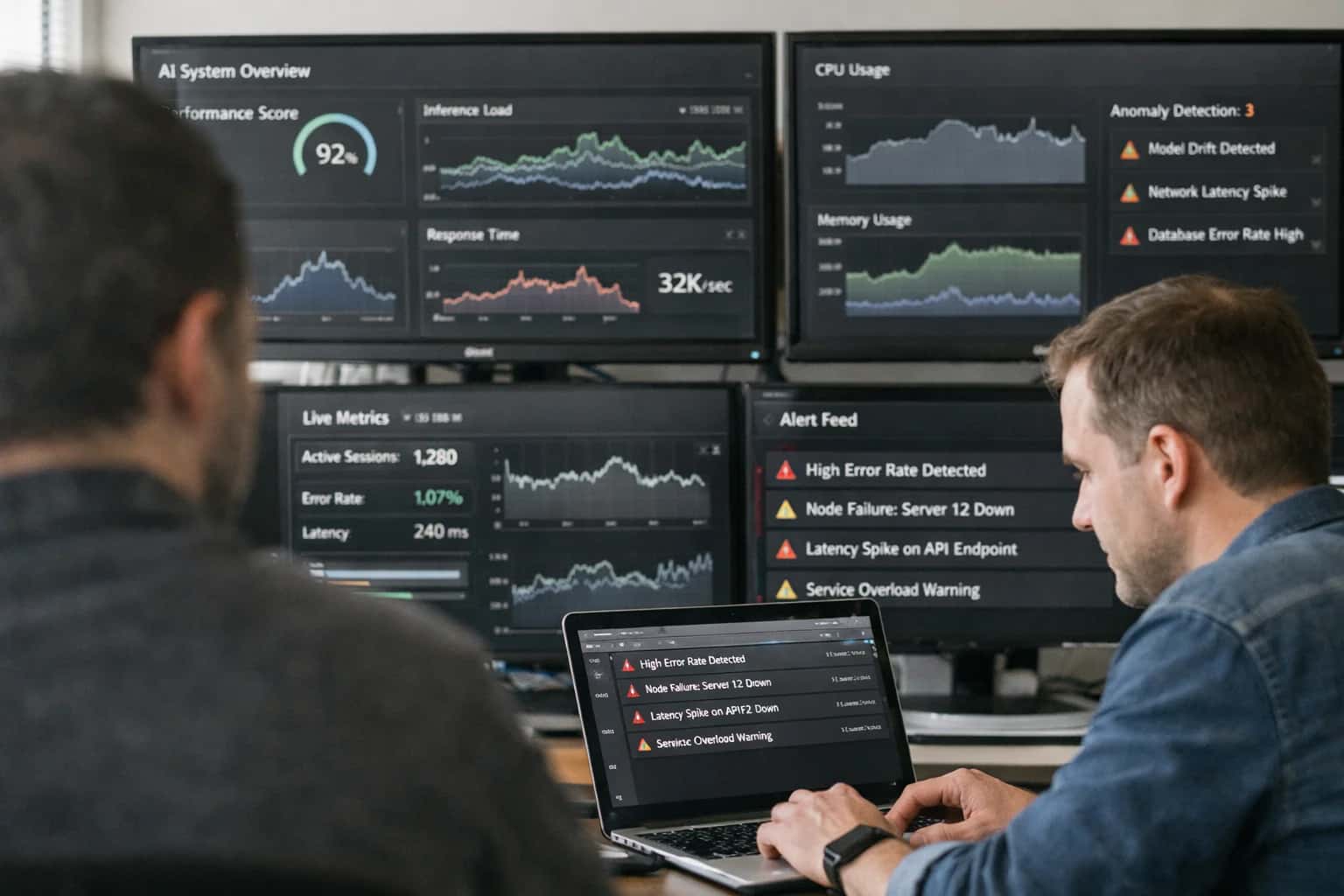
This guide details the deployment of a sensor network and AI models to monitor the integrity of bridges, dams, and buildings. It covers selecting and installing accelerometers, strain gauges, and inclinometers, streaming data to the cloud via LTE/5G, and using anomaly detection algorithms to identify concerning shifts or vibrations. The system provides early warnings for potential failures and schedules inspections, forming a core component of a digital twin for infrastructure.
Implementing SHM requires a methodical approach: first, select and install sensors based on the failure modes you intend to detect. Next, establish a robust data pipeline using LTE/5G or LoRaWAN for transmission. Then, train models like Isolation Forest or LSTM autoencoders on historical data to recognize anomalous patterns. Finally, integrate alerts with inspection scheduling systems. This creates a closed-loop, self-healing capability, a key component of autonomous infrastructure management, moving from reactive repairs to predictive preservation.
FOUNDATIONAL STEP
Step 1: Select and Deploy Your Sensor Network
The sensor network is the nervous system of your structural health monitoring (SHM) platform. This step covers selecting the right hardware, planning deployment, and establishing reliable data ingestion.
02
Design the Network Topology
Map sensor placement to your structure's digital twin. Position sensors at high-stress points identified by finite element analysis (FEA) and near historical failure locations. Ensure network resilience:
- Use a mesh topology for redundancy; if one node fails, data can route through another.
- Place gateway nodes strategically to aggregate data from clusters of sensors.
- Calculate power budgets; for remote locations, plan for solar panels or long-life batteries.
- Factor in environmental hardening (IP67 rating for outdoor use).
04
Deploy and Calibrate On-Site
Physical installation determines data quality. Anchor sensors directly to the structure using epoxy or bolts to ensure coupling; poor mounting creates noise. Calibrate each sensor against a known reference post-installation. Log precise GPS coordinates and orientations for spatial mapping in your analytics platform. Perform a network commissioning test: trigger a known event (e.g., a controlled impact) to verify all sensors report coherently and latency meets requirements.
06
Validate the Data Pipeline
Before training models, verify data integrity. Create dashboards to monitor:
- Data completeness: Percentage of expected data points received.
- Signal-to-noise ratio (SNR): Ensure readings are above sensor noise floors.
- Cross-sensor correlation: Verify physically linked sensors (e.g., strain and acceleration at the same point) show expected relationships.
- Latency: End-to-end delay from measurement to cloud storage must be under your alerting threshold (often < 5 seconds). This validation is the foundation for reliable anomaly detection in critical infrastructure.
CORE ALGORITHM
Step 3: Develop and Train the Anomaly Detection Model
This step transforms raw sensor data into an intelligent system capable of identifying structural deviations. You will select, develop, and train the machine learning model that forms the analytical core of your monitoring solution.
Begin by selecting an appropriate anomaly detection algorithm. For time-series sensor data from accelerometers and strain gauges, models like Isolation Forests, One-Class SVMs, or Autoencoders are effective. The choice depends on your data's nature: labeled historical failures allow for supervised learning, while the more common scenario of only 'normal' operational data necessitates unsupervised or semi-supervised techniques. Frame the problem as detecting deviations from a learned baseline of healthy structural behavior.
Implement the model using a framework like Scikit-learn or PyTorch. First, preprocess your sensor streams: handle missing values, normalize features, and create rolling windows for temporal context. Train the model exclusively on data representing normal conditions to establish the baseline. Validate performance using a held-out test set containing injected synthetic faults or, if available, rare real failure events. Finally, integrate the model into a continuous inference pipeline that streams live data and outputs an anomaly score, forming the trigger for your early warning system as part of a larger digital twin for infrastructure.
SENSOR SELECTION
Sensor Type Comparison and Use Cases
A comparison of primary sensor types used in AI-based Structural Health Monitoring, detailing their capabilities, deployment considerations, and ideal applications for monitoring bridges, dams, and buildings.
| Feature / Metric | Accelerometers | Strain Gauges | Inclinometers | Acoustic Emission Sensors |
|---|---|---|---|---|
Primary Measurement | Vibration & Acceleration | Surface Deformation (Strain) | Angular Tilt / Rotation | High-Frequency Sound Waves |
Data Type | Time-series acceleration | Microstrain (με) | Angular displacement (degrees) | Acoustic event counts & waveforms |
Detection Capability | Resonant frequency shifts, unusual vibrations | Crack initiation, overloading, fatigue | Settlement, foundation movement, creep | Active crack growth, material failure onset |
Sampling Rate | 50–1000 Hz | < 10 Hz | 0.1–10 Hz | 100 kHz – 1 MHz |
Installation Complexity | Medium (needs secure mounting) | High (surface preparation & bonding) | Low (bolt-on or embedded) | High (precise coupling required) |
Long-term Stability | High | Medium (prone to drift) | Very High | Medium |
Power Consumption | Low to Medium | Very Low | Very Low | Medium to High |
Ideal Use Case | Monitoring dynamic response to wind/ traffic on bridges | Measuring stress in critical weld points or concrete beams | Tracking tilt of dam walls or building foundations | Detecting early-stage crack propagation in pressure vessels or pipelines |
Cost per Node (approx.) | $200–$1000 | $50–$500 | $300–$1500 | $1000–$5000 |
Data Volume per Day | 10 MB – 1 GB | < 1 MB | < 10 MB | 1 GB – 10 GB+ |
TROUBLESHOOTING
Common Mistakes
Deploying AI for structural health monitoring (SHM) is complex. These are the most frequent technical pitfalls developers encounter, from sensor setup to model drift, and how to fix them.
Noisy data is the primary cause of poor model performance in SHM. It's rarely a software bug; it's usually a hardware or installation issue.
Common root causes:
- Improper Sensor Mounting: Accelerometers and strain gauges must be rigidly coupled to the structure. A loose mount introduces spurious vibrations.
- Inadequate Signal Conditioning: Raw analog signals from sensors like piezoelectric accelerometers require amplification and anti-aliasing filters before analog-to-digital conversion. Skipping this step leads to signal distortion.
- Environmental Interference: Electromagnetic interference from nearby power lines or machinery can corrupt signals. Always use shielded cables and ensure proper grounding.
- Sampling Rate Mismatch: The Nyquist theorem states you must sample at least twice the highest frequency of interest. For bridge vibrations, this is often 50-200 Hz. Sampling at 10 Hz will alias higher frequencies, creating false low-frequency data.
Fix: Validate your data pipeline with a known physical test (e.g., tapping the sensor). Use a data acquisition (DAQ) system with built-in signal conditioning, like those from National Instruments or Dewesoft, and log raw alongside processed signals for debugging.
Enabling Efficiency, Speed & Accuracy
Intelligent Analysis, Decision & Execution
We build AI systems for teams that need search across company data, workflow automation across tools, or AI features inside products and internal software.
Talk to Us
Search across company data
Give teams answers from docs, tickets, runbooks, and product data with sources and permissions.
Useful when people spend too long searching or get different answers from different systems.
Enterprise searchRAGPermissions
Read more
Automate internal workflows
Use AI to route work, draft outputs, trigger actions, and keep approvals and logs in place.
Useful when repetitive work moves across multiple tools and teams.
AI agentsWorkflow automationGovernance
Read more
Add AI to products and internal tools
Build assistants, guided actions, or decision support into the software your team or customers already use.
Useful when AI needs to be part of the product, not a separate tool.
AI integrationDecision supportModel routing
Read more
About the author
Prasad Kumkar
CEO & MD, Inference Systems
Prasad Kumkar is the CEO & MD of Inference Systems and writes about AI systems architecture, LLM infrastructure, model serving, evaluation, and production deployment. Over 5+ years, he has worked across computer vision models, L5 autonomous vehicle systems, and LLM research, with a focus on taking complex AI ideas into real-world engineering systems.
His work and writing cover AI systems, large language models, AI agents, multimodal systems, autonomous systems, inference optimization, RAG, evaluation, and production AI engineering.
LinkedIn
Limited slotsGet a Free AI Consultation
Partnered with leading AI, data, and software stack.





How We Work
Custom AI workflows for your Business
One-fit-all AI don't work for modern businesses. At Inferensys, we aim to understand your business & custom requirements; which we use to define most efficient agentic workflows, the data, and the tools for your business.
01
Review the use case
We understand the task, the users, and where AI can actually help.
Read more02
Pick the right approach
We define what needs search, automation, or product integration.
Read more03
Build the first useful version
We implement the part that proves the value first.
Read more04
Improve from there
We add the checks and visibility needed to keep it useful.
Read moreThe first call is a practical review of your use case and the right next step.
Talk to Us