A self-remediating industrial control system integrates an AI reasoning layer with legacy hardware like Programmable Logic Controllers (PLCs) to autonomously detect, diagnose, and correct process faults. The core architecture involves secure data ingestion via OPC UA, a state machine for safe autonomous actions, and a verification agent to approve remediation steps. This creates a closed-loop system that maintains uptime and safety, forming a critical component of modern Self-Healing Physical Infrastructure.

Guide
How to Design a Self-Remediating Industrial Control System
A developer guide to retrofit legacy PLCs and DCS with an AI layer for autonomous fault detection and remediation. Covers secure OPC UA communication, safe state machine design, and verification agents for IEC 62443 compliance.
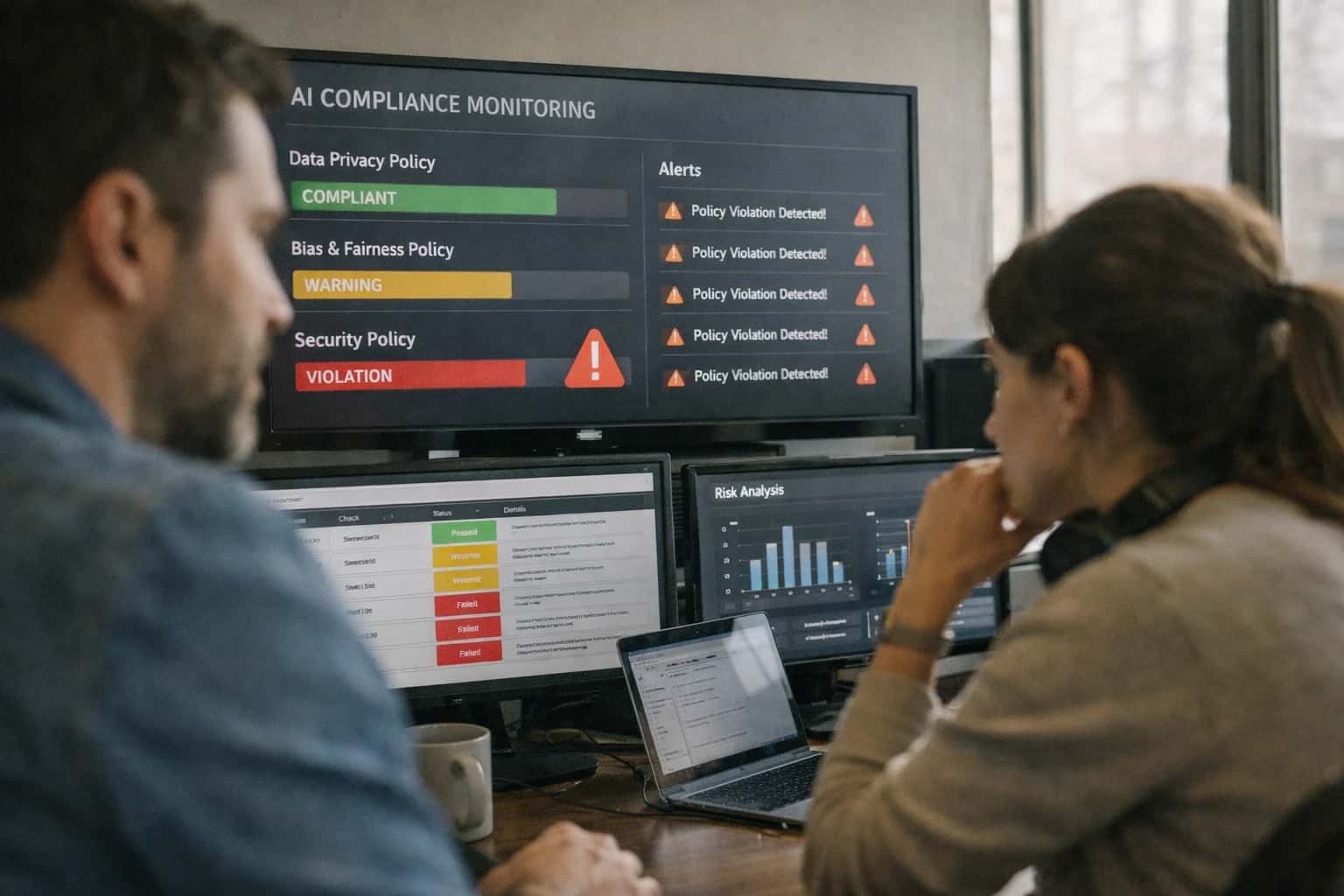
This guide explains how to retrofit legacy industrial systems with an AI layer for autonomous fault detection and correction, ensuring operational resilience and compliance.
Design begins by establishing a secure, real-time data pipeline from sensors and control networks. You then implement a multi-agent system where a diagnostic agent identifies anomalies, a planner proposes corrective actions (e.g., adjusting a valve or pump), and a verifier checks these against safety rules before execution. This architecture must comply with IEC 62443 security standards and include mandatory human-in-the-loop (HITL) governance overrides for critical decisions to ensure trust and operational safety.
SELF-HEALING PHYSICAL INFRASTRUCTURE
Key Concepts
Designing a self-remediating industrial control system requires integrating AI into legacy hardware. These concepts form the technical foundation for autonomous detection, diagnosis, and safe correction of process faults.
02
State Machine for Safe Autonomous Actions
Autonomous remediation requires a deterministic state machine to govern the system's behavior and prevent unsafe actions. This defines the legal states (e.g., NORMAL, FAULT_DETECTED, REMEDIATION_IN_PROGRESS) and the allowed transitions between them.
- Safety First: The state machine enforces pre-conditions and interlocks before any physical action, like closing a valve or starting a pump.
- Implementation: Model states and transitions explicitly in code; never rely on an LLM's unstructured output for state control.
03
Verification Agent & Pre-Execution Checks
A verification agent is a separate AI component that audits every proposed remediation action before execution. This creates a plan-verify-execute loop, a critical safety pattern for high-stakes environments.
- Function: The verifier checks the action against process limits, historical data, and safety rules. It can simulate the action in a digital twin to predict outcomes.
- Outcome: Actions are only executed if they pass verification, otherwise, they are logged and escalated for human review.
05
Human-in-the-Loop (HITL) Governance
Human-in-the-Loop (HITL) governance provides oversight for autonomous systems. It is not an afterthought but a core architectural component that defines when human approval is required.
- Confidence Thresholds: Actions with low confidence scores or high potential impact are routed to a human operator via a dashboard.
- Audit Trail: Every autonomous action and human decision is logged with full context, creating an immutable record for compliance and post-incident analysis. Learn more about designing these systems in our guide on Human-in-the-Loop (HITL) Governance Systems.
06
Digital Twin for Simulation & Training
A digital twin is a virtual, dynamic model of the physical process used for testing remediation strategies safely. It is essential for training AI models and validating actions.
- Use Cases: Simulate fault scenarios to train anomaly detection models; run 'what-if' analyses for proposed autonomous actions in the verification stage.
- Integration: The twin should mirror the real system's data model and logic, often built using tools like ANSYS Twin Builder or Siemens NX. For a related application, see our guide on Digital Twins for Clinical Trial Simulation.
FOUNDATION
Step 1: Define the System Architecture
The first step in designing a self-remediating industrial control system is to establish a robust, secure, and layered architecture. This blueprint separates the legacy operational technology (OT) layer from the new AI-driven intelligence and control layer, ensuring safety and compliance.
A self-remediating architecture is built on a separation of concerns. The legacy Programmable Logic Controller (PLC) or Distributed Control System (DCS) layer continues its primary control functions. A new, parallel AI agent layer is added, which monitors the OT layer via a secure data historian using the OPC UA protocol. This design ensures the AI can observe and analyze without directly interfering with critical real-time control loops, maintaining the integrity and safety of the physical process. The architecture must be designed to comply with IEC 62443 security standards from the outset.
The core of this architecture is a state machine that defines the system's operational modes and the safe transitions between them—such as Normal, Anomaly Detected, Remediation Proposed, and Human Approval Pending. This state machine governs the autonomous remediation loop, which includes distinct agents for detection, planning, and a critical verification agent. The verification agent acts as a safety check, simulating or logically validating any proposed control action (e.g., closing a valve) against the digital twin and process rules before execution is permitted.
ARCHITECTURE
Agent Responsibility Matrix
Defines the roles, capabilities, and boundaries for each AI agent in a self-remediating industrial control system, ensuring safe, coordinated autonomy.
| Agent / Responsibility | Diagnostic Agent | Remediation Agent | Verification Agent |
|---|---|---|---|
Primary Objective | Detect and classify process anomalies | Execute safe physical control actions | Validate actions before execution |
Data Inputs | PLC/DCS sensor streams, historical logs | Diagnostic report, system state machine | Proposed action, current system snapshot |
Key Actions | Run anomaly detection models, generate root-cause hypothesis | Calculate control setpoints, send commands via OPC UA | Run digital twin simulation, check against safety rules |
Autonomy Level | Fully autonomous detection | Conditional autonomy (requires verification) | Autonomous validation; can veto actions |
Human Escalation Trigger | High-severity unknown fault pattern | Action outside pre-approved envelope | Validation failure or simulation conflict |
Output | Anomaly report with confidence score | Secure OPC UA command packet | Go/No-Go decision with reasoning trace |
Integration Point | SCADA/Historian data pipeline | Secure OPC UA server on PLC network | Digital twin API, safety rule engine |
Compliance Focus | IEC 62443 monitoring & logging | IEC 62443 secure communication | IEC 61511 safety instrumented system logic |
STEP 5
Add Compliance Logging and HITL Overrides
This step ensures your autonomous system remains auditable and safe by implementing immutable logs for all actions and designing clear human intervention points.
Compliance logging creates an immutable, timestamped record of every system state, sensor reading, and autonomous action. This is not just for debugging; it's a legal requirement under standards like IEC 62443. Implement this by writing all events to a write-once-read-many (WORM) data store or a blockchain ledger. Each log entry must include the action, the agentic reasoning that justified it, and the resulting system state. This creates a defensible audit trail for regulators and forms the training data for your verification agent.
Human-in-the-Loop (HITL) overrides are mandatory safety breaks. Design them as configurable confidence thresholds within your autonomous state machine. For example, an agent can close a minor valve autonomously, but tripping a main circuit breaker requires human approval. Implement these as synchronous API calls to an approval dashboard that alerts an operator. This architecture, central to Human-in-the-Loop (HITL) Governance Systems, ensures human judgment is inserted where risk is highest, maintaining the system's self-healing capability within safe boundaries.
Enabling Efficiency, Speed & Accuracy
Intelligent Analysis, Decision & Execution
We build AI systems for teams that need search across company data, workflow automation across tools, or AI features inside products and internal software.
Talk to Us
Search across company data
Give teams answers from docs, tickets, runbooks, and product data with sources and permissions.
Useful when people spend too long searching or get different answers from different systems.
Enterprise searchRAGPermissions
Read more
Automate internal workflows
Use AI to route work, draft outputs, trigger actions, and keep approvals and logs in place.
Useful when repetitive work moves across multiple tools and teams.
AI agentsWorkflow automationGovernance
Read more
Add AI to products and internal tools
Build assistants, guided actions, or decision support into the software your team or customers already use.
Useful when AI needs to be part of the product, not a separate tool.
AI integrationDecision supportModel routing
Read moreDESIGNING SELF-REMEDIATING SYSTEMS
Common Mistakes
When retrofitting industrial control systems (ICS) with AI for autonomous remediation, developers often stumble on the same critical pitfalls. This guide explains the most frequent errors in architecture, safety, and implementation, providing clear solutions to ensure your system is both effective and secure.
Skipping a dedicated verification agent is the fastest path to catastrophic failure. An autonomous system that acts without independent validation is a rogue system.
The verification agent is a separate AI component that acts as a final checkpoint. Before any remediation command (e.g., closing a valve, starting a pump) is sent to the PLC, the verifier must:
- Simulate the action's outcome using a digital twin or physics-based model.
- Check for constraint violations (e.g., pressure limits, safety interlocks).
- Confirm the action aligns with the diagnosed root cause.
Without this, a single misdiagnosis by the primary AI can trigger an unsafe action, potentially causing equipment damage or process shutdowns. This pattern is a core requirement for safe Multi-Agent System (MAS) Orchestration.

About the author
Prasad Kumkar
CEO & MD, Inference Systems
Prasad Kumkar is the CEO & MD of Inference Systems and writes about AI systems architecture, LLM infrastructure, model serving, evaluation, and production deployment. Over 5+ years, he has worked across computer vision models, L5 autonomous vehicle systems, and LLM research, with a focus on taking complex AI ideas into real-world engineering systems.
His work and writing cover AI systems, large language models, AI agents, multimodal systems, autonomous systems, inference optimization, RAG, evaluation, and production AI engineering.
LinkedIn
Limited slotsGet a Free AI Consultation
Partnered with leading AI, data, and software stack.





How We Work
Custom AI workflows for your Business
One-fit-all AI don't work for modern businesses. At Inferensys, we aim to understand your business & custom requirements; which we use to define most efficient agentic workflows, the data, and the tools for your business.
01
Review the use case
We understand the task, the users, and where AI can actually help.
Read more02
Pick the right approach
We define what needs search, automation, or product integration.
Read more03
Build the first useful version
We implement the part that proves the value first.
Read more04
Improve from there
We add the checks and visibility needed to keep it useful.
Read moreThe first call is a practical review of your use case and the right next step.
Talk to Us