Automated documentation compliance transforms a manual, error-prone process into a continuous, agent-driven workflow. The core challenge is designing a system that autonomously manages the document lifecycle—creation, review, approval, and archival—while enforcing Good Manufacturing Practice (GMP) rules and 21 CFR Part 11 requirements for electronic signatures and audit trails. This requires integrating specialized AI agents that act as checkers for regulatory keywords, version control, and required metadata, ensuring every document is compliant by design.

Guide
How to Design an AI System for Automated Documentation Compliance
A developer guide to building an AI-powered system that automates the creation, review, approval, and archival of GMP documents. Implement agents for regulatory keyword checks, version control, and audit-ready workflows compliant with 21 CFR Part 11.
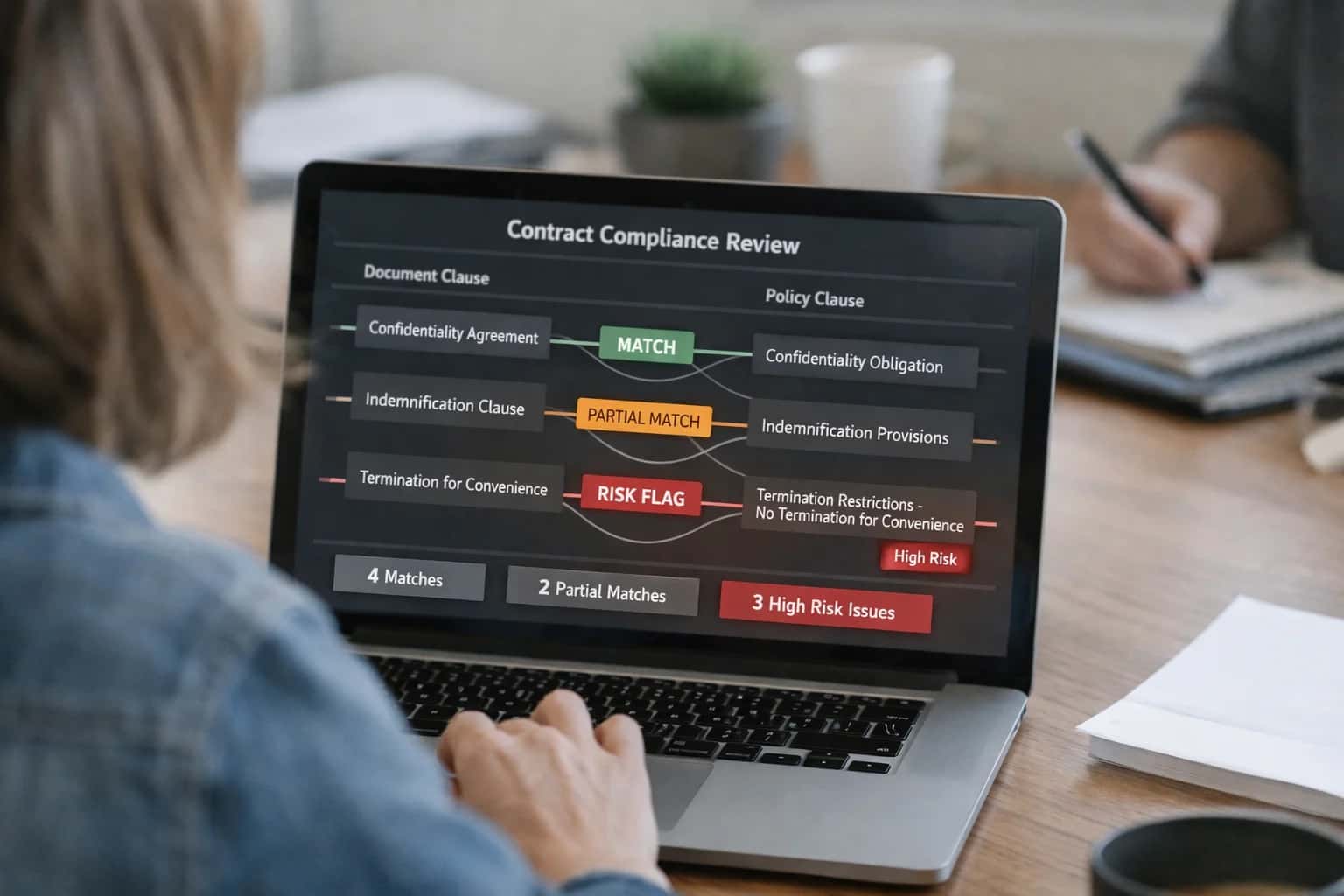
This guide details the technical architecture for automating the GMP document lifecycle, from creation to archival, using AI agents to enforce regulatory standards and ensure audit readiness.
You will implement this system by first defining the document ontology—the structured data model for all compliance artifacts. Next, you architect multi-agent workflows where a planner agent routes documents, a reviewer agent validates content, and an archiver agent manages retention. This design directly supports building an AI-Powered GMP Compliance Platform and relates to principles of Multi-Agent System (MAS) Orchestration. The result is a self-auditing documentation fabric that drastically reduces manual overhead and inspection risk.
FOUNDATIONAL PRINCIPLES
Key Concepts
Designing an AI system for automated documentation compliance requires a blend of regulatory knowledge, software architecture, and agentic AI. These core concepts define the technical approach.
01
Regulatory Knowledge Graph
A Regulatory Knowledge Graph is the semantic backbone of your compliance system. It maps entities like regulations (21 CFR Part 11), document types (SOPs, Batch Records), required metadata, and approval workflows into a connected network. This allows AI agents to reason about relationships, such as which clauses in Annex 11 apply to electronic signatures on a specific document version. Building this graph is the first step toward context-aware automation.
02
Agentic Document Lifecycle
Automation moves beyond simple triggers to an Agentic Document Lifecycle. Specialized AI agents own each stage:
- Creation Agent: Ensures new documents include required regulatory keywords and metadata.
- Review Agent: Checks for version control errors and cross-references against the knowledge graph.
- Approval Agent: Manages e-signature workflows and enforces the four-eyes principle.
- Archival Agent: Ensures immutable storage and retrieval per retention policies. These agents collaborate, passing context to maintain a continuous, audit-ready state.
03
21 CFR Part 11 & Electronic Signatures
21 CFR Part 11 is the FDA regulation governing electronic records and signatures. Your AI system must enforce its core requirements programmatically:
- Non-repudiation: Each signature action must be logged with a unique user ID, timestamp, and meaning (e.g., "reviewed", "approved").
- Audit Trail: The system must maintain a secure, computer-generated audit trail for all create, modify, or delete events.
- System Validation: The AI components themselves must be validated as fit-for-purpose, requiring rigorous testing and documentation. This is non-negotiable for GMP compliance.
04
Context Engineering for Compliance
Context Engineering is the practice of structuring data and objectives so AI agents make sound, compliant decisions. For documentation, this involves:
- Clear Objective Statements: Instead of "check document," the instruction is "Verify that Document ID X-123 references the current version of SOP Y-456 and has all required metadata fields populated per Policy Z."
- Data Relationship Maps: Explicitly defining how a Deviation Report links to a CAPA, which in turn references an investigation. This prevents agents from operating in isolation.
- Feedback Loops: Using human corrections to continuously refine the agent's understanding of compliance context.
05
Multi-Agent Orchestration
A single AI model cannot handle the entire compliance workflow. You need Multi-Agent Orchestration—a system where specialized agents communicate and hand off tasks. A typical orchestration for document approval might involve:
- Planner Agent: Receives a new document and sequences the required checks.
- Checker Agent: Executes specific validation rules.
- Router Agent: Sends the document to the correct human approver based on rules.
- Logger Agent: Records every action in the immutable audit trail. This design, central to Multi-Agent System (MAS) Orchestration, ensures scalability and fault tolerance.
06
Explainability & Audit Trails
For regulatory acceptance, every AI-driven action must be explainable. Your system must generate a human-readable trace of:
- Why an agent flagged a document (e.g., "Missing 'Effective Date' metadata field").
- What data or rule it used (e.g., "Checked against Document Type template 'SOP-001'").
- The decision path taken. This goes beyond simple logging to create a reasoning trace that can be presented to an auditor. This principle is critical for Explainability and Traceability for High-Risk AI under regulations like the EU AI Act.
FOUNDATION
Step 1: Define the Regulatory Document Schema
The first and most critical step in automating compliance is structuring your data. A well-defined schema acts as the single source of truth for all regulatory documents, enabling AI agents to parse, validate, and enforce rules consistently.
A regulatory document schema is a structured data model that defines the required fields, data types, relationships, and validation rules for all compliance artifacts—from SOPs and batch records to deviations and CAPAs. This schema is the backbone of your AI system for automated documentation compliance. It must encode regulatory metadata like document type, effective date, version, approval status, and links to related records (e.g., a deviation linked to its CAPA). Use a standard like JSON Schema or an entity-relationship diagram to model this formally, ensuring it aligns with regulations like 21 CFR Part 11 for electronic signatures and audit trails.
Start by auditing your existing document types and extracting common fields. Define mandatory properties (e.g., documentId, title, currentVersion, approvalStatus) and controlled vocabularies for fields like documentType (SOP, Protocol, Report). Implement this schema in your document database (e.g., PostgreSQL, MongoDB) and expose it via an API. This structured foundation allows your AI agents to perform automated checks for regulatory keyword compliance, validate version control, and enforce required metadata, which is essential for the document lifecycle management covered in this guide.
GMP DOCUMENT COMPLIANCE
Agent Responsibility Matrix
Defines the distinct roles and responsibilities of specialized AI agents within an automated documentation compliance system. This clear separation of duties ensures accountability, prevents conflicts, and aligns with regulatory principles of data integrity and auditability.
| Agent Role | Primary Responsibility | Key Actions | Integration Points | Human-in-the-Loop (HITL) Trigger |
|---|---|---|---|---|
Document Ingestion Agent | Parse and structure incoming documents | Extract text/metadata, apply version control, validate file format | Document Management System (DMS), Electronic Batch Records (EBR) | Unreadable file format or corrupted data |
Regulatory Keyword Scanner | Check for required/forbidden terminology | Scan against controlled keyword lists (e.g., ICH, FDA guidances), flag omissions or non-compliant language | Regulatory Intelligence Knowledge Graph, Standard Operating Procedures (SOPs) | Ambiguous phrase requiring expert interpretation |
Metadata & Signature Validator | Enforce 21 CFR Part 11 electronic signature rules | Verify signature authenticity, check timestamps, confirm approver roles are valid | Identity & Access Management (IAM) System, Audit Trail Database | Missing signature or role-based access conflict |
Workflow Enforcer | Route documents through approval lifecycle | Initiate review tasks, enforce sequential approvals, escalate overdue items | Workflow Orchestration Engine, Notification System (e.g., Teams/Slack) | Workflow deviation or exception requiring manual override |
Audit Trail Generator | Create immutable logs of all document actions | Record every create, read, update, delete (CRUD) event with user, timestamp, and reason | Immutable Ledger (e.g., blockchain-based log), Centralized Log Aggregator | None - operates autonomously to ensure integrity |
Compliance Report Aggregator | Compile evidence for inspection readiness | Auto-generate compliance dashboards, assemble document packages for specific audit questions | Quality Management System (QMS), Reporting Dashboard | Report request outside of pre-defined scope |
Anomaly Detector | Identify patterns indicating potential non-compliance | Use ML to spot version control errors, unusual approval loops, or metadata inconsistencies | Deviation Management System, Predictive Analytics Engine | High-confidence anomaly requiring immediate investigation |
Enabling Efficiency, Speed & Accuracy
Intelligent Analysis, Decision & Execution
We build AI systems for teams that need search across company data, workflow automation across tools, or AI features inside products and internal software.
Talk to Us
Search across company data
Give teams answers from docs, tickets, runbooks, and product data with sources and permissions.
Useful when people spend too long searching or get different answers from different systems.
Enterprise searchRAGPermissions
Read more
Automate internal workflows
Use AI to route work, draft outputs, trigger actions, and keep approvals and logs in place.
Useful when repetitive work moves across multiple tools and teams.
AI agentsWorkflow automationGovernance
Read more
Add AI to products and internal tools
Build assistants, guided actions, or decision support into the software your team or customers already use.
Useful when AI needs to be part of the product, not a separate tool.
AI integrationDecision supportModel routing
Read moreTROUBLESHOOTING
Common Mistakes
Designing an AI system for automated documentation compliance is complex. These are the most frequent technical and architectural pitfalls developers encounter, and how to fix them.
This happens when you treat keyword detection as a simple string match. Regulatory language is nuanced, with synonyms, negations, and context-dependent meanings.
Fix: Implement a semantic search layer using a fine-tuned embedding model. Instead of just matching "deviation," your system should also flag "unplanned event," "non-conformance," or "out-of-specification result" based on the surrounding context. Use a knowledge graph to map related terms from regulations like 21 CFR Part 11 and ICH Q10. For example, an agent should understand that "electronic signature" is linked to "biometrics" and "audit trail."
python# Example using sentence transformers for semantic similarity from sentence_transformers import SentenceTransformer, util model = SentenceTransformer('all-MiniLM-L6-v2') # Encode regulatory phrases and document text reg_phrase = "requires documented justification" doc_sentence = "A rationale must be provided in the change control record." emb1 = model.encode(reg_phrase, convert_to_tensor=True) emb2 = model.encode(doc_sentence, convert_to_tensor=True) cosine_sim = util.cos_sim(emb1, emb2) # High similarity score indicates a potential match, even without keyword overlap.

About the author
Prasad Kumkar
CEO & MD, Inference Systems
Prasad Kumkar is the CEO & MD of Inference Systems and writes about AI systems architecture, LLM infrastructure, model serving, evaluation, and production deployment. Over 5+ years, he has worked across computer vision models, L5 autonomous vehicle systems, and LLM research, with a focus on taking complex AI ideas into real-world engineering systems.
His work and writing cover AI systems, large language models, AI agents, multimodal systems, autonomous systems, inference optimization, RAG, evaluation, and production AI engineering.
LinkedIn
Limited slotsGet a Free AI Consultation
Partnered with leading AI, data, and software stack.





How We Work
Custom AI workflows for your Business
One-fit-all AI don't work for modern businesses. At Inferensys, we aim to understand your business & custom requirements; which we use to define most efficient agentic workflows, the data, and the tools for your business.
01
Review the use case
We understand the task, the users, and where AI can actually help.
Read more02
Pick the right approach
We define what needs search, automation, or product integration.
Read more03
Build the first useful version
We implement the part that proves the value first.
Read more04
Improve from there
We add the checks and visibility needed to keep it useful.
Read moreThe first call is a practical review of your use case and the right next step.
Talk to Us