Architecting an AI-powered GMP compliance platform requires integrating disparate data sources—Manufacturing Execution Systems (MES), Laboratory Information Management Systems (LIMS), and IoT sensors—into a unified data fabric. The core challenge is designing a system that not only aggregates data but applies real-time monitoring agents and predictive analytics to automate document control, deviation management, and corrective actions. This architecture must enforce data integrity and provide a complete audit trail that satisfies stringent regulations like FDA 21 CFR Part 11 from the ground up.

Guide
How to Architect an AI-Powered GMP Compliance Platform
A developer's guide to building a system that automates Good Manufacturing Practice (GMP) adherence. This tutorial covers data integration, real-time monitoring agents, and compliant audit trail design with code examples.
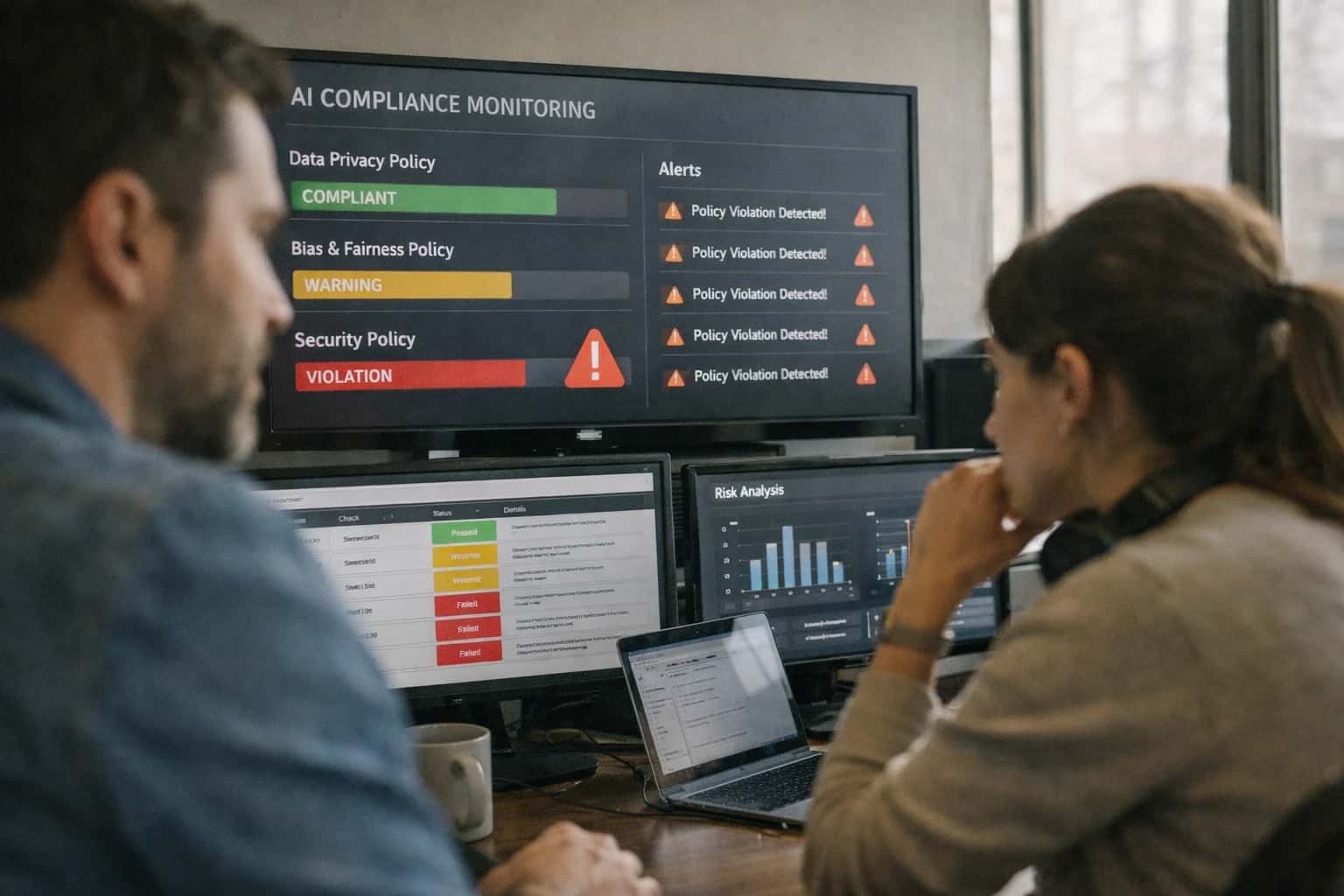
This guide provides the foundational blueprint for building a unified AI system that automates Good Manufacturing Practice (GMP) adherence, transforming manual quality processes into a proactive, intelligent platform.
The platform's intelligence layer uses specialized AI agents for tasks like anomaly detection in batch records and automated root cause analysis for deviations. You will implement multi-agent workflows where agents collaborate to route incidents, trigger investigations, and ensure closure, creating a self-correcting quality system. This end-to-end automation shifts compliance from a periodic checklist to a state of continuous adherence, dramatically reducing manual overhead and inspection risk. For foundational concepts, see our guide on autonomous workflow design.
GMP COMPLIANCE PLATFORM
Key Architectural Concepts
Building an AI-powered GMP platform requires a foundational architecture that integrates data, ensures auditability, and enables autonomous action. These concepts are the core building blocks.
01
Unified Data Fabric
A unified data fabric is the foundational layer that connects disparate systems like LIMS, MES, and ERP. It provides a single source of truth by:
- Ingesting structured and unstructured data in real-time.
- Normalizing data into a common schema using ontologies specific to pharma (e.g., BRIDG model).
- Serving context-rich data to AI agents via APIs, enabling them to make decisions based on complete operational pictures. Without this fabric, agents operate in silos, leading to inconsistent and non-compliant outcomes.
02
Agentic Workflow Orchestration
Compliance is not a single task but a series of interconnected processes. Agentic workflow orchestration uses specialized AI agents (e.g., for deviation detection, document review, CAPA initiation) that are coordinated by a central orchestrator. This design:
- Dynamically routes tasks based on context, such as escalating a critical deviation to a human-in-the-loop (HITL) agent.
- Maintains state across long-running processes like investigations.
- Ensures accountability by logging every agent interaction. This relates directly to principles of Multi-Agent System (MAS) Orchestration for achieving shared goals without human bottlenecks.
03
Immutable Audit Trail (21 CFR Part 11)
Every action in a GMP platform must be traceable. An immutable audit trail is a non-negotiable architectural component that:
- Logs all data changes, user actions, and AI agent decisions with timestamps and user/agent identity.
- Uses cryptographic hashing (e.g., SHA-256) to prevent tampering, creating a verifiable chain of custody.
- Supports electronic signatures with binding meaning, meeting FDA 21 CFR Part 11 requirements. This is not just a log file; it's a dedicated, secure datastore designed for forensic regulatory review.
04
Human-in-the-Loop (HITL) Governance
Full autonomy is risky in regulated environments. HITL governance is a design pattern that formally inserts human oversight into autonomous cycles. Key implementations include:
- Confidence-based escalation: An agent routes low-confidence decisions (e.g., a complex deviation classification) to a quality specialist.
- Approval gates: Critical actions like closing a CAPA or releasing a batch require a mandated electronic signature.
- Real-time intervention triggers: The system monitors for predefined risk thresholds and pauses agentic workflows for human review. This is essential for ethical alignment and risk mitigation.
05
Real-Time Monitoring & Anomaly Detection
Proactive compliance requires moving from periodic checks to continuous assurance. This involves deploying statistical process control (SPC) and machine learning models that:
- Analyze streaming data from IoT sensors (e.g., cleanroom environmental monitors) and manufacturing systems.
- Detect anomalies in real-time using algorithms like Isolation Forest or autoencoders, flagging potential excursions before they become deviations.
- Trigger automated alerts and initiate investigation workflows. This transforms compliance from a documentary exercise to an operational intelligence layer, a core concept in Cognitive Load Reduction for Human Operators.
06
Explainable AI (XAI) & Reasoning Traces
Under regulations like the EU AI Act, 'black box' AI is unacceptable for high-risk applications. Explainable AI (XAI) provides defensible reasoning for every AI-driven decision. Your architecture must:
- Generate step-by-step reasoning traces (e.g., "Flagged deviation due to correlation between sensor X out-of-trend and batch Y yield drop").
- Use techniques like LIME, SHAP, or inherently interpretable models for critical classifications.
- Store these traces as part of the immutable audit trail. This is critical for building explainable AI reasoning traces for compliance and satisfying inspector queries.
FOUNDATION
Step 1: Design the Unified Data Layer
The unified data layer is the central nervous system of your AI-powered GMP compliance platform. It aggregates, normalizes, and governs all compliance-critical data from disparate sources into a single, queryable source of truth.
Begin by identifying and integrating core Good Manufacturing Practice (GMP) data sources: Laboratory Information Management Systems (LIMS) for test results, Manufacturing Execution Systems (MES) for batch records, and Quality Management Systems (QMS) for deviations and CAPAs. Use a schema-on-read approach with tools like Apache Spark or a cloud data warehouse (BigQuery, Snowflake) to ingest raw data without imposing rigid structures upfront. This flexibility is crucial for handling the varied and evolving data formats inherent in pharmaceutical manufacturing.
Implement a semantic data model that maps raw system data to standardized business entities like Batch, Specification, or Deviation. This model, often built as a knowledge graph, establishes the relationships between data points, enabling complex queries like "find all batches affected by a specific raw material deviation." Enforce data integrity and audit trail requirements from FDA 21 CFR Part 11 at this layer, ensuring all data changes are immutably logged. This foundational work enables all downstream AI agents—for real-time monitoring, batch review, or audit simulation—to operate from a consistent, reliable data foundation.
ARCHITECTURAL COMPARISON
Agent Responsibility Matrix
This table compares three common architectural patterns for assigning responsibilities to AI agents within a GMP compliance platform, detailing their core features and trade-offs.
| Responsibility / Feature | Specialized Agent Pattern | Orchestrator-Agent Pattern | Holistic Agent Pattern |
|---|---|---|---|
Primary Design Philosophy | Single-purpose agents for discrete tasks | A central planner delegates to specialized workers | A single, generalist agent handles end-to-end workflows |
Example: Deviation Management | Separate agents for detection, RCA, and CAPA initiation | Orchestrator routes incident; specialized agents execute steps | One agent manages the entire deviation lifecycle |
System Complexity | Moderate (managing many agents) | High (requires robust communication protocols) | Low (single agent logic) |
Fault Isolation | ✅ High - failure is contained | ✅ Moderate - orchestrator is a single point of failure | ❌ Low - agent failure halts entire process |
Audit Trail Clarity | ✅ Excellent - each step is a distinct agent action | ✅ Good - orchestrator provides central log | ⚠️ Challenging - reasoning is internalized |
Integration Effort with MES/LIMS | Low per agent, high total | Centralized via orchestrator | High - requires broad system knowledge |
Adaptability to New Regulations | Fast for specific agents, slower for system-wide changes | Moderate - update orchestrator logic | Slow - requires retraining the generalist agent |
Alignment with 21 CFR Part 11 | ✅ Easier to implement electronic signatures per step | ✅ Can enforce signatures at delegation points | ⚠️ Must be designed into the single agent's workflow |
ARCHITECTURE PITFALLS
Common Mistakes
Building an AI-powered GMP platform is a high-stakes engineering challenge. These are the most frequent technical and architectural mistakes that lead to system failure, audit findings, or costly rework.
Treating the AI component as a single, monolithic 'brain' creates a single point of failure and makes the system impossible to audit or update. GMP compliance requires traceability; you must be able to pinpoint which agent or model made a specific decision.
Correct Architecture: Design a multi-agent system (MAS) where specialized, smaller agents handle discrete tasks:
- A document parsing agent extracts data from SOPs.
- An anomaly detection agent monitors LIMS feeds.
- A routing agent assigns deviations for investigation.
This aligns with principles of autonomous workflow design, allowing you to update, monitor, and govern each component independently while maintaining a clear audit trail.
Enabling Efficiency, Speed & Accuracy
Intelligent Analysis, Decision & Execution
We build AI systems for teams that need search across company data, workflow automation across tools, or AI features inside products and internal software.
Talk to Us
Search across company data
Give teams answers from docs, tickets, runbooks, and product data with sources and permissions.
Useful when people spend too long searching or get different answers from different systems.
Enterprise searchRAGPermissions
Read more
Automate internal workflows
Use AI to route work, draft outputs, trigger actions, and keep approvals and logs in place.
Useful when repetitive work moves across multiple tools and teams.
AI agentsWorkflow automationGovernance
Read more
Add AI to products and internal tools
Build assistants, guided actions, or decision support into the software your team or customers already use.
Useful when AI needs to be part of the product, not a separate tool.
AI integrationDecision supportModel routing
Read moreARCHITECTURE DEEP DIVE
Frequently Asked Questions
Practical answers to common technical challenges when building an AI-powered GMP compliance platform. Covers system design, data integration, agent orchestration, and audit-proofing.
The foundational pattern is a multi-agent system (MAS) orchestrated around a central event bus. This design separates concerns and enables autonomous workflows.
- Specialized Agents: Deploy discrete agents for specific GMP functions: a
Document Control Agent, aDeviation Triage Agent, aBatch Record Reviewer, and anAudit Trail Monitor. - Event-Driven Communication: Agents publish and subscribe to events (e.g.,
deviation.detected,document.approval.required) via a message broker like Apache Kafka or RabbitMQ. This creates loose coupling and scalable, resilient workflows. - Orchestration Layer: A central orchestrator agent manages complex, multi-step processes like a full CAPA (Corrective and Preventive Action) lifecycle, ensuring state is maintained and human approvals are inserted where required. This pattern is central to autonomous workflow design and logic routing.
This architecture allows you to update or scale individual agents without disrupting the entire compliance ecosystem.

About the author
Prasad Kumkar
CEO & MD, Inference Systems
Prasad Kumkar is the CEO & MD of Inference Systems and writes about AI systems architecture, LLM infrastructure, model serving, evaluation, and production deployment. Over 5+ years, he has worked across computer vision models, L5 autonomous vehicle systems, and LLM research, with a focus on taking complex AI ideas into real-world engineering systems.
His work and writing cover AI systems, large language models, AI agents, multimodal systems, autonomous systems, inference optimization, RAG, evaluation, and production AI engineering.
LinkedIn
Limited slotsGet a Free AI Consultation
Partnered with leading AI, data, and software stack.





How We Work
Custom AI workflows for your Business
One-fit-all AI don't work for modern businesses. At Inferensys, we aim to understand your business & custom requirements; which we use to define most efficient agentic workflows, the data, and the tools for your business.
01
Review the use case
We understand the task, the users, and where AI can actually help.
Read more02
Pick the right approach
We define what needs search, automation, or product integration.
Read more03
Build the first useful version
We implement the part that proves the value first.
Read more04
Improve from there
We add the checks and visibility needed to keep it useful.
Read moreThe first call is a practical review of your use case and the right next step.
Talk to Us