A dynamic learning infrastructure is the foundational platform that enables non-situational AI to update its knowledge and behavior in real-time. Unlike static deployments, this system must orchestrate continuous data ingestion, incremental model updates, and live validation without service disruption. Your core architectural decision is selecting between serverless runtimes (e.g., AWS Lambda) for event-driven updates and Kubernetes-based orchestration for complex, stateful learning pipelines requiring GPU autoscaling and fine-grained resource control.

Guide
Launching a Dynamic Learning Infrastructure for AI Services
A strategic, code-rich guide for engineering leaders to provision and manage the cloud infrastructure required for real-time learning at scale. This covers selecting between serverless and Kubernetes-based orchestration, configuring GPU-enabled autoscaling, implementing cost controls, and designing for fault tolerance.
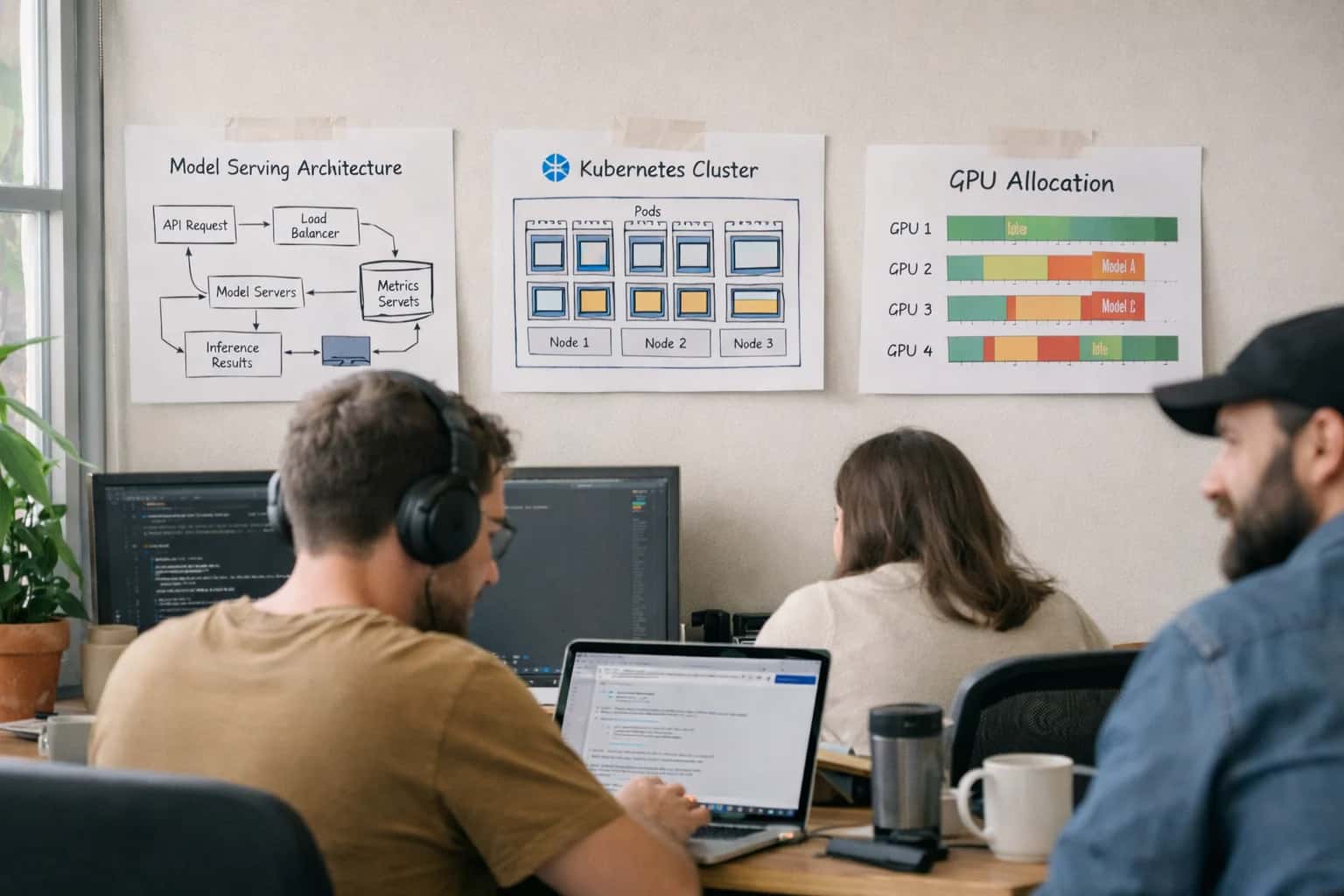
A technical blueprint for engineering leaders to provision and manage the cloud infrastructure required for real-time learning at scale.
Implementation requires configuring fault-tolerant data pipelines with tools like Apache Flink, integrating with MLOps platforms like Kubeflow for experiment tracking, and establishing rigorous cost controls. You must design for data lineage tracking and seamless integration with existing services to support a portfolio of adaptive AI agents. This infrastructure is the engine for our guides on real-time learning pipelines and continuous model improvement.
INFRASTRUCTURE CORE
Step 1: Choose Your Orchestration Model
This table compares the two primary orchestration models for deploying and managing a dynamic learning infrastructure. The choice dictates scalability, cost, and operational complexity.
| Feature | Kubernetes-Based Orchestration | Serverless Orchestration |
|---|---|---|
Primary Use Case | Long-running, stateful services (e.g., training clusters, model serving) | Event-driven, stateless functions (e.g., data validation, lightweight inference) |
GPU Autoscaling | ||
Cold Start Latency | < 1 sec (warm pods) | 2-10 sec (function initialization) |
Cost Model | Per-node hour (reserved/spot) | Per-invocation & compute-second |
State Management | Native (Persistent Volumes, StatefulSets) | External service required (e.g., database) |
Fault Tolerance | High (self-healing pods, node redundancy) | Managed by provider (stateless retries) |
MLOps Integration | Deep (Kubeflow, Seldon Core, MLflow) | Limited (vendor-specific tooling) |
Operational Overhead | High (cluster management required) | Low (fully managed by cloud provider) |
INFRASTRUCTURE
Step 2: Provision a GPU-Enabled Autoscaling Cluster
This step builds the elastic compute foundation for real-time learning, where models must adapt to live data streams without performance degradation.
A GPU-enabled autoscaling cluster is the compute backbone for non-situational AI. It provides the burst capacity for training spikes and the sustained throughput for low-latency inference. For dynamic learning, you need a hybrid orchestration layer: use Kubernetes (e.g., via Amazon EKS or Google GKE) for stateful, GPU-intensive model adaptation workloads, and pair it with serverless (AWS Lambda) for stateless preprocessing tasks. This separation, guided by our Multi-Agent System Orchestration principles, ensures efficient resource utilization and fault isolation.
Configure your cluster with node pools that mix cost-optimized CPU instances with GPU-accelerated instances (like NVIDIA A100s). Implement Horizontal Pod Autoscaling (HPA) and Cluster Autoscaler to dynamically match pod demand. Crucially, integrate a cost governance tool like Kubecost to set spending limits and alerts. This setup creates a resilient platform for the real-time learning pipelines that will drive your adaptive AI services, scaling compute precisely with learning demand.
INFRASTRUCTURE STACK
Essential Tools and Resources
Launching a dynamic learning infrastructure requires a deliberate stack of orchestration, compute, and monitoring tools. These resources form the backbone for AI services that adapt in real-time.
Enabling Efficiency, Speed & Accuracy
Intelligent Analysis, Decision & Execution
We build AI systems for teams that need search across company data, workflow automation across tools, or AI features inside products and internal software.
Talk to Us
Search across company data
Give teams answers from docs, tickets, runbooks, and product data with sources and permissions.
Useful when people spend too long searching or get different answers from different systems.
Enterprise searchRAGPermissions
Read more
Automate internal workflows
Use AI to route work, draft outputs, trigger actions, and keep approvals and logs in place.
Useful when repetitive work moves across multiple tools and teams.
AI agentsWorkflow automationGovernance
Read more
Add AI to products and internal tools
Build assistants, guided actions, or decision support into the software your team or customers already use.
Useful when AI needs to be part of the product, not a separate tool.
AI integrationDecision supportModel routing
Read moreTROUBLESHOOTING
Common Mistakes
Launching a dynamic learning infrastructure is a complex engineering challenge. These are the most frequent technical pitfalls that derail projects, from architectural missteps to operational oversights.
Model collapse occurs when a continuously learning model catastrophically forgets previous knowledge. This is often caused by unbounded online learning without safeguards.
The Fix: Implement a hybrid learning strategy.
- Use a replay buffer to store and periodically retrain on historical data.
- Apply Elastic Weight Consolidation (EWC) to penalize changes to weights important for prior tasks.
- Architect a two-tier system: a stable base model updated via controlled, scheduled fine-tuning, and a lightweight adaptation layer that handles real-time adjustments. This separation is a core principle of non-situational AI architecture.

About the author
Prasad Kumkar
CEO & MD, Inference Systems
Prasad Kumkar is the CEO & MD of Inference Systems and writes about AI systems architecture, LLM infrastructure, model serving, evaluation, and production deployment. Over 5+ years, he has worked across computer vision models, L5 autonomous vehicle systems, and LLM research, with a focus on taking complex AI ideas into real-world engineering systems.
His work and writing cover AI systems, large language models, AI agents, multimodal systems, autonomous systems, inference optimization, RAG, evaluation, and production AI engineering.
LinkedIn
Limited slotsGet a Free AI Consultation
Partnered with leading AI, data, and software stack.





How We Work
Custom AI workflows for your Business
One-fit-all AI don't work for modern businesses. At Inferensys, we aim to understand your business & custom requirements; which we use to define most efficient agentic workflows, the data, and the tools for your business.
01
Review the use case
We understand the task, the users, and where AI can actually help.
Read more02
Pick the right approach
We define what needs search, automation, or product integration.
Read more03
Build the first useful version
We implement the part that proves the value first.
Read more04
Improve from there
We add the checks and visibility needed to keep it useful.
Read moreThe first call is a practical review of your use case and the right next step.
Talk to Us