A Real-Time Deposition Monitoring System processes live audio/video streams to deliver immediate insights to co-counsel. The core architecture consists of three layers: an ingestion layer capturing streams via WebRTC, a processing layer performing live transcription with services like AssemblyAI, and an analysis layer running lightweight models for sentiment tracking and keyword flagging. This builds upon the foundational Deposition Analysis System but is optimized for sub-second latency and continuous data flow.

Guide
How to Architect a Real-Time Deposition Monitoring System
A developer guide to building a system that provides live AI analysis during legal depositions. You will implement real-time audio/video streaming, live transcription, sentiment tracking, and a dashboard for strategic alerts.
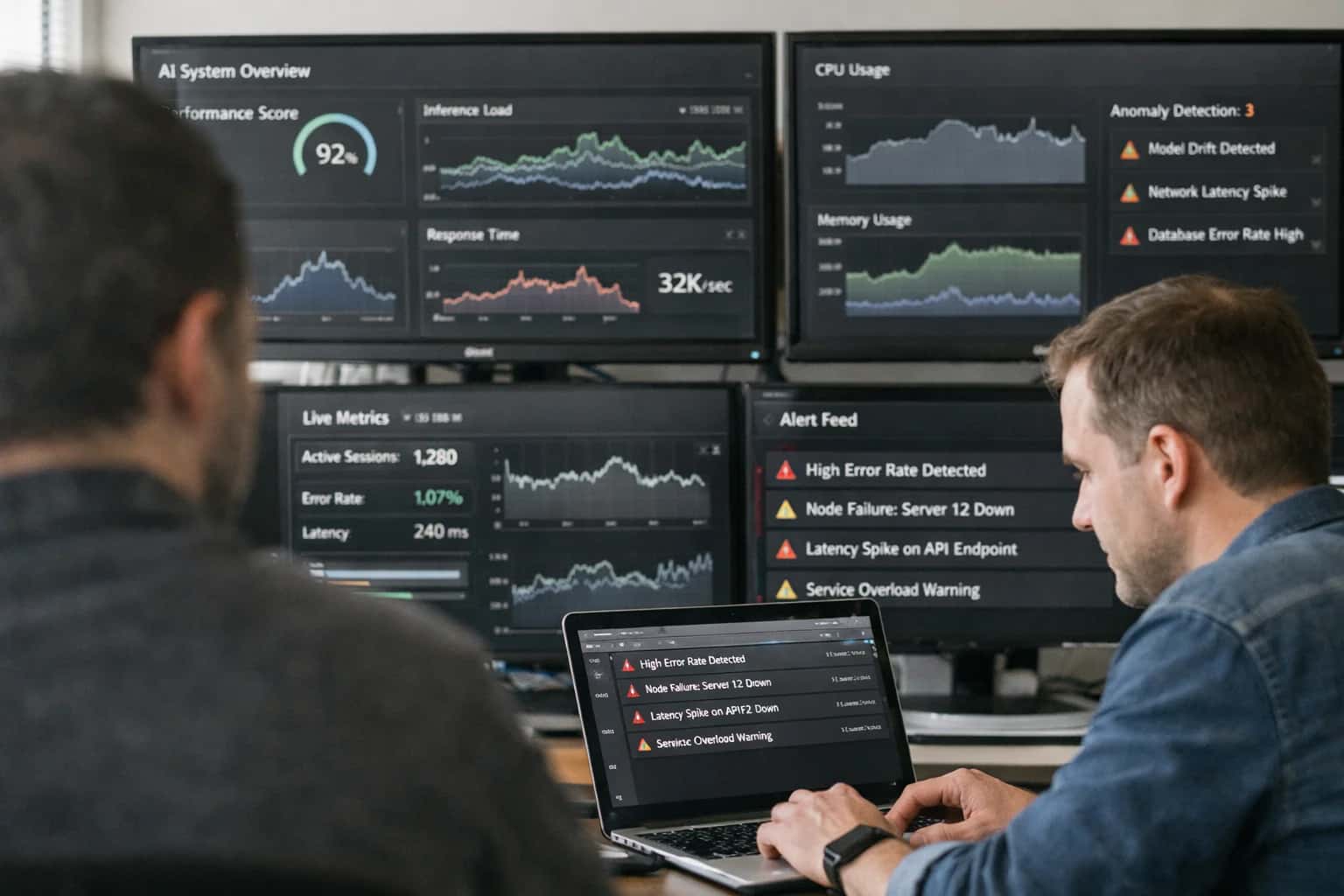
ARCHITECTURE GUIDE
Introduction
This guide details the architecture for a system that provides live, strategic intelligence to attorneys during depositions, enabling dynamic case strategy adjustments.
The system outputs alerts and strategic suggestions to a secure dashboard, allowing attorneys to react to testimony as it happens. Key technical challenges include managing streaming data pipelines, ensuring low-latency inference, and maintaining a secure, multi-tenant environment. This guide provides the actionable steps to architect this system, from selecting real-time ASR services to designing the alerting logic and integrating with existing legal workflows.
REAL-TIME PROCESSING LAYER
Technology Stack Comparison
This table compares core architectural choices for the live audio/video ingestion, transcription, and analysis pipeline. The selection dictates latency, scalability, and the complexity of your deployment.
| Architectural Feature | Cloud-Native Serverless (Recommended) | Edge-First Containerized | Hybrid Cloud-Edge |
|---|---|---|---|
Primary Latency (End-to-End) | < 2 seconds | < 500 milliseconds | < 1 second |
Transcription Service | AssemblyAI / Deepgram Stream | Whisper.cpp (On-Device) | Dual-Mode: Cloud w/ Edge Fallback |
Real-Time Sentiment Model | Lightweight Distilled Model (e.g., DistilBERT) | Ultra-Lite SLM (e.g., Phi-3-Mini) | Model Routing Based on Network QoS |
Keyword/Contradiction Flagging | Streaming RAG with Vector Cache | Pre-loaded Case Glossary & Rule Engine | Hybrid: Local Rules + Cloud RAG |
Co-Counsel Alert Delivery | WebSocket Push to Secure Dashboard | Local Network Broadcast | Multi-Channel (WebSocket, SMS) |
Offline/Network Drop Resilience | |||
Scalability (Concurrent Sessions) | High (Elastic Cloud Scaling) | Limited (Local Hardware) | Moderate (Managed Edge Nodes) |
Implementation Complexity | Medium | High | Very High |
Data Sovereignty & Privacy | Dependent on Cloud Provider Region | Full On-Premises Control | Configurable by Workflow Segment |
Enabling Efficiency, Speed & Accuracy
Intelligent Analysis, Decision & Execution
We build AI systems for teams that need search across company data, workflow automation across tools, or AI features inside products and internal software.
Talk to Us
Search across company data
Give teams answers from docs, tickets, runbooks, and product data with sources and permissions.
Useful when people spend too long searching or get different answers from different systems.
Enterprise searchRAGPermissions
Read more
Automate internal workflows
Use AI to route work, draft outputs, trigger actions, and keep approvals and logs in place.
Useful when repetitive work moves across multiple tools and teams.
AI agentsWorkflow automationGovernance
Read more
Add AI to products and internal tools
Build assistants, guided actions, or decision support into the software your team or customers already use.
Useful when AI needs to be part of the product, not a separate tool.
AI integrationDecision supportModel routing
Read moreARCHITECTURE PITFALLS
Common Mistakes
Building a real-time deposition monitoring system introduces unique challenges in streaming, latency, and reliability. These are the most frequent technical mistakes developers make and how to fix them.
High latency typically stems from inefficient audio streaming or blocking API calls. Real-time means sub-second (<500ms) processing; achieving this requires a WebSocket-based streaming client to send audio chunks as they are captured, not after a full recording.
Common Fixes:
- Use a service like AssemblyAI's real-time streaming API with its WebSocket SDK.
- Implement client-side buffering to send small, consistent audio packets (e.g., 200-500ms chunks).
- Avoid synchronous
POSTrequests; they create stop-and-go processing. - Process the audio stream directly from the deposition video feed using FFmpeg to pipe audio to the transcription service.
Latency kills the utility of 'live' alerts. Test your end-to-end pipeline with a stopwatch from utterance to dashboard alert.

About the author
Prasad Kumkar
CEO & MD, Inference Systems
Prasad Kumkar is the CEO & MD of Inference Systems and writes about AI systems architecture, LLM infrastructure, model serving, evaluation, and production deployment. Over 5+ years, he has worked across computer vision models, L5 autonomous vehicle systems, and LLM research, with a focus on taking complex AI ideas into real-world engineering systems.
His work and writing cover AI systems, large language models, AI agents, multimodal systems, autonomous systems, inference optimization, RAG, evaluation, and production AI engineering.
LinkedIn
Limited slotsGet a Free AI Consultation
Partnered with leading AI, data, and software stack.





How We Work
Custom AI workflows for your Business
One-fit-all AI don't work for modern businesses. At Inferensys, we aim to understand your business & custom requirements; which we use to define most efficient agentic workflows, the data, and the tools for your business.
01
Review the use case
We understand the task, the users, and where AI can actually help.
Read more02
Pick the right approach
We define what needs search, automation, or product integration.
Read more03
Build the first useful version
We implement the part that proves the value first.
Read more04
Improve from there
We add the checks and visibility needed to keep it useful.
Read moreThe first call is a practical review of your use case and the right next step.
Talk to Us