Continuous monitoring for AI explainability moves beyond tracking standard performance metrics like accuracy to ensure the stability and quality of a model's explanations over its lifecycle. This is a core requirement for high-risk AI systems, where subtle changes in model behavior—explanation drift—can erode trust and create compliance risks without affecting traditional KPIs. You must define metrics for explanation consistency, such as the stability of feature importance scores or the similarity of counterfactual examples across model versions.

Guide
Setting Up Continuous Monitoring for AI Explainability
A developer guide to implementing continuous monitoring systems that track the stability and quality of AI explanations over time, ensuring compliance and model reliability.
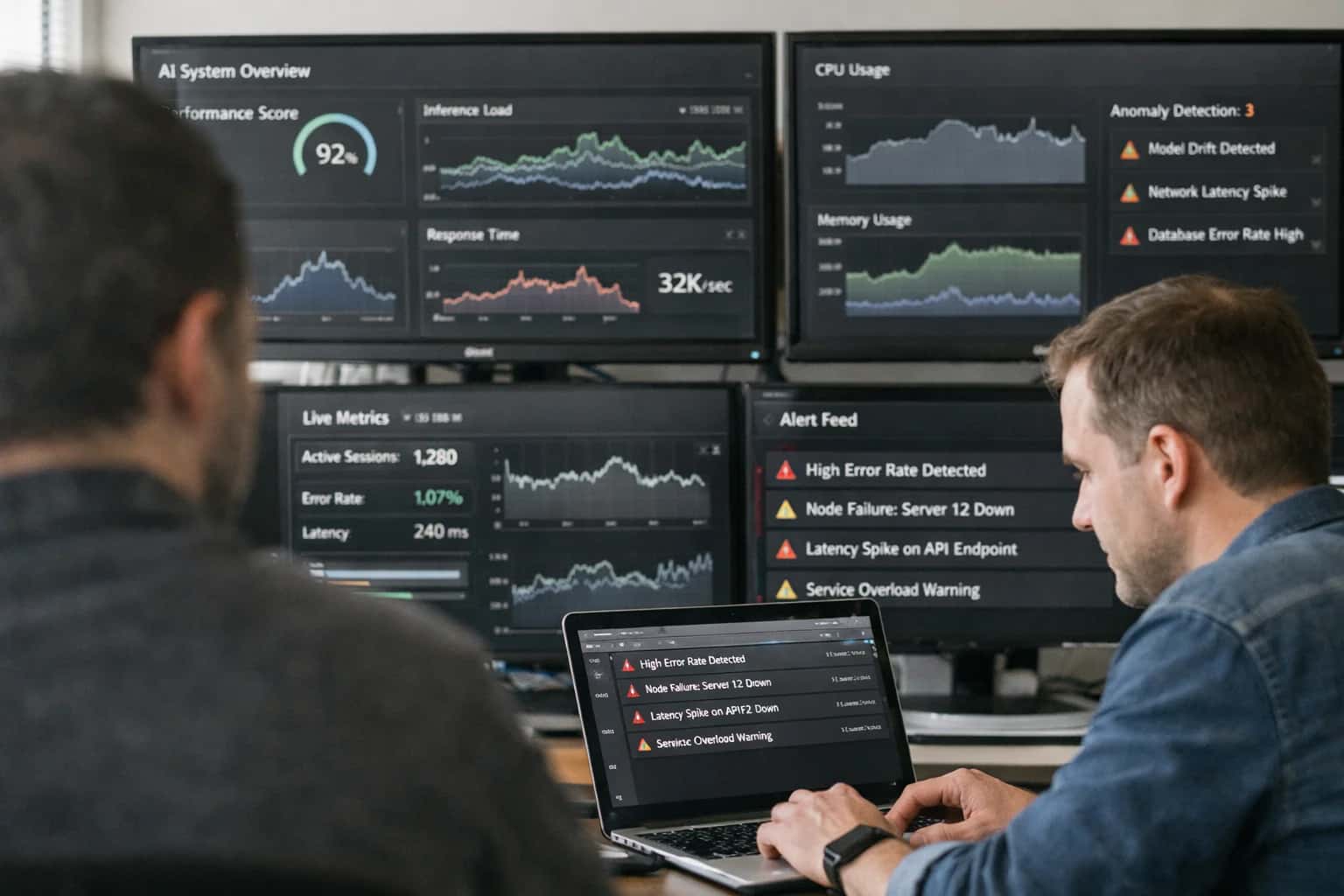
Continuous monitoring for AI explainability ensures the stability and trustworthiness of your model's reasoning over time, a critical requirement for high-risk applications under regulations like the EU AI Act.
Implementing these monitors involves integrating explainability libraries like SHAP or Alibi into your observability stack. You will set up automated pipelines to generate explanations on live inference data, compare them against a baseline, and trigger alerts when metrics degrade. This process is a key component of operationalizing transparency, as detailed in our guide on How to Integrate Explainability into Your MLOps Lifecycle, ensuring your system remains defensible and auditable.
OPEN-SOURCE VS. COMMERCIAL
Explainability Monitoring Tools Comparison
A comparison of core features, performance, and integration capabilities for tools that monitor explanation quality and stability in production AI systems.
| Feature / Metric | Arize | Fiddler | Custom (Alibi/MLflow) |
|---|---|---|---|
Explanation Drift Detection | Manual Implementation | ||
Real-Time Alerting | Via Custom Dashboards | ||
SHAP/LIME Integration | |||
Counterfactual Explanation Support | |||
Model-Agnostic Support | |||
Integration Complexity | Low | Low | High |
Cost for 10M inferences/mo | $500-1000 | $600-1200 | Engineering Time |
Audit Trail Logging | Manual Schema Design |
Enabling Efficiency, Speed & Accuracy
Intelligent Analysis, Decision & Execution
We build AI systems for teams that need search across company data, workflow automation across tools, or AI features inside products and internal software.
Talk to Us
Search across company data
Give teams answers from docs, tickets, runbooks, and product data with sources and permissions.
Useful when people spend too long searching or get different answers from different systems.
Enterprise searchRAGPermissions
Read more
Automate internal workflows
Use AI to route work, draft outputs, trigger actions, and keep approvals and logs in place.
Useful when repetitive work moves across multiple tools and teams.
AI agentsWorkflow automationGovernance
Read more
Add AI to products and internal tools
Build assistants, guided actions, or decision support into the software your team or customers already use.
Useful when AI needs to be part of the product, not a separate tool.
AI integrationDecision supportModel routing
Read moreTROUBLESHOOTING
Common Mistakes
Implementing continuous monitoring for AI explainability is critical for compliance and trust, but developers often stumble on subtle pitfalls that undermine the entire system. This section addresses the most frequent technical errors and misconceptions.
This is a classic sign of explanation drift detection failure. You are likely monitoring the wrong metrics or using flawed baselines.
Explanation consistency (e.g., SHAP value correlation) can remain high even as a model's decision boundary shifts, because the relative importance of features stays the same while their actual impact on incorrect predictions changes.
How to fix it:
- Monitor explanation correctness: Use a small, human-verified ground-truth set to check if explanations still point to the correct rationales.
- Implement prediction-explanation alignment tests: Trigger an alert if high-confidence predictions are paired with low-saliency explanations for the predicted class.
- Track counterfactual stability: Generate counterfactuals for a reference set; significant changes in the suggested "what-if" scenarios indicate underlying model drift.
Integrate these checks with your broader MLOps pipelines for agentic systems to catch silent failures.

About the author
Prasad Kumkar
CEO & MD, Inference Systems
Prasad Kumkar is the CEO & MD of Inference Systems and writes about AI systems architecture, LLM infrastructure, model serving, evaluation, and production deployment. Over 5+ years, he has worked across computer vision models, L5 autonomous vehicle systems, and LLM research, with a focus on taking complex AI ideas into real-world engineering systems.
His work and writing cover AI systems, large language models, AI agents, multimodal systems, autonomous systems, inference optimization, RAG, evaluation, and production AI engineering.
LinkedIn
Limited slotsGet a Free AI Consultation
Partnered with leading AI, data, and software stack.





How We Work
Custom AI workflows for your Business
One-fit-all AI don't work for modern businesses. At Inferensys, we aim to understand your business & custom requirements; which we use to define most efficient agentic workflows, the data, and the tools for your business.
01
Review the use case
We understand the task, the users, and where AI can actually help.
Read more02
Pick the right approach
We define what needs search, automation, or product integration.
Read more03
Build the first useful version
We implement the part that proves the value first.
Read more04
Improve from there
We add the checks and visibility needed to keep it useful.
Read moreThe first call is a practical review of your use case and the right next step.
Talk to Us