AI workload placement is the automated decision engine that determines the optimal location—device, edge server, or cloud—to execute an inference task. This decision is driven by a constraint-based algorithm evaluating real-time telemetry for latency, data gravity, compute availability, and cost. Effective placement is the cornerstone of building scalable AI Grids, enabling applications like autonomous vehicles and real-time video analytics to meet strict performance SLAs. You will learn to integrate this logic with Kubernetes schedulers like Kueue and Volcano to automate one of the most critical decisions in edge AI orchestration.

Guide
How to Implement AI Workload Placement for Edge Sites
Build an automated system that decides where to run AI inference jobs—on device, edge server, or cloud—based on real-time constraints like latency, cost, and data gravity. This guide provides code and architecture for a production-grade placement engine.
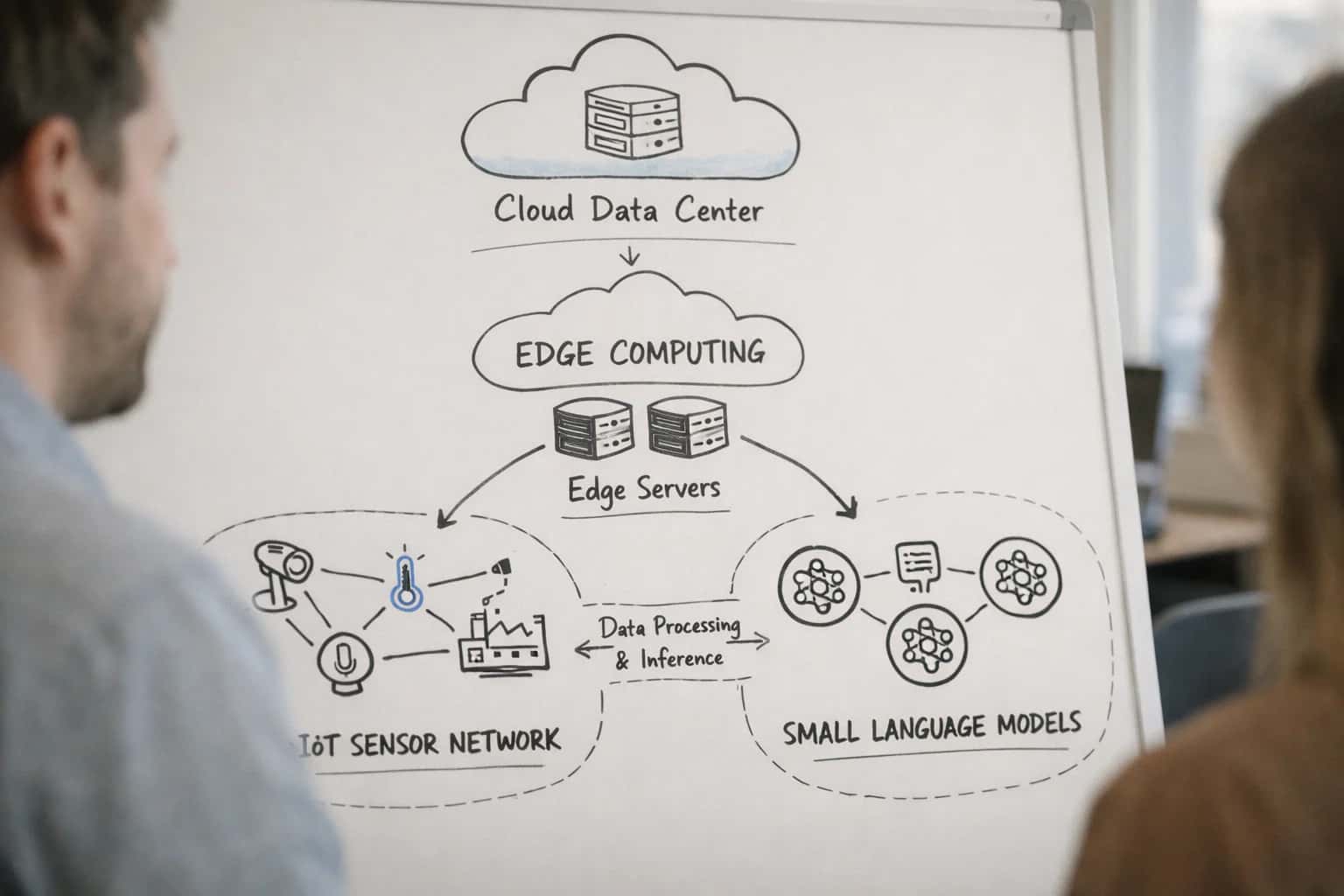
This guide explains the core algorithms and systems for automatically deciding where to run an AI inference job across a distributed grid of edge sites, cloud, and devices.
Implementing a placement engine requires a systematic approach. First, instrument your edge nodes to collect real-time metrics on GPU utilization, memory, and network latency. Next, define your placement policies as declarative rules, such as 'minimize latency for video streams' or 'prioritize cost for batch processing.' Finally, integrate these policies with your orchestration layer to make dynamic scheduling decisions. This guide provides the practical steps to build this system, ensuring your distributed inference infrastructure is both efficient and resilient. For foundational concepts, see our guide on How to Architect a Geo-Distributed AI Inference Network.
FOUNDATIONAL KNOWLEDGE
Key Concepts for AI Workload Placement
Master the core principles and systems that automate the critical decision of where to run an AI inference job—on a device, edge server, or cloud—based on real-time constraints.
01
Placement Engine Core Logic
A placement engine is the decision-making brain that evaluates multiple constraints to select the optimal compute target. Key inputs include:
- Latency SLOs: The maximum acceptable response time for the application.
- Data Gravity: The cost of moving data versus moving compute; favors placing workloads near the data source.
- Resource Availability: Real-time telemetry on GPU/CPU, memory, and network bandwidth at candidate nodes.
- Operational Cost: The financial cost of execution on different infrastructure tiers (device, edge, cloud).
The engine scores each potential target using a weighted policy, often implemented as a scheduler extender for Kubernetes.
02
Kubernetes Scheduler Integration
For cloud-native edge AI, workload placement integrates directly with the Kubernetes scheduler. Instead of building a standalone orchestrator, you extend the native scheduler using:
- Scheduler Extenders: Custom webhooks that filter and prioritize nodes based on AI-specific constraints.
- Custom Schedulers: Dedicated schedulers like Kueue (for job queueing and fair sharing) or Volcano (for batch and high-performance workloads) that offer advanced placement policies.
- Node Feature Discovery: Tools that automatically label nodes with hardware capabilities (e.g.,
accelerator: nvidia-t4) for hardware-aware scheduling.
This approach leverages the existing Kubernetes ecosystem for deployment, health checking, and lifecycle management.
03
Real-Time Telemetry Collection
Accurate placement requires a live view of your distributed grid. You must collect and expose metrics from edge nodes, including:
- Hardware Utilization: GPU memory, compute load, and power draw.
- Network Conditions: Latency to data sources and dependent services, available bandwidth.
- Model Performance: Inference latency and throughput per node-model pair.
Implement this using agents (e.g., Prometheus Node Exporter) and push metrics to a time-series database. The placement engine queries this data via a low-latency API to make informed decisions.
04
Constraint & Policy Definition
Placement is governed by declarative policies attached to AI workloads. A typical InferenceService CRD might include:
yamlconstraints: maxLatency: "100ms" preferredLocation: "edge-zone-a" requiredHardware: "nvidia-gpu" costPolicy: "minimize-latency"
Common policy types are:
- Latency Minimization: For real-time applications like video analytics.
- Cost Optimization: For batch processing where deadlines are flexible.
- Data Locality: For bandwidth-heavy inputs like raw sensor streams. Policies are evaluated by the engine, and violations trigger re-scheduling or alerts.
05
Fallback & Resilience Patterns
Edge environments are unstable. Your placement strategy must include failure handling:
- Fallback Targets: Define an ordered list of compute locations (e.g., on-prem edge -> regional cloud -> central cloud).
- Health Checks & Eviction: Continuously monitor node health. Evict pods from unhealthy nodes and re-place them elsewhere.
- State Management: For stateful inference services, use leader election and persistent volumes to enable failover without data loss.
- Circuit Breakers: Prevent cascading failures by stopping requests to a failing node after a threshold of errors. These patterns ensure your AI grid remains operational despite node outages or network partitions.
06
Tools & Reference Architectures
Implement placement using proven open-source tools and patterns:
- Orchestration: Kubernetes with Karmada for multi-cluster management.
- Scheduling: Kueue for quota management, Volcano for batch scheduling.
- Telemetry: Prometheus for metrics, OpenTelemetry for traces.
- Service Mesh: Istio or Linkerd for advanced traffic routing and failover between locations.
- Reference Architectures: Study designs like AI-RAN for telecom edge or NVIDIA Fleet Command for managed edge AI. These provide blueprints for integrating placement logic into a larger distributed system.
FOUNDATION
Step 1: Design the Placement Engine Architecture
The placement engine is the core decision-making system that determines where to execute each AI inference job across your distributed edge grid. This step defines its components and data flows.
A placement engine evaluates incoming inference requests against a real-time view of your edge infrastructure. Its architecture consists of three core components: a constraint evaluator that checks requirements like latency and data gravity, a cost optimizer that balances performance with operational spend, and a scheduler integration layer that enforces decisions on platforms like Kubernetes. The engine consumes telemetry from edge nodes—GPU utilization, network latency, and model availability—to make optimal placement decisions. For foundational concepts, see our guide on Edge Inference and Distributed Computing Grids.
Start by defining the decision algorithm. A common approach is a two-stage process: first, filter all possible edge sites using hard constraints (e.g., model must be within 50ms). Second, score the remaining candidates using a weighted cost function. Implement this logic as a standalone microservice, not embedded in your scheduler. It must expose a simple API (e.g., /place) that accepts a workload spec and returns a target location. Integrate this service with your orchestration layer, such as a custom Kubernetes scheduler or a policy engine like Kueue, to automate deployment.
CORE ALGORITHMS
Placement Strategy Comparison
Comparison of three fundamental strategies for deciding where to execute an AI inference job across a distributed edge network.
| Decision Factor | Latency-First | Cost-Optimized | Data Gravity-Aware |
|---|---|---|---|
Primary Objective | Minimize end-to-end response time | Minimize infrastructure & data transfer cost | Minimize data movement and preserve locality |
Optimal For | Real-time video analytics, AR/VR | Batch processing, non-critical reports | GDPR-sensitive data, bandwidth-constrained sites |
Key Metric | P95 latency < 100ms | Cost per inference < $0.001 | Data egress volume < 1 GB/day |
Typical Placement | Closest edge node with GPU | Cheapest available zone (cloud/edge) | Edge site where raw data is generated |
Model Synchronization | High-frequency updates for latest models | Lazy updates during off-peak hours | On-demand updates triggered by data changes |
Fallback Behavior | Failover to next nearest edge | Failover to pre-warmed cloud instance | Queue requests locally until connectivity resumes |
Integration Complexity | Requires real-time node telemetry | Requires detailed cost APIs | Requires data lineage and residency tags |
Use with Kubernetes | Custom scheduler using node affinity | Kueue for quota and cost management | Volcano for batch scheduling with data locality |
VALIDATION
Step 5: Deploy and Test the End-to-End System
This final step validates your placement engine by deploying it into a realistic test environment and executing a full workflow to confirm it makes optimal decisions under real constraints.
Deploy your placement engine as a microservice integrated with your cluster scheduler, such as Kubernetes Kueue or Volcano. Use a staging environment that mirrors your production edge topology, including simulated nodes with varied resources and network latencies. Deploy a set of test inference workloads with defined Service Level Objectives (SLOs) for latency and cost. The engine should now autonomously evaluate each job's constraints against real-time telemetry from your simulated nodes to select a placement target.
Execute a comprehensive test suite that validates the engine's decisions. This includes: - Latency SLO Tests: Verify jobs are placed to meet sub-100ms targets. - Cost-Boundary Tests: Ensure budget constraints are respected. - Failure Scenarios: Simulate node failures to test re-scheduling logic. Monitor the system with dashboards to track placement accuracy and resource utilization, confirming the engine's decisions align with your defined policies before promoting to production. For related concepts, see our guide on How to Architect a Geo-Distributed AI Inference Network.
Enabling Efficiency, Speed & Accuracy
Intelligent Analysis, Decision & Execution
We build AI systems for teams that need search across company data, workflow automation across tools, or AI features inside products and internal software.
Talk to Us
Search across company data
Give teams answers from docs, tickets, runbooks, and product data with sources and permissions.
Useful when people spend too long searching or get different answers from different systems.
Enterprise searchRAGPermissions
Read more
Automate internal workflows
Use AI to route work, draft outputs, trigger actions, and keep approvals and logs in place.
Useful when repetitive work moves across multiple tools and teams.
AI agentsWorkflow automationGovernance
Read more
Add AI to products and internal tools
Build assistants, guided actions, or decision support into the software your team or customers already use.
Useful when AI needs to be part of the product, not a separate tool.
AI integrationDecision supportModel routing
Read moreAI WORKLOAD PLACEMENT
Common Mistakes
Automating where to run an AI inference job is critical for edge performance and cost. These are the most frequent technical pitfalls developers encounter when building their placement engine.
AI workload placement is the automated decision of where to execute an inference task—on a device, edge server, regional cloud, or central data center. It's hard because you must evaluate a dynamic set of multi-dimensional constraints in real-time:
- Latency SLOs: User-facing apps may require sub-100ms response.
- Data Gravity: Moving large data (e.g., video streams) is expensive; compute must follow data.
- Cost: Cloud GPU vs. edge CPU costs differ by orders of magnitude.
- Resource Availability: Edge nodes have limited, shared GPU memory and may be overloaded.
A naive placement that only considers one factor, like latency, will violate other constraints and increase operational costs. For a foundational understanding, see our guide on Edge Inference and Distributed Computing Grids.

About the author
Prasad Kumkar
CEO & MD, Inference Systems
Prasad Kumkar is the CEO & MD of Inference Systems and writes about AI systems architecture, LLM infrastructure, model serving, evaluation, and production deployment. Over 5+ years, he has worked across computer vision models, L5 autonomous vehicle systems, and LLM research, with a focus on taking complex AI ideas into real-world engineering systems.
His work and writing cover AI systems, large language models, AI agents, multimodal systems, autonomous systems, inference optimization, RAG, evaluation, and production AI engineering.
LinkedIn
Limited slotsGet a Free AI Consultation
Partnered with leading AI, data, and software stack.





How We Work
Custom AI workflows for your Business
One-fit-all AI don't work for modern businesses. At Inferensys, we aim to understand your business & custom requirements; which we use to define most efficient agentic workflows, the data, and the tools for your business.
01
Review the use case
We understand the task, the users, and where AI can actually help.
Read more02
Pick the right approach
We define what needs search, automation, or product integration.
Read more03
Build the first useful version
We implement the part that proves the value first.
Read more04
Improve from there
We add the checks and visibility needed to keep it useful.
Read moreThe first call is a practical review of your use case and the right next step.
Talk to Us