A hybrid cloud-edge AI deployment strategically splits inference workloads between local vehicle hardware and centralized cloud resources. Latency-critical tasks like object detection and collision avoidance run on edge devices (e.g., zonal controllers) for immediate response. Complex, non-time-sensitive tasks like model retraining, long-term anomaly detection, and fleet-wide analytics are offloaded to the cloud, leveraging its vast compute and storage. This architecture is foundational for software-defined vehicles transitioning to zonal E/E architectures.

Guide
How to Architect a Hybrid Cloud-Edge AI Deployment for Sensing
A technical guide to strategically splitting AI inference between vehicle-edge devices and the cloud for context-aware automotive sensing. Includes workload partitioning criteria, communication protocol design, and system topology management.
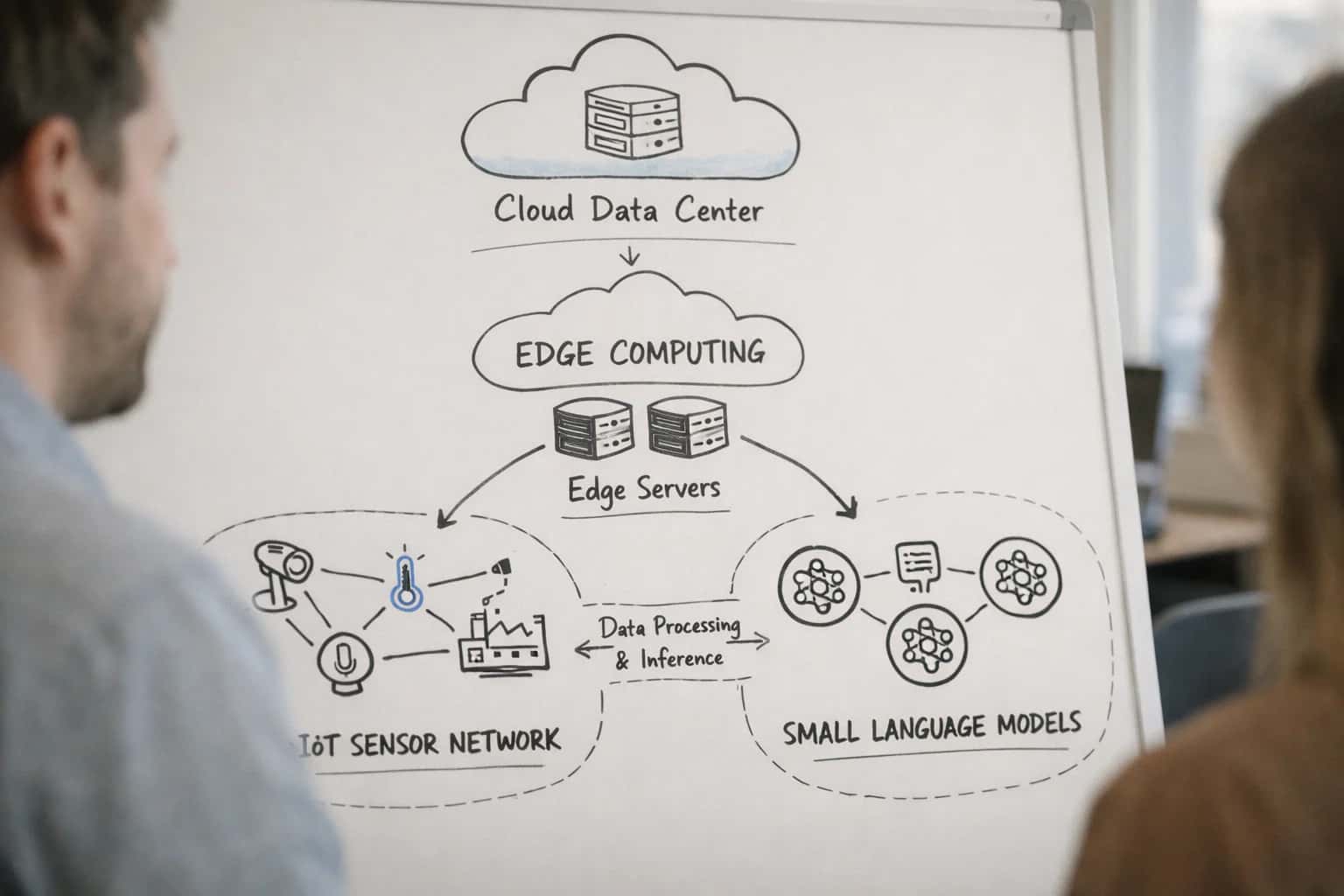
This guide explains the strategic partitioning of AI workloads between vehicle-edge devices and the cloud to balance performance, cost, and capability for automotive sensing.
Architecting this system requires clear workload partitioning criteria based on latency, bandwidth, data privacy, and compute requirements. You must design a robust communication protocol for over-the-air (OTA) model updates and data syncing. Finally, implement a system topology with failover mechanisms, ensuring the edge can operate with degraded functionality if cloud connectivity is lost. This approach directly enables the robust systems described in guides on How to Design a Real-Time Sensor Fusion Pipeline for Vehicle Safety and How to Architect a Fail-Operational AI Sensing System.
FOUNDATIONAL PATTERNS
Key Architectural Concepts
Master the core design patterns for splitting AI workloads between vehicle-edge devices and centralized cloud resources. These concepts balance latency, bandwidth, cost, and capability.
01
Workload Partitioning Strategy
The first decision is where to run inference. Partition workloads based on latency, connectivity, and data sensitivity.
- Edge (Zonal/ECU): Run models for real-time reaction (<100ms). Examples: obstacle detection, emergency braking triggers.
- Cloud: Run models for complex, non-latency-sensitive tasks. Examples: long-term trajectory prediction, fleet-wide model retraining.
- Hybrid: Use edge for initial inference and cloud for validation or refinement. This pattern, often called edge-cloud collaboration, sends compressed features or low-confidence results to the cloud for a second opinion.
02
Data Synchronization & Model Update Protocol
A hybrid system requires a robust protocol for syncing data and deploying new models. Design for intermittent connectivity and bandwidth constraints.
- Delta Updates: Transmit only model parameter differences, not full weights.
- Federated Learning: Aggregate learnings from edge devices to update a central model without sharing raw data, crucial for privacy.
- Conditional Sync: Use rules (e.g., 'sync only when on Wi-Fi' or 'when battery >50%') to manage resource consumption. This protocol is the backbone of a Closed-Loop Learning System for Sensor AI.
03
Latency-Aware Topology Design
Map the physical and logical flow of data and commands. The topology defines performance ceilings.
- Star Topology: Edge devices connect directly to the cloud. Simple but vulnerable to connectivity loss.
- Hierarchical Topology: Edge devices report to a gateway (e.g., a central vehicle computer), which aggregates and communicates with the cloud. This reduces cloud connection points.
- Mesh Topology: Edge devices can communicate peer-to-peer. Enables functionality even if the cloud link is broken, supporting fail-operational requirements.
04
Context-Aware Offloading
Dynamically decide where to process data based on real-time context. This maximizes system efficiency.
- Input-Based: Offload complex sensor fusion (e.g., correlating camera and LiDAR) to the cloud only when raw data volume is low.
- Resource-Based: Offload tasks from a busy zonal controller to a neighboring zone or the cloud.
- Connectivity-Based: Cache cloud-bound data when in a tunnel and sync upon reconnection. This intelligence is enabled by the context models built in a Context-Aware Sensing System.
05
State Management & Consistency
Maintain a coherent view of the vehicle's environment across edge and cloud. Eventual consistency is often sufficient.
- Optimistic Updates: The edge acts on its local state immediately; the cloud reconciles asynchronously.
- Conflict Resolution: Define rules for when edge and cloud interpretations differ (e.g., cloud overrides edge only for non-safety-critical predictions).
- State Vectors: Share compact representations of the vehicle's perceived world (object lists, occupancy grids) rather than raw sensor streams.
06
Security & Trust Boundary Enforcement
The hybrid model expands the attack surface. Security must be designed in, not bolted on.
- Zero-Trust Between Zones: Authenticate and encrypt all inter-zonal and vehicle-to-cloud communication.
- Secure Boot & Attestation: Ensure only authorized, signed AI models can load on edge devices.
- Data Provenance: Tag all sensor data and inference results with origin and integrity metadata to detect tampering. This aligns with principles for Digital Provenance and Content Authenticity.
FOUNDATION
Step 1: Define and Classify AI Workloads
The first and most critical step in architecting a hybrid cloud-edge AI system is to rigorously categorize your sensing workloads. This classification directly dictates where each model runs, the required infrastructure, and the overall system cost and performance.
Begin by analyzing each AI inference task for its latency sensitivity, data privacy requirements, and computational complexity. Real-time perception tasks, like object detection from a camera feed for immediate collision avoidance, are latency-critical and must run at the vehicle edge. Conversely, non-real-time analytics, such as aggregating fleet-wide sensor data to train a new model for predicting signal degradation, are complexity-bound and belong in the cloud. This initial triage prevents costly architectural mistakes.
Next, classify workloads by their data gravity and update frequency. Models that process high-bandwidth, ephemeral sensor streams (e.g., LiDAR point clouds) have high data gravity, favoring edge processing to avoid network bottlenecks. Models requiring frequent updates based on centralized learning, like a multi-modal correlation engine improved with data from thousands of vehicles, are cloud-centric. This clear separation establishes the data flow and communication protocols needed for the hybrid system, linking directly to principles of Edge Inference and Distributed Computing Grids.
ARCHITECTURE PATTERNS
Hybrid Deployment Pattern Comparison
A comparison of core architectural patterns for partitioning AI workloads between vehicle-edge devices and the cloud in a sensing system.
| Feature | Edge-Only | Cloud-Offload | Hybrid Adaptive |
|---|---|---|---|
Primary Inference Location | On-vehicle compute | Central cloud | Dynamic (edge/cloud) |
Latency for Safety Loops | < 100 ms |
| < 100 ms (edge), > 500 ms (cloud) |
Model Complexity Supported | Small SLMs / CNNs | Large VLMs / Transformers | Context-dependent |
Bandwidth Consumption | Minimal | High (raw data) | Moderate (features/updates) |
Offline Operation Capability | |||
System-Wide Learning | |||
Hardware Cost per Vehicle | High | Low | Medium |
Operational Complexity | Low | Medium | High |
Enabling Efficiency, Speed & Accuracy
Intelligent Analysis, Decision & Execution
We build AI systems for teams that need search across company data, workflow automation across tools, or AI features inside products and internal software.
Talk to Us
Search across company data
Give teams answers from docs, tickets, runbooks, and product data with sources and permissions.
Useful when people spend too long searching or get different answers from different systems.
Enterprise searchRAGPermissions
Read more
Automate internal workflows
Use AI to route work, draft outputs, trigger actions, and keep approvals and logs in place.
Useful when repetitive work moves across multiple tools and teams.
AI agentsWorkflow automationGovernance
Read more
Add AI to products and internal tools
Build assistants, guided actions, or decision support into the software your team or customers already use.
Useful when AI needs to be part of the product, not a separate tool.
AI integrationDecision supportModel routing
Read moreTROUBLESHOOTING
Common Mistakes
Architecting a hybrid cloud-edge AI system for automotive sensing is complex. These are the most frequent technical pitfalls developers encounter and how to fix them.
High latency at the edge is often caused by model bloat and inefficient data flow. Developers frequently deploy models that are too large for the target hardware's memory or compute constraints.
Fix:
- Profile your model on the target hardware (e.g., using TensorFlow Lite Micro's benchmark tool).
- Apply aggressive quantization (INT8 or FP16) and pruning to shrink the model.
- Design a staged pipeline: Run a tiny, ultra-fast model on the edge for immediate reaction (e.g., obstacle detection), and only send pre-processed data or uncertain cases to a larger cloud model for complex reasoning. Ensure your data serialization (e.g., Protocol Buffers) is lean.

About the author
Prasad Kumkar
CEO & MD, Inference Systems
Prasad Kumkar is the CEO & MD of Inference Systems and writes about AI systems architecture, LLM infrastructure, model serving, evaluation, and production deployment. Over 5+ years, he has worked across computer vision models, L5 autonomous vehicle systems, and LLM research, with a focus on taking complex AI ideas into real-world engineering systems.
His work and writing cover AI systems, large language models, AI agents, multimodal systems, autonomous systems, inference optimization, RAG, evaluation, and production AI engineering.
LinkedIn
Limited slotsGet a Free AI Consultation
Partnered with leading AI, data, and software stack.





How We Work
Custom AI workflows for your Business
One-fit-all AI don't work for modern businesses. At Inferensys, we aim to understand your business & custom requirements; which we use to define most efficient agentic workflows, the data, and the tools for your business.
01
Review the use case
We understand the task, the users, and where AI can actually help.
Read more02
Pick the right approach
We define what needs search, automation, or product integration.
Read more03
Build the first useful version
We implement the part that proves the value first.
Read more04
Improve from there
We add the checks and visibility needed to keep it useful.
Read moreThe first call is a practical review of your use case and the right next step.
Talk to Us