A natural language interface transforms how operators interact with collaborative robots by replacing complex programming with intuitive speech or text commands. This is achieved by fine-tuning a Small Language Model (SLM) like Llama 3 or Phi-3 on a domain-specific vocabulary of tasks, tools, and locations. The SLM acts as an intent parser, converting a command like "pick up the red bolt from bin three" into structured data that can be mapped to precise robot motion commands via a secure API. This foundational step bridges human instruction and machine execution.

Guide
How to Implement a Natural Language Interface for Cobot Command and Control
A technical guide to building a voice and text interface for collaborative robots using fine-tuned small language models (SLMs), speech-to-text services, and secure command APIs.
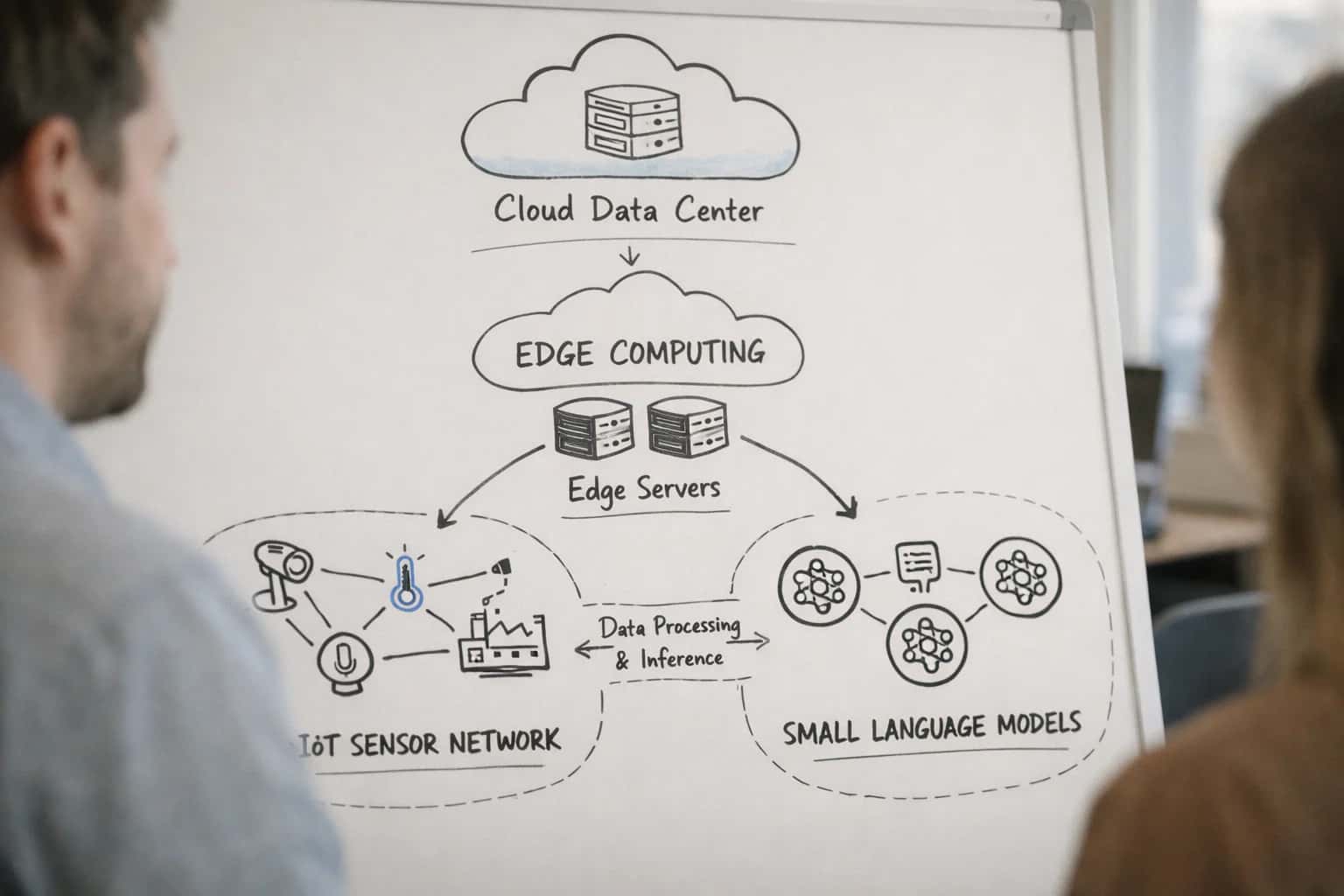
This guide details integrating a small language model (SLM) to enable voice and text-based cobot control, reducing training time and making robots more accessible to operators.
Implementation requires a three-part pipeline: a speech-to-text service (e.g., Azure Speech) for voice input, the fine-tuned SLM for intent classification, and a command mapping layer that translates intents into low-level robot API calls. Key steps include collecting and annotating operator phrases for fine-tuning, designing a robust fallback protocol for ambiguous commands, and integrating with existing safety systems. For a complete operational strategy, see our guide on How to Architect a Cobot Integration Strategy for Legacy Manufacturing Systems.
MODEL SELECTION
Small Language Model (SLM) Comparison for Cobot Interfaces
This table compares key technical and operational criteria for selecting a fine-tuned SLM to power a natural language interface for collaborative robots.
| Feature / Metric | Meta Llama 3.1 8B Instruct | Microsoft Phi-3-mini | Google Gemma 2 2B |
|---|---|---|---|
Model Size (Parameters) | 8 Billion | 3.8 Billion | 2 Billion |
Recommended Minimum VRAM | 16 GB | 8 GB | 4 GB |
Fine-Tuning for Domain Commands | |||
Quantization Support (INT4/INT8) | |||
Inference Latency Target (< 1 sec) | 0.7 sec | < 0.5 sec | < 0.3 sec |
Function Calling / Tool Use | |||
Commercial Use License | |||
Integration with ROS 2 / MoveIt | Via Custom Adapter | Via Custom Adapter | Via Custom Adapter |
Enabling Efficiency, Speed & Accuracy
Intelligent Analysis, Decision & Execution
We build AI systems for teams that need search across company data, workflow automation across tools, or AI features inside products and internal software.
Talk to Us
Search across company data
Give teams answers from docs, tickets, runbooks, and product data with sources and permissions.
Useful when people spend too long searching or get different answers from different systems.
Enterprise searchRAGPermissions
Read more
Automate internal workflows
Use AI to route work, draft outputs, trigger actions, and keep approvals and logs in place.
Useful when repetitive work moves across multiple tools and teams.
AI agentsWorkflow automationGovernance
Read more
Add AI to products and internal tools
Build assistants, guided actions, or decision support into the software your team or customers already use.
Useful when AI needs to be part of the product, not a separate tool.
AI integrationDecision supportModel routing
Read moreNATURAL LANGUAGE INTERFACE
Common Mistakes
Implementing a natural language interface for cobots is a powerful way to reduce operator training time. However, developers often stumble on the same critical issues, from intent mapping to safety. This section addresses the most frequent technical pitfalls and their solutions.
This is typically a data quality and grounding problem. Fine-tuning a Small Language Model (SLM) on generic conversational data without strict domain constraints leads to hallucinations.
Solution:
- Create a constrained grammar: Define a formal grammar (e.g., using a parser like Lark) that represents all valid commands (e.g.,
move_arm_to <named_position>,gripper <open|close>,speed <percentage>). - Use the SLM for intent classification, not command generation: Train the SLM to classify the user's utterance into a predefined intent and extract parameters (like
position="bin_a"), then use deterministic code to map this to the exact robot motion command. This pattern is central to building reliable Agentic Retrieval-Augmented Generation (RAG) systems. - Fine-tune with adversarial examples: Include examples of unsafe commands in your training data with labels that reject the command or request clarification.

About the author
Prasad Kumkar
CEO & MD, Inference Systems
Prasad Kumkar is the CEO & MD of Inference Systems and writes about AI systems architecture, LLM infrastructure, model serving, evaluation, and production deployment. Over 5+ years, he has worked across computer vision models, L5 autonomous vehicle systems, and LLM research, with a focus on taking complex AI ideas into real-world engineering systems.
His work and writing cover AI systems, large language models, AI agents, multimodal systems, autonomous systems, inference optimization, RAG, evaluation, and production AI engineering.
LinkedIn
Limited slotsGet a Free AI Consultation
Partnered with leading AI, data, and software stack.





How We Work
Custom AI workflows for your Business
One-fit-all AI don't work for modern businesses. At Inferensys, we aim to understand your business & custom requirements; which we use to define most efficient agentic workflows, the data, and the tools for your business.
01
Review the use case
We understand the task, the users, and where AI can actually help.
Read more02
Pick the right approach
We define what needs search, automation, or product integration.
Read more03
Build the first useful version
We implement the part that proves the value first.
Read more04
Improve from there
We add the checks and visibility needed to keep it useful.
Read moreThe first call is a practical review of your use case and the right next step.
Talk to Us