
Guides
Autonomous Drone Navigation and Fleet Coordination

Autonomous Drone Navigation and Fleet Coordination
This pillar focuses on the AI needed for drones to perceive, plan, and act autonomously in complex environments, as well as the coordination of multiple drones for logistics or surveillance. Guides cover 'How to build collision avoidance systems for autonomous drones,' 'Implementing swarm intelligence for fleet coordination,' and 'Using AI for real-time drone-based infrastructure monitoring' for utilities and defense.
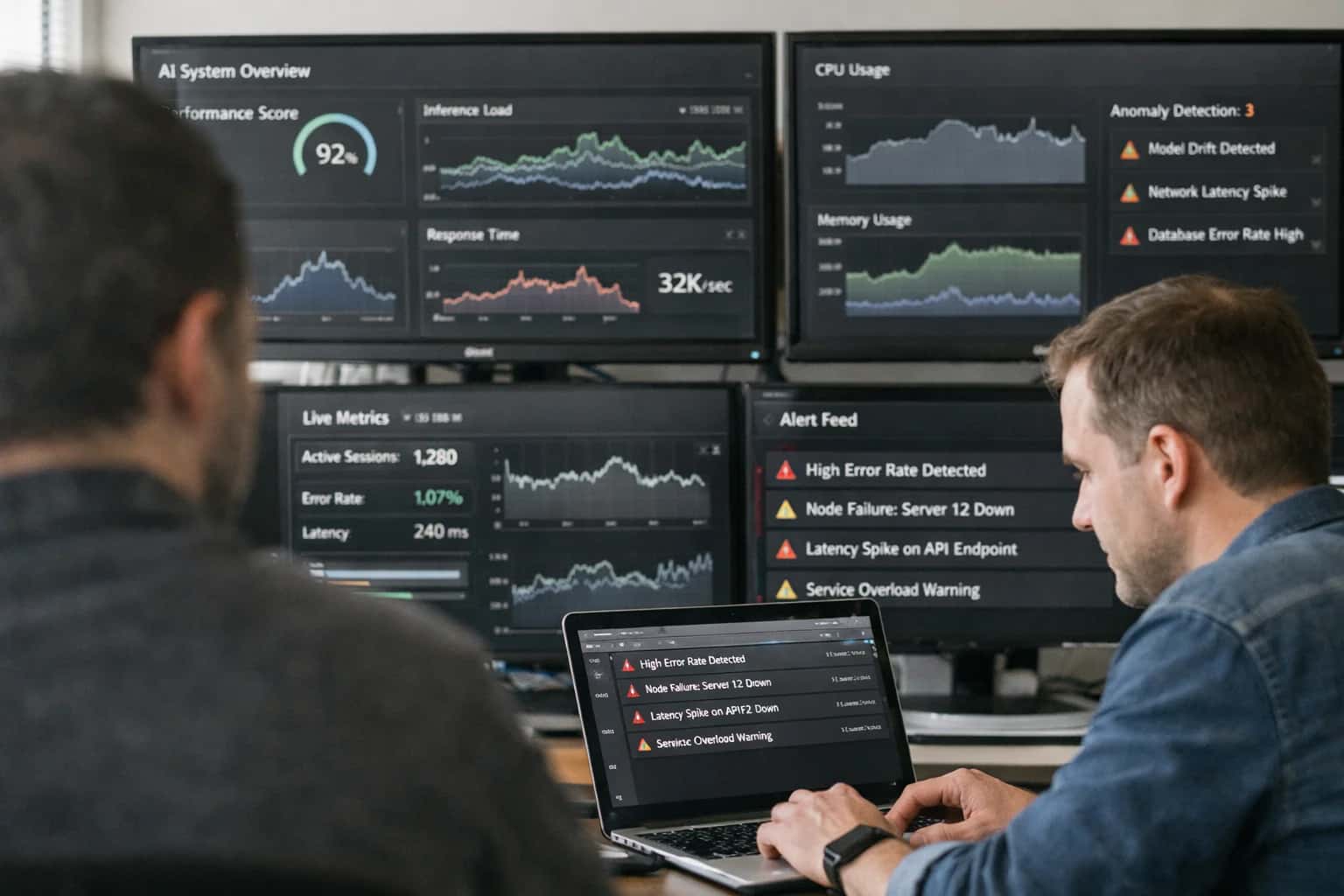
How to Architect a Real-Time Drone Perception System
This guide covers the system design for fusing data from cameras, LiDAR, and IMU sensors into a unified world model for autonomous drones. You'll learn to implement sensor fusion algorithms like Kalman filters, manage latency for real-time decision-making, and structure the perception pipeline using ROS 2 and NVIDIA Isaac Sim. The architecture is critical for enabling reliable obstacle detection and environmental understanding in dynamic conditions.
Setting Up an AI-Powered Collision Avoidance Framework
This guide explains how to implement a multi-layered collision avoidance system using AI models like YOLO for object detection and reinforcement learning for dynamic path adjustment. You'll integrate this framework with a drone's flight controller using PX4 or ArduPilot, set safety margins, and test scenarios in simulation environments like AirSim. The result is a robust system that prevents mid-air and ground collisions during autonomous missions.
Launching a Drone Fleet Coordination Platform
This guide provides a blueprint for building a central platform to manage multiple autonomous drones as a unified fleet. You'll design APIs for mission dispatch, implement real-time telemetry dashboards with tools like Grafana, and establish communication backbones using MQTT or DDS. The platform ensures scalable command and control for applications like delivery networks or large-scale surveillance.
How to Design a Swarm Intelligence System for Logistics
This guide details the implementation of decentralized swarm algorithms, such as ant colony optimization or flocking rules (Boids), for coordinating drone fleets in logistics. You'll learn to encode mission objectives, enable emergent cooperative behaviors without a central leader, and simulate swarm performance using NetLogo or custom Python scripts. This system optimizes package delivery routes and load distribution across a dynamic fleet.
Setting Up Multi-Drone Communication Protocols
This guide walks through implementing robust, low-latency communication protocols for drone-to-drone and drone-to-ground coordination. You'll evaluate technologies like MAVLink, LTE/5G mesh networks, and LoRa for different range requirements, and implement handshake and data relay mechanisms. Reliable communication is foundational for any collaborative fleet operation and is a key component of a larger [Multi-Agent System (MAS) Orchestration](/multi-agent-system-mas-orchestration) strategy.
How to Build a Sensor Fusion Pipeline for Drone Navigation
This guide provides a hands-on tutorial for creating a pipeline that combines visual, inertial, and positional data. You'll use libraries like OpenCV and GTSAM to implement Visual-Inertial Odometry (VIO) and tightly-coupled GPS fusion, reducing drift for accurate localization. The pipeline is the core of a reliable [redundant navigation system](/autonomous-drone-navigation-and-fleet-coordination) needed for safety-critical BVLOS flights.
Setting Up a Geofencing and Compliance System for Drones
This guide explains how to programmatically enforce flight boundaries and regulatory rules. You'll integrate with airspace data services like AirMap, implement geofence validation in the flight stack, and create audit logs for compliance reporting. This system is essential for operating legally in controlled airspace and near sensitive infrastructure.
How to Implement Path Planning Algorithms for Complex Environments
This guide compares and implements path planning algorithms like A*, RRT*, and trajectory optimization for drones navigating urban canyons or dense forests. You'll learn to factor in dynamic obstacles, weather constraints, and vehicle kinematics to generate safe, efficient 4D trajectories. This is a prerequisite for autonomous missions in non-GPS-denied but cluttered environments.
Setting Up a Fail-Safe System for Autonomous Drone Operations
This guide details the architecture for a multi-tiered fail-safe system, including heartbeat monitoring, battery failover procedures, and automated Return-to-Home (RTH) triggers. You'll implement watchdog timers, define severity-level-based responses, and integrate with a [Human-in-the-Loop (HITL) Governance System](/human-in-the-loop-hitl-governance-systems) for critical override protocols. This system ensures operational safety when drones encounter unexpected failures.
Launching a BVLOS (Beyond Visual Line of Sight) Drone Program
This strategic guide outlines the end-to-end process for legally and technically enabling BVLOS operations. It covers obtaining regulatory waivers, designing redundant communication links with LTE/5G, implementing advanced detect-and-avoid systems, and establishing operational procedures. This program unlocks the full potential of autonomous drones for long-range inspection and delivery.
How to Architect a Low-Latency Communication Network for Swarm Coordination
This guide focuses on designing a physical and network layer architecture to support high-frequency state synchronization within a drone swarm. You'll evaluate ad-hoc WiFi, custom RF solutions, and time-synchronized protocols, minimizing latency to enable tight formation flying and real-time collaborative tasks. This network is the nervous system for any advanced swarm intelligence application.
Setting Up an Edge AI Inference Pipeline for Real-Time Drone Decisions
This guide explains how to deploy and optimize AI models (e.g., for object detection) directly on a drone's onboard computer like an NVIDIA Jetson. You'll cover model conversion with TensorRT or ONNX Runtime, managing power and thermal constraints, and streaming only essential insights to the cloud. This [Edge Inference](/edge-inference-and-distributed-computing-grids) approach is critical for autonomy when connectivity is unreliable.
How to Build a Vision-Based Landing System for Precision
This guide provides a step-by-step method for creating a system that uses computer vision to identify and align with a landing target. You'll implement AprilTag or ArUco marker detection, estimate pose with OpenCV, and create a control loop that guides the drone to a precise touchdown point, even on moving platforms. This is essential for automated docking in delivery and charging scenarios.
Setting Up a Simulation Environment for Drone AI Training
This guide shows how to use simulators like Gazebo, AirSim, or NVIDIA Isaac Sim to generate synthetic training data and safely test autonomous behaviors. You'll configure physics engines, script complex scenarios, and integrate the simulation with reinforcement learning frameworks like RLlib. This environment is indispensable for training and validating AI models without physical risk.
Launching a Continuous Learning Pipeline for Drone Perception Models
This guide outlines an MLOps pipeline to continuously improve a drone's vision models using data collected from real-world flights. You'll set up automated data labeling with tools like Scale AI, implement model retraining triggers, and manage A/B testing of new model versions in a controlled fleet subset. This pipeline ensures your drones adapt to new environments and object types over time, aligning with modern [MLOps for agentic systems](/mlops-and-model-lifecycle-management-for-agents) practices.
Partnered with leading AI, data, and software stack.
How We Work
Custom AI workflows for your Business
One-fit-all AI don't work for modern businesses. At Inferensys, we aim to understand your business & custom requirements; which we use to define most efficient agentic workflows, the data, and the tools for your business.
01
Review the use case
We understand the task, the users, and where AI can actually help.
Read more02
Pick the right approach
We define what needs search, automation, or product integration.
Read more03
Build the first useful version
We implement the part that proves the value first.
Read more04
Improve from there
We add the checks and visibility needed to keep it useful.
Read moreThe first call is a practical review of your use case and the right next step.
Talk to Us
