An ERP integration is the backbone that transforms an AI support agent from a conversational interface into an autonomous operator. It provides the real-time operational data—inventory levels, order status, financial records—required for the agent to make accurate decisions and execute backend actions. Without this integration, your ACSR system is limited to providing information, not resolution. This guide focuses on the first principles of building secure, reliable data pipelines using APIs and event streams.

Guide
Setting Up ERP Integration for Agentic Customer Support
A developer guide to architecting secure, real-time connections between autonomous customer support agents and enterprise ERP systems for end-to-end case resolution.
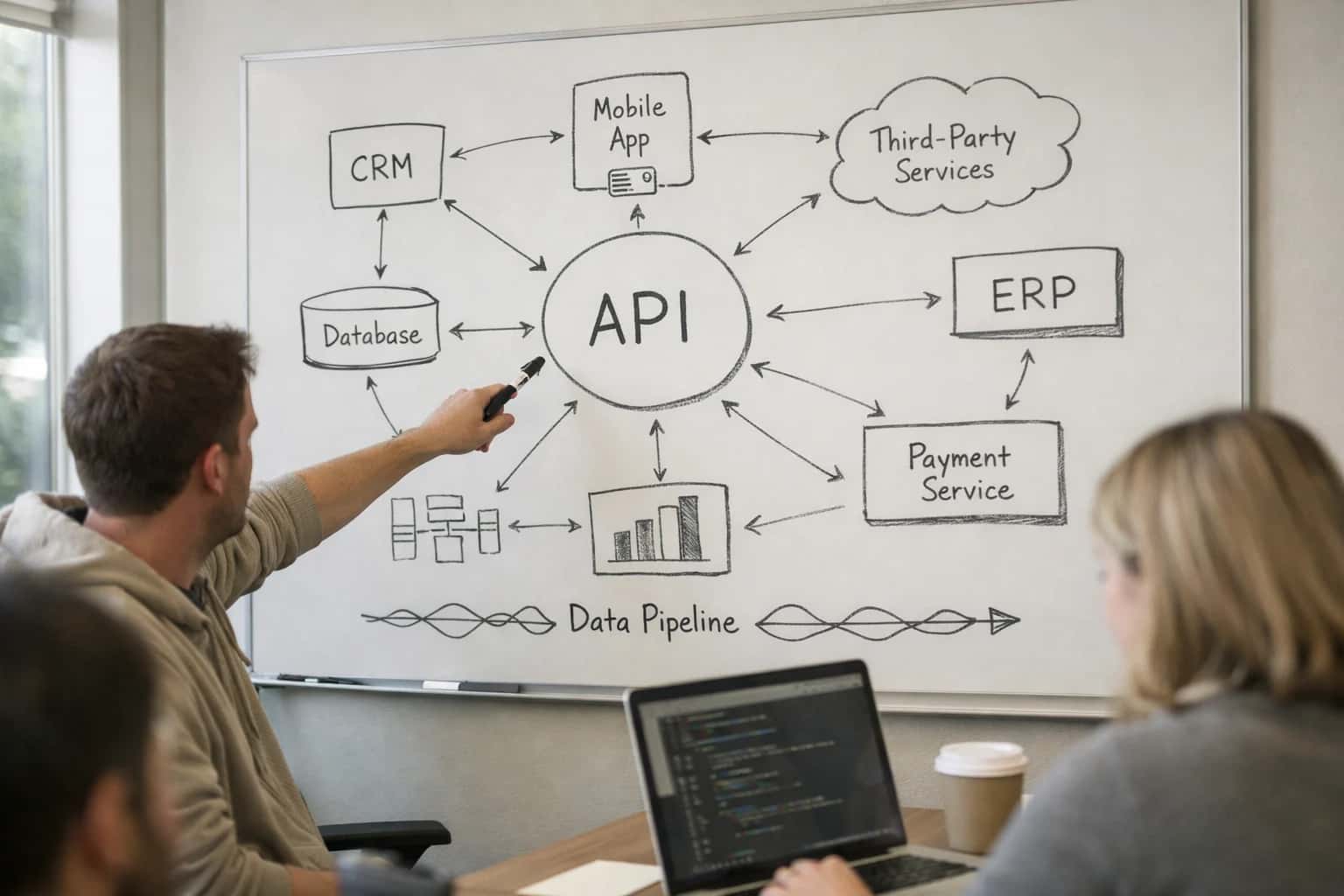
This guide explains how to connect your Autonomous Customer Support Resolution (ACSR) agent to enterprise resource planning systems like SAP or Oracle NetSuite. Learn to architect secure data pipelines that allow the agent to query inventory, validate order status, initiate shipments, and update financial records.
You will learn to design for idempotency to ensure actions like refunds or shipments are not duplicated, handle batch processes within an autonomous workflow, and implement robust error handling. We connect these concepts directly to practical steps, such as setting up authentication with OAuth 2.0, mapping data schemas, and building the action execution framework that allows your agent to act. This foundation is critical for guides on multi-step resolution flows and governance systems.
INTEGRATION ARCHITECTURE
ERP API Protocol Comparison
A comparison of common protocols for connecting AI agents to ERP systems like SAP and Oracle NetSuite, focusing on real-time data access for autonomous workflows.
| Feature / Metric | REST API | SOAP API | OData |
|---|---|---|---|
Primary Use Case | General-purpose CRUD operations | Structured, transactional processes | Standardized querying & data aggregation |
Data Format | JSON | XML | JSON or XML (Atom) |
Real-Time Capability | High (stateless requests) | Medium (stateful sessions possible) | High (built for querying live data) |
Idempotency Support | Native (HTTP PUT/DELETE) | Must be designed in payload | Native (via HTTP methods) |
Authentication Complexity | Low (OAuth 2.0, API keys) | High (WS-Security, certificates) | Medium (OAuth 2.0, service principals) |
Batch Operation Support | Limited (requires custom logic) | Strong (native in SOAP envelopes) | Strong (via $batch endpoint) |
Learning Curve for Agents | Low (simple HTTP semantics) | High (complex WSDL schemas) | Medium (standardized query syntax) |
Best For ACSR Agents | Simple reads & updates (inventory check) | Complex transactions (financial posting) | Exploratory queries (multi-table joins) |
Enabling Efficiency, Speed & Accuracy
Intelligent Analysis, Decision & Execution
We build AI systems for teams that need search across company data, workflow automation across tools, or AI features inside products and internal software.
Talk to Us
Search across company data
Give teams answers from docs, tickets, runbooks, and product data with sources and permissions.
Useful when people spend too long searching or get different answers from different systems.
Enterprise searchRAGPermissions
Read more
Automate internal workflows
Use AI to route work, draft outputs, trigger actions, and keep approvals and logs in place.
Useful when repetitive work moves across multiple tools and teams.
AI agentsWorkflow automationGovernance
Read more
Add AI to products and internal tools
Build assistants, guided actions, or decision support into the software your team or customers already use.
Useful when AI needs to be part of the product, not a separate tool.
AI integrationDecision supportModel routing
Read moreERP INTEGRATION
Common Mistakes
Connecting an autonomous AI agent to an ERP is a high-stakes integration. These are the most frequent technical pitfalls developers encounter and how to fix them.
This is a classic failure of idempotency. ERP APIs for actions like 'create shipment' or 'update order status' must be designed to handle duplicate calls safely.
The Fix: Implement idempotency keys. Generate a unique key (e.g., a UUID) for each distinct agent intent before calling the ERP. Send this key in an Idempotency-Key HTTP header. Your ERP integration layer must check this key and return the same result for duplicate requests without re-executing the business logic.
pythonimport uuid def create_erp_shipment(order_id, data): idempotency_key = str(uuid.uuid4()) headers = { 'Idempotency-Key': idempotency_key, 'Content-Type': 'application/json' } # Your API call here response = requests.post(ERP_URL, json=data, headers=headers) return response
Without this, network retries or agent re-planning can create duplicate financial transactions.

About the author
Prasad Kumkar
CEO & MD, Inference Systems
Prasad Kumkar is the CEO & MD of Inference Systems and writes about AI systems architecture, LLM infrastructure, model serving, evaluation, and production deployment. Over 5+ years, he has worked across computer vision models, L5 autonomous vehicle systems, and LLM research, with a focus on taking complex AI ideas into real-world engineering systems.
His work and writing cover AI systems, large language models, AI agents, multimodal systems, autonomous systems, inference optimization, RAG, evaluation, and production AI engineering.
LinkedIn
Limited slotsGet a Free AI Consultation
Partnered with leading AI, data, and software stack.





How We Work
Custom AI workflows for your Business
One-fit-all AI don't work for modern businesses. At Inferensys, we aim to understand your business & custom requirements; which we use to define most efficient agentic workflows, the data, and the tools for your business.
01
Review the use case
We understand the task, the users, and where AI can actually help.
Read more02
Pick the right approach
We define what needs search, automation, or product integration.
Read more03
Build the first useful version
We implement the part that proves the value first.
Read more04
Improve from there
We add the checks and visibility needed to keep it useful.
Read moreThe first call is a practical review of your use case and the right next step.
Talk to Us