Human-in-the-Loop (HITL) escalation is the critical safety mechanism that prevents autonomous agents from making costly errors. It moves beyond simple fallback by implementing a governance layer that monitors agent confidence and reasoning in real-time. You define confidence score thresholds for actions like issuing refunds or interpreting complex policies. When an agent's self-assessed certainty dips below this threshold, or its proposed action violates a predefined rule, the system triggers an immediate handoff to a human operator, freezing the autonomous workflow.

Guide
How to Implement Human-in-the-Loop Escalation for ACSR
A technical guide to building controlled oversight for autonomous customer support agents. Learn to set confidence thresholds, design real-time intervention triggers, and create seamless handoff workflows that transfer cases from AI to human agents with full context.
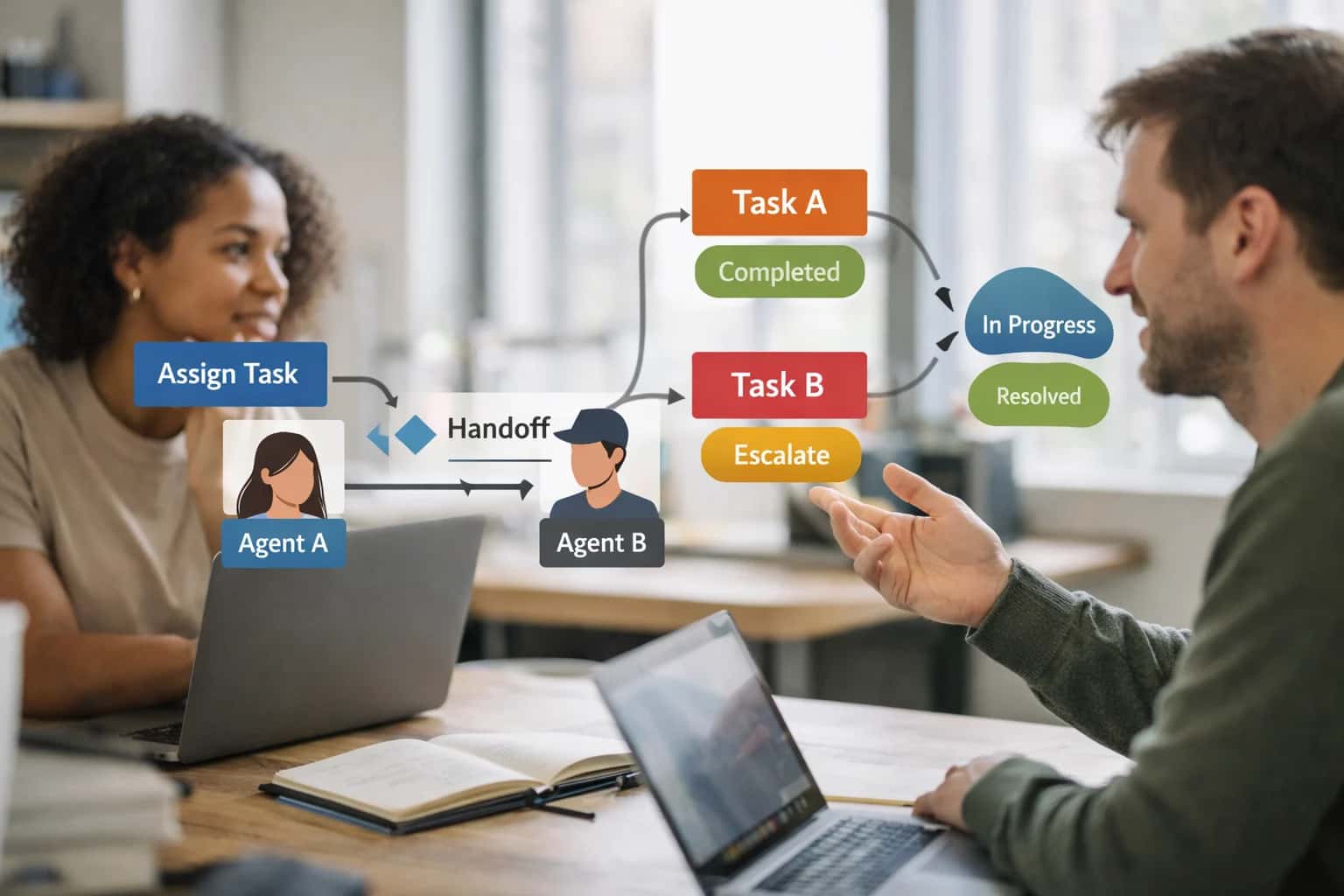
This guide details the technical implementation of Human-in-the-Loop (HITL) governance within an Autonomous Customer Support Resolution (ACSR) system.
The technical core is designing seamless handoff workflows. This involves capturing the agent's complete reasoning trace—its retrieved context, decision logic, and proposed action—and packaging it into a human-readable ticket within your CRM, like Salesforce Service Cloud. The handoff must be context-preserving, providing the human agent with all necessary information to resolve the case efficiently, ensuring no customer issue falls through the cracks and building trust in the autonomous system.
HITL GOVERNANCE
Escalation Trigger Matrix: When to Intervene
This matrix defines the specific conditions that should trigger a handoff from an autonomous AI agent to a human support specialist. Use it to configure your escalation logic.
| Trigger Condition | Low Risk (Monitor) | Medium Risk (Alert Human) | High Risk (Immediate Escalation) |
|---|---|---|---|
Confidence Score |
| 70% - 90% | < 70% |
Requested Action Sensitivity | FAQ / Informational | Standard Refund / Account Update | Large Refund / Policy Exception / Data Deletion |
Customer Sentiment Score | Neutral or Positive | Mildly Frustrated | Angry / Abusive / Threatening |
Policy Ambiguity Detected | |||
Number of Failed Retry Attempts | 0 | 1 |
|
Required System Integration | Internal KB / CRM Read | CRM Write / Basic API | ERP / Financial System / Legacy API |
Historical Escalation Rate for Intent | < 5% | 5% - 20% |
|
Regulatory or Compliance Flag |
Enabling Efficiency, Speed & Accuracy
Intelligent Analysis, Decision & Execution
We build AI systems for teams that need search across company data, workflow automation across tools, or AI features inside products and internal software.
Talk to Us
Search across company data
Give teams answers from docs, tickets, runbooks, and product data with sources and permissions.
Useful when people spend too long searching or get different answers from different systems.
Enterprise searchRAGPermissions
Read more
Automate internal workflows
Use AI to route work, draft outputs, trigger actions, and keep approvals and logs in place.
Useful when repetitive work moves across multiple tools and teams.
AI agentsWorkflow automationGovernance
Read more
Add AI to products and internal tools
Build assistants, guided actions, or decision support into the software your team or customers already use.
Useful when AI needs to be part of the product, not a separate tool.
AI integrationDecision supportModel routing
Read moreHITL ESCALATION
Common Mistakes
Implementing Human-in-the-Loop (HITL) escalation is critical for safe ACSR deployment, but developers often stumble on the same technical pitfalls. This section addresses the most frequent mistakes, from misconfigured triggers to broken handoff workflows.
This is almost always caused by poorly calibrated confidence score thresholds. Setting a single, arbitrary threshold (e.g., 0.8) ignores the varying risk and complexity of different intents.
How to fix it:
- Implement intent-specific thresholds. A password reset can have a high threshold (0.95), while a financial refund requires a lower one (0.7) to trigger early human review.
- Use multi-factor triggering. Don't rely on confidence alone. Combine it with:
- The presence of specific policy keywords (e.g., "legal," "dispute").
- The number of steps in the proposed resolution.
- Historical data on escalation rates for similar cases.
- Continuously A/B test and tune thresholds based on the escalation rate and first-contact resolution metrics.

About the author
Prasad Kumkar
CEO & MD, Inference Systems
Prasad Kumkar is the CEO & MD of Inference Systems and writes about AI systems architecture, LLM infrastructure, model serving, evaluation, and production deployment. Over 5+ years, he has worked across computer vision models, L5 autonomous vehicle systems, and LLM research, with a focus on taking complex AI ideas into real-world engineering systems.
His work and writing cover AI systems, large language models, AI agents, multimodal systems, autonomous systems, inference optimization, RAG, evaluation, and production AI engineering.
LinkedIn
Limited slotsGet a Free AI Consultation
Partnered with leading AI, data, and software stack.





How We Work
Custom AI workflows for your Business
One-fit-all AI don't work for modern businesses. At Inferensys, we aim to understand your business & custom requirements; which we use to define most efficient agentic workflows, the data, and the tools for your business.
01
Review the use case
We understand the task, the users, and where AI can actually help.
Read more02
Pick the right approach
We define what needs search, automation, or product integration.
Read more03
Build the first useful version
We implement the part that proves the value first.
Read more04
Improve from there
We add the checks and visibility needed to keep it useful.
Read moreThe first call is a practical review of your use case and the right next step.
Talk to Us