Building a sovereign AI talent strategy requires moving beyond generic recruitment to strategic alignment with national research and economic priorities. This involves analyzing government AI policy documents to identify critical skill gaps—such as in confidential computing or neuro-symbolic AI—and partnering with national universities to co-develop curricula that address them. Your goal is to create a talent pipeline that fuels both organizational innovation and national strategic autonomy, turning individual career growth into a competitive advantage for your country's AI ecosystem.

Guide
How to Build an AI Talent Strategy Aligned with National Goals
A technical guide for engineering leads and CTOs on developing an AI talent pipeline that supports national strategic autonomy, featuring actionable steps, code for tracking alignment, and frameworks for university partnerships.
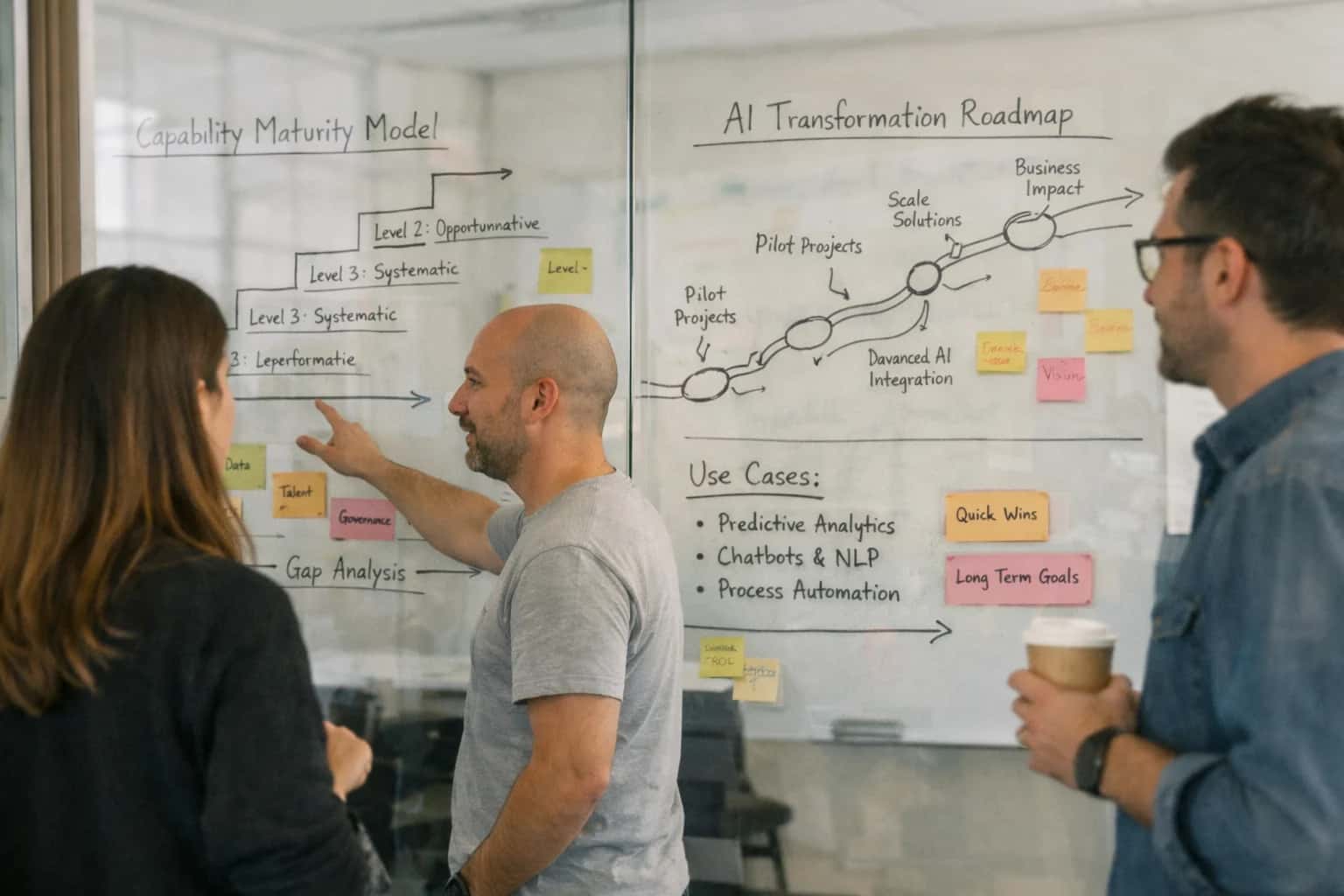
A practical guide for developing and retaining AI talent in competition with global tech giants, ensuring your workforce supports sovereign AI objectives.
Practical execution involves incentive structures that reward contributions to sovereign AI goals, such as publishing in national research consortia or developing open-source models like Llama. Leverage favorable immigration policies to attract global experts while implementing robust retention programs focused on mission-driven work. This dual focus on development and retention ensures you build a resilient, aligned workforce capable of executing complex projects like sovereign AI cloud architecture and navigating the geopolitical risks detailed in our guide on AI supply chain resilience.
STRATEGIC ALIGNMENT
Sovereign AI Talent Priority Matrix
Evaluates talent acquisition and development strategies against sovereign AI imperatives of strategic autonomy, economic value capture, and national security.
| Strategic Priority | Global Talent Acquisition | Domestic University Partnership | National Reskilling Initiative |
|---|---|---|---|
Alignment with National Research Priorities | |||
Speed to Operational Capability | |||
Long-term Talent Sovereignty | |||
Upfront Investment Cost | $200-500k per role | $50-150k partnership | $5-20k per trainee |
IP Retention & Control Risk | High (leakage risk) | Medium (shared IP) | Low (internal) |
Resilience to Geopolitical Shocks | Low (visa dependency) | Medium | High |
Economic Value Multiplier | 1x (individual) | 3-5x (ecosystem) | 10x+ (workforce) |
Time to Scale Critical Mass | < 12 months | 24-36 months | 36-60 months |
TALENT PIPELINE
Step 3: Design a Technical University Partnership Program
This step transforms national AI goals into a sustainable talent pipeline by co-designing university curricula and research programs.
A strategic partnership moves beyond simple recruitment to co-develop curriculum and joint research initiatives. This ensures graduates possess the precise skills—such as agentic RAG or neuro-symbolic AI—needed for sovereign priorities. Define clear learning objectives with faculty, sponsor capstone projects using real national datasets, and embed industry practitioners as guest lecturers to bridge academic theory with applied AI-native development.
Establish a structured governance model with quarterly reviews to align the program with evolving national strategy. Key deliverables include a modular course catalog, funded PhD positions in strategic areas like sovereign AI cloud architecture, and a shared digital twin lab for simulation. This creates a closed-loop system where academic research directly feeds into the national AI ecosystem, ensuring long-term resilience and reducing dependency on foreign talent.
Enabling Efficiency, Speed & Accuracy
Intelligent Analysis, Decision & Execution
We build AI systems for teams that need search across company data, workflow automation across tools, or AI features inside products and internal software.
Talk to Us
Search across company data
Give teams answers from docs, tickets, runbooks, and product data with sources and permissions.
Useful when people spend too long searching or get different answers from different systems.
Enterprise searchRAGPermissions
Read more
Automate internal workflows
Use AI to route work, draft outputs, trigger actions, and keep approvals and logs in place.
Useful when repetitive work moves across multiple tools and teams.
AI agentsWorkflow automationGovernance
Read more
Add AI to products and internal tools
Build assistants, guided actions, or decision support into the software your team or customers already use.
Useful when AI needs to be part of the product, not a separate tool.
AI integrationDecision supportModel routing
Read moreAI TALENT STRATEGY
Common Mistakes
Building an AI talent strategy aligned with national goals requires navigating unique pitfalls. Avoid these common errors that derail recruitment, retention, and strategic impact.
The most critical mistake is treating national AI goals as a vague, external concern rather than a core business driver. Alignment fails when talent initiatives are siloed in HR, disconnected from R&D and product roadmaps.
Strategic alignment requires directly mapping your hiring and upskilling plans to specific national priorities, such as sovereign AI cloud development or secure multi-agent systems. For example, if a national strategy emphasizes computational genomics, your talent plan must prioritize bioinformaticians and AI researchers skilled in omics data, not just generic ML engineers. Partner with government and academic bodies to co-design curricula and internship programs that feed directly into these strategic areas.

About the author
Prasad Kumkar
CEO & MD, Inference Systems
Prasad Kumkar is the CEO & MD of Inference Systems and writes about AI systems architecture, LLM infrastructure, model serving, evaluation, and production deployment. Over 5+ years, he has worked across computer vision models, L5 autonomous vehicle systems, and LLM research, with a focus on taking complex AI ideas into real-world engineering systems.
His work and writing cover AI systems, large language models, AI agents, multimodal systems, autonomous systems, inference optimization, RAG, evaluation, and production AI engineering.
LinkedIn
Limited slotsGet a Free AI Consultation
Partnered with leading AI, data, and software stack.





How We Work
Custom AI workflows for your Business
One-fit-all AI don't work for modern businesses. At Inferensys, we aim to understand your business & custom requirements; which we use to define most efficient agentic workflows, the data, and the tools for your business.
01
Review the use case
We understand the task, the users, and where AI can actually help.
Read more02
Pick the right approach
We define what needs search, automation, or product integration.
Read more03
Build the first useful version
We implement the part that proves the value first.
Read more04
Improve from there
We add the checks and visibility needed to keep it useful.
Read moreThe first call is a practical review of your use case and the right next step.
Talk to Us