An AIOps Center of Excellence (CoE) is a centralized team responsible for defining strategy, selecting technology, and governing the lifecycle of AI models used for IT operations. Its primary goal is to transition from reactive, manual processes to predictive and self-healing systems. The CoE establishes standards for key use cases like automated root-cause analysis, intelligent alert correlation, and predictive outage detection, ensuring initiatives align with business outcomes such as reduced MTTR and improved SLO adherence.

Guide
How to Build an AIOps Center of Excellence
A strategic, step-by-step guide for establishing a centralized team and framework to scale AIOps adoption across a large enterprise. Covers defining use cases, selecting technology stacks, building cross-functional skills, and creating governance models for model lifecycle management.
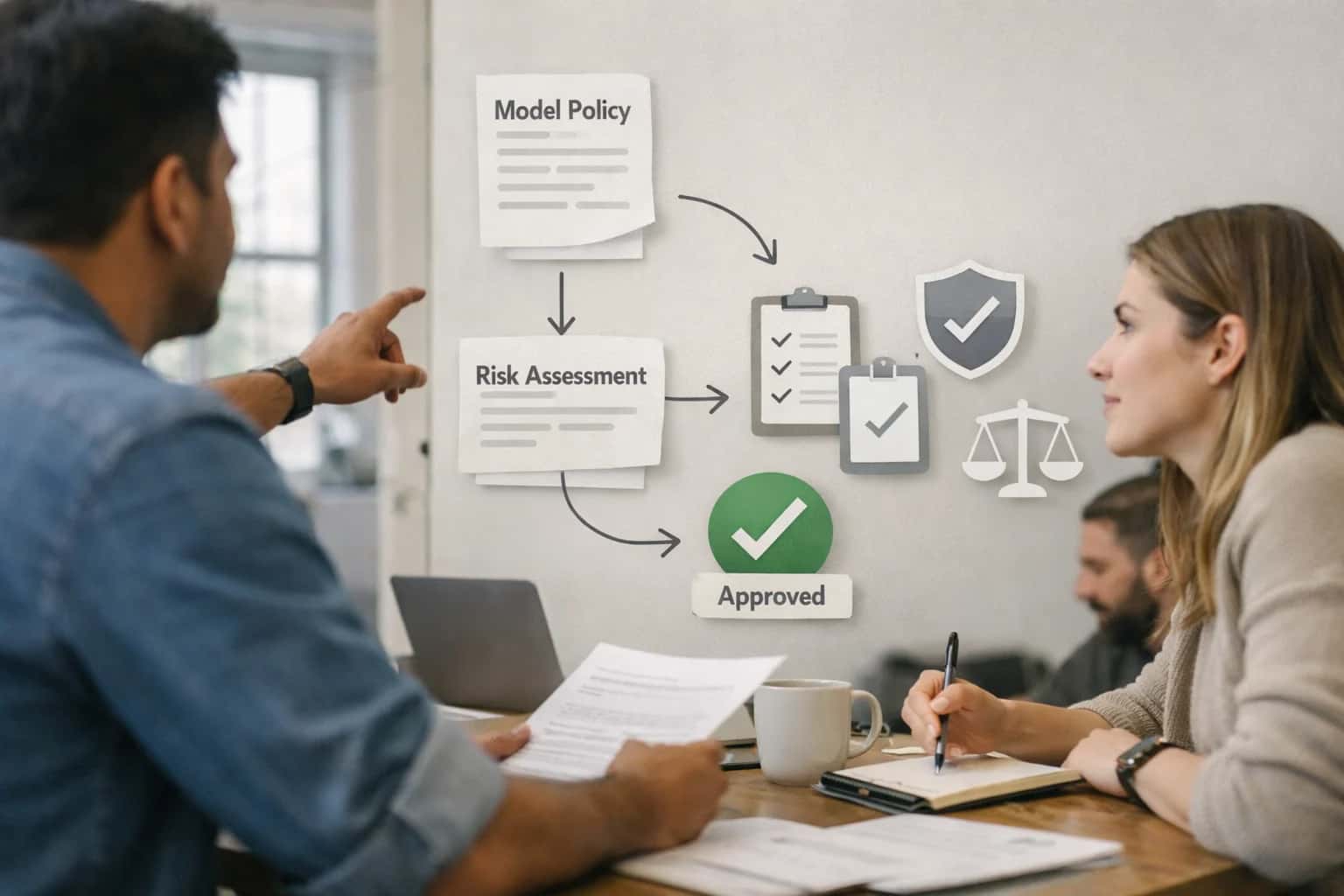
This guide provides a strategic framework for establishing a centralized team and governance model to scale AIOps adoption across your enterprise, ensuring consistent, measurable improvements in IT operations.
Building the CoE requires a cross-functional team with skills in data engineering, MLOps, and ITSM processes. Start by defining a clear charter, then select a core technology stack (e.g., Moogsoft, BigPanda, or open-source tools integrated with your observability platform). Implement a governance model for model lifecycle management, including monitoring for agent drift and establishing Human-in-the-Loop approval gates for high-risk automated actions. This creates a repeatable framework for scaling AIOps.
FOUNDATIONAL KNOWLEDGE
Key AIOps Concepts
Master the core technical concepts and architectural patterns required to build a successful AIOps Center of Excellence. These are the building blocks for self-healing IT systems.
04
Self-Healing Automation
The architectural pattern where systems autonomously detect, diagnose, and remediate faults. This is the ultimate goal of AIOps.
- Components: Combines RCA, alerting, and automated playbook execution. Requires a Human-in-the-Loop (HITL) Governance system for high-risk actions.
- Example: A Self-Healing CI/CD Pipeline uses AI to validate deployments and automatically roll back failures.
- Key Concept: Built on a foundation of MLOps for Agents to manage the lifecycle, monitoring, and versioning of autonomous remediation logic.
05
Unified Observability Data Layer
A centralized, normalized repository for all telemetry data (logs, metrics, traces) across hybrid and multi-cloud environments. This is the single source of truth for AI models.
- Challenge: Ingesting and normalizing data from diverse sources (AWS CloudWatch, Azure Monitor, on-prem tools).
- Solution: Often implemented using a data lake (e.g., on Snowflake or Databricks) or a specialized observability platform.
- Importance: AI/ML models for RCA and prediction are only as good as the data they are trained on. This enables Architecting a Unified AIOps Platform.
FOUNDATION
Define the CoE Mission and Charter
The first and most critical step in building an AIOps Center of Excellence is establishing a clear mission and formal charter. This document aligns stakeholders, defines scope, and creates the authority needed for enterprise-wide transformation.
A Center of Excellence (CoE) is a centralized team with the mandate to drive strategy, governance, and best practices for a specific domain. For AIOps, its core mission is to transform IT operations from reactive to proactive and self-healing. The charter must explicitly answer: Why does this CoE exist? Define its primary objectives—such as reducing Mean Time to Resolution (MTTR) by 40% or achieving 99.99% application uptime. This clarity prevents scope creep and aligns all initiatives with measurable business outcomes from the start.
The charter also establishes the CoE's governance authority and operational model. Specify its leadership, core members from DevOps, SRE, and platform engineering, and its decision-making power over tool selection (e.g., Moogsoft, BigPanda) and model lifecycle management. Crucially, define its relationship with other teams—it is an enabling function, not a replacement. A strong charter, endorsed by executive leadership, is the bedrock for scaling AIOps initiatives and integrating with existing ITSM tools and processes.
CORE COMPONENTS
Step 3: Evaluate and Select the Technology Stack
Comparison of foundational technology categories for an AIOps platform, balancing open-source flexibility with enterprise-grade support.
| Core Capability | Open-Source / Build | Commercial Platform | Hybrid Approach |
|---|---|---|---|
Event Correlation & Noise Reduction | Apache Flink, custom clustering | Moogsoft, BigPanda | |
Anomaly & Outage Prediction | Prophet, LSTM networks | Dynatrace, Splunk ITSI | |
Automated Root-Cause Analysis | causalnex, custom models | See our guide on How to Architect an Automated Root-Cause Analysis Engine | |
Log Intelligence & Parsing | ELK Stack, Drain3 | Datadog, Sumo Logic | |
Automated Remediation & Playbooks | Ansible, custom scripts | ServiceNow ITOM, BMC Helix | Keptn, integrated with ITSM |
Unified Data Lake & Telemetry | OpenTelemetry, MinIO | Splunk, Elastic Cloud | Cloud data warehouse (Snowflake, BigQuery) |
Model Lifecycle Management (MLOps) | MLflow, Kubeflow | Domino Data Lab, SageMaker | Integrated pipeline for agent monitoring |
COE FOUNDATION
Build the Cross-Functional AIOps Team
A successful AIOps Center of Excellence requires a dedicated team with diverse skills to bridge IT operations, data science, and software engineering. This step defines the core roles and responsibilities.
An AIOps CoE is not an IT-only initiative; it is a cross-functional team integrating Site Reliability Engineers (SREs) for operational context, Data Scientists for model development, and MLOps Engineers for pipeline orchestration. This structure ensures the AI models are grounded in real-world IT data and integrated into production systems. The team's first deliverable is a unified data platform, often built on a data lake, to ingest and normalize logs, metrics, and traces from your hybrid multi-cloud environment.
Establish clear RACI matrices for model lifecycle management, from development to monitoring for agent drift. The team must operate with a product mindset, defining and tracking key outcomes like reduced Mean Time to Resolution (MTTR) and increased automated remediation rates. For governance, integrate with existing ITSM tools like ServiceNow and establish a Human-in-the-Loop (HITL) approval framework for high-risk automated actions, as detailed in our guide on Human-in-the-Loop Governance Systems.
Enabling Efficiency, Speed & Accuracy
Intelligent Analysis, Decision & Execution
We build AI systems for teams that need search across company data, workflow automation across tools, or AI features inside products and internal software.
Talk to Us
Search across company data
Give teams answers from docs, tickets, runbooks, and product data with sources and permissions.
Useful when people spend too long searching or get different answers from different systems.
Enterprise searchRAGPermissions
Read more
Automate internal workflows
Use AI to route work, draft outputs, trigger actions, and keep approvals and logs in place.
Useful when repetitive work moves across multiple tools and teams.
AI agentsWorkflow automationGovernance
Read more
Add AI to products and internal tools
Build assistants, guided actions, or decision support into the software your team or customers already use.
Useful when AI needs to be part of the product, not a separate tool.
AI integrationDecision supportModel routing
Read moreAIOPS CENTER OF EXCELLENCE
Common Mistakes to Avoid
Building an AIOps Center of Excellence (CoE) is a strategic initiative that often fails due to common technical and organizational pitfalls. This guide identifies the critical mistakes that derail AIOps adoption and provides actionable solutions to ensure your CoE delivers measurable, scalable value.
Choosing platforms like Moogsoft or BigPanda before defining clear use cases is the most common failure point. This leads to shelfware—expensive tools that don't solve real problems.
The solution is use-case-first design. Begin by identifying 2-3 high-impact, measurable problems like reducing Mean Time to Resolution (MTTR) for critical application outages or eliminating 50% of low-priority alerts. Document the current process, data sources, and success metrics. Only then evaluate tools against these specific requirements. This ensures the technology serves the strategy, not the other way around. For a deeper dive on defining these problems, see our guide on How to Design an AI-First IT Operations Strategy.

About the author
Prasad Kumkar
CEO & MD, Inference Systems
Prasad Kumkar is the CEO & MD of Inference Systems and writes about AI systems architecture, LLM infrastructure, model serving, evaluation, and production deployment. Over 5+ years, he has worked across computer vision models, L5 autonomous vehicle systems, and LLM research, with a focus on taking complex AI ideas into real-world engineering systems.
His work and writing cover AI systems, large language models, AI agents, multimodal systems, autonomous systems, inference optimization, RAG, evaluation, and production AI engineering.
LinkedIn
Limited slotsGet a Free AI Consultation
Partnered with leading AI, data, and software stack.





How We Work
Custom AI workflows for your Business
One-fit-all AI don't work for modern businesses. At Inferensys, we aim to understand your business & custom requirements; which we use to define most efficient agentic workflows, the data, and the tools for your business.
01
Review the use case
We understand the task, the users, and where AI can actually help.
Read more02
Pick the right approach
We define what needs search, automation, or product integration.
Read more03
Build the first useful version
We implement the part that proves the value first.
Read more04
Improve from there
We add the checks and visibility needed to keep it useful.
Read moreThe first call is a practical review of your use case and the right next step.
Talk to Us