An AI-First IT Operations (AIOps) strategy reorients your entire IT function around proactive, intelligent automation. It moves beyond using AI for isolated tasks to creating a self-healing IT ecosystem where systems autonomously predict, diagnose, and resolve incidents. This requires assessing your current operational maturity, defining clear business objectives like reducing Mean Time to Resolution (MTTR), and calculating a phased ROI that justifies the investment in platforms and skills.

Guide
How to Design an AI-First IT Operations Strategy
A strategic framework for CIOs to assess AIOps maturity, build a phased roadmap, calculate ROI, and align AI with business outcomes like uptime and efficiency.
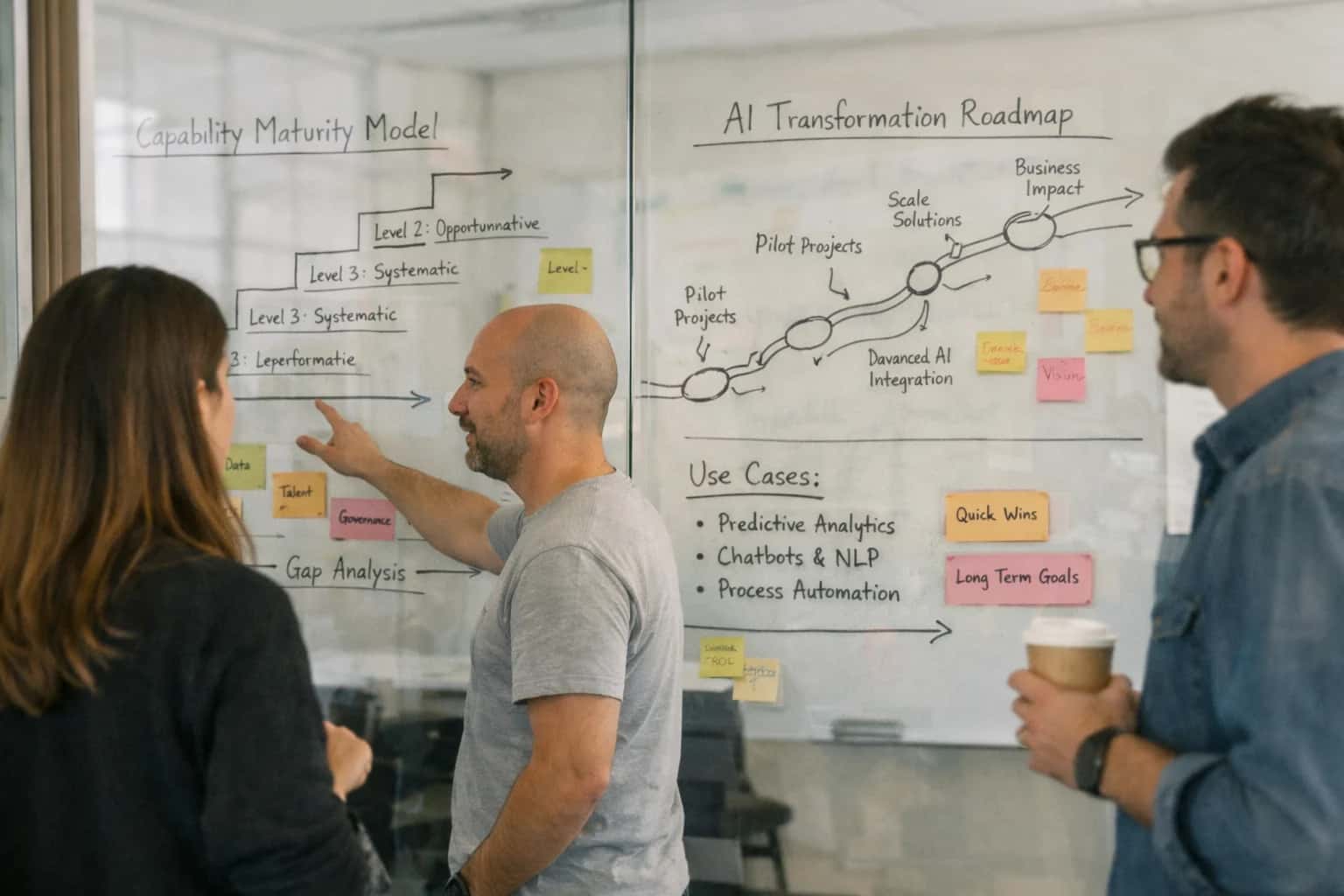
A framework for CIOs and IT leaders to plan an enterprise-wide AIOps transformation, aligning technology with business outcomes like uptime and operational efficiency.
Design your roadmap by starting with high-value, low-complexity use cases such as intelligent alert correlation to reduce noise. Then, progressively implement predictive outage detection and automated root-cause analysis. Crucially, this strategy bridges technology and organizational change, requiring you to establish an AIOps Center of Excellence, integrate with existing ITSM tools like ServiceNow, and design governance for model lifecycle management as outlined in our guide on MLOps for agentic systems.
STRATEGIC FRAMEWORK
AIOps Use Case Prioritization Matrix
Use this matrix to objectively score and rank potential AIOps initiatives based on business impact, technical feasibility, and strategic alignment.
| Evaluation Criteria | High Priority (Quick Wins) | Medium Priority (Strategic Projects) | Low Priority (Future Consideration) |
|---|---|---|---|
Business Impact (Uptime, Cost) |
| 10-20% efficiency gain, indirect savings | < 10% improvement, unclear ROI |
Implementation Complexity | Leverages existing tools, < 3 months | Requires new integrations, 3-6 months | Needs new platform, > 6 months |
Data Readiness | Structured, real-time feeds available | Data exists but needs normalization | Data collection is a prerequisite |
Organizational Alignment | Cross-team buy-in, executive sponsor | Single-team initiative, moderate support | No clear owner, cultural resistance |
Risk of Failure | Low (proven use case, simple logic) | Medium (novel integration, some unknowns) | High (unproven model, complex environment) |
Strategic Fit | Core to digital transformation roadmap | Aligns with departmental goals | Nice-to-have, exploratory |
STRATEGIC EXECUTION
Build a Phased Implementation Roadmap
A successful AI-First IT Operations (AIOps) strategy requires a deliberate, staged rollout. This roadmap prioritizes quick wins, builds momentum, and systematically scales capabilities to achieve self-healing IT.
Begin with a foundational phase focused on data unification and noise reduction. Integrate logs, metrics, and traces into a centralized data lake. Deploy intelligent alert correlation to reduce noise by 70-80%, providing immediate relief from alert fatigue and establishing clean data for AI models. This phase delivers tangible ROI by improving Mean Time to Acknowledge (MTTA) and builds organizational trust. Reference our guide on Setting Up Intelligent Alert Correlation and Noise Reduction for tactical steps.
The advanced phase introduces predictive and autonomous capabilities. Implement forecasting models for outages and capacity needs, and deploy automated root-cause analysis. Finally, the transformational phase integrates these components into a closed-loop, self-healing system where AI agents diagnose and remediate incidents within a governed Multi-Agent System (MAS) Orchestration framework. Always design with Human-in-the-Loop (HITL) Governance Systems for high-risk actions.
FOUNDATIONAL LAYERS
Core AIOps Technology Stack Components
An AI-first IT operations strategy is built on four foundational technology layers. Each layer provides specific capabilities that, when integrated, create a self-healing system.
04
Knowledge & Continuous Learning Layer
AIOps systems must learn from every incident to improve. This layer captures institutional knowledge and refines models. Implement using:
- Agentic RAG Systems: Use frameworks like LangChain or LlamaIndex to build a self-improving knowledge base from runbooks, past incidents, and documentation.
- Feedback Loops: Ensure every automated action and its outcome is logged and fed back into the ML models for retraining.
- MLOps for Agents: Manage the lifecycle of autonomous agents, monitoring for agent drift and rogue actions, as detailed in our guide on MLOps for agentic systems. This turns your AIOps platform from a static tool into a learning system.
EXPLORE
06
Governance & Human-in-the-Loop (HITL) Interface
Autonomy requires oversight. This component ensures ethical operation, risk management, and provides human operators with control. Key elements are:
- Confidence Thresholds: Define scores (e.g., 95% confidence) below which the system must escalate to a human, a concept from our HITL Governance Systems pillar.
- Approval Workflows: Integrate with collaboration tools like Slack or Microsoft Teams for real-time intervention.
- Audit Logs: Immutable logs of every AI decision and action for compliance and explainability. This layer builds trust and ensures the system aligns with business risk tolerance.
Enabling Efficiency, Speed & Accuracy
Intelligent Analysis, Decision & Execution
We build AI systems for teams that need search across company data, workflow automation across tools, or AI features inside products and internal software.
Talk to Us
Search across company data
Give teams answers from docs, tickets, runbooks, and product data with sources and permissions.
Useful when people spend too long searching or get different answers from different systems.
Enterprise searchRAGPermissions
Read more
Automate internal workflows
Use AI to route work, draft outputs, trigger actions, and keep approvals and logs in place.
Useful when repetitive work moves across multiple tools and teams.
AI agentsWorkflow automationGovernance
Read more
Add AI to products and internal tools
Build assistants, guided actions, or decision support into the software your team or customers already use.
Useful when AI needs to be part of the product, not a separate tool.
AI integrationDecision supportModel routing
Read moreSTRATEGIC PITFALLS
Common Mistakes in AIOps Strategy Design
Designing an AI-First IT Operations (AIOps) strategy is a complex organizational transformation. This guide identifies the most frequent and costly mistakes made by engineering leaders, providing actionable solutions to ensure your initiative delivers measurable business outcomes like uptime and operational efficiency.
The most common and fatal mistake is technology-first thinking. Teams often begin by procuring a vendor tool or building a complex model without first defining the specific business problems it must solve. This leads to impressive demos that fail in production.
The correct approach is outcome-first:
- Start by quantifying pain points: high MTTR, alert fatigue, unplanned downtime costs.
- Define 1-2 high-impact use cases with clear Key Performance Indicators (KPIs), such as reducing Severity-1 incident resolution time by 30%.
- Only then evaluate technologies (like Moogsoft or BigPanda) or build models that directly address those defined outcomes. This aligns your AIOps strategy with the core goal of creating a self-healing IT ecosystem.

About the author
Prasad Kumkar
CEO & MD, Inference Systems
Prasad Kumkar is the CEO & MD of Inference Systems and writes about AI systems architecture, LLM infrastructure, model serving, evaluation, and production deployment. Over 5+ years, he has worked across computer vision models, L5 autonomous vehicle systems, and LLM research, with a focus on taking complex AI ideas into real-world engineering systems.
His work and writing cover AI systems, large language models, AI agents, multimodal systems, autonomous systems, inference optimization, RAG, evaluation, and production AI engineering.
LinkedIn
Limited slotsGet a Free AI Consultation
Partnered with leading AI, data, and software stack.





How We Work
Custom AI workflows for your Business
One-fit-all AI don't work for modern businesses. At Inferensys, we aim to understand your business & custom requirements; which we use to define most efficient agentic workflows, the data, and the tools for your business.
01
Review the use case
We understand the task, the users, and where AI can actually help.
Read more02
Pick the right approach
We define what needs search, automation, or product integration.
Read more03
Build the first useful version
We implement the part that proves the value first.
Read more04
Improve from there
We add the checks and visibility needed to keep it useful.
Read moreThe first call is a practical review of your use case and the right next step.
Talk to Us