An AI Buyer Authentication and Authorization Framework is the security backbone for autonomous commerce. It moves beyond simple API keys to implement OAuth 2.0 for machines, defining precise scopes and permissions for different agent roles, such as a product researcher versus a purchasing agent. This ensures agents operate within strict, auditable boundaries, a foundational principle for Human-in-the-Loop (HITL) Governance Systems.

Guide
Launching an AI Buyer Authentication and Authorization Framework
A technical guide to implementing a secure authentication and authorization framework for autonomous AI agents accessing your commerce APIs. Move beyond API keys to OAuth 2.0 flows, define granular scopes, and enforce spending limits.
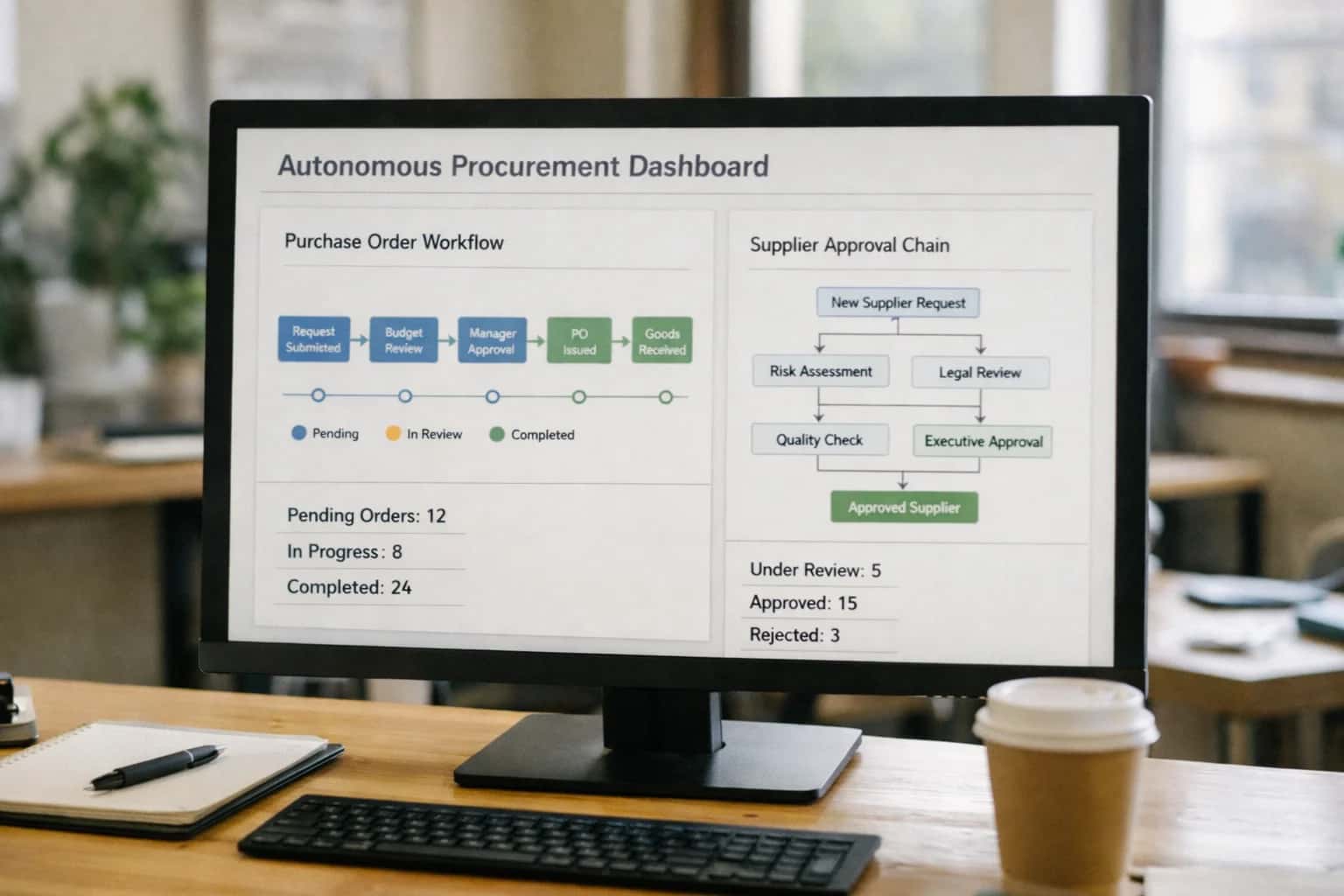
Secure your commerce platform for the next generation of autonomous purchasing agents.
You will implement this framework by first defining agent personas and their required permissions. Then, integrate with enterprise identity providers like Okta or Azure AD to issue machine tokens. Finally, build logic for spending limits, activity auditing, and real-time policy enforcement. This creates a secure, compliant environment for agentic transactions, directly enabling the workflows described in How to Architect an AI Buyer-Ready Product API.
MACHINE-TO-MACHINE AUTHENTICATION
OAuth 2.0 Flow Comparison for AI Agents
Evaluating OAuth 2.0 grant types for authenticating autonomous AI buyers that act on behalf of human users or enterprise service accounts.
| Flow / Feature | Client Credentials | Authorization Code (with PKCE) | Device Authorization |
|---|---|---|---|
Primary Use Case | Service account / backend integration | Delegated user access via a trusted client | Devices with limited input (e.g., IoT, CLI tools) |
User Interaction Required | |||
Confidential Client Assumption | |||
Best for AI Buyer Role | Background researcher / data aggregator | Purchasing agent with delegated user budget | Embedded agent in hardware or kiosk |
Refresh Token Support | |||
Typical Token Lifetime | < 1 hour | 1-24 hours | 1-24 hours |
Risk of Credential Exposure | Low (server-side only) | Medium (mitigated by PKCE) | Low (user code input) |
Integration Complexity | Low | High | Medium |
Enabling Efficiency, Speed & Accuracy
Intelligent Analysis, Decision & Execution
We build AI systems for teams that need search across company data, workflow automation across tools, or AI features inside products and internal software.
Talk to Us
Search across company data
Give teams answers from docs, tickets, runbooks, and product data with sources and permissions.
Useful when people spend too long searching or get different answers from different systems.
Enterprise searchRAGPermissions
Read more
Automate internal workflows
Use AI to route work, draft outputs, trigger actions, and keep approvals and logs in place.
Useful when repetitive work moves across multiple tools and teams.
AI agentsWorkflow automationGovernance
Read more
Add AI to products and internal tools
Build assistants, guided actions, or decision support into the software your team or customers already use.
Useful when AI needs to be part of the product, not a separate tool.
AI integrationDecision supportModel routing
Read moreTROUBLESHOOTING
Common Mistakes
Launching a secure authentication framework for AI buyers is complex. These are the most frequent technical pitfalls developers encounter and how to fix them.
API keys are static secrets that offer no granular permissions, cannot be easily revoked per session, and provide zero context about the agent's intent. An AI buyer with a leaked key has unlimited access. The fix is to implement OAuth 2.0 Client Credentials Grant for machine-to-machine authentication. This flow issues short-lived JWT access tokens with embedded scopes (e.g., product:read, order:write), enabling fine-grained control and automatic key rotation.
httpPOST /oauth/token Content-Type: application/x-www-form-urlencoded grant_type=client_credentials&client_id=AGENT_ID&client_secret=AGENT_SECRET&scope=product:read inventory:read

About the author
Prasad Kumkar
CEO & MD, Inference Systems
Prasad Kumkar is the CEO & MD of Inference Systems and writes about AI systems architecture, LLM infrastructure, model serving, evaluation, and production deployment. Over 5+ years, he has worked across computer vision models, L5 autonomous vehicle systems, and LLM research, with a focus on taking complex AI ideas into real-world engineering systems.
His work and writing cover AI systems, large language models, AI agents, multimodal systems, autonomous systems, inference optimization, RAG, evaluation, and production AI engineering.
LinkedIn
Limited slotsGet a Free AI Consultation
Partnered with leading AI, data, and software stack.





How We Work
Custom AI workflows for your Business
One-fit-all AI don't work for modern businesses. At Inferensys, we aim to understand your business & custom requirements; which we use to define most efficient agentic workflows, the data, and the tools for your business.
01
Review the use case
We understand the task, the users, and where AI can actually help.
Read more02
Pick the right approach
We define what needs search, automation, or product integration.
Read more03
Build the first useful version
We implement the part that proves the value first.
Read more04
Improve from there
We add the checks and visibility needed to keep it useful.
Read moreThe first call is a practical review of your use case and the right next step.
Talk to Us