A procurement policy engine is a rules-based system that encodes corporate purchasing policies—budget limits, vendor preferences, restricted items—into executable logic. It acts as the guardrail for autonomous AI agents, ensuring every automated purchase request complies with company rules before execution. This moves procurement from manual review to automated governance, a core requirement for scaling Agentic Commerce and AI Buyer Optimization.

Guide
How to Build a Procurement Policy Engine for AI Buyers
A technical guide to encoding corporate procurement policies—budget approvals, vendor restrictions, compliance checks—into executable logic for autonomous AI agents. Implement with Drools or a custom DSL.
AGENTIC COMMERCE
Introduction
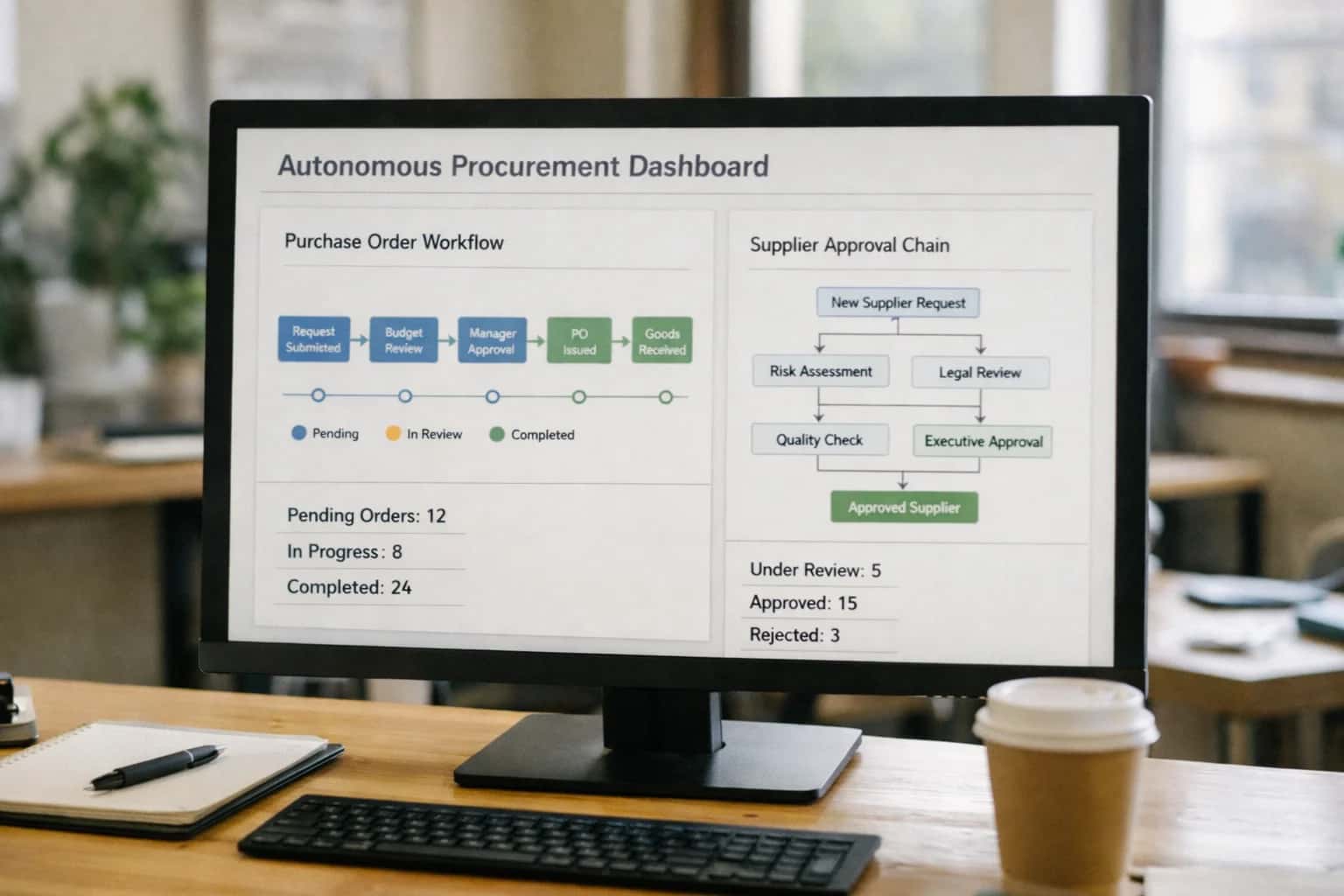
A procurement policy engine is the rulebook for autonomous AI buyers, transforming corporate guidelines into executable guardrails for compliant, automated purchasing.
Building this engine requires defining policies as structured rules, selecting a rules engine like Drools or a custom DSL, and integrating it with your commerce APIs. The system evaluates agent requests in real-time, approving compliant orders or escalating exceptions. This foundational control layer is critical for deploying trustworthy AI buyers in B2B environments, directly supporting the need for auditability defined in Human-in-the-Loop (HITL) Governance Systems.
FOUNDATIONAL BUILDING BLOCKS
Key Concepts
Understand the core technical components required to build a system that governs autonomous AI purchasing decisions. These concepts form the backbone of a compliant, secure policy engine.
02
Policy DSL Design
A Domain-Specific Language (DSL) allows non-technical stakeholders (e.g., procurement officers) to define and update policies. Instead of writing code, they use a structured, human-readable syntax.
- Example Rule:
APPROVE IF vendor IN preferred_list AND total < budget_limit - Key Components: Define the vocabulary (e.g.,
budget,vendor,item_category) and the operators (e.g.,IN,<,REQUIRES_APPROVAL). - Implementation: Build a parser that translates DSL statements into the internal rule format for the engine. This bridges the gap between policy and execution, a core principle of Context Engineering and Semantic Alignment.
03
Context Enrichment Layer
A policy decision is only as good as its data. The context enrichment layer gathers and structures all relevant data points about a transaction before the rules engine evaluates it.
- Required Data: Agent identity, purchase history, real-time budget status, vendor risk score, item specifications.
- Architecture: Build a service that queries internal databases (ERP, CRM) and external APIs (compliance lists, credit checks).
- Output: Produces a unified context object containing all facts for rule evaluation. This is critical for enabling the precise reasoning found in Neuro-Symbolic AI for Legal and Medical Reasoning.
04
Audit Log & Explainability
Every autonomous decision must be traceable. The audit log captures the complete reasoning path: the input context, every rule fired, and the final decision.
- Immutable Storage: Log to a write-once system like an append-only database or a blockchain ledger.
- Explainability: For any denied transaction, you must generate a human-readable explanation (e.g., 'Denied: Purchase exceeds quarterly budget by $500').
- Compliance: This traceability is non-negotiable for regulations and internal audits, directly supporting requirements for Explainability and Traceability for High-Risk AI.
05
HITL Escalation Gateway
Not all decisions can be automated. The Human-in-the-Loop (HITL) Escalation Gateway is a fail-safe that routes edge cases to a human for review.
- Triggers: Define clear thresholds (e.g.,
transaction > $10,000ORrule_confidence < 95%). - Workflow Integration: Pause the autonomous workflow, send an alert to an approval queue (e.g., in Slack, ServiceNow), and resume upon human decision.
- Feedback Loop: Human decisions should be fed back into the system to refine future rule logic. This is a foundational pattern of Human-in-the-Loop (HITL) Governance Systems.
06
Real-Time Budget Enforcement
Static budget checks are insufficient for autonomous agents making rapid, concurrent purchases. Real-time budget enforcement requires a globally consistent, low-latency ledger.
- Implementation: Use a distributed database like Redis or Apache Cassandra to maintain a central budget ledger with atomic operations.
- Concurrency Control: Employ database transactions or optimistic locking to prevent race conditions where two agents could overspend a shared budget.
- Integration: The rules engine must query this ledger as part of the context enrichment phase for every transaction.
FOUNDATION
Step 1: Define Your Policy Data Model
The data model is the single source of truth for your procurement rules. It defines the entities, relationships, and constraints that your AI agents will enforce.
Your policy data model is the structured schema that encodes all corporate procurement rules into machine-readable form. Start by identifying core entities: PurchaseRequest, Budget, Vendor, Product, and Approver. Define their attributes and relationships using a domain-specific language (DSL) or a simple JSON schema. For example, a Budget entity must have fields for department, allocatedAmount, and remainingBalance. This model becomes the foundation for all subsequent rule logic, ensuring consistency across your Agentic Commerce platform.
Map each business constraint to a field or relationship. A rule like "orders over $10,000 require VP approval" translates to a PurchaseRequest.amount field and a relationship to an Approver with role=VP. Use enums for categorical data like Product.category or Vendor.tier. Implement this model in code, typically as Python dataclasses or TypeScript interfaces. This explicit structure prevents ambiguous rules and is the first step toward building a compliant Procurement Policy Engine.
ARCHITECTURE DECISION
Rules Engine Comparison: Drools vs. Custom DSL
Evaluating the core technologies for encoding procurement policies into executable logic for AI Buyers.
| Feature / Metric | Drools (Business Rules Management System) | Custom DSL (Domain-Specific Language) |
|---|---|---|
Implementation Speed | Fast (< 2 weeks) | Slow (6-12 weeks) |
Business User Maintainability | ||
Complex Logic & Recursion Support | ||
Integration Complexity with Existing APIs | Low | High |
Runtime Performance (Rule Evaluation) | < 10 ms | < 5 ms |
Audit Trail & Explainability | Built-in | Must be custom-built |
Initial Development Cost | $15-25k | $50-100k+ |
Alignment with Agentic Principles | Requires adaptation | Native from design |
Enabling Efficiency, Speed & Accuracy
Intelligent Analysis, Decision & Execution
We build AI systems for teams that need search across company data, workflow automation across tools, or AI features inside products and internal software.
Talk to Us
Search across company data
Give teams answers from docs, tickets, runbooks, and product data with sources and permissions.
Useful when people spend too long searching or get different answers from different systems.
Enterprise searchRAGPermissions
Read more
Automate internal workflows
Use AI to route work, draft outputs, trigger actions, and keep approvals and logs in place.
Useful when repetitive work moves across multiple tools and teams.
AI agentsWorkflow automationGovernance
Read more
Add AI to products and internal tools
Build assistants, guided actions, or decision support into the software your team or customers already use.
Useful when AI needs to be part of the product, not a separate tool.
AI integrationDecision supportModel routing
Read moreTROUBLESHOOTING
Common Mistakes
Building a procurement policy engine for AI buyers is complex. These are the most frequent technical pitfalls developers encounter, from logic design to runtime performance.
This happens when you hard-code business rules directly into application logic instead of using a dedicated rules engine. A monolithic if-else chain is brittle and requires a full redeploy for every policy change.
Solution: Use a declarative rules engine like Drools or Open Policy Agent (OPA). Define policies in a separate DSL (Domain-Specific Language) or Rego files. This separates business logic from application code, allowing procurement managers to update rules without developer intervention. Store rules in a version-controlled repository and implement a CI/CD pipeline for safe deployment.
yaml# Example OPA Rule Snippet allow { input.action == "purchase" input.user.department == "Engineering" input.item.cost <= input.user.budget not input.item.restricted }

About the author
Prasad Kumkar
CEO & MD, Inference Systems
Prasad Kumkar is the CEO & MD of Inference Systems and writes about AI systems architecture, LLM infrastructure, model serving, evaluation, and production deployment. Over 5+ years, he has worked across computer vision models, L5 autonomous vehicle systems, and LLM research, with a focus on taking complex AI ideas into real-world engineering systems.
His work and writing cover AI systems, large language models, AI agents, multimodal systems, autonomous systems, inference optimization, RAG, evaluation, and production AI engineering.
LinkedIn
Limited slotsGet a Free AI Consultation
Partnered with leading AI, data, and software stack.





How We Work
Custom AI workflows for your Business
One-fit-all AI don't work for modern businesses. At Inferensys, we aim to understand your business & custom requirements; which we use to define most efficient agentic workflows, the data, and the tools for your business.
01
Review the use case
We understand the task, the users, and where AI can actually help.
Read more02
Pick the right approach
We define what needs search, automation, or product integration.
Read more03
Build the first useful version
We implement the part that proves the value first.
Read more04
Improve from there
We add the checks and visibility needed to keep it useful.
Read moreThe first call is a practical review of your use case and the right next step.
Talk to Us