Teleoperation is the real-time remote control of a physical robot by a human operator, where the operator's commands—transmitted via a joystick, haptic interface, or exoskeleton—directly govern the robot's actuators to perform tasks at a distance. This forms the core of direct human-in-the-loop (HITL) control, bridging geographical or hazardous gaps. The operator receives sensory feedback, typically visual from onboard cameras, and sometimes force or tactile data, creating a closed control loop. This technology is critical in domains like underwater exploration, disaster response, and remote surgery, where embodied intelligence systems cannot yet operate fully autonomously.

Glossary
Teleoperation
Teleoperation is the direct, real-time remote control of a robot by a human operator, extending human capability into hazardous, inaccessible, or distant environments.
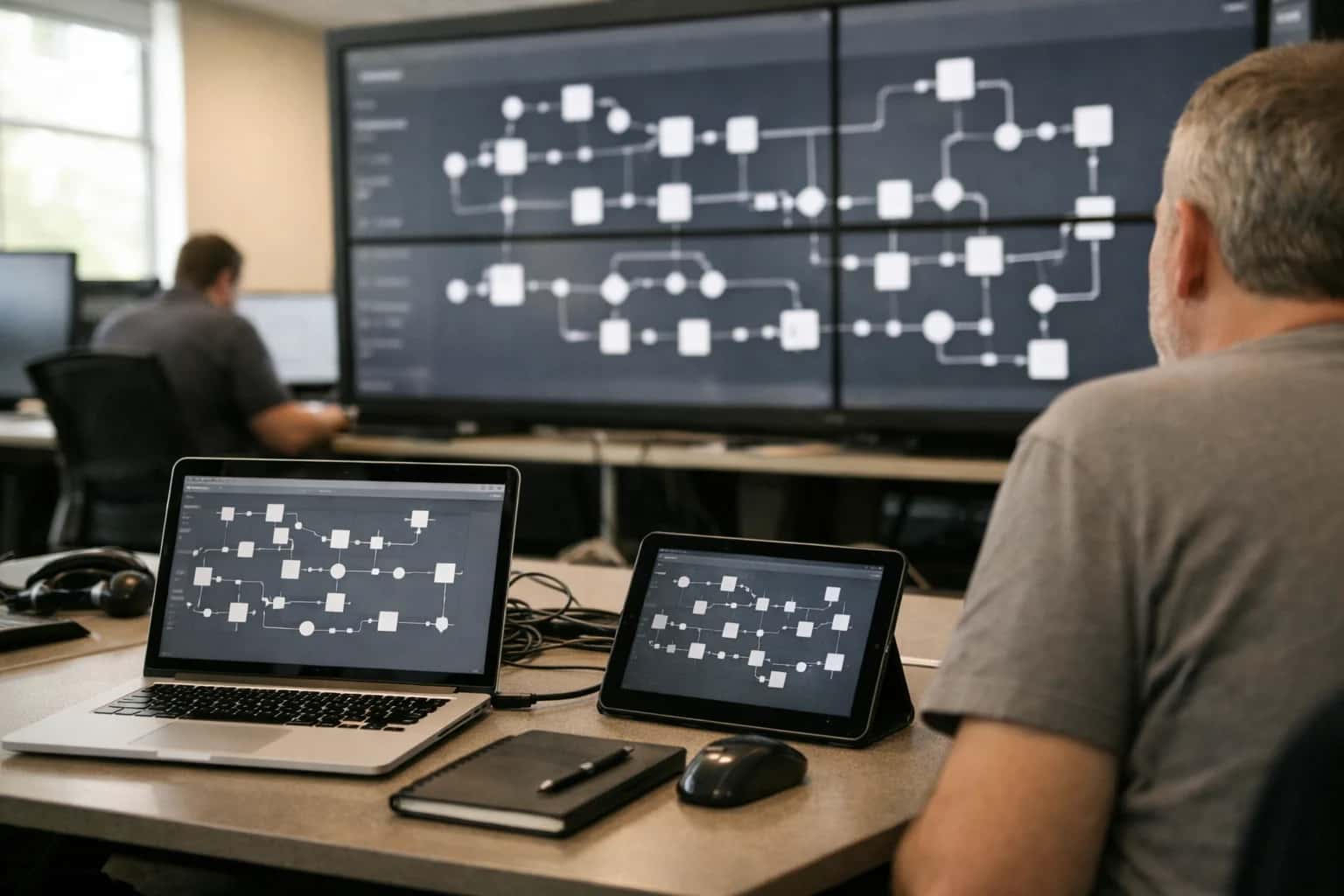
HUMAN-ROBOT INTERACTION
What is Teleoperation?
Teleoperation is the foundational technology for remote robotic control, enabling precise manipulation and navigation from a distance.
Modern teleoperation systems increasingly incorporate elements of shared autonomy, where an underlying autonomous controller assists the human by stabilizing motions, avoiding obstacles, or executing repetitive sub-tasks. This reduces operator cognitive load and improves precision. Advanced interfaces move beyond simple joysticks to include haptic feedback devices that convey force and texture, and virtual reality (VR) setups that provide immersive stereoscopic vision and spatial control. Within Vision-Language-Action (VLA) models, teleoperation serves as a primary source of high-quality demonstration data for imitation learning, allowing robots to learn complex visuomotor skills by observing human-guided executions.
SYSTEM ARCHITECTURE
Core Components of a Teleoperation System
A teleoperation system is a complex cyber-physical architecture enabling remote control. It comprises several tightly integrated hardware and software subsystems that work together to bridge the distance between operator and robot.
01
Operator Control Unit (OCU)
The Operator Control Unit (OCU) is the human interface for the system. It consists of:
- Input Devices: Joysticks, haptic exoskeletons, steering wheels, or specialized controllers that translate human motion into command signals.
- Feedback Displays: Visual monitors (often stereoscopic), audio feeds, and haptic feedback devices that provide the operator with a sense of telepresence.
- Command Computer: The local machine running the operator-side software, handling command encoding, state monitoring, and communication with the remote site.
02
Remote Robotic Platform
The Remote Robotic Platform is the physical agent executing tasks in the distant environment. Its key elements include:
- Actuators: Motors, hydraulics, or pneumatics that provide movement and force.
- End-Effectors: Grippers, welding tools, or surgical instruments for task-specific manipulation.
- Onboard Computer: Processes received commands, executes low-level control loops (e.g., PID for joint positions), and manages local sensor data.
- Power System: Batteries or tethered power supplies that energize all onboard systems.
03
Sensor & Perception Suite
This subsystem gathers data from the remote environment to create the operator's situational awareness. It typically involves:
- Exteroceptive Sensors: Cameras (RGB, stereo, thermal), LiDAR, radar, and microphones that perceive the external world.
- Proprioceptive Sensors: Encoders, inertial measurement units (IMUs), and force/torque sensors that measure the robot's own state (joint angles, velocity, applied forces).
- Perception Stack: Software pipelines for sensor fusion, 3D reconstruction, object detection, and tracking, often creating a unified world model for the operator.
04
Communication Link
The Communication Link is the data channel connecting the OCU and the remote robot. Its critical characteristics are:
- Latency: The time delay between sending a command and observing its effect. High latency (>500ms) severely degrades performance and can cause instability.
- Bandwidth: The data rate required to transmit high-fidelity video, sensor data, and commands. Low-bandwidth links may use heavy compression or selective data transmission.
- Protocols: Use of specialized protocols like ROS 2 with DDS/RTPS for real-time, reliable data distribution, or User Datagram Protocol (UDP) for low-latency video streaming, often with Forward Error Correction (FEC).
05
Control Architecture
The Control Architecture defines how commands are generated and executed. Common paradigms include:
- Direct Control (Rate Control): The operator's joystick input directly commands the velocity of a robot joint or the end-effector.
- Supervisory Control: The operator issues high-level goals (e.g., "grasp the valve"), and the robot's autonomy handles the detailed trajectory planning and execution.
- Shared Control: Blends human input with autonomous assistance. For example, the robot assists with obstacle avoidance while the operator guides the gross motion, or provides virtual fixtures that constrain movement to safe or optimal paths.
- Bilateral Teleoperation: A advanced scheme where force feedback from the robot's sensors is rendered to the operator's haptic device, allowing them to 'feel' remote forces.
06
Safety & Supervisory Systems
These are fail-safe mechanisms critical for reliable operation, especially when delays or link dropouts occur.
- Watchdog Timers: Monitor communication heartbeat; trigger a safe state (e.g., stop, hold position) if signals are lost.
- Software Limit Switches: Enforce virtual boundaries in the robot's workspace to prevent collisions with itself or critical infrastructure.
- Local Autonomy Reflexes: Pre-programmed behaviors (e.g., automatic braking upon detecting an unexpected obstacle) that operate independently of the delayed operator command stream.
- Redundant Systems: Backup communication channels (e.g., radio and tethered fiber) and fallback control modes to maintain some level of operation during partial failures.
MECHANISM
How Teleoperation Works: The Control Loop
Teleoperation functions through a continuous, bidirectional flow of information between a human operator and a remote robot, forming a closed-loop control system essential for precise remote manipulation.
Teleoperation establishes a closed-loop control system where sensor data from the robot's environment is transmitted to the operator, who perceives it via a human-machine interface (e.g., video feed, haptic feedback). The operator then generates command signals—through a joystick, exoskeleton, or other controller—which are sent back to the robot to execute physical actions. This continuous cycle of perception, decision, and actuation allows for real-time remote operation despite physical separation and potential communication latency.
The fidelity of this loop is defined by its transparency, or how accurately the operator feels physically present at the remote site. Key engineering challenges include minimizing time delay (latency) in the communication channel, which can cause instability, and designing effective sensor fusion and feedback modalities (visual, auditory, force, tactile) to provide the operator with sufficient situational awareness. Advanced systems employ predictive displays and shared control algorithms to compensate for delay and reduce operator cognitive load.
REMOTE ROBOTIC CONTROL
Teleoperation Applications and Use Cases
Teleoperation enables human expertise to be projected across hazardous distances, from deep-sea exploration to surgical theaters. These cards detail the primary domains where direct, real-time remote control of robots is essential.
01
Hazardous Environment Intervention
Teleoperation is the primary method for conducting work in environments that are immediately lethal or inaccessible to humans. Operators control robots from a safe location, using sensor feeds to perceive the remote site.
Key Applications:
- Nuclear Decommissioning: Manipulating highly radioactive materials for waste handling and facility dismantling.
- Bomb Disposal (EOD): Using tracked or wheeled robots to inspect, manipulate, and neutralize explosive ordnance.
- Deep-Sea Exploration & Maintenance: Operating Remotely Operated Vehicles (ROVs) for pipeline inspection, cable laying, and scientific sampling at extreme ocean depths.
- Disaster Response: Searching collapsed structures after earthquakes or assessing damage in chemically contaminated zones.
Core Challenge: Maintaining high-fidelity situational awareness and control despite latency, limited bandwidth, and degraded sensor data.
02
Remote Surgery (Telesurgery)
In telesurgery, a surgeon operates a master console that controls robotic surgical arms at a remote patient site. This system translates the surgeon's hand movements into precise, scaled, and tremor-filtered motions of the surgical instruments.
Technical Components:
- Master-Slave Architecture: The surgeon's console (master) sends commands to the patient-side robot (slave).
- Haptic Feedback: Force feedback is relayed to the surgeon's controls, providing a sense of touch and tissue resistance.
- Stereo Visual Feed: High-definition 3D video provides depth perception.
Primary Use Cases:
- Enabling specialist surgeons to operate on patients in rural or underserved areas.
- Allowing expert guidance and demonstration during procedures.
- Performing surgery on astronauts from Earth (a future goal for space medicine).
The major constraint is network reliability and latency, as delays above a few hundred milliseconds can compromise safety and control.
03
Space Robotics
Teleoperation is fundamental to space exploration, where the vast distances make fully autonomous robots impractical for complex, unstructured tasks. Ground-based operators control robots on other planetary bodies with significant time delay.
Paradigm Examples:
- NASA's Mars Rovers (e.g., Perseverance): While capable of autonomous navigation, their most precise scientific activities—like using a robotic arm to drill rock samples—are meticulously planned and commanded by teams on Earth.
- International Space Station's Canadarm2 & Dextre: Astronauts or ground controllers use teleoperation to capture visiting spacecraft, move equipment, and perform external maintenance.
Operational Model: Due to communication latency (e.g., 4-24 minutes round-trip to Mars), operations follow a "command, wait, verify" cycle rather than real-time joystick control. Commands are sequenced and uploaded, the robot executes them, and data is returned for verification before the next command set is sent.
04
Industrial Remote Operations
Beyond traditional industrial robots, teleoperation enables remote expertise and labor in large-scale, distributed, or undesirable work sites.
Primary Industrial Applications:
- Mining: Operating massive haul trucks, loaders, and drilling rigs from surface control centers, removing humans from dusty, noisy, and potentially unstable underground environments.
- Construction: Controlling excavators, cranes, and other heavy machinery from a safe, ergonomic station, improving precision and operator comfort.
- Logistics & Warehousing: Remotely piloting forklifts or mobile robots in large fulfillment centers, allowing a single operator to manage multiple sites or handle exception cases.
- Power Plant & Refinery Inspection: Using mobile robots equipped with cameras and sensors to conduct routine patrols and inspections in high-temperature or confined spaces.
Key Driver: This model decouples skilled labor from geographic location, allowing experts to operate machinery anywhere in the world, and improves safety by removing personnel from hazardous workspaces.
05
Shared Control & Assisted Teleoperation
Pure, direct teleoperation places a high cognitive load on the operator. Shared control paradigms blend human commands with autonomous assistance to reduce fatigue and improve outcomes.
Common Assistance Modalities:
- Virtual Fixtures: Software-defined guidance constraints (e.g., forbidden regions, guiding paths, or surfaces) that prevent the operator from making dangerous or inefficient movements.
- Automated Sub-Tasks: The operator issues a high-level command ("grasp the valve"), and an onboard autonomy system executes the fine-grained motion primitives (approach, align, close gripper).
- Haptic Guidance: The control interface physically nudges the operator toward an optimal path or away from obstacles.
- Viewpoint Stabilization & Augmentation: The visual feed is automatically stabilized, and critical information (e.g., object outlines, distance markers) is overlaid to improve situational awareness.
This approach is critical in surgical robotics and complex assembly tasks, where it enhances precision and reduces the operator's mental workload.
06
Telepresence & Social Robotics
Teleoperation extends beyond physical manipulation to enable remote social presence and interaction. A human operator embodies a mobile robotic platform to interact with a distant environment and people.
Core Applications:
- Telepresence Robots: Mobile video-conferencing units used in offices, hospitals, and schools, allowing remote employees, doctors, or students to "move around" and interact naturally.
- Remote Tourism & Exploration: Operators can pilot drones or ground robots through museums, historical sites, or natural wonders, providing an immersive first-person experience.
- Socially Assistive Robotics (SAR): A caregiver or therapist can operate a robot to provide companionship, reminders, or guided activities for elderly or isolated individuals.
Key Technologies:
- Low-latency, high-quality audiovisual streaming.
- Intuitive navigation interfaces (often via tablet or keyboard).
- Expressive features on the robot (e.g., a movable screen "head," lights) to convey the operator's attention and intent.
The focus here is on fluent communication and social embodiment, rather than dexterous manipulation.
CONTROL PARADIGMS
Teleoperation vs. Related Concepts
A comparison of teleoperation with other human-involved control paradigms for robotic and autonomous systems, highlighting key distinctions in autonomy level, latency tolerance, and primary use cases.
| Feature / Dimension | Teleoperation | Shared Autonomy | Supervised Autonomy | Full Autonomy |
|---|---|---|---|---|
Core Definition | Direct, continuous remote control of a robot by a human operator. | Dynamic blending of human input and autonomous assistance. | Human supervises and occasionally corrects a primarily autonomous system. | Robot operates independently without human intervention. |
Level of Human Control | High (Direct, low-level control) | Medium (High-level intent or blended control) | Low (Supervision and veto authority) | None |
Latency Sensitivity | Critical (< 100-500ms for direct control) | Moderate (Tolerates short delays for intent processing) | Low (Tolerates longer delays for supervisory input) | Not applicable |
Primary Communication | Bidirectional: Commands (joystick, haptics) & sensor feedback (video, force). | Bidirectional: Intent signals & state suggestions. | Unidirectional (mostly): Status alerts & correction commands from human. | Unidirectional (mostly): Status reports to human. |
Operator Cognitive Load | Very High (Continuous piloting and situation awareness) | Moderate (High-level guidance and monitoring) | Low (Intermittent monitoring and exception handling) | Very Low (System monitoring only) |
Typical Use Case | Remote surgery, hazardous environment inspection, complex manipulation. | Assisted driving, robotic co-manipulation, drone piloting with obstacle avoidance. | Warehouse AMR fleet management, manufacturing line oversight. | Industrial pick-and-place, autonomous vacuuming, closed-loop process control. |
System Complexity | Medium (Focus on high-fidelity control and feedback links) | High (Requires seamless arbitration and intent recognition) | High (Requires reliable autonomy and clear failure modes for human) | High (Requires robust perception, planning, and execution) |
Failure Mode Response | Human operator directly responsible for recovery. | System or human can initiate recovery based on arbitration rules. | Autonomous system halts; human operator diagnoses and corrects. | Autonomous system must have built-in fallback strategies. |
TELEOPERATION
Frequently Asked Questions
Teleoperation enables the remote control of robots across distances, from deep-sea exploration to delicate surgery. These FAQs address the core technologies, applications, and distinctions within this critical field of robotics.
Teleoperation is the real-time remote control of a robot by a human operator, where the operator's commands are transmitted to the robot to perform tasks at a distance. It works through a closed-loop system comprising several key components: a human operator interface (like a joystick, haptic device, or exoskeleton), a communication link (wired or wireless, often requiring low latency), and the remote robot with its sensors and actuators. The operator receives sensory feedback—typically visual from cameras, but also potentially force (haptic feedback) or auditory—to perceive the remote environment. This feedback allows the operator to make continuous control decisions, creating a bidirectional flow of commands and sensor data that enables precise remote manipulation and navigation.
Enabling Efficiency, Speed & Accuracy
Intelligent Analysis, Decision & Execution
We build AI systems for teams that need search across company data, workflow automation across tools, or AI features inside products and internal software.
Talk to Us
Search across company data
Give teams answers from docs, tickets, runbooks, and product data with sources and permissions.
Useful when people spend too long searching or get different answers from different systems.
Enterprise searchRAGPermissions
Read more
Automate internal workflows
Use AI to route work, draft outputs, trigger actions, and keep approvals and logs in place.
Useful when repetitive work moves across multiple tools and teams.
AI agentsWorkflow automationGovernance
Read more
Add AI to products and internal tools
Build assistants, guided actions, or decision support into the software your team or customers already use.
Useful when AI needs to be part of the product, not a separate tool.
AI integrationDecision supportModel routing
Read more
About the author
Prasad Kumkar
CEO & MD, Inference Systems
Prasad Kumkar is the CEO & MD of Inference Systems and writes about AI systems architecture, LLM infrastructure, model serving, evaluation, and production deployment. Over 5+ years, he has worked across computer vision models, L5 autonomous vehicle systems, and LLM research, with a focus on taking complex AI ideas into real-world engineering systems.
His work and writing cover AI systems, large language models, AI agents, multimodal systems, autonomous systems, inference optimization, RAG, evaluation, and production AI engineering.
LinkedIn
Limited slotsGet a Free AI Consultation
Partnered with leading AI, data, and software stack.





How We Work
Custom AI workflows for your Business
One-fit-all AI don't work for modern businesses. At Inferensys, we aim to understand your business & custom requirements; which we use to define most efficient agentic workflows, the data, and the tools for your business.
01
Review the use case
We understand the task, the users, and where AI can actually help.
Read more02
Pick the right approach
We define what needs search, automation, or product integration.
Read more03
Build the first useful version
We implement the part that proves the value first.
Read more04
Improve from there
We add the checks and visibility needed to keep it useful.
Read moreThe first call is a practical review of your use case and the right next step.
Talk to Us