Shared Autonomy is a robotic control paradigm where decision-making and control authority are dynamically allocated between a human operator and an autonomous system. This creates a blended control loop, allowing human judgment and contextual understanding to complement the machine's precision, repeatability, and computational speed. The system continuously arbitrates control, often based on user input confidence, task complexity, or safety constraints, to execute a single, coherent action stream.

Glossary
Shared Autonomy
Shared autonomy is a control paradigm where authority over a robot's actions is dynamically allocated between a human operator and an autonomous controller.
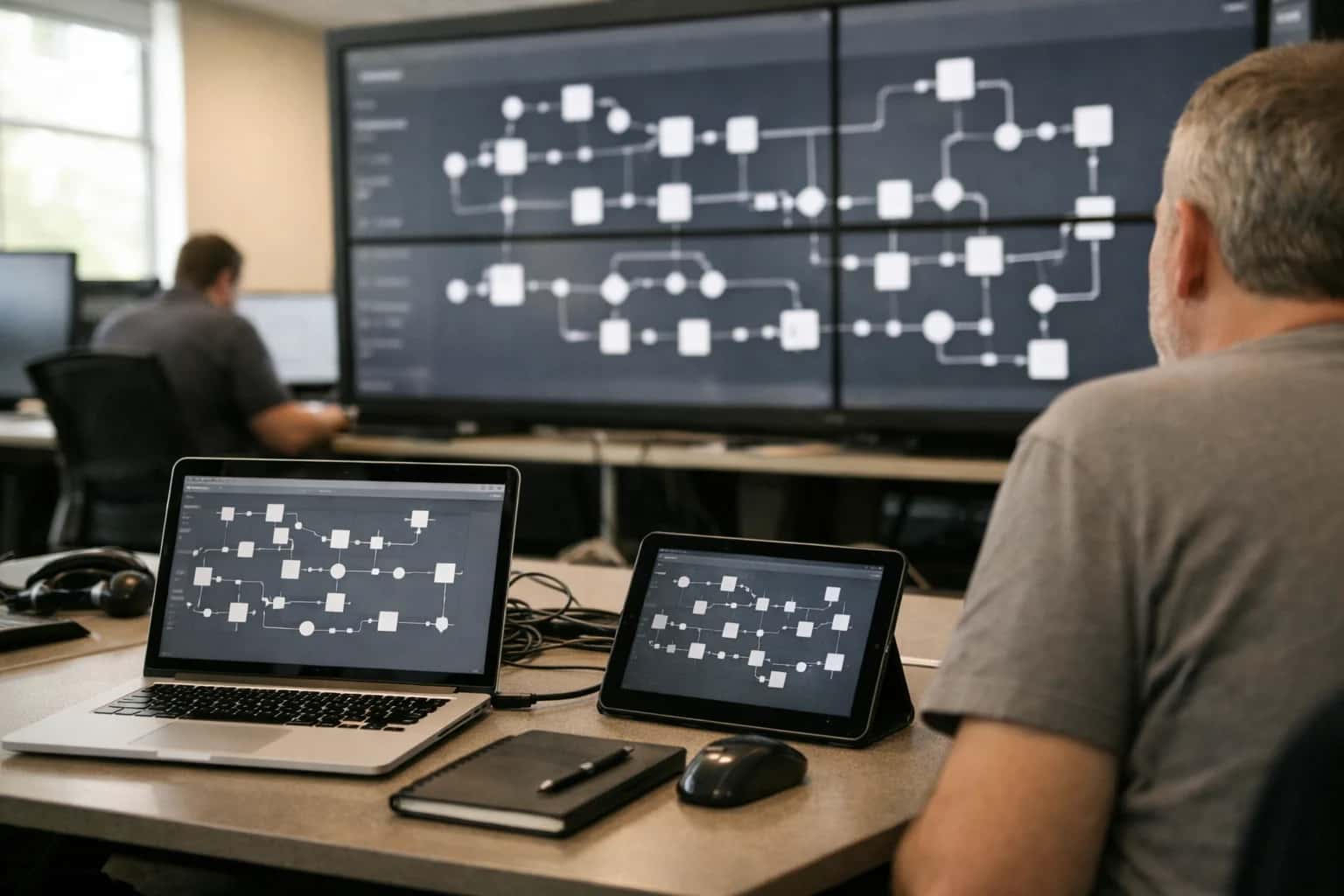
HUMAN-ROBOT INTERACTION
What is Shared Autonomy?
A control paradigm for robotic systems that dynamically blends human and machine intelligence.
Implementation typically involves intent inference, where the robot interprets the human's goal from joystick signals, gestures, or brain-computer interfaces, and then autonomously plans and executes the necessary motions to achieve it. This is distinct from pure teleoperation or full autonomy, sitting in a middle ground that enhances performance in complex tasks like robotic surgery, assisted driving, or remote manipulation. Core to its design are safety protocols like ISO/TS 15066 and fluent human-robot teaming.
CONTROL PARADIGM
Key Characteristics of Shared Autonomy
Shared Autonomy is defined by a dynamic, fluid exchange of control between human and machine. These characteristics distinguish it from simpler teleoperation or full autonomy.
01
Dynamic Control Allocation
The core mechanism of Shared Autonomy is the real-time arbitration of control authority between the human operator and the autonomous controller. This is not a binary switch but a continuous spectrum. The system uses a mixing function or arbitration policy to blend inputs, often weighting them based on:
- Operator intent confidence: How certain is the system of the human's goal?
- Environmental uncertainty: How complex or unpredictable is the task?
- Autonomous capability: How well can the machine perform the sub-task?
- Safety criticality: What is the risk of error?
For example, in a surgical robot, fine suturing may grant high authority to the surgeon's hand motions, while gross positioning and tremor filtering are handled autonomously.
02
Intent Inference & Prediction
The autonomous system must model and predict the human operator's intent to provide helpful assistance. This goes beyond interpreting direct commands to infer high-level goals. Techniques include:
- Trajectory prediction: Forecasting the operator's desired path from partial input.
- Goal recognition: Using task context and history to identify the most probable objective from a set of possibilities.
- Bayesian inference: Continuously updating a probability distribution over potential goals as more evidence (operator inputs) is observed.
This allows the autonomy to "fill in the gaps," smoothing jerky commands or completing motions toward the inferred goal, as seen in assistive feeding arms that predict bite acquisition points.
03
Blended Control Signals
The final command to the robot's actuators is a mathematical fusion of human and autonomous inputs. Common blending strategies are:
- Linear blending:
u_final = α * u_human + (1-α) * u_auto, where α is the dynamic arbitration variable. - Constrained optimization: The autonomy solves for commands that satisfy the robot's dynamics while staying as close as possible to the human's input, often within a safe corridor.
- Virtual fixtures: The autonomy provides guidance forces (haptic or software constraints) that channel the human's input along preferred paths or away from forbidden regions, used extensively in robotic surgery and assembly.
The result is a single, coherent action that leverages the strengths of both agents.
04
Context-Aware Assistance
The level and type of autonomy provided are highly dependent on situational context. The system modulates its behavior based on:
- Task phase: Different assistance for reaching, grasping, and placing an object.
- Operator skill: Providing more guidance for novices and less for experts.
- Environmental state: Increasing autonomy in cluttered spaces or when obstacles appear.
- Human state: Detecting fatigue or distraction and compensating accordingly.
This requires a rich world model that fuses sensor data (vision, force) with task knowledge to make context-sensitive arbitration decisions.
05
Bidirectional Communication
Effective Shared Autonomy requires a closed loop of communication between human and machine, not just one-way control. This includes:
- Human → Robot: Direct control inputs (joystick, gestures, voice).
- Robot → Human: Haptic feedback, visual overlays, or auditory cues that communicate the autonomous system's intent, confidence, and constraints. This is critical for trust calibration and situation awareness.
For instance, a shared-control wheelchair might provide gentle resistive force through the joystick to indicate an autonomously detected obstacle, or a drone interface might visually highlight the autonomous system's proposed path.
06
Graceful Degradation & Intervention
A robust Shared Autonomy system is designed for seamless handling of edge cases and failures. Key aspects are:
- Failure detection: The autonomy must recognize when its model is invalid or its sensors have failed.
- Authority transfer: Upon detecting failure or extreme uncertainty, control must smoothly revert fully to the human operator with clear signaling.
- Intervention readiness: The human must always retain the overriding authority to take full manual control instantly, a principle known as the "big red button" or veto authority.
- Minimal interference: When the human is in full control, the autonomy should provide zero resistance, avoiding any unwanted "fighting" against the operator's commands.
CONTROL PARADIGM
How Shared Autonomy Works
Shared Autonomy is a control paradigm for robotic systems where decision-making authority is dynamically allocated between a human operator and an autonomous controller.
Shared Autonomy is a control paradigm where authority over a robot's actions is dynamically allocated between a human operator and an autonomous controller. This creates a blended control loop, merging human situational judgment and strategic oversight with the machine's precision, speed, and consistency. The system continuously assesses context—such as task complexity, environmental uncertainty, and operator intent—to adjust the level of autonomy (LOA) in real-time. This fluid allocation is the core mechanism that differentiates it from static modes like full teleoperation or full autonomy.
Implementation relies on sophisticated intent recognition and state estimation. The autonomous controller interprets the human's high-level goals from inputs like joystick motions, gaze, or spoken commands, then generates compliant, refined motor actions to achieve them. Techniques like model predictive control (MPC) and hierarchical task networks are often used. Safety is enforced through power and force limiting (PFL) and impedance control, ensuring physical collaboration remains safe. This paradigm is foundational for collaborative robots (cobots) and complex human-robot teaming scenarios in surgery, rehabilitation, and advanced manufacturing.
SHARED AUTONOMY IN ACTION
Examples and Applications
Shared autonomy is not a single technology but a design philosophy applied across diverse domains. These examples illustrate how the dynamic allocation of control between human and machine solves real-world problems.
04
Disaster Response & Remote Exploration
In hazardous, unstructured environments (e.g., nuclear decommissioning, deep-sea exploration, planetary rovers), shared autonomy balances human oversight with robotic self-reliance.
- Intermittent Supervision: An operator may supervise multiple robots, issuing high-level goals while each robot handles local navigation and obstacle avoidance autonomously.
- Latency Compensation: For space applications, significant communication delay necessitates high robot autonomy, with humans providing strategic waypoints.
- Application Context: DARPA Robotics Challenge tasks and NASA's Mars rover operations.
20+ min
Round-Trip Latency (Earth-Mars)
06
Drone Piloting for Cinematography
Consumer and professional cinematography drones implement shared autonomy to enable complex shots with simple user inputs.
- Intent Interpretation: The user specifies a high-level goal like 'follow me' or 'orbit this subject.' The drone's autonomy system handles all low-level stabilization, obstacle avoidance, and smooth trajectory generation.
- Creative Collaboration: The human is the director of photography, framing the shot and triggering actions; the drone acts as an intelligent, steady camera crane.
- Example Feature: 'ActiveTrack' in DJI drones allows the pilot to tap a subject on-screen, and the drone autonomously maintains framing while the pilot controls camera angle.
10+
Autonomous Flight Modes
CONTROL PARADIGM COMPARISON
Shared Autonomy vs. Related Paradigms
A feature comparison of Shared Autonomy against other major human-robot interaction and control paradigms, highlighting key distinctions in control allocation, safety, and application focus.
| Feature / Dimension | Shared Autonomy | Full Teleoperation | Full Autonomy | Supervisory Control |
|---|---|---|---|---|
Core Control Principle | Dynamic, continuous blending of human and machine control signals | Direct, 1:1 mapping of human operator input to robot motion | Robot executes pre-programmed or learned policies without human input | Human sets high-level goals; robot plans and executes independently |
Control Allocation | Variable and context-dependent; can be 50/50, 90/10, etc. | 100% human | 100% autonomous system | Sequential: human commands, then robot executes |
Human Role | Co-pilot; provides guidance, corrections, or high-level intent | Pilot; responsible for all low-level actuation | Supervisor/Observer; monitors for failures | Supervisor/Commander; issues discrete task commands |
Machine Role | Assists with precision, stability, and constraint satisfaction; implements human intent | Passive actuator; no autonomous decision-making | Independent agent; makes all decisions based on sensors and models | Subordinate agent; performs autonomous planning and execution after receiving orders |
Typical Latency Tolerance | Low to moderate (< 500ms); requires fluid, real-time interaction | Very low (< 100ms); critical for direct control feel | Not applicable; operates on its own clock | High (seconds to minutes); human intervenes only intermittently |
Primary Safety Mechanism | Blended control with human oversight; autonomous safeguards (e.g., virtual fixtures) | Human vigilance; often requires physical separation (caging) or reduced robot power | Inherent system reliability; extensive pre-deployment testing and validation | Human monitoring and ability to issue stop/override commands |
Adaptability to Novel Situations | High; leverages human's contextual understanding and machine's precision | Very High; relies entirely on human's problem-solving | Low; limited to its training distribution and programmed responses | Moderate; human can re-task, but robot must replan from scratch |
Operator Cognitive Load | Moderate; shared responsibility reduces fatigue but requires monitoring the blend | Very High; continuous, demanding focus on low-level control | Low; only required for exception handling | Moderate; high during planning/tasking phases, low during execution |
Key Enabling Technologies | Intent recognition, arbitration controllers, virtual fixtures, impedance control | Low-latency communication, haptic feedback, immersive interfaces | Computer vision, motion planning, reinforcement learning, world models | Task planning algorithms, human-machine interfaces, system status displays |
Example Applications | Surgical robotics, assisted driving, complex assembly guidance | Bomb disposal, underwater exploration, space robotics | Warehouse sorting, autonomous vacuuming, structured manufacturing | Process control rooms, unmanned aerial vehicle mission command, automated manufacturing lines |
SHARED AUTONOMY
Frequently Asked Questions
Shared Autonomy is a control paradigm for robotics and autonomous systems where decision-making authority is dynamically allocated between a human operator and an autonomous controller. This FAQ addresses common technical questions about its mechanisms, applications, and relationship to adjacent fields.
Shared Autonomy is a control paradigm where authority over a system's actions is dynamically allocated between a human operator and an autonomous controller. It works by blending human judgment with machine precision through a continuous arbitration mechanism. The system typically uses a mixing function or a dynamic allocation policy to combine or select between human inputs (e.g., from a joystick) and autonomous controller outputs (e.g., from a motion planner). This arbitration is often based on real-time factors like the human's intent, the robot's confidence in its task, environmental uncertainty, and predefined safety rules. The goal is not full human control (teleoperation) nor full robot autonomy, but an adaptive partnership that leverages the strengths of both.
Enabling Efficiency, Speed & Accuracy
Intelligent Analysis, Decision & Execution
We build AI systems for teams that need search across company data, workflow automation across tools, or AI features inside products and internal software.
Talk to Us
Search across company data
Give teams answers from docs, tickets, runbooks, and product data with sources and permissions.
Useful when people spend too long searching or get different answers from different systems.
Enterprise searchRAGPermissions
Read more
Automate internal workflows
Use AI to route work, draft outputs, trigger actions, and keep approvals and logs in place.
Useful when repetitive work moves across multiple tools and teams.
AI agentsWorkflow automationGovernance
Read more
Add AI to products and internal tools
Build assistants, guided actions, or decision support into the software your team or customers already use.
Useful when AI needs to be part of the product, not a separate tool.
AI integrationDecision supportModel routing
Read more
About the author
Prasad Kumkar
CEO & MD, Inference Systems
Prasad Kumkar is the CEO & MD of Inference Systems and writes about AI systems architecture, LLM infrastructure, model serving, evaluation, and production deployment. Over 5+ years, he has worked across computer vision models, L5 autonomous vehicle systems, and LLM research, with a focus on taking complex AI ideas into real-world engineering systems.
His work and writing cover AI systems, large language models, AI agents, multimodal systems, autonomous systems, inference optimization, RAG, evaluation, and production AI engineering.
LinkedIn
Limited slotsGet a Free AI Consultation
Partnered with leading AI, data, and software stack.





How We Work
Custom AI workflows for your Business
One-fit-all AI don't work for modern businesses. At Inferensys, we aim to understand your business & custom requirements; which we use to define most efficient agentic workflows, the data, and the tools for your business.
01
Review the use case
We understand the task, the users, and where AI can actually help.
Read more02
Pick the right approach
We define what needs search, automation, or product integration.
Read more03
Build the first useful version
We implement the part that proves the value first.
Read more04
Improve from there
We add the checks and visibility needed to keep it useful.
Read moreThe first call is a practical review of your use case and the right next step.
Talk to Us