Quantization is a model compression technique that reduces the numerical precision of a neural network's parameters (weights) and activations, typically converting them from 32-bit floating-point (FP32) to lower-bit integer representations like INT8 or INT4. This process drastically decreases the model size and memory bandwidth requirements while enabling faster inference through efficient integer arithmetic, which is natively supported on most microcontrollers without dedicated floating-point units. The core challenge is minimizing the inevitable precision loss and accuracy degradation that accompanies this reduction in bit-depth.

Glossary
Quantization
Quantization is a model compression technique that reduces the numerical precision of a neural network's weights and activations to decrease size and accelerate inference, enabling deployment on microcontrollers.
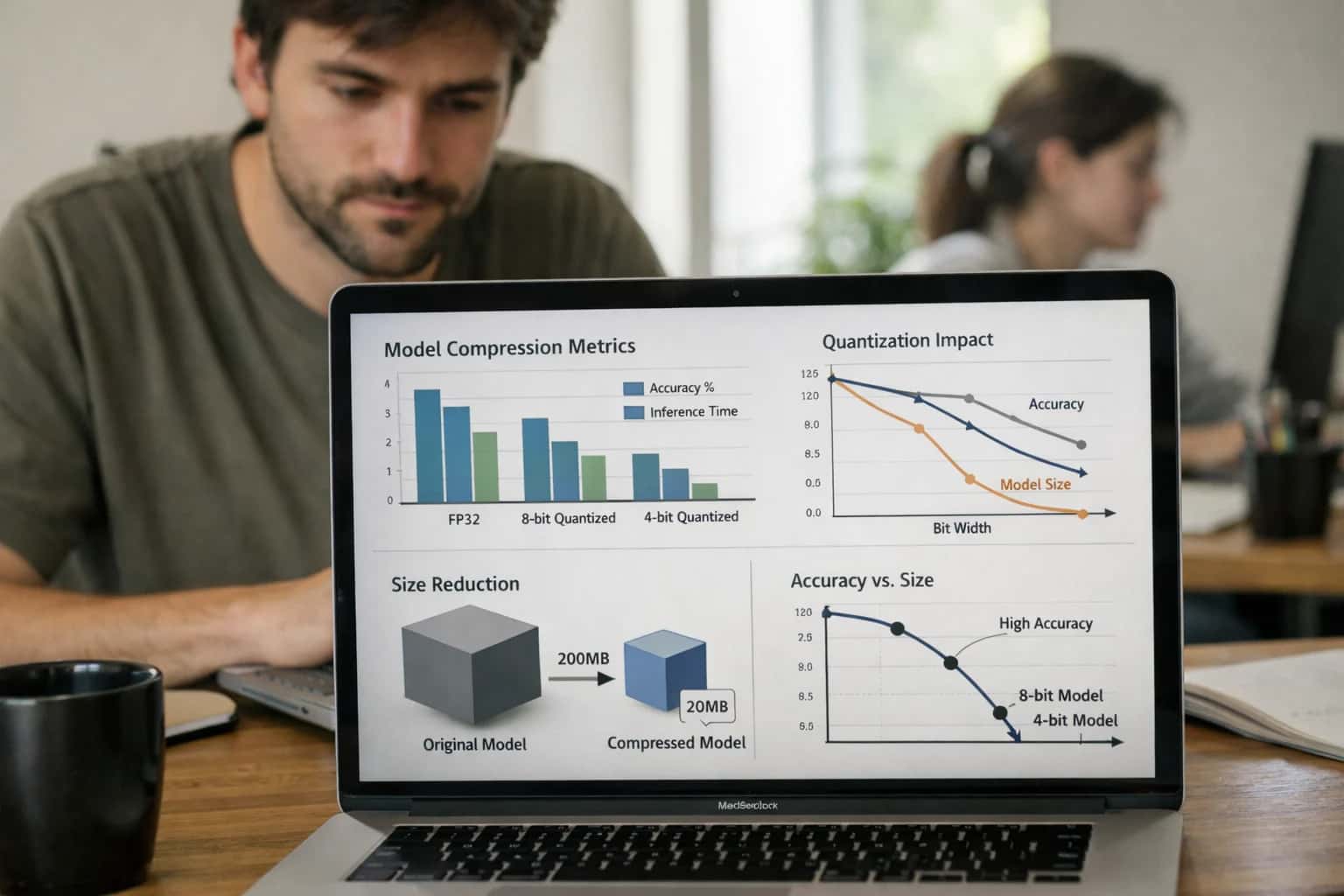
MODEL COMPRESSION
What is Quantization?
Quantization is a fundamental model compression technique critical for deploying neural networks on microcontrollers and other resource-constrained hardware.
The technique operates by mapping a continuous range of floating-point values to a finite set of discrete integer levels. This involves calculating a scaling factor (or scale) and a zero-point to define the linear transformation between the two numerical domains. Quantization is implemented via post-training quantization (PTQ), using a calibration dataset to set ranges, or quantization-aware training (QAT), where the model learns to compensate for precision loss during training. Successful quantization is a prerequisite for TinyML deployment, enabling complex models to run within the severe kilobyte-scale memory budgets of microcontrollers.
MODEL COMPRESSION
Key Characteristics of Quantization
Quantization is a foundational technique for deploying neural networks on microcontrollers. Its core characteristics define the trade-offs between model size, speed, accuracy, and hardware compatibility.
01
Precision Reduction
Quantization fundamentally reduces the numerical precision of a model's parameters (weights) and activations. The most common transition is from 32-bit floating-point (FP32) to 8-bit integers (INT8), which provides a 4x reduction in model size and a 4x reduction in memory bandwidth. Lower precisions like INT4 or binary (1-bit) are possible for extreme compression, but with greater accuracy trade-offs. This precision shift enables models to fit into the limited flash memory of microcontrollers and accelerates computation by leveraging efficient integer arithmetic units.
02
Hardware Acceleration
Quantized models unlock the performance of specialized hardware. Microcontrollers and neural processing units (NPUs) often have dedicated integer arithmetic logic units (ALUs) that execute INT8 operations much faster and more efficiently than floating-point ones. Frameworks like CMSIS-NN provide hand-optimized kernels for these operations. Key hardware benefits include:
- Lower power consumption per operation.
- Higher operations per second (OPS) within the same power budget.
- Direct compatibility with digital signal processor (DSP) instructions and SIMD extensions for parallel computation.
03
Calibration & Range Mapping
A critical step in quantization is determining how to map the continuous range of float values to a discrete set of integers. This is done via calibration using a representative dataset. The process defines two key parameters:
- Scale (S): A floating-point factor that maps integer values back to their approximate float range.
- Zero-Point (Z): An integer bias that ensures the real value zero is exactly representable, crucial for layers like ReLU.
The formula for affine (asymmetric) quantization is:
float_value ≈ S * (int_value - Z). Proper calibration minimizes the information loss from this mapping.
04
Symmetric vs. Asymmetric Schemes
Quantization schemes define how the integer range is aligned with the float range.
- Symmetric Quantization: The range is symmetric around zero (e.g., [-127, 127] for INT8). The zero-point is fixed at 0. This simplifies the computation (no zero-point subtraction needed) and is commonly used for weight quantization.
- Asymmetric Quantization: The range is defined by actual min/max values (e.g., mapping min_float to 0 and max_float to 255). It uses a non-zero zero-point. This is more accurate for activation quantization because it can precisely capture the asymmetric output of ReLU activations (all non-negative).
05
Accuracy vs. Efficiency Trade-off
Quantization introduces a quantization error—the difference between the original float value and its dequantized equivalent. This error propagates through the network, potentially degrading task accuracy (e.g., classification score). The trade-off is managed by:
- Choosing bit-width: INT8 typically has minimal loss (<1% for many models), while INT4 can be significant.
- Quantization Granularity: Per-tensor scaling is simple; per-channel scaling for weights is more granular and often preserves accuracy better.
- Quantization-Aware Training (QAT): Simulating quantization during training allows the model to adapt and recover accuracy, often outperforming Post-Training Quantization (PTQ).
06
Integer-Only Inference
A key goal for microcontroller deployment is integer-only inference, where the entire forward pass uses integer arithmetic, avoiding costly float operations. This requires:
- Fusing operations like convolution, batch normalization, and activation into a single integer kernel.
- Pre-computing weight and bias parameters as integers.
- Using fixed-point arithmetic for any necessary non-integer scaling, often implemented with integer multiplication and bit-shifting. This characteristic is essential for deterministic, low-latency execution on cores without a floating-point unit (FPU).
MICROCONTROLLER INFERENCE OPTIMIZATION
Quantization Methods Compared
A comparison of core quantization techniques used to reduce model precision for deployment on memory-constrained microcontrollers.
| Method / Feature | Post-Training Quantization (PTQ) | Quantization-Aware Training (QAT) | Integer-Only Quantization |
|---|---|---|---|
Primary Goal | Convert pre-trained FP32 model to lower precision without retraining | Train/fine-tune model with simulated quantization to recover accuracy | Enable inference using integer-only arithmetic, eliminating FPU dependency |
Typical Workflow | Calibrate with representative dataset → quantize model | Insert fake quantization ops → train/fine-tune → export quantized model | Apply PTQ or QAT, then use integer kernels for all ops |
Accuracy vs. FP32 | Typically 0.5-2% drop for INT8 | Often < 0.5% drop for INT8 | Dependent on underlying PTQ/QAT method |
Requires Retraining | |||
Model Size Reduction | 4x (FP32 to INT8) | 4x (FP32 to INT8) | 4x (FP32 to INT8) |
Inference Speedup | 2-4x on integer hardware | 2-4x on integer hardware | Maximized on MCUs without FPU |
Hardware Requirement | INT8/INT16 support | INT8/INT16 support | Integer ALU only (no FPU needed) |
Common Use Case | Rapid deployment of existing models | High-accuracy production models | Extreme edge devices (e.g., Cortex-M0+) |
Framework Support | TFLite, PyTorch Mobile | TFLite, PyTorch (QAT modules) | TFLite Micro, CMSIS-NN |
INFRASTRUCTURE
Frameworks & Hardware Supporting Quantization
Quantization requires specialized software frameworks to perform the conversion and hardware that can efficiently execute low-precision integer operations. This ecosystem is critical for deploying models on microcontrollers.
05
Hardware: CPU Integer Units & DSPs
Most modern microcontrollers (e.g., Arm Cortex-M4, M7, M33, M55, RISC-V cores with P extension) include hardware that accelerates quantized inference:
- Integer Arithmetic Logic Units (ALUs): Native support for 8-bit and 16-bit integer operations, which are fundamentally faster and more energy-efficient than software-emulated floating-point.
- Single Instruction, Multiple Data (SIMD): Instructions like Arm's MVE (Helium) or DSP extensions (e.g., SMLAD, SMLAL) allow a single instruction to perform multiple multiply-accumulate (MAC) operations in parallel on integer data, crucial for convolution and matrix multiplication.
- Digital Signal Processors (DSPs): Often integrated as a co-processor (e.g., the Cadence Tensilica HiFi DSPs), these are highly optimized for the vector math of quantized neural networks, offering significant performance per mW advantages over the main CPU.
06
Hardware: MicroNPUs & AI Accelerators
Dedicated neural processing units (NPUs) are becoming common in high-end microcontrollers and system-on-chips (SoCs) for the edge. Examples include the Arm Ethos-U55/U65, Synaptics Astra, and GreenWaves GAP9. These accelerators are designed from the ground up for quantized tensor operations:
- Systolic Arrays or Tensor Cores: Hardware that performs massive parallel matrix multiplications for INT8/INT4 data.
- Weight Activation Sparsity Support: Hardware that can skip computations involving zero values, exploiting the sparsity often induced by pruning.
- On-Chip Memory Hierarchies: Dedicated SRAM for weights and activations to minimize power-hungry external memory accesses. Using these accelerators requires framework support via delegates (TFLite) or BYOC mechanisms (TVM), which partition the model graph and offload quantized layers to the NPU.
QUANTIZATION
Frequently Asked Questions
Quantization is a core model compression technique for deploying neural networks on microcontrollers. These questions address its mechanisms, trade-offs, and implementation for resource-constrained hardware.
Quantization is a model compression technique that reduces the numerical precision of a neural network's weights and activations from high-precision floating-point (e.g., 32-bit) to lower-precision integers (e.g., 8-bit), decreasing model size and accelerating inference. This is critical for microcontroller deployment, where memory and compute are severely limited. The process involves mapping a range of floating-point values to a smaller, finite set of integer values using a scaling factor and a zero-point. By converting expensive floating-point operations to efficient integer arithmetic, quantization enables complex models to run on devices with only kilobytes of RAM and no dedicated floating-point unit (FPU).
Enabling Efficiency, Speed & Accuracy
Intelligent Analysis, Decision & Execution
We build AI systems for teams that need search across company data, workflow automation across tools, or AI features inside products and internal software.
Talk to Us
Search across company data
Give teams answers from docs, tickets, runbooks, and product data with sources and permissions.
Useful when people spend too long searching or get different answers from different systems.
Enterprise searchRAGPermissions
Read more
Automate internal workflows
Use AI to route work, draft outputs, trigger actions, and keep approvals and logs in place.
Useful when repetitive work moves across multiple tools and teams.
AI agentsWorkflow automationGovernance
Read more
Add AI to products and internal tools
Build assistants, guided actions, or decision support into the software your team or customers already use.
Useful when AI needs to be part of the product, not a separate tool.
AI integrationDecision supportModel routing
Read more
About the author
Prasad Kumkar
CEO & MD, Inference Systems
Prasad Kumkar is the CEO & MD of Inference Systems and writes about AI systems architecture, LLM infrastructure, model serving, evaluation, and production deployment. Over 5+ years, he has worked across computer vision models, L5 autonomous vehicle systems, and LLM research, with a focus on taking complex AI ideas into real-world engineering systems.
His work and writing cover AI systems, large language models, AI agents, multimodal systems, autonomous systems, inference optimization, RAG, evaluation, and production AI engineering.
LinkedIn
Limited slotsGet a Free AI Consultation
Partnered with leading AI, data, and software stack.





How We Work
Custom AI workflows for your Business
One-fit-all AI don't work for modern businesses. At Inferensys, we aim to understand your business & custom requirements; which we use to define most efficient agentic workflows, the data, and the tools for your business.
01
Review the use case
We understand the task, the users, and where AI can actually help.
Read more02
Pick the right approach
We define what needs search, automation, or product integration.
Read more03
Build the first useful version
We implement the part that proves the value first.
Read more04
Improve from there
We add the checks and visibility needed to keep it useful.
Read moreThe first call is a practical review of your use case and the right next step.
Talk to Us